European Ecommerce Overview: Ireland
Look into the heart of Ireland’s e-commerce ecosystem. Uncover the growth drivers shaping this vibrant European market, optimize your online presence, and drive success with our overview.
Ireland might be a small island nation on the western edge of Europe, but when it comes to Irish e-commerce, it punches way above its weight. With a population of just over five million people, it has become one of the most digitally advanced and ecommerce-hungry markets on the continent.
Whether you’re a retailer looking to expand into a new market or simply someone trying to understand the Irish digital landscape – read our overview, as it goes into many different areas of e-commerce in this country. From market size and consumer habits to shipping realities, we’ve packed this guide with the freshest data.
E-commerce Overview in Ireland
If you’re looking for a market that absolutely loves online shopping, Ireland should be at the very top of your list right now. The Irish e-commerce space is one of the most dynamic, fast-moving, and exciting digital retail environments in all of Europe, and the numbers in 2026 are genuinely impressive to look at.
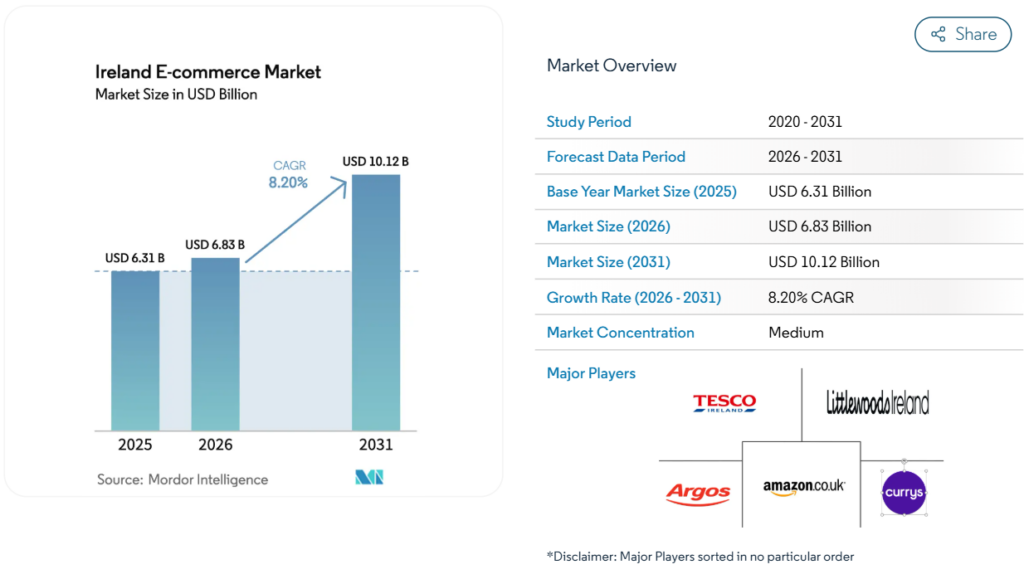
The Ireland e-commerce market is valued at USD 6.83 billion in 2026, growing at a healthy CAGR of 8.2% and projected to hit USD 10.12 billion by 2031.
Irish e-commerce is recording an average year-on-year growth of 19%, making online unarguably the primary growth engine for retail in the country.
Ireland currently has over 31,300 active e-commerce stores, with 5,293 new stores launched in the past 12 months alone, demonstrating the incredible momentum in the market.
Fashion and apparel leads B2C product categories with a 26.4% revenue share, while beauty and personal care is the fastest-growing segment at an 11.8% CAGR through to 2031.
B2B Ireland e-commerce is on an even steeper upward trajectory, forecast to grow at a 12.4% CAGR to 2031, outpacing the mature but still dominant B2C segment, which is exciting news for businesses operating in the wholesale and trade space.
Ireland’s e-commerce growth story is genuinely one of Europe’s great digital retail success stories, and it shows absolutely no sign of slowing down as we head deeper into the second half of this decade.
Consumer Behavior in Ireland
Here’s something that should genuinely impress you: Ireland is actually ranked number one in Europe for online shopping adoption, and that’s a title the Irish are holding with pride right now. An extraordinary 96% of Irish internet users make online purchases, which is significantly higher than the EU average of 77–78%, giving Ireland the biggest percentage of online shoppers in all of Europe.
The Irish CSO reports that 85% of internet users purchased goods and/or services online in 2025, remaining steady from 2024, with women (86%) slightly outpacing men (84%) in online shopping activity. Moreover, among the 30–44 age group, online shopping rates hit a remarkable 97% for females and 92% for males, making this cohort the most digitally active shoppers in the country.
Consumer trust in online shopping has risen to 78% following the post-2024 rollout of the EU’s Digital Services Act, giving retailers a much more confident and purchase-ready audience to engage with.
A stunning 30% of Irish consumers are now using ChatGPT to research purchases before making a buying decision, signaling a seismic shift in how the pre-purchase discovery phase works for Irish retailers.
Mobile commerce accounts for around 65% of all online transactions in Ireland, which really hammers home just how much Irish shoppers have shifted to doing their browsing and buying on their phones.
What’s especially exciting for anyone operating in this market is that Irish consumers are genuinely open to new technology, quick to adopt new channels, and increasingly expect a seamless, personalised, and mobile-first experience at every stage of their shopping journey.
Ireland Payment Preferences
Payments in Ireland are going through a genuinely fascinating transformation right now, and if you want to win over Irish shoppers at checkout, you need to understand exactly where their preferences sit in 2026.
Contactless payments now account for an astonishing 87.9% of all point-of-sale card payments in the first half of 2025, showing that the tap-and-go mentality has become deeply embedded in everyday Irish consumer life.
Over 1.6 billion contactless POS payments worth €28.3 billion were processed in Ireland in the 12 months to June 2025, a figure that beautifully illustrates the sheer scale of digital payment adoption happening across the country. Mobile wallets like Apple Pay and Google Pay now represent 58.2% of all contactless payments in Ireland, meaning more than half of all tap payments are now made with a phone or smartwatch rather than a physical card.
Ireland has over 3 million Revolut users, with more than 400,000 of those being under 18, making Revolut one of the most significant fintech players in the Irish payments ecosystem alongside Apple Pay and Google Pay.
Credit and debit cards held a 54.2% share of Irish e-commerce payments in 2025, while BNPL (Buy Now, Pay Later) is advancing at a 13.1% CAGR through to 2031, showing growing appetite for flexible payment options.
Bank of Ireland recorded that e-commerce contactless card transactions (including digital wallets) increased by 10% year on year in Q4 2025, with over 1.1 million e-commerce contactless transactions recorded in a single day on November 28, 2025.
For any merchant entering or expanding in Ireland, the message from these numbers is crystal clear: support mobile wallets, make checkout frictionless, and consider flexible payment options like BNPL, because Irish shoppers have very high expectations around how smooth and fast paying should feel.
Social Media in Ireland
Social media and e-commerce are increasingly becoming the same thing in Ireland, and the platform-level numbers for 2026 give a fascinating picture of exactly where Irish consumers are spending their attention and their money.
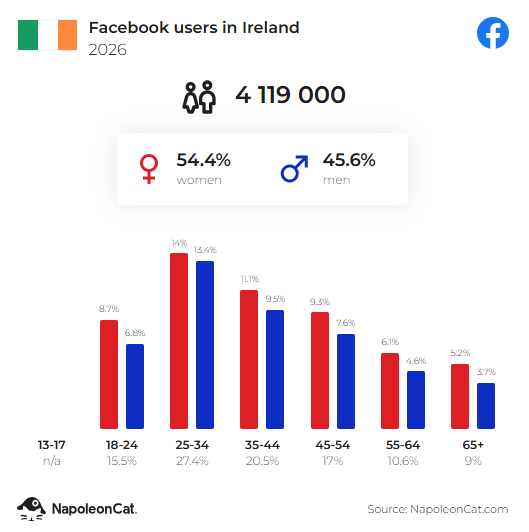
Facebook remains the most-used social platform in Ireland, with 4,119,000 users as of February 2026, accounting for a remarkable 79.1% of the entire Irish population, making it still the single biggest digital audience any brand can tap into.
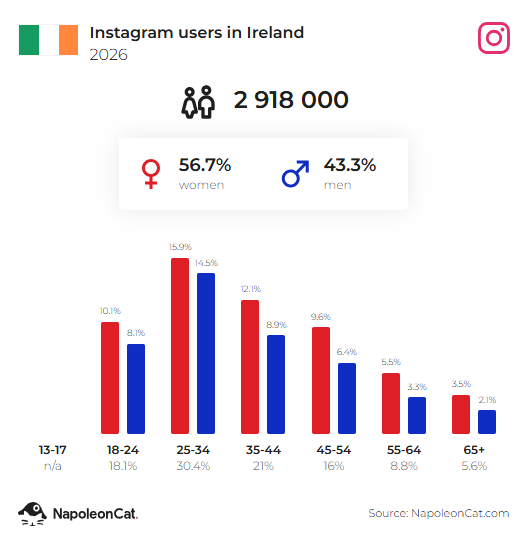
Instagram has grown to 2,966,700 users in Ireland as of February 2026, representing 57% of the total population, with women making up 56.5% of the platform’s Irish audience, making it a powerful channel for visual commerce and product discovery.
TikTok reached 2,918,000 million users in Ireland in 2026, capturing 56.1% of the online population with short-form video content, representing a growth of 500,000 users since 2023 and driven by its younger, highly engaged audience.
Social commerce is expected to account for over 20% of mobile commerce sales in key markets by 2026, with Irish businesses increasingly creating shoppable content directly on Instagram and TikTok to convert browsers into buyers in-app.
Email marketing continues to punch above its weight, now generating 6.4% of e-commerce revenue on average in Ireland, with record performance recorded in 2026 as brands double down on first-party data and owned channels.
A healthy 33.9% of Irish internet users use social media for brand research before making a purchase, making social proof, reviews, and community content absolutely essential parts of any Irish e-commerce marketing strategy.
The social media opportunity in Ireland is genuinely vast, and with platforms like TikTok and Instagram enabling seamless in-app shopping, the line between scrolling and buying is becoming thinner every single month.
Shipping in Ireland
Logistics and delivery is one of those topics that can make or break an e-commerce business in Ireland, and in 2026 the expectations Irish consumers have around shipping are incredibly high, which is both a challenge and a massive opportunity.
An Post delivered 54 million parcel and contract packets across 2024, and that record-breaking number has been exceeded in 2025, cementing An Post’s position as the backbone of e-commerce fulfillment across the island of Ireland.
An Post, DPD, and Fastway (prior to its receivership in late 2025) jointly operated 47 automated sortation sites and 312 parcel lockers, enabling same-day fulfilment promises to 2.1 million Irish households for orders placed before 14:00.
Orders using same-day fulfilment services have an average order value that is 23% higher than standard-delivery baskets, giving retailers a strong commercial incentive to invest in fast fulfilment infrastructure.
Post-Brexit complications have cut UK-to-Ireland cross-border volumes by 27% since 2024, with additional customs paperwork and €8–€15 handling fees per shipment adding 2–4 days of delivery latency, pushing Irish consumers to increasingly source from EU suppliers instead.
Despite the National Broadband Plan’s rollout to 544,000 rural premises, parcel carriers face 40–60% higher per-stop costs in remote counties like Leitrim and Roscommon, meaning rural delivery remains a genuine challenge and a growth opportunity for innovative logistics solutions.
The Irish consumer expectation around delivery is clear: they want fast, trackable, flexible, and ideally free shipping, and poor delivery experience remains one of the top reasons Irish shoppers stop purchasing from foreign websites, so getting your logistics right is absolutely non-negotiable.
To Sum Up
Ireland is, without exaggeration, one of the most exciting and rewarding e-commerce markets in Europe right now. With a market growing at 8.2% annually, with 96% of internet users shopping online, with mobile wallets dominating payments, and with social commerce accelerating fast, Ireland ticks almost every box you’d want from a market entry or expansion perspective.
The combination of a highly digitally literate population, strong consumer trust, excellent mobile penetration, and a logistics network that continues to invest and improve means the opportunity for both domestic and international e-commerce players is genuinely substantial.
The brands and retailers who will win in Ireland going forward are those who invest in mobile-first experiences, embrace flexible payment options, build strong social commerce presences on Instagram and TikTok, and pair all of that with a reliable, fast, and transparent delivery experience.
Ireland has already quietly become a global leader in e-commerce adoption, and if the trajectory of the past few years is anything to go by, the next five years are going to be even more remarkable for anyone operating in this vibrant digital market.