European ecommerce overview: guide through ecommerce in Europe in 2026
Explore the European ecommerce market with key trends and opportunities shaping online retail across Europe.
Updated: June 2026
Europe is one of the most attractive ecommerce regions in the world, but it is also one of the hardest to treat as one market.
A customer in Sweden may expect fast mobile payments, flexible delivery, and strong sustainability signals. A shopper in Germany may care more about trust, returns, clear product information, and familiar payment methods. A buyer in Romania may compare prices across several sellers before ordering. A Dutch customer may expect a smooth omnichannel experience from brands they already know.
That is the first thing to understand about ecommerce in Europe in 2026: the opportunity is huge, but the details decide everything.
The market is mature in many countries, especially in Northern and Western Europe. At the same time, Central, Eastern, and parts of South-Eastern Europe still offer strong growth potential because digital adoption, logistics, marketplace use, and payment habits continue to develop.
The numbers confirm the scale. In 2025, 95% of EU citizens aged 16–74 used the internet, and 78% of EU internet users bought or ordered goods or services online. Ecommerce is no longer a niche shopping habit in Europe. It is part of everyday consumer behavior.
There is also a new layer that brands cannot ignore anymore. European ecommerce in 2026 is not only about demand, localization, marketplaces, and delivery. It is also about regulation. Online sellers need to think about the Digital Services Act, product safety, accessibility, customs changes, data protection, sustainability claims, and platform accountability.
So, if you are looking at Europe as one big expansion target, take a step back.
Europe rewards brands that localize. It punishes brands that copy-paste.
Below, we’ll walk through the main ecommerce regions in Europe, what makes each one different, and where to look next if you want to understand specific country markets in more detail.
What changed in European ecommerce between 2021 and 2026?
The older version of this guide focused mostly on consumer behavior, regional groups, and country-level market potential. That still matters, but the market has changed a lot since then.
In 2026, European ecommerce is shaped by five bigger shifts.
First, online shopping has become normal in most markets. Growth is no longer about convincing people to buy online for the first time. In many countries, the real challenge is winning repeat purchases, improving profitability, and reducing friction in checkout, delivery, and returns.
The long-term shift is clear. In 2015, 62% of EU internet users bought online. By 2025, that share had grown to 78%. That means ecommerce has moved from “digital behavior” to normal shopping behavior for most European consumers.
Second, marketplaces have become stronger. Amazon, Zalando, Allegro, Bol, eMAG, Cdiscount, Otto, Kaufland, About You, and other regional players influence how people search, compare, and buy. For many brands, the question is not “marketplace or own store?” It is “which mix gives us reach, data, margin, and control?”
Third, cross-border ecommerce is more competitive. European consumers compare prices and availability across borders with ease. That helps brands enter new markets faster, but it also raises expectations around shipping costs, local returns, language, tax clarity, and delivery timing.
Fourth, regulation now has a direct impact on day-to-day ecommerce operations. Product pages need better safety information. Online shops need to meet accessibility expectations. Marketplaces need stronger controls. Low-value imports face new pressure. Compliance is no longer a legal footnote at the bottom of an expansion plan.
Fifth, consumers are more selective. Inflation, household budget pressure, sustainability concerns, and growing choice have changed buying behavior. People still shop online, but many compare more, wait for discounts, use second-hand platforms, or choose brands that make the buying decision feel safer.
The market is still growing, though. In 2024, European B2C ecommerce turnover increased by 7%, from €784 billion to €842 billion. That growth came after a slower period and shows that the European ecommerce market remains resilient.
For ecommerce teams, that means Europe is still full of opportunity. It is just less forgiving than before.
Ecommerce in Scandinavia
Scandinavia remains one of Europe’s strongest regions for digital commerce. Denmark, Sweden, Norway, and Finland have high internet use, strong digital infrastructure, and consumers who are comfortable with online payments, delivery apps, subscriptions, and cross-border shopping.
Northern Europe reached €63.5 billion in B2C ecommerce turnover in 2024 and matched the European average growth rate at 7%. That makes the region smaller than Western Europe in absolute value, but still highly important for brands that sell premium, digital-friendly, or sustainability-led products.
This region is not the place to test a half-finished ecommerce experience. Buyers are used to polished digital journeys. They expect clear product pages, fast checkout, reliable delivery, easy returns, and customer support that does not feel like an afterthought.
Scandinavian shoppers are also practical. They may pay more for quality, but the product needs to justify the price. Durability, design, brand trust, local relevance, and sustainability can influence the decision, especially in categories like fashion, home, electronics, beauty, outdoor goods, and grocery.
The sustainability angle is especially important here. It is not enough to add a green badge to a product page. Nordic shoppers are used to brands talking about materials, packaging, delivery emissions, second-hand options, repair, and responsible sourcing. They are also good at spotting vague claims.
For international brands, Scandinavia can be a great ecommerce market, but it requires strong execution. Local payment options, localized checkout, accurate delivery estimates, and transparent returns matter. So does language. Many consumers speak English well, but local-language content still improves trust, especially for product information, support, delivery, and returns.
The region also has a strong recommerce and second-hand culture. That creates pressure for brands that sell new products. If you sell premium items, you need to explain why the product is worth buying new. If you sell affordable items, you need to show value without looking disposable.
Country-level reading:
- European Ecommerce Overview: Norway
- European Ecommerce Overview: Sweden
- European Ecommerce Overview: Finland
- European Ecommerce Overview: Denmark
Ecommerce in DACH
DACH is one of the most important ecommerce regions in Europe. Germany, Austria, and Switzerland combine high purchasing power, mature online shopping habits, strong logistics, and demanding customers.
This is not an easy region to enter, though.
Germany alone can look attractive because of its size, but it is also one of Europe’s most competitive ecommerce markets. Customers are used to detailed product pages, transparent pricing, trusted payment methods, clear delivery information, and well-managed returns. German shoppers often research before buying, compare options carefully, and expect brands to communicate clearly.
Trust is a serious conversion factor in DACH. Customer reviews, seals, warranties, return policies, legal pages, company details, and support availability all matter. A store that looks vague, overhyped, or poorly localized will struggle.
Austria is closely connected to the German ecommerce ecosystem. Many Austrian consumers buy from German retailers, and German-language localization gives brands a strong starting point. But Austria should not be treated as a copy of Germany. Delivery expectations, local competition, and payment preferences still need separate checks.
Switzerland is different again. It has high purchasing power, but it also brings customs, currency, logistics, and localization complexity. Swiss consumers are comfortable buying online, including from abroad, but they expect quality, reliability, and transparent costs. Hidden customs charges or unclear delivery timelines can damage trust quickly.
In DACH, fashion, electronics, home, beauty, DIY, grocery, and health-related categories remain important, but the bigger point is operational discipline. The region rewards brands that look stable, credible, and precise.
For ecommerce businesses, DACH is rarely a “quick win” market. It is a market for teams that can invest in localization, customer service, compliance, product information, returns, and long-term brand building.
Country-level reading:
- European Ecommerce Overview: Germany
- European Ecommerce Overview: Austria
- European Ecommerce Overview: Switzerland
Ecommerce in Central and Eastern Europe
Central and Eastern Europe is one of the most interesting ecommerce regions in Europe because it combines rising digital maturity with uneven market development.
Poland, Czechia, Slovakia, Hungary, Romania, the Baltic states, Slovenia, Croatia, Bulgaria, and other nearby markets differ a lot. Some are already highly competitive and marketplace-driven. Others still have more room for growth in online retail, logistics, digital payments, and niche category development.
Central and Eastern Europe should not be treated as a secondary ecommerce region anymore. In 2024, Eastern Europe recorded the fastest B2C ecommerce turnover growth in Europe at 18%, while Central Europe grew by 8%. That does not mean every market is easy to enter. It means the region deserves a serious place in European expansion planning.
The most important thing to understand about CEE is that price sensitivity often plays a bigger role than in Northern or Western Europe. That does not mean consumers only want the cheapest option. It means they often compare value carefully. Promotions, delivery cost, payment flexibility, warranty, local reviews, and perceived quality can all change the final decision.
Poland is one of the region’s ecommerce leaders. It has a strong marketplace culture, with Allegro playing a central role in consumer behavior. Polish buyers are used to fast delivery, parcel lockers, convenient payments, and competitive prices. For many international sellers, Poland can work as a serious expansion market, but not without localization and marketplace strategy.
Czechia and Slovakia have mature online shopping habits, strong comparison behavior, and active local ecommerce players. Customers often research before buying and care about price, availability, delivery, and trust signals.
The Baltic states are smaller but digitally advanced. Estonia, Lithuania, and Latvia can be attractive for ecommerce brands that know how to work with smaller markets, cross-border logistics, and highly connected consumers. Estonia, in particular, has a strong digital identity and startup reputation, while Lithuania and Latvia often require careful category and price positioning.
Hungary, Romania, and Bulgaria continue to grow, but businesses need to pay close attention to logistics, payment preferences, customer support, and marketplace behavior. In some categories, cash-on-delivery habits have declined but still influence expectations. In others, card payments, bank transfers, wallets, and instant payment solutions are gaining more ground.
Ukraine deserves a separate note. Despite the impact of the war, Ukrainian ecommerce has shown resilience, especially in digital services, local marketplaces, logistics adaptation, and mobile-first behavior. For many companies, Ukraine is not a simple market entry question in 2026. It requires sensitivity, operational checks, and a realistic view of risk, demand, and infrastructure.
Russia should no longer sit inside a standard CEE ecommerce expansion overview as if nothing has changed. For EU-based businesses, Russia involves sanctions, payment restrictions, logistics issues, reputational risk, and legal complexity. It should be treated as a separate compliance topic, not a normal ecommerce growth market.
Country-level reading:
- European Ecommerce Overview: Estonia
- European Ecommerce Overview: Latvia
- European Ecommerce Overview: Lithuania
- European Ecommerce Overview: Ukraine
- European Ecommerce Overview: Slovakia
- European Ecommerce Overview: the Czech Republic
- European Ecommerce Overview: Hungary
- European Ecommerce Overview: Slovenia
Ecommerce in the Balkans and South-Eastern Europe
The Balkans and South-Eastern Europe are often grouped together, but this region is highly diverse. Croatia, Serbia, Bosnia and Herzegovina, Albania, Moldova, Bulgaria, Romania, and Greece do not move at the same pace.
Some markets are already well connected to EU retail habits. Others still have more room for basic ecommerce infrastructure, online payment adoption, delivery reliability, and consumer trust.
That creates a different kind of opportunity.
In highly mature markets, brands fight for attention and loyalty. In developing ecommerce markets, brands often need to build trust first. That means clear product descriptions, visible contact details, fair return policies, secure payments, local delivery options, and customer support in the right language.
Price matters strongly in many South-Eastern European markets, but so does reliability. A cheaper product is not always enough if delivery feels risky or returns look difficult. Consumers may choose a known local retailer or marketplace because it feels safer, even if the price is slightly higher.
Romania is one of the region’s most important ecommerce markets. It has strong local and regional players, rising digital adoption, and a growing online retail culture. Buyers compare prices, watch promotions, and increasingly expect better delivery and payment options.
Bulgaria still has growth potential, especially for brands that combine competitive pricing with trust-building and local-language support. Greece has a more mature online shopping base, with fashion, electronics, beauty, travel-related products, and everyday categories performing well. Croatian consumers are influenced by EU standards, tourism, cross-border shopping, and local brand trust.
Serbia, Bosnia and Herzegovina, Albania, and Moldova are more complex. Ecommerce adoption may be lower or more uneven, but that also means the market is not as saturated in some categories. Local partnerships, marketplace presence, payment flexibility, and patient brand building can matter more than aggressive performance marketing.
For this region, the biggest mistake is assuming one playbook will fit every country. The second biggest mistake is underestimating trust. A good-looking website is not enough if the buyer is unsure about payment, delivery, authenticity, or returns.
Country-level reading:
- European Ecommerce Overview: Croatia
- European Ecommerce Overview: Bosnia and Herzegovina
- European Ecommerce Overview: Romania
- European Ecommerce Overview: Serbia
- European Ecommerce Overview: Moldova
- European Ecommerce Overview: Bulgaria
- European Ecommerce Overview: Albania
- European Ecommerce Overview: Greece
Ecommerce in Western Europe
Western Europe remains one of the strongest ecommerce regions globally. France, the Netherlands, Belgium, Luxembourg, Ireland, Spain, Portugal, and nearby markets offer high online shopping penetration, strong logistics, developed payment systems, and large consumer bases.
But again, maturity does not mean simplicity.
Western Europe still dominates the European ecommerce map. In 2024, it generated €489.5 billion in B2C ecommerce turnover, which makes it the region with the largest commercial weight. At the same time, its 6% growth rate was lower than the European average, which shows how mature the region has become.
The Netherlands is highly competitive and digitally advanced. Dutch shoppers expect convenience, clear pricing, fast delivery, good service, and smooth returns. They are used to strong local and regional players, and many compare options before buying. For ecommerce brands, the Netherlands is attractive because it is compact, connected, and logistics-friendly. It is also demanding because buyers know what a good online experience looks like.
Belgium is more complex than its size suggests. Language matters because the market is split between Dutch-speaking Flanders, French-speaking Wallonia, and multilingual Brussels. A generic “Belgium page” can miss local expectations. Payment methods, delivery options, and customer service language need careful setup.
France is one of Europe’s largest ecommerce markets and a major opportunity for brands in fashion, beauty, home, food, electronics, marketplaces, and lifestyle categories. French consumers value convenience, trust, brand reputation, customer service, and clear information. Local language is not optional. French buyers may use marketplaces for discovery and comparison, but brand-owned stores can still perform well when the experience feels credible and localized.
Spain and Portugal have seen strong ecommerce development over the last few years. Consumers are comfortable shopping online, but price, promotions, delivery, and payment flexibility remain important. Spain has a large consumer base and strong mobile usage. Portugal is smaller, but it can be attractive for brands with a good localization setup and a clear value proposition.
Ireland deserves more attention in 2026 than it often gets in European ecommerce overviews. It is English-speaking, digitally mature, connected to both EU and UK commerce patterns, and attractive for brands that want an EU market where English-language assets can work more naturally. However, logistics, pricing, returns, and local competition still require planning.
Western Europe is a strong fit for brands that already have a professional ecommerce setup. But it can be expensive. Paid media competition, marketplace fees, delivery expectations, return costs, and customer acquisition costs can eat margins quickly.
That makes retention important. Brands entering Western Europe should think beyond first orders. Email, loyalty, subscriptions, post-purchase support, personalization, and customer service can make a major difference.
Country-level reading:
- European Ecommerce Overview: Benelux
- European Ecommerce Overview: France
- European Ecommerce Overview: Spain
- European Ecommerce Overview: Portugal
- European Ecommerce Overview: Ireland
The regulatory layer: what ecommerce brands need to watch in 2026
No European ecommerce overview is complete in 2026 without regulation.
The Digital Services Act has changed expectations for online platforms, marketplaces, and intermediary services. It focuses on safer digital spaces, better accountability, and stronger controls around illegal content, illegal products, transparency, and platform risk management.
The rules become even stricter for the biggest platforms. Under the Digital Services Act, platforms with more than 45 million monthly users in the EU fall into the “very large online platform” or “very large online search engine” category and face additional obligations.
That matters for ecommerce because large marketplaces are no longer just sales channels. They are regulated digital environments. Brands that sell through major platforms need to understand how product compliance, seller verification, content moderation, transparency, and consumer protection rules shape marketplace operations.
The General Product Safety Regulation also matters for ecommerce. It applies to consumer products sold in the EU and raises the standard for product safety information, responsible economic operators, traceability, and marketplace obligations. For sellers, this means product listings need more than persuasive copy. They need correct product data, safety information, manufacturer or responsible person details where required, and processes for product issues.
The European Accessibility Act is another major shift. Online stores and digital services need to be accessible to people with disabilities. This affects navigation, checkout, product information, forms, customer communication, and digital service design. Accessibility is not only a compliance issue. It can also improve conversion because clearer experiences help all users.
Customs are also changing. From 1 July 2026, goods entering the EU in small consignments and valued below €150 will be subject to a fixed €3 customs duty. According to the Council of the EU, this applies to goods entering the EU where non-EU sellers are registered in the EU’s import one-stop shop for VAT purposes, covering 93% of ecommerce flows to the EU.
This is especially important for platforms and sellers that rely on direct-to-consumer imports from outside the EU. It may affect pricing, delivery promises, landed cost, marketplace competition, and product compliance checks.
For ecommerce businesses, the takeaway is simple: European expansion now needs a legal, logistics, and compliance review much earlier in the planning process.
A beautiful storefront will not fix broken compliance.
How to approach ecommerce expansion in Europe
The best way to approach Europe is not to launch everywhere at once. Start with a market fit check.
Look at your product category, average order value, margin, delivery model, return rate, language resources, payment setup, marketplace options, and customer support capacity. Then compare markets based on real operating fit, not only population size.
For example, Germany may look attractive because of its scale, but it can be difficult if your product pages are thin, your return process is weak, or your trust signals are poor. The Netherlands may be easier from a logistics perspective, but competition can be intense. Poland may offer strong marketplace access, but price comparison and delivery expectations can be tough. Scandinavia may suit premium products, but only if quality, sustainability, and convenience are clear.
A practical market-entry checklist should include:
- Local demand for your category
- Main competitors and marketplaces
- Local payment expectations
- Delivery cost and delivery timing
- Return cost and return location
- Language and customer support needs
- VAT, customs, and product compliance
- Accessibility and legal requirements
- Review culture and trust signals
- Margin after ads, fees, shipping, and returns
This is where many brands make mistakes. They calculate revenue potential but forget the cost of serving the market. Europe can generate sales quickly, especially through marketplaces, but profit depends on the operational details.
What European consumers expect from ecommerce brands in 2026
European consumers are not identical, but several expectations now appear across many markets.
They want transparent pricing. That means no unpleasant surprises at checkout, no vague delivery fees, and no unclear customs charges.
They want delivery choice. Home delivery still matters, but pickup points, parcel lockers, out-of-home delivery, and flexible returns are important in many countries.
They want trust. Reviews, clear company information, secure payments, realistic delivery promises, and easy support all reduce purchase anxiety.
They want better product content. Size guides, product specifications, materials, images, videos, comparison information, and usage details matter more when people compare several sellers.
They want payment methods they recognize. Cards alone may not be enough. Local payment systems, wallets, bank transfer options, buy now pay later, invoice payments, or marketplace checkout can all influence conversion depending on the country.
They want responsible ecommerce. That does not mean every buyer chooses the most sustainable option every time. It means sustainability claims, product origin, packaging, repairability, and second-hand options can affect brand perception.
They want less friction. Slow websites, forced account creation, confusing forms, unclear returns, weak mobile UX, and poor translations all hurt conversion.
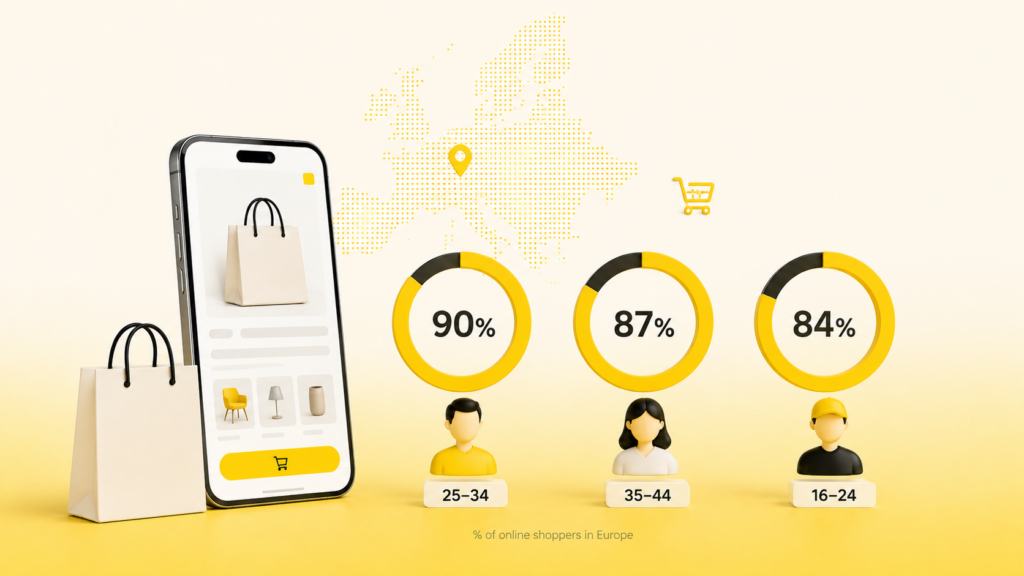
Eurostat data also shows how normal ecommerce has become across age groups. In 2025, 90% of EU internet users aged 25–34 bought online, followed by 87% of those aged 35–44 and 84% of those aged 16–24. Younger shoppers may get more attention, but the European online buyer is not only a Gen Z or millennial profile anymore.
That matters for UX, messaging, and accessibility. A store built only for the fastest, most mobile-first buyer can still lose older customers, cautious buyers, or users who need more information before purchase.
Final thoughts
European ecommerce in 2026 is mature, competitive, and still full of room for growth.
The opportunity is not disappearing. It is becoming more specific.
Brands that win in Europe understand local behavior, not just regional averages. They build trust before asking for the sale. They adapt payments, delivery, content, and support to the market. They treat compliance as part of the ecommerce experience. And they choose expansion markets based on operational fit, not only demand.
If there is one rule for ecommerce in Europe, it is this:
Do not sell to “Europe.”
Sell to Germany, Sweden, Poland, France, Spain, Romania, the Netherlands, Greece, Ireland, or any other specific market with a clear reason, a local plan, and an experience that feels built for the people there.
That is where European ecommerce starts to make sense.