The $265 billion mistake: How e-commerce turns away its customers with false declines
A false decline in ecommerce now cost more than global fraud. See why legitimate payments get refused – and the fixes that lift approval rates. (Ad)
The most expensive line item in e-commerce is the one that never appears in a budget: the false decline. It is a legitimate payment rejected by an issuing bank or a fraud filter that mistook a real buyer for a criminal.
Picture a shopper who reaches the checkout with a full cart, taps “pay,” and watches the transaction fail with no explanation. A loyal customer might retry with another card or message support. A first-time buyer rarely does. They read the rejection as a verdict on them, close the tab, and the acquisition spend that brought them there leaves with them.
Let’s look at why good payments get refused, what those refusals actually cost, and the concrete moves a merchant can make in its payment infrastructure to win that revenue back.
Author of the article: Slava Trubnikov
Why real payments get refused
False declines are caution stacked on caution, and three forces drive them.
Over-correction is the first. Every chargeback pushes a risk team to tighten its rules, and each tightening rejects more legitimate orders along with the bad ones. The card networks penalise fraud through monitoring programmes and fees; nobody penalises a merchant for turning away a good customer. The incentive runs only to rejection.
Cross-border friction is the second. Issuers apply stricter logic to transactions that cross a border, because a foreign-routed payment reads as higher risk. International cards routinely approve several percentage points below domestic ones, so any merchant selling into more than one market carries a built-in decline penalty before it does anything wrong.
Legacy logic is the third. Rules that auto-decline on a billing-and-shipping mismatch, or on a customer shipping to a work address, were written for a cruder era of fraud. They cannot read the nuance of real behaviour, so they fire on the honest and the fraudulent alike.
The asymmetry underneath all three is what makes the problem so durable. Actual fraud is visible: it lands on statements, triggers processor notifications, and generates fees a team can count. A refused good customer generates none of that. The sale simply does not happen, and the loss is absorbed in silence.
For the false-decline problem specifically, the value comes from being a direct acquirer rather than working through intermediaries. Fewer parties in the chain means less data loss and fewer conservative risk decisions stacked on top of each other before a transaction reaches the issuer. Combined with 3DS2's risk-based, frictionless authentication, that keeps strong customer authentication from turning into a hard challenge on every payment. This isn't a fraud tool — it's an approval tool, and approval is where the lost revenue lives.
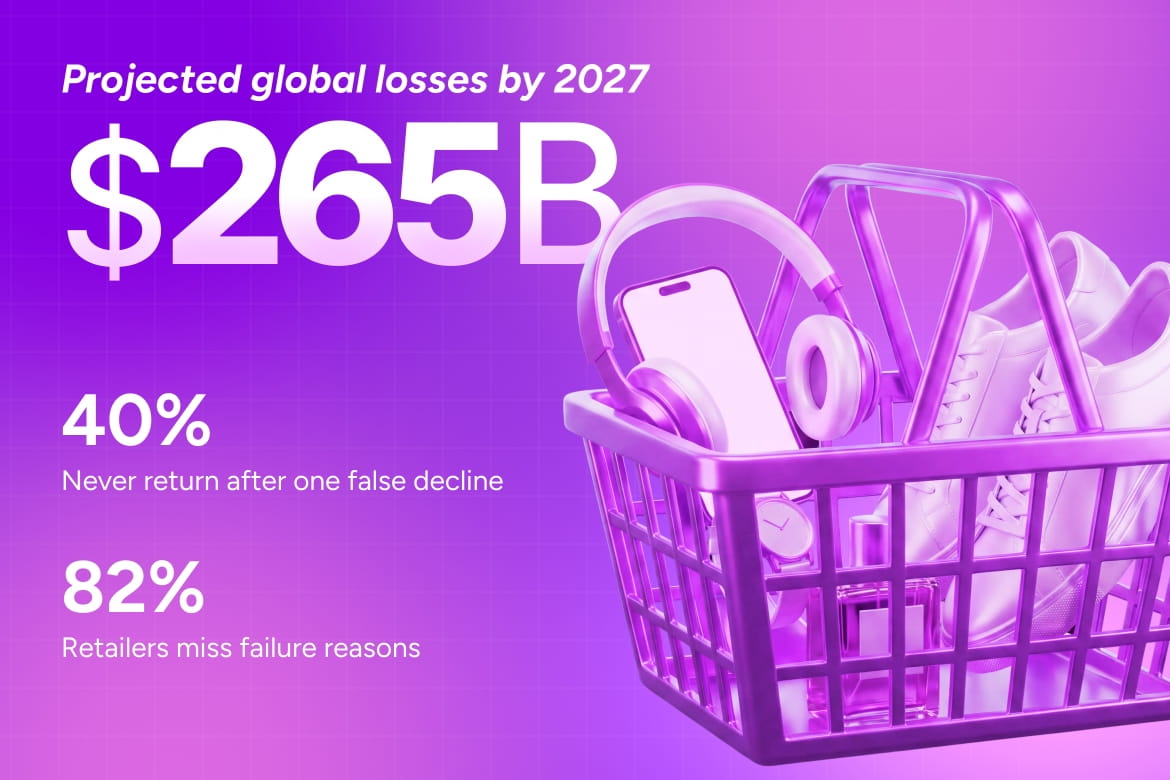
This is why most merchants track fraud to two decimal places yet cannot state their false-decline rate at all. In PYMNTS Intelligence research, 82% of online retailers said they could not identify the causes of their failed payments. A business cannot budget for a cost it cannot see, so the cost goes unmanaged and grows.
False declines in one market are twice the size of global fraud
Here is the figure that should reframe the entire conversation. In the United States alone, $157 billion in e-commerce sales were at risk from false declines in 2023, and $81 billion was permanently lost after recovery attempts failed, according to PYMNTS Intelligence. For scale, Juniper Research put global e-commerce fraud losses at roughly $48 billion in 2023. One country’s false declines outweighed the entire world’s actual fraud, by a wide margin.
The pattern holds globally. The Datos Insights E-Commerce Fraud Landscape report puts the average false-decline rate at 1.51% of e-commerce sales worldwide, with losses on track to approach $265 billion by 2027. The same research found a persistent gap between the false-decline rate merchants believe they have and the one they actually run, which means that, for most teams, the measurement itself is the first fix.
A lost sale is only the visible half of the damage, the invisible half is the relationship. The Merchant Risk Council ranks false declines a top-three payment concern for merchants, alongside chargebacks and authorisation rates. The reason is a false decline arrives at the worst possible moment: after a merchant has paid to acquire the customer and after they have shown clear intent to buy. Rejection at that point does not read as a technical glitch, but reads as an accusation.
Customers do not offer second chances easily. Ethoca, a Mastercard company, reports that 40% of customers will not buy from a merchant again after a single false decline. Nearly half of retailers already feel it: 47% told PYMNTS that false declines severely hurt customer satisfaction.
And the distrust runs both ways. While the system treats a real buyer as a fraudster and rejects the payment for no visible reason, the buyer starts to read the store itself as suspicious: a checkout that fails without explanation looks less like a bank issue and more like a phishing page or a site that cannot be trusted with a card. So the merchant’s system distrusts the customer, the customer distrusts the merchant, and the loop closes. The cost compounds: one rejected checkout can erase a customer’s entire lifetime value.
The 1% of revenue lost on false declines
The most useful shift in thinking is to stop treating the fraud function as pure defence. Ethoca frames it plainly: a fraud department that tunes its models with better data is not only blocking losses, it is unlocking sales. On the volumes most mid-market and enterprise merchants run, Ethoca estimates that fraud teams could realistically drive a 1% increase to the top line simply by approving more of the good transactions they currently reject.
The mechanism is data. Real-time dispute and chargeback alerts tell a team which approved transactions actually turned fraudulent: feedback that sharpens a model’s precision instead of forcing it to over-block out of uncertainty. A sharper model rejects fewer legitimate orders, which lifts authorisation rates, which reduces cart abandonment and brings customers back for repeat purchases. Framed this way, fraud prevention and revenue growth stop being a trade-off and become the same project. A single point of authorisation-rate improvement sounds modest until it is applied to annual card volume, where it routinely outweighs the fraud a tighter ruleset would have caught.
How a merchant can fix the false-decline problem
False declines are diagnosable and measurable, and the levers that fix them are practical rather than exotic.
Start by reading your decline codes. A generic “do not honour” hides very different problems, and the newer, more specific issuer response codes tell you whether a payment is worth retrying or permanently dead. Sorting soft declines from hard ones gives most teams their first honest picture of what is actually failing.
Measure your authorisation rate by segment, not as a blended average. A healthy overall number can mask a weak corridor: EU-issued cards on one acquirer, high-value baskets in a single market, one card scheme underperforming abroad. Approval by segment is the number that matters, and it is where recoverable revenue hides.
Feed the model better signals. This is where real-time dispute alerts earn their place. By confirming which transactions genuinely became fraud, they let a risk engine tighten where fraud actually lives and relax everywhere else, which is the difference between blocking loss and blocking customers.
Reduce friction where the rules force it. EMV 3DS supports risk-based, frictionless authentication for lower-risk transactions, so strong customer authentication need not mean a hard challenge on every payment. Network tokenisation is the other major lever: Visa reports that tokenised card-not-present transactions see an authorisation-rate lift of roughly 4.6% globally against a raw card number, alongside about a 30% reduction in fraud. Those are recovered sales from customers who already wanted to buy, not a security cost.
Match the payment method to the market. Cross-border approval gaps narrow when a shopper can pay the way their local banking system expects. Offering local payment methods, and routing card traffic through an acquirer that holds the right local connections, often lifts approval rates more than any single fraud-rule change.
This last point is where payment infrastructure does the heavy lifting, and where the gap between a single-acquirer setup and a multi-rail one shows up directly on the revenue line. A provider such as COLIBRIX ONE illustrates the pattern: it combines acquiring and card processing on one platform across 130+ countries and reports approval rates near 90% on the volume it handles.
Crucially, most of this work does not require ripping out an existing fraud stack. It requires treating declines as a metric the business owns, measures by segment, and improves on purpose.
Treat payments as a customer experience, not back office
The instinct to see checkout as plumbing is the root of the problem. Plumbing either works or leaks, and you only look at it when it floods. But payment is the last thing a customer does before handing over money, and the moment they are most certain they want to buy. Refuse them there, and no amount of upstream marketing spend will win them back.
False declines are a customer-engagement problem sitting at the front door, priced in lost loyalty and paid quietly every day. The merchants who pull ahead over the next few years will be the ones who build a payment infrastructure engineered to keep false declines to a minimum, approving every good customer who intends to buy while still holding real fraud in check.
Author’s bio

Slava Trubnikov is a business leader with 15+ years of professional experience, including 7 years in the fintech industry. His expertise includes payment solutions, business development, and building strategic partnerships.
Throughout his career, he has driven revenue growth and led high-performing teams, helping businesses scale their payment operations and strengthen long-term client relationships. His professional interests include payment innovation, subscription-based business models, and the evolving fintech partnership landscape.