15 Parcel Locker Technology Providers in Europe Compared [2026]
Compare 15 parcel locker technology providers in Europe by hardware, software, power options, integrations and best-fit use cases.

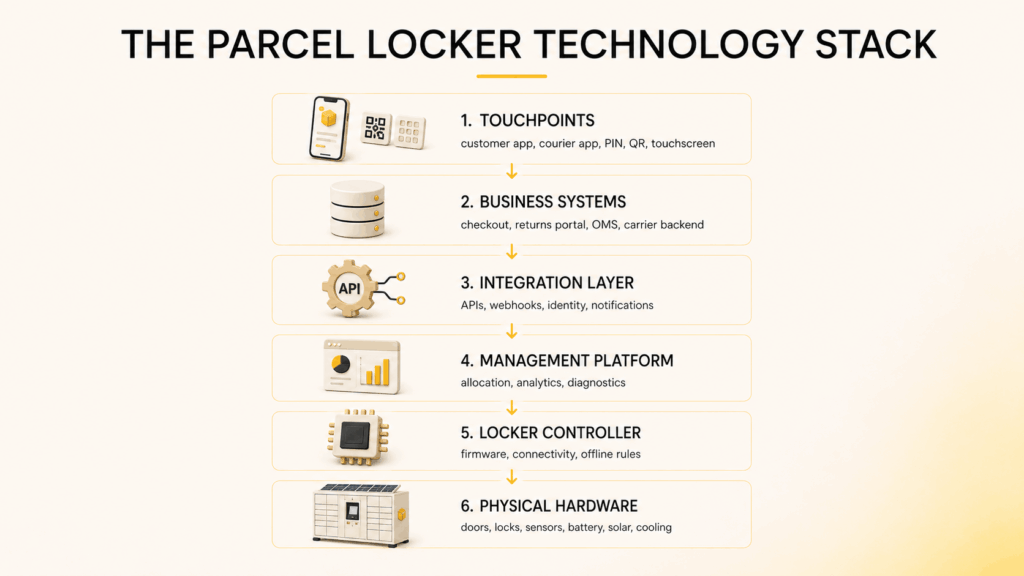
Parcel lockers may look simple from the outside. Behind each door sits a much larger technology stack: electronic locks, controllers, connectivity, customer interfaces, courier tools, APIs and fleet management software.
For carriers, retailers and property operators, the real challenge isn’t finding a familiar locker brand. It’s choosing technology that fits the planned locations, workflows and network model.
Last checked: August 2026
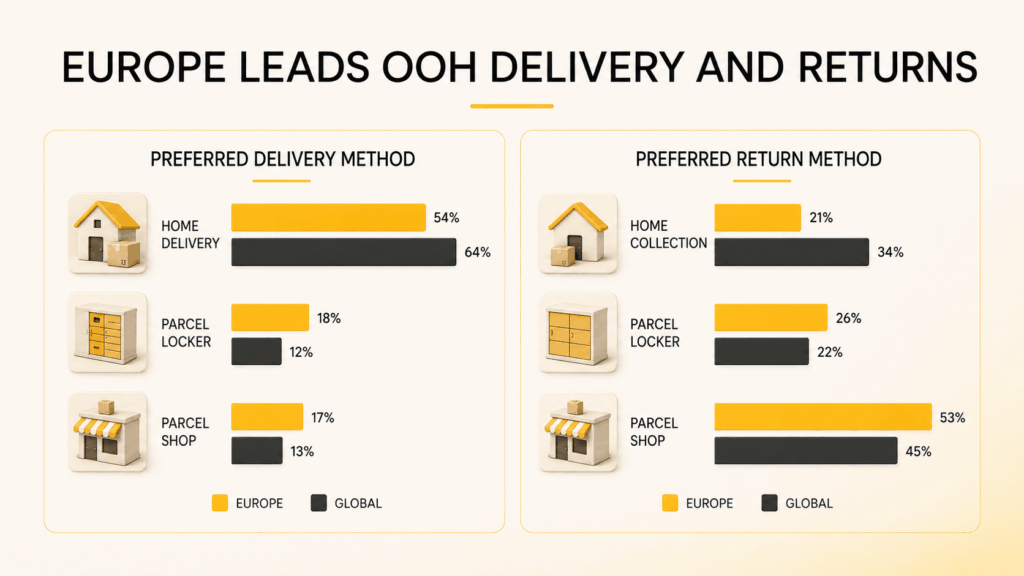
Source note under chart: DHL E-Commerce Online Shopper Survey 2025, based on 24,000 respondents across 24 countries.
Why parcel locker technology matters
Out-of-home delivery has become a normal part of European e-commerce. DHL’s 2025 research found that 35% of European shoppers have purchases delivered to an out-of-home location. The preference becomes even clearer during returns: 53% use parcel shops and 26% use parcel lockers.
The shift creates demand for more than metal cabinets. Operators need systems that can assign compartments, authenticate users, connect several carriers, process returns and monitor thousands of doors remotely.
Open networks are also gaining ground. In March 2026, GLS and DPD launched inboxx, a shared parcel locker brand in Germany. Their plan covers 20,000 shared OOH points, including up to 6,000 lockers, before the end of 2027.
For more context around customer behavior, infrastructure and returns, read our analysis of why consumers choose OOH delivery in DACH.
Parcel locker operator vs technology provider
A parcel locker operator manages a network that shoppers use to collect or return orders. DHL Packstation and InPost are familiar examples.
A technology provider supplies the infrastructure used to create that network. Its offering may include:
- physical cabinets and compartments
- electronic locks and controllers
- customer and courier interfaces
- network management software
- mobile applications
- APIs and integrations
- installation and field maintenance
- location management
- analytics and capacity planning
Some companies provide the complete stack. Others focus on one layer, such as software or low-power electronic controllers.
The distinction matters. A comparison of technology providers shouldn’t become another list of consumer-facing locker brands. Our separate guide to smart parcel lockers and leading brands in DACH covers that side of the market.
How we selected the providers
The 15 companies below meet four criteria:
- They offer parcel locker hardware, software or embedded technology.
- External organizations can purchase or license their products.
- They support European deployments.
- Their current offer covers delivery, collection, returns or related unattended handovers.
The order isn’t a ranking. A national carrier, grocery retailer and apartment operator need very different locker systems.
Parcel locker technology providers compared
| Provider | Main offering | Power options | Strongest use case |
| Bloq.it | Hardware, software and network operations | Grid, battery | Large and mixed-hardware networks |
| KEBA | Modular hardware, software and lifecycle services | Grid, solar and battery | Postal and carrier networks |
| SwipBox | App and interface-operated lockers | Battery | Dense, fast-deployment networks |
| Cleveron | Conventional and robotic lockers | Grid | High-volume retail click and collect |
| Parcel Pending by Quadient | Broad locker hardware and software portfolio | Mainly grid | Carrier, retail and residential projects |
| ARKA | Locker hardware, electronics and software | Grid, battery and solar | Autonomous outdoor networks |
| Direct4.me | Hardware and hardware-agnostic software | Grid, battery and solar | Mixed-hardware and open networks |
| Jetbeep | Embedded controllers, software and locker designs | Battery and solar | Manufacturers and systems integrators |
| Punta | APM hardware and network management software | Configuration dependent | Postal and courier operators |
| kernTerminal | Hardware, software and network services | Grid | White-label and refrigerated projects |
| LockTec | Custom locker and collection systems | Grid | Bulky goods and specialized projects |
| Variocube | Modular hardware and cloud software | Grid | Mixed-use and corporate locations |
| StrongPoint | Retail and grocery lockers | Grid | Temperature-controlled collection |
| Keynius | Hardware, locks and cloud management | Grid and battery | Enterprise and property workflows |
| Nextlox | Hardware, software and support | Grid | Offices, residential sites and retail |
1. Bloq.it
Bloq.it provides locker hardware, software, deployment support and maintenance. Businesses can use the full end-to-end service or connect existing lockers to Bloq.OS.
Its software is hardware-agnostic. An operator can bring lockers from different manufacturers into one management platform instead of running separate systems for each model.
Bloq.OS includes remote fleet control, hardware diagnostics, analytics, carrier integrations and open-network functions. Its APIs can also connect a network with an operator’s existing applications and backend systems.
Best for: Large carriers, open networks and operators consolidating several hardware types.
Check before buying: Ask which manufacturers already have production-ready integrations. Hardware-agnostic software may still require development for a previously unsupported model.
2. KEBA
KEBA has more than 25 years of experience in parcel locker technology. Its current loxmate platform combines modular hardware with locker management software and long-term operational services.
Loxmate can use grid or solar power. Its solar version includes a battery buffer that can keep the locker running for up to ten days without new solar input. Operators can also choose different screens, scanners, payment options and mounting configurations.
KEBA has added accessibility features such as audio guidance, light guidance and an operating mode aligned with European Accessibility Act requirements.
Best for: Postal operators and carriers planning long-term outdoor infrastructure.
Check before buying: Compare the complete KEBA platform against a mixed-vendor model. One hardware ecosystem can simplify maintenance but may reduce future supplier choice.
3. SwipBox
SwipBox Infinity moves most of the interface from the locker to the customer’s or courier’s smartphone. The locker communicates through Bluetooth, runs on batteries and doesn’t require Wi-Fi or cabling.
SwipBox states that the Infinity battery can last around ten years. The lean design also allows installation in around ten minutes when no groundwork is required. APIs and SDKs support integration with courier and customer applications.
For locations that need a physical interface, operators can add screen or PIN-based configurations instead of making every interaction app-dependent.
Best for: Dense networks that need quick installation and low energy use.
Check before buying: Test the process for people without smartphones, mobile data or the required app. A screenless locker reduces infrastructure but transfers more of the journey to the user’s device.
4. Cleveron
Cleveron focuses heavily on retail collection and automated order handover.
The Cleveron 402 is a modular robotic system that stores parcels behind one customer-facing console. It measures packages and rearranges them to use the available storage space more efficiently. Cleveron reports capacity of up to 118 parcels per square meter and average distribution in roughly ten seconds.
The newer Cleveron 403 targets retail-driven open networks and click-and-collect locations. It supports returns and secure storage alongside collection and has been designed for European accessibility requirements.
Best for: Retailers handling high collection volumes in limited customer-facing space.
Check before buying: A robotic system needs enough volume to justify its installation, service requirements and larger initial investment.
5. Parcel Pending by Quadient
Parcel Pending by Quadient has one of the broadest hardware portfolios in the market. Its range includes indoor, outdoor, refrigerated, oversized and drop-box lockers, plus package-room systems.
The software supports automatic notifications, reporting, PIN or barcode access and integrations with property, retail and logistics systems through an open API. Quadient reports more than 28,000 installations worldwide.
The company also operates carrier-agnostic networks. Its European projects include multi-carrier installations in France and an expanded partnership with Evri in the UK.
Best for: Organizations that need several locker formats from one supplier.
Check before buying: Separate the private hardware offer from Quadient’s public open-network model. They may involve different commercial terms, integrations and responsibilities.
6. ARKA
ARKA develops parcel locker cabinets, electronics, control systems and software.
Its SunCharge model uses solar power and batteries while retaining features usually associated with grid-powered machines. These include a color touchscreen, 4G connectivity, remote access, QR scanning and optional monitoring equipment.
ARKA states that its energy-management system uses 1.7 Wh and can support battery charging at temperatures as low as -25°C.
Best for: Outdoor networks that need an autonomous locker with a full physical interface.
Check before buying: Battery and solar performance depends on traffic, connected components, local weather and location. Request results from deployments with similar conditions.
7. Direct4.me
Direct4.me combines its own locker models with hardware-agnostic software.
Direct4Smart is a touchscreen locker available with solar and battery or grid and battery configurations. Direct4Lean is a screenless version designed for lower-volume or mobile-first locations.
The platform supports more than 15 locker types. Its public APIs can connect carrier, retail and customer systems. Access options include PIN, barcode, Bluetooth, NFC, apps and an interactive phone service for people without a smartphone application.
Best for: Operators seeking hardware choice and several customer access methods.
Check before buying: Ask for the exact functions supported on each integrated locker model. A connected cabinet may not offer every function available on Direct4.me’s own hardware.
8. Jetbeep
Jetbeep supplies the technology inside a locker rather than focusing only on the finished cabinet.
Its platform includes low-power controllers, firmware, mobile SDKs, fleet management software, connectivity components and optional screens or scanners. Locker manufacturers can embed the system into cabinet designs covering between one and 240 compartments.
Battery life ranges from several months to four years depending on the size and selected features. Optional solar charging can extend operation. Jetbeep reports that its technology runs in around 5,800 lockers across the EU.
Best for: Cabinet manufacturers, integrators and carriers building custom autonomous lockers.
Check before buying: Define who handles each layer of support. Hardware faults, firmware issues and network problems may belong to different partners.
9. Punta
Finnish provider Punta develops APM hardware and the software used to manage parcel locker networks.
Its Parcel Management System covers parcel events, workflows, remote administration and customer communications. It can connect a locker network with an operator’s existing management environment.
Punta reports more than 6,000 APMs deployed and over 500 million parcels delivered through its systems. Its main focus remains postal and carrier operations rather than general office storage.
Best for: Postal operators and carriers seeking hardware and software from one experienced provider.
Check before buying: Confirm installation, maintenance and spare-parts coverage in every target country, particularly outside Punta’s core Nordic markets.
10. kernTerminal
kernTerminal develops hardware, white-label software and operational services for locker networks.
Its range includes single-column, double-column and refrigerated systems. A locker may use a touchscreen, scanner and speaker or run through an application.
The accompanying platform includes network administration, monitoring and business intelligence. kernTerminal can also support location management, installation, integrations, maintenance and network operation.
Best for: Carriers and retailers looking for a white-label system with operational support.
Check before buying: Decide which functions should stay in-house. Outsourcing hardware, software and operations to one partner speeds up launch but increases supplier dependency.
11. LockTec
LockTec builds customized locker and pickup systems in Germany.
Its portfolio covers standard parcel stations, temperature-controlled lockers, residential systems and large pallet boxes. The pallet configuration can handle bulky products that don’t fit standard parcel compartments and can connect with ERP or e-commerce systems.
LockTec also provides project planning, installation, training and maintenance. The company has produced electronic locker systems for more than 35 years.
Best for: Bulky goods, specialist retail, public infrastructure and customized projects.
Check before buying: Custom systems may take longer to specify and can rely on non-standard replacement parts. Ask how easily the installation can expand after launch.
12. Variocube
Variocube combines modular cabinets with cloud-based software developed in Austria.
One installation can run several applications, including parcel delivery, internal mail, click and collect, equipment rental and service handovers. That makes it suitable for a mixed-use building that can’t justify separate locker systems for every workflow.
Its cloud environment includes administration tools, notifications, transaction logs and REST APIs for connections with ERP, CRM, shop and access-management systems. Variocube also supports customized and white-label applications.
Best for: Offices, residential developments and mixed-use properties.
Check before buying: Multifunctional installations need clear rules around access, compartment priorities and administrative ownership.
13. StrongPoint
StrongPoint specializes in retail technology and temperature-controlled grocery lockers.
Its modular units can combine frozen, chilled and ambient compartments. Available features include customer communications, self-closing doors, collection through a screen or smartphone and age-verification software in markets where the process is permitted.
StrongPoint’s outdoor systems are designed for Scandinavian weather and can be configured around different compartment sizes and temperature zones.
Best for: Supermarkets, grocery retailers and temperature-sensitive collection.
Check before buying: Refrigerated lockers carry higher energy and service requirements. Review temperature logs, alarm processes, backup plans and local refrigeration support.
14. Keynius
Keynius provides locker cabinets, electronic locks and cloud management software.
Its parcel platform records each handover, sends automatic notifications and offers centralized reporting. Open APIs support connections with courier, ERP and e-commerce platforms.
Users can authenticate through methods such as PIN, QR code, RFID, mobile access or browser-based links. Indoor and weather-resistant outdoor configurations are available.
Best for: Enterprise, education, residential and workplace parcel management.
Check before buying: Keynius supports many storage applications beyond parcels. Confirm which courier and returns workflows are already included in the proposed configuration.
15. Nextlox
Nextlox supplies smart locker hardware together with Blinkspace management software.
Administrators can monitor occupancy, faults, access rights and usage history through a web platform. Users can access lockers through RFID, QR codes, PINs or an application. The software also supports multi-site management, reporting and integrations with other business systems.
Nextlox covers parcel lockers alongside IT equipment, medicine, tools, clothing and luggage storage.
Best for: Offices, residential buildings and retail sites that need parcel handling plus other storage workflows.
Check before buying: Confirm which Blinkspace modules, integrations and service levels are included in the initial quote.
What changed in parcel locker technology?
The original version of this guide appeared in 2021. The market now looks very different.
Off-grid lockers offer more functions
Battery-operated lockers once needed extremely simple interfaces. New low-power controllers and solar systems can support displays, scanners, mobile connectivity and remote monitoring.
SwipBox still represents the lean, screenless model. KEBA, ARKA and Direct4.me show how an autonomous unit can retain more features.
Software no longer has to follow the hardware
Many older networks used one backend for each locker manufacturer. Hardware-agnostic platforms now let operators view several locker types through one dashboard.
Bloq.it and Direct4.me actively promote this model. Jetbeep takes it one step further and supplies technology that cabinet manufacturers can embed in their own products.
Shared networks are becoming more visible
Carrier-specific networks still dominate many markets, but shared infrastructure is expanding.
The inboxx project from GLS and DPD is a clear example. Quadient, Punta, Bloq.it and Direct4.me also support open or carrier-agnostic models.
Our overview of OOH e-commerce delivery trends explains how shared networks fit into the wider last-mile market.
Returns are now a core workflow
A locker used for deliveries won’t automatically provide an efficient return process.
Returns may require:
- QR-code authentication
- a label printer
- label-free intake
- compartment reservation
- retailer confirmation
- carrier collection planning
- chain-of-custody records
- temporary storage rules
DHL’s data shows why this matters. Across Europe, 79% of consumers prefer returning items through parcel shops or lockers.
Accessibility can’t be treated as an add-on
Since 2025, selected products and services sold in the EU have had to meet common accessibility requirements under the European Accessibility Act. Examples include readable text and text-to-speech support on relevant self-service devices.
Locker buyers should assess:
- screen and scanner height
- compartment reach
- text size and contrast
- audio guidance
- app accessibility
- tactile controls
- alternatives to app-only access
- lighting and the area around the locker
A compliant screen won’t help if the customer can’t reach the assigned compartment.
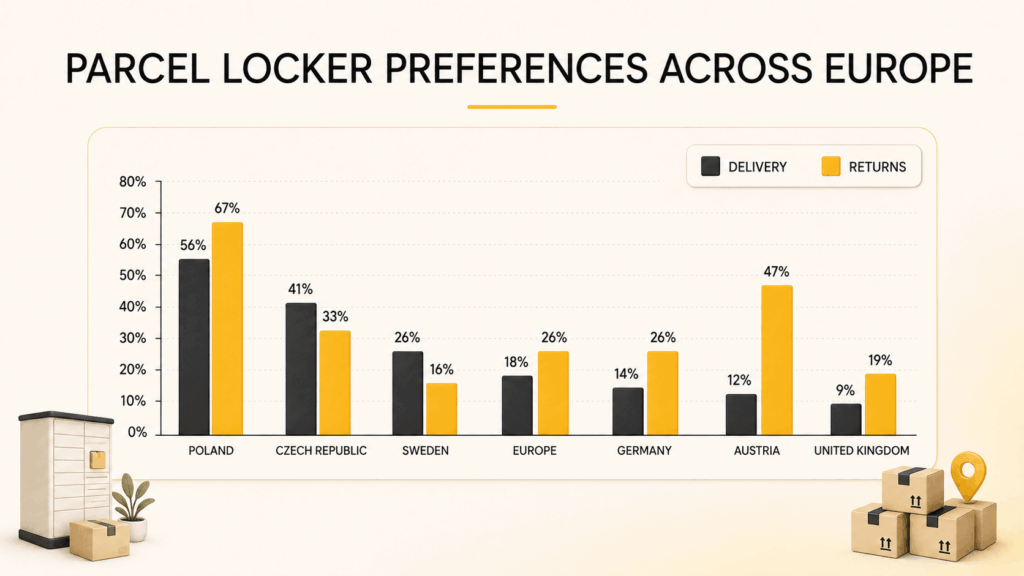
Source note under chart: DHL E-Commerce Online Shopper Survey 2025.
How to choose a parcel locker technology provider
A polished customer interface can hide difficult operational problems. Start with the planned network rather than the appearance of the cabinet.
1. Define the use case
Decide what the locker needs to handle:
- carrier delivery and collection
- consumer returns
- click and collect
- grocery collection
- residential deliveries
- internal company mail
- tool or equipment distribution
- bulky products
- luggage storage
- temperature-sensitive goods
A supermarket collecting frozen orders needs different hardware from a carrier installing hundreds of outdoor APMs.
2. Assess each location
Check the physical conditions before selecting a model.
Important factors include:
- indoor or outdoor placement
- available electrical power
- mobile and internet coverage
- direct and indirect sunlight
- local temperatures
- foundation requirements
- access hours
- delivery vehicle access
- pedestrian flow
- risk of vandalism or vehicle damage
- available loading and collection space
A lower-cost locker may become expensive once electrical work, foundations and protective barriers are included.
Good locations also influence adoption. Train stations, for example, place collection directly on existing commuter routes. Our guide to parcel lockers at train stations explores that location model in more detail.
3. Select the network model
Specify who can use the infrastructure:
- one carrier
- selected partner carriers
- every integrated carrier
- one retailer
- several retailers
- building residents
- employees
- public users
- internal service teams
Open networks need more complex software. The platform must allocate capacity fairly, exchange data with several partners and separate billing or reporting.
4. Compare power options
Grid power
A permanent electrical connection supports large displays, printers, refrigeration, heating and continuous connectivity.
The trade-off is higher installation cost and fewer possible locations.
Battery power
Battery lockers can launch quickly without electrical work. Their operating time depends on traffic, communication frequency, temperature and interface design.
Ask the supplier which assumptions support its battery-life estimate.
Solar and battery
Solar systems can retain more features without a grid connection. Performance still depends on panel position, local daylight and battery capacity.
Request winter performance data, not only annual averages.
5. Review the management software
Ask to see the operator dashboard during the sales process.
It should show:
- locker and door status
- compartment occupancy
- failed openings
- battery or power status
- connectivity
- dwell time
- courier activity
- return events
- maintenance tickets
- incident history
- usage across locations
- remote administrative actions
Also ask what the locker can do during an outage. Some systems process transactions locally and synchronize later. Others lose important functions without a live connection.
6. Examine the integration model
Request API documentation early.
Ask:
- Is there a public API?
- Are webhooks available?
- Which carrier systems already have integrations?
- Can an existing consumer app open the locker?
- Can third-party hardware join the platform?
- Who develops custom connectors?
- Who maintains them after launch?
- Can the operator export all data?
- What happens to integrations when the contract ends?
“Supports integration” can mean a ready production connector or a custom project that takes months.
7. Calculate the full operating cost
The cabinet price covers only part of the project.
Include:
- site acquisition
- transport
- installation
- foundations
- electrical work
- connectivity
- software licenses
- transaction fees
- routine maintenance
- cleaning
- repairs
- spare parts
- battery replacement
- technical support
- customer support
- relocation
- branding
- removal at the end of the contract
Request a breakdown of fixed, per-location, per-compartment and per-transaction charges.
8. Test the courier process
A small delay at one locker can become a large network cost.
Measure how long a courier needs to:
- authenticate
- scan or register parcels
- receive compartment assignments
- open several doors
- correct an incorrect placement
- collect returns
- close the session
Watch real couriers complete the test. A smooth marketing demonstration may not reflect a busy route with 50 parcels and poor weather.
9. Plan capacity around demand
Total door count isn’t enough.
A network with too many small compartments will reject larger parcels. Too many large doors will waste capacity when small packages occupy them.
Recent research highlights the relationship between compartment sizes, pickup times and future demand. A small parcel placed in a large compartment can block a later shipment that has nowhere else to go.
Use expected parcel dimensions, delivery peaks and collection times to plan the compartment mix.
10. Check support coverage
A provider may sell across Europe without having technicians in every market.
Confirm:
- response-time commitments
- remote support hours
- local service partners
- spare-parts locations
- preventative maintenance
- responsibility for connectivity faults
- battery replacement processes
- refrigeration support
- support during peak season
- escalation for a complete site outage
A locker with excellent specifications still fails its purpose when it stays offline for several days.
Best parcel locker providers for different projects
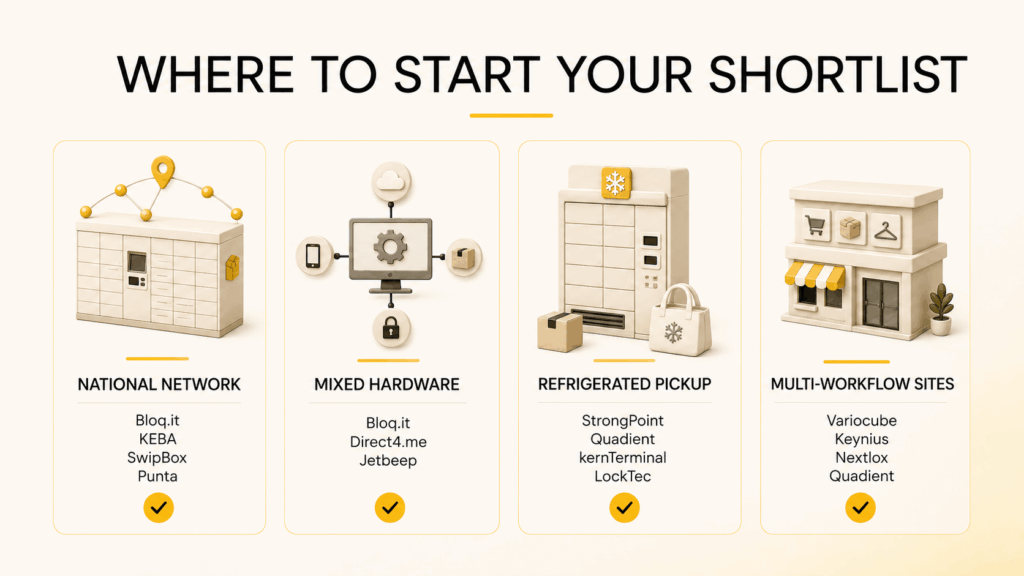
National carrier networks
Consider:
- Bloq.it
- KEBA
- SwipBox
- ARKA
- Direct4.me
- Jetbeep
- Punta
- kernTerminal
The right shortlist will depend on the power model, existing carrier systems and desired level of operational support.
Mixed-hardware networks
Start with Bloq.it or Direct4.me. Both promote management software that can connect hardware from several suppliers.
Jetbeep also deserves consideration when an operator wants to add autonomous technology to existing or custom cabinets.
High-volume retail click and collect
Cleveron stands out for robotic storage and compact customer-facing installations.
Quadient, LockTec, Variocube, Keynius and Nextlox provide more conventional modular options for stores with lower volumes.
Grocery and temperature-sensitive collection
Compare:
- StrongPoint
- Parcel Pending by Quadient
- kernTerminal
- LockTec
Look beyond the number of temperature zones. Review temperature records, refrigeration support and emergency procedures.
Residential and workplace parcel management
Consider:
- Parcel Pending by Quadient
- Variocube
- Keynius
- Nextlox
- LockTec
These providers support building-based workflows where couriers, residents, employees or reception teams may share one system.
Autonomous outdoor rollout
Compare:
- SwipBox
- KEBA
- ARKA
- Direct4.me
- Jetbeep
- Bloq.it
Their power systems and interfaces vary. Some use apps and Bluetooth, while others retain physical screens and scanners.
Oversized goods
Cleveron, LockTec and Quadient offer configurations designed for products that don’t fit standard parcel compartments.
Custom modular providers such as kernTerminal may also adapt the hardware around the planned product range.
Parcel locker procurement checklist
Hardware
- Which compartment sizes are standard?
- Can columns be added later?
- Is the system approved for outdoor use?
- Which tests and certifications apply?
- Can damaged modules be replaced separately?
- What happens when an electronic lock fails?
- Is a mechanical override available?
- Which parts should be stored locally?
Power and connectivity
- Does the locker require grid power?
- What assumptions support the battery estimate?
- How does cold weather affect performance?
- Can solar power run the selected interface?
- Which mobile networks are supported?
- Which functions continue offline?
- How quickly does the platform report lost connectivity?
Software
- Can one dashboard manage every site?
- Can it connect third-party hardware?
- Are APIs and webhooks available?
- Can the interface use the operator’s branding?
- Are remote diagnostics included?
- Can data be exported?
- Where is data stored?
- How are updates tested and released?
Customer experience
- Can users collect through a PIN or QR code?
- Is an app required?
- Is there an alternative for people without smartphones?
- Are several languages available?
- Does the system offer audio guidance?
- Can users extend collection time?
- Can the same locker accept returns?
- What happens after a parcel enters the wrong compartment?
Operations
- Who installs the equipment?
- Who manages each location?
- Who handles preventative maintenance?
- What uptime commitment applies?
- How quickly are field issues addressed?
- Is support available during evenings?
- Can the provider support every planned country?
- Who communicates with customers during an incident?
Commercial terms
- Is pricing based on locations, doors or transactions?
- Which integrations cost extra?
- Are software updates included?
- Who owns custom code?
- Can another company maintain the cabinets?
- Can the lockers move to a different platform?
- What happens to stored data after termination?
Frequently asked questions
What is parcel locker software?
Parcel locker software manages the processes behind a locker network. It can assign compartments, authenticate users, track deliveries and returns, send notifications and monitor the condition of each machine. More advanced platforms also connect several carriers or hardware manufacturers through one system.
What does hardware-agnostic parcel locker software mean?
Hardware-agnostic software can manage locker models from several manufacturers. It gives operators more flexibility when expanding or consolidating a network. Compatibility still depends on available integrations, so buyers should request a confirmed list of supported models before making a decision.
Do parcel lockers need electricity?
Not all parcel lockers require a grid connection. Some models run on batteries, while others use solar panels and battery storage. Screens, printers, heating, cooling and continuous connectivity consume more energy, so the selected interface will affect the available power options.
Can several carriers use one parcel locker?
Yes. An open or carrier-agnostic network can accept deliveries from several logistics companies. Its platform must manage integrations, capacity allocation, parcel records and access permissions for every carrier. The commercial model must also define responsibility for support, damage and uncollected parcels.
Can parcel lockers process returns?
Many current systems support returns, but their processes differ. One may require a printed label, while another accepts a QR code or label-free drop-off. Retailers should also check compartment reservations, customer confirmation, courier collection and chain-of-custody reporting.
What’s an automated parcel machine?
Automated parcel machine, often abbreviated to APM, is another term for a connected self-service parcel locker. An APM lets users collect, send or return packages without a staffed counter. The term appears frequently in carrier and postal technology projects.
How much does a commercial parcel locker cost?
Most providers use custom pricing. The total depends on cabinet size, number of compartments, interface, power source, software, integrations, installation and service coverage. Comparing hardware quotes alone may hide major differences in ongoing software and maintenance costs.
What makes a parcel locker accessible?
An accessible locker may provide reachable screens and compartments, strong contrast, readable text, audio instructions and alternatives to app-only access. The surrounding area matters too. Poor lighting, steps or insufficient space can make an otherwise accessible machine difficult to use.
Parcel lockers are becoming infrastructure
Parcel locker projects are no longer defined only by the number of cabinets an operator can install.
The strongest networks combine suitable locations, reliable hardware, flexible software, efficient courier flows and enough access options to serve different customers.
For one project, the right answer may be a screenless battery locker installed in minutes. Another may need robotic storage, refrigerated compartments or software connecting several hardware brands.
Start with the network model and operating requirements. Select the provider after those decisions, not before.
For broader market context, see our key takeaways about out-of-home delivery in Europe.