Top e-commerce statistics for individuals [Eurostat 2026]
Explore the latest EU e-commerce statistics on online shopping adoption, buyer demographics, popular purchases and customer problems.
Online shopping continues to grow across Europe, but the EU isn’t one uniform e-commerce market. Adoption ranges from below 60% in some countries to more than 90% in others. Age, employment and education still shape shopping habits, while delivery delays remain the most common source of customer frustration.
EU e-commerce statistics at a glance
| Statistic | Latest result |
| People aged 16–74 who used the internet within the previous 12 months | 95% |
| Internet users who bought goods or services online | 78% |
| Online purchasing rate in 2015 | 62% |
| Online purchasing rate among people aged 25–34 | 90% |
| Recent shoppers who encountered an online shopping problem | 35.4% |
| People who searched online for information about goods and services | 72% |
| People who searched for product safety information | 36% |
Eurostat’s 2025 data shows that 95% of people aged 16–74 had used the internet during the previous year. Among those internet users, 78% had bought or ordered something online.
A note on how Eurostat measures online shopping
Eurostat’s figures don’t always use the same group of people or reference period.
Some statistics cover:
- all people aged 16–74
- people who used the internet during the previous year
- people who bought online during the previous three months
- people who bought online during the previous 12 months
That difference matters. For example, a product category may be popular among recent e-shoppers without being purchased by the same percentage of the total population.
The 2025 results came from around 330,000 respondents aged 16–74 across the EU. Most countries collected their answers during the second quarter of 2025.
Online shopping adoption reached 78% in 2025
Among EU internet users, the share buying goods or services online increased from 62% in 2015 to 78% in 2025.
That’s an increase of 16 percentage points over ten years. Growth was particularly strong in Romania, where the online purchasing rate rose by 46 percentage points. Cyprus recorded an increase of 35 points, while Czechia gained 33 points.
Germany moved in a different direction. Its online shopping rate increased by only three percentage points, one of the smallest changes recorded across the EU. This most likely reflects the maturity of the German market rather than a lack of consumer interest: Germany already had a relatively large online buyer base at the start of the period.
For retailers, slower percentage growth in a mature market changes the goal. Growth may need to come from improving purchase frequency, average order value and retention rather than simply converting first-time online shoppers.
Which European countries shop online most?
Online shopping participation differs sharply across the EU.
In 2025, Ireland had the highest rate, with 95% of internet users purchasing online during the previous 12 months. The Netherlands followed at 94%.
At the other end of the ranking, 57% of internet users in Bulgaria shopped online, while Italy recorded 62%.
| Country | Internet users who shopped online |
| Ireland | 95% |
| Netherlands | 94% |
| Italy | 62% |
| Bulgaria | 57% |
The gap between internet access and e-commerce use is another useful signal. In Ireland and the Netherlands, the difference was only five percentage points. In Bulgaria, it reached 33 points.
This suggests that internet access alone doesn’t create an active e-commerce market. Payment preferences, trust, logistics, digital skills and the availability of suitable local stores may also affect adoption, although Eurostat’s figures don’t establish the impact of each factor.
Regional differences are even larger
Country-level averages can hide substantial differences inside national markets.
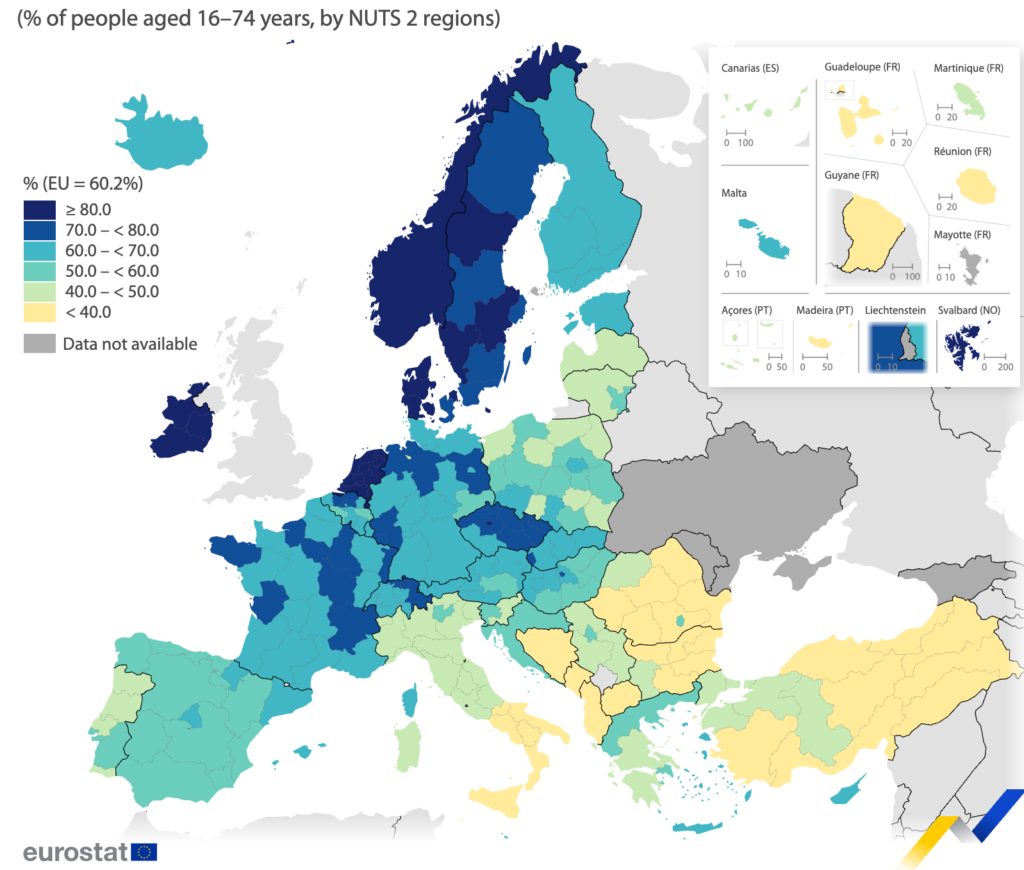
Eurostat’s regional data shows that 23 EU regions had an online shopping rate of at least 80% in 2024 when measuring purchases made during the previous three months. All 12 Dutch regions appeared in that group.
Utrecht recorded the highest regional result at 91.5%. The Bulgarian region of Yugoiztochen had the lowest at 21.7%.
In total, 21 EU regions recorded online shopping rates below 40%. Many were located in Romania, Bulgaria and southern Italy.
For international retailers, this makes regional planning more useful than treating an entire country as one audience. Delivery coverage, payment options and acquisition costs may differ considerably between a capital region and less connected areas of the same country.
Who shops online in Europe?
Age remains one of the clearest differences in European online shopping behaviour.
People aged 25–34 had the highest purchasing rate in 2025 at 90%. The result remained high among people aged 35–44, at 87%.
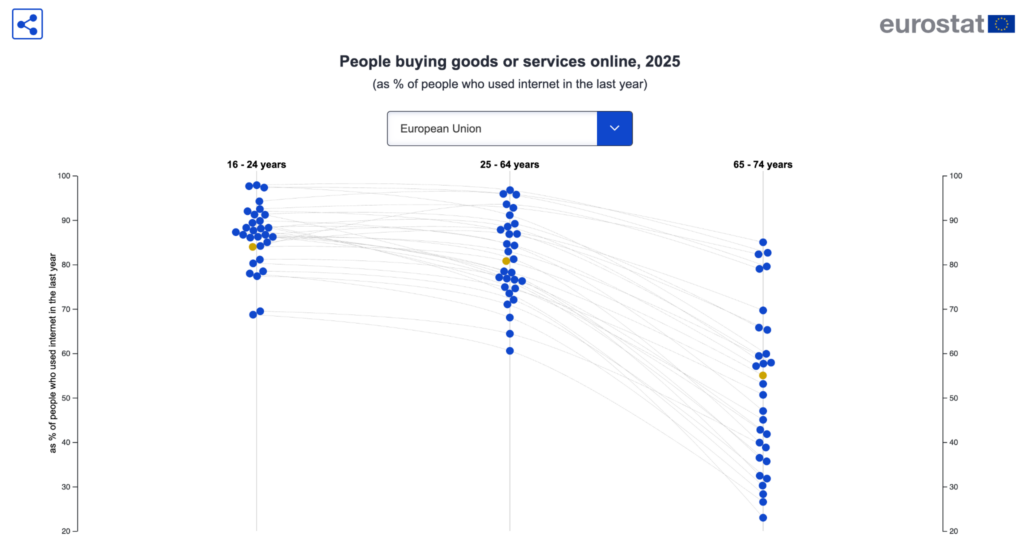
Participation gradually declined among older consumers, but the oldest group was far from absent. More than half of internet users aged 65–74 bought something online.
| Age group | Share buying online |
| 16–24 | 84% |
| 25–34 | 90% |
| 35–44 | 87% |
| 45–54 | 80% |
| 55–64 | 69% |
| 65–74 | 55% |
Men and women both recorded an online buying rate of 78%, meaning Eurostat found no overall gender gap in 2025.
The figures also challenge the idea that older consumers can be reached only through offline channels. A 55% purchasing rate among people aged 65–74 represents a substantial e-commerce audience, especially for retailers selling health, home, travel or lifestyle products.
Employment and education still influence online shopping
Employment status created a larger difference than place of residence.
In 2025:
- 85% of employees shopped online
- 83% of students did so
- 69% of unemployed internet users made online purchases
- 60% of pensioners bought online
The gap between urban and rural buyers was much smaller. Online purchasing reached 79% among city residents, compared with 76% among people living in rural areas.
Education produced another visible divide:
| Formal education level | Share buying online |
| Low | 59% |
| Medium | 77% |
| High | More than 89% |
These results show correlation rather than direct causation. Eurostat doesn’t prove that education itself makes someone purchase online. Income, occupation, confidence using digital services and access to suitable payment methods could also contribute.
For online stores, the practical lesson is straightforward: don’t assume every visitor has the same level of digital confidence. Clear navigation, familiar payment methods and simple returns information can make a store accessible to a broader customer base.
How often do Europeans shop online?
Most recent online shoppers placed a relatively modest number of orders.
Among people who purchased during the three months before the survey:
- 34% bought something once or twice
- 33% made between three and five purchases
Italy had the highest percentage of occasional e-shoppers, with 49% making only one or two purchases. Slovenia followed at 45%.
The figures show that regular online purchasing is common, but weekly shopping isn’t the norm for everyone.
Retailers serving occasional buyers may gain more from well-timed retention campaigns than aggressive daily promotions. Replenishment reminders, useful post-purchase emails and relevant product recommendations can bring customers back without overwhelming them.
What do Europeans buy online?
Clothing remains Europe’s dominant online product category.
In 2024, 70% of people who had purchased online during the previous three months bought clothes, shoes or accessories.
Other popular purchases included:
| Purchase | Share of recent online shoppers |
| Clothes, shoes or accessories | 70% |
| Film, series or sports streaming subscriptions | 46% |
| Tickets to events | 38% |
| Transport services from a company | 38% |
| Restaurant deliveries | 33% |
| Accommodation from a company | 33% |
| Cosmetics | 31% |
These percentages shouldn’t be compared directly with the overall 78% online shopping rate. The product figures cover people who had already shopped online in the previous three months, not all internet users.
Clothing’s popularity also doesn’t make it an easy category. Fashion retailers still need to manage sizing uncertainty, return costs and product presentation. Strong demand can come with expensive operational problems.
E-commerce now covers far more than physical products
Eurostat’s 2025 results show how widely online purchasing has spread into travel, entertainment, household services and finance.
Among EU internet users:
- 33% subscribed to film, series or sports streaming services
- 29% bought tickets to events
- 27% purchased transport services from a company
- 23% booked accommodation from a company
- 23% subscribed to music streaming
- 13% downloaded software
- 12% downloaded games
- 9% purchased e-books or audiobooks
Online household services are growing too. Around 15% subscribed to an internet or mobile connection online, while 9% purchased services such as electricity, heating or waste disposal through the internet.
The definition of e-commerce now stretches well beyond traditional retail. A subscription renewal, insurance policy, train ticket and software download can all be part of the same consumer’s online spending.
Online shopping starts before the checkout
Purchasing data captures only part of the customer journey.
In 2025, 72% of people aged 16–74 used the internet to find information about goods and services. Eurostat also measured searches for product safety information for the first time.
More than one in three people, or 36%, looked online for details such as:
- potential health risks
- product composition
- safe use instructions
- contact information for reporting safety issues
This has clear implications for product pages. Shoppers may be looking for far more than a price, photo and delivery date.
Retailers selling electronics, cosmetics, children’s products or household equipment should make safety and compliance details easy to find. Hiding that information in a downloadable manual or an obscure footer page adds unnecessary friction before purchase.
Product pages can answer these questions with clear specifications, material information, usage guidance, certificates and direct links to warranty terms.
More than one in three shoppers encountered a problem
Online shopping adoption is growing, but the experience still fails a large percentage of buyers.
In Eurostat’s 2025 survey, 35.4% of recent online shoppers encountered at least one problem when buying through a website or app.
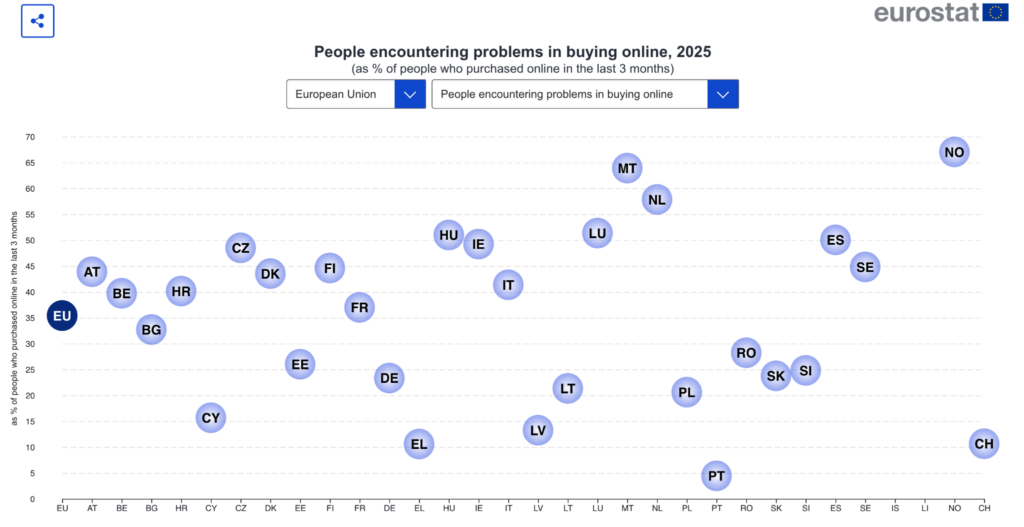
The highest problem rates appeared in:
- Malta: 64.0%
- Netherlands: 57.9%
- Luxembourg: 51.4%
Portugal reported the lowest rate at 4.5%, followed by Greece at 10.6% and Latvia at 13.3%. Differences between countries may reflect customer expectations, purchasing frequency and reporting patterns as well as store performance.
Slow delivery remains the biggest issue
| Problem | Share of recent e-shoppers |
| Delivery slower than promised | Around 20% |
| Website difficult to use or unreliable | Around 12% |
| Incorrect or damaged item | Around 10% |
| Guarantee or legal-rights information difficult to find | 8% |
| Unsatisfactory complaint handling | 6% |
| Costs higher than indicated | 5% |
| Fraud | 4% |
Delivery is the largest problem, but it isn’t the only one retailers can address.
A store may attract customers with competitive pricing and still lose them through:
- unrealistic delivery promises
- poorly tested mobile pages
- unclear warranty information
- unexpected checkout charges
- slow complaint resolution
The strongest fix isn’t always faster shipping. More accurate delivery estimates can produce a better experience than an ambitious promise the retailer can’t consistently meet.
What the data means for European retailers
Mature markets need retention, not only acquisition
Online shopping already exceeds 90% among internet users in Ireland and the Netherlands. There are fewer consumers left to convert into first-time e-shoppers.
Retailers in mature markets may need to focus more heavily on repeat orders, loyalty and category expansion.
Older consumers are a real e-commerce segment
More than half of internet users aged 65–74 now shop online. Stores that use small text, unclear menus or unnecessarily complicated checkouts may be excluding a commercially valuable audience.
Regional strategy matters
A national average can conceal a gap of dozens of percentage points between regions. Retailers planning expansion should assess local demand, logistics and payment habits before applying one strategy across an entire country.
Product information supports conversion
Consumers actively research goods and product safety online. Complete descriptions can answer pre-purchase questions while reducing the risk of returns caused by misunderstood features or usage requirements.
Customer experience continues after payment
Late delivery remains the most common complaint. Order tracking, realistic estimates and proactive delay notifications deserve the same attention as landing pages and checkout optimisation.
Frequently asked questions
What percentage of Europeans shop online?
In 2025, 78% of EU internet users aged 16–74 bought or ordered goods or services online during the previous 12 months. The rate increased from 62% in 2015.
Which European country has the most online shoppers?
Ireland recorded the highest online shopping rate in 2025 at 95% of internet users. The Netherlands followed at 94%.
What’s the most popular online purchase in Europe?
Clothing, shoes and accessories are the leading category. In 2024, 70% of people who had recently shopped online purchased items from this group.
Which age group shops online most?
People aged 25–34 had the highest online purchasing rate in 2025 at 90%. Those aged 35–44 followed at 87%.
What’s the most common online shopping problem?
Delivery taking longer than promised is the most frequently reported problem. Around 20% of recent EU online shoppers experienced it in 2025.
How many Europeans research products online?
In 2025, 72% of people aged 16–74 used the internet to find information about goods and services. Another 36% searched specifically for product safety information.
European e-commerce is growing, but the gaps remain
Europe’s online shopping market is larger and more established than it was ten years ago. Yet adoption, purchasing frequency and customer experience continue to differ across countries and consumer groups.
For retailers, the next stage of growth won’t come only from putting more products online. Clearer information, more reliable delivery and experiences designed for a wider range of customers will decide which stores turn high adoption into repeat business.