Top 30 Ecommerce Agencies in Germany in 2026
Compare 30 leading ecommerce agencies in Germany for 2026, with BVDW ranking data, ecommerce focus and specialist picks for Shopify, D2C and marketplaces.

Finding an ecommerce agency in Germany is easy. Finding one that fits your platform, business model and growth stage is much harder.
Germany has large digital consultancies running complex enterprise commerce programs, highly specialized Shopify and Shopware teams, performance marketing agencies and marketplace specialists. Putting all of them into one list without explaining the differences isn’t particularly useful.
The market itself also keeps moving. German ecommerce is forecast to grow again in 2026, while marketplaces continue to account for a large part of online sales. For the broader context, see our latest overview of German ecommerce growth in 2026.
So we’ve done things differently for this update.
The first 20 companies come directly from the E-Commerce subranking of the BVDW Internet Agency Ranking 2026, published in May 2026. We then added 10 specialist picks based on current ecommerce credentials, platform expertise and industry recognition. BVDW’s ranking has been produced annually since 2001 and is designed to provide orientation within Germany’s digital agency market.
The result covers both scale and specialization.
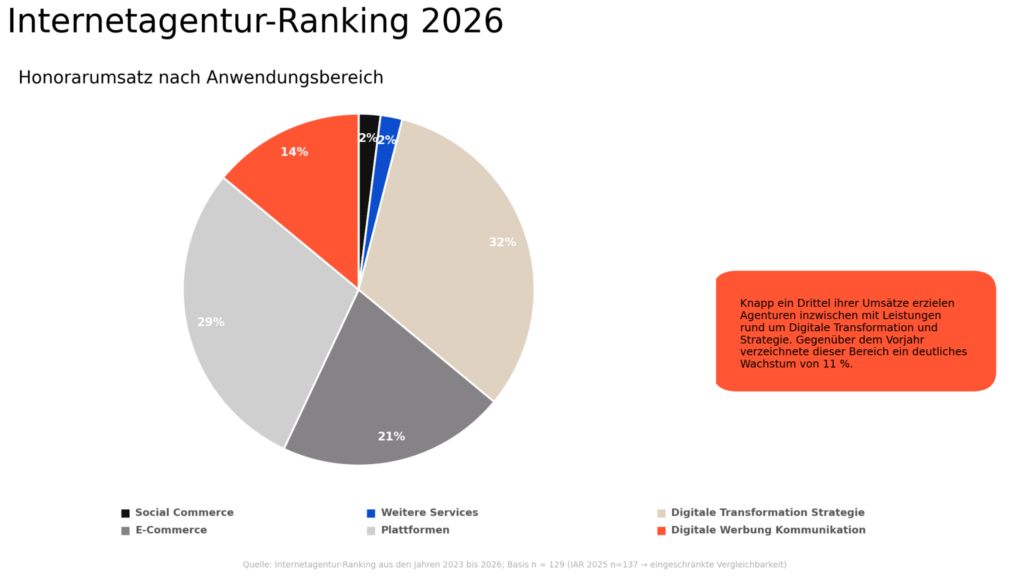
Top ecommerce agencies in Germany: quick comparison
| # | Agency | Ecommerce fee revenue* | Ecommerce share | Good fit for |
| 1 | Plan.Net Germany | €98.35m | 38% | Large enterprise commerce |
| 2 | Valtech | €53.43m | 60% | Enterprise CX and commerce |
| 3 | valantic | €42.34m | 35% | B2B, B2C and D2C commerce |
| 4 | Wiethe Content | €37.00m | 100% | Ecommerce content |
| 5 | dotSource | €31.17m | 85% | Complex commerce ecosystems |
| 6 | team neusta | €29.72m | 39% | Digital transformation and commerce |
| 7 | intive | €16.71m | 34% | Digital products and engineering |
| 8 | neuland | €15.84m | 95% | Ecommerce-focused development |
| 9 | Unic | €8.34m | 70% | Digital experience and commerce |
| 10 | BRANDUNG | €4.94m | 35% | Experience-led commerce |
| 11 | dc | €4.92m | 70% | Ecommerce projects |
| 12 | DigitalNativeAlliance | €4.67m | 33% | Mid-market digital commerce |
| 13 | dreifive | €3.90m | 31% | Commerce and digital marketing |
| 14 | SHOPMACHER | €3.63m | 55% | Retail ecommerce |
| 15 | Blackbit digital Commerce | €3.24m | 80% | Digital commerce platforms |
| 16 | COBE | €3.17m | 30% | UX-led digital products |
| 17 | Latori | €3.08m | 100% | Shopify and Shopify Plus |
| 18 | Krankikom | €2.86m | 52% | Ecommerce development |
| 19 | For Sale Digital | €2.67m | 90% | Ecommerce-focused projects |
| 20 | foobar Agency | €2.41m | 90% | Ecommerce development |
*Fee revenue attributed to ecommerce in the BVDW Internet Agency Ranking 2026, rather than the companies’ total ecommerce transaction volume.
BVDW’s E-Commerce subranking puts Plan.Net first, followed by Valtech and valantic. The specialization figures tell another part of the story: Wiethe Content and Latori report 100% ecommerce shares, while neuland reports 95%, For Sale Digital and foobar Agency 90% and dotSource 85%.
That distinction matters. The largest agency isn’t automatically the most specialized one.
How we selected the agencies
Ranks 1 to 20 follow the order of the BVDW Internet Agency Ranking 2026 E-Commerce subranking. The ranking covers companies participating in BVDW’s industry study and reports fee revenue, employee numbers and business-area data.
It doesn’t represent every ecommerce agency operating in Germany.
That’s why positions 21 to 30 are E-commerce Germany editorial picks rather than extensions of the BVDW ranking. For these, we looked at current indicators including industry recognition, ecommerce specialization and platform credentials.
If you’re particularly interested in smaller, emerging and boutique companies, we have a separate selection of ecommerce agencies in Germany to watch in 2026.
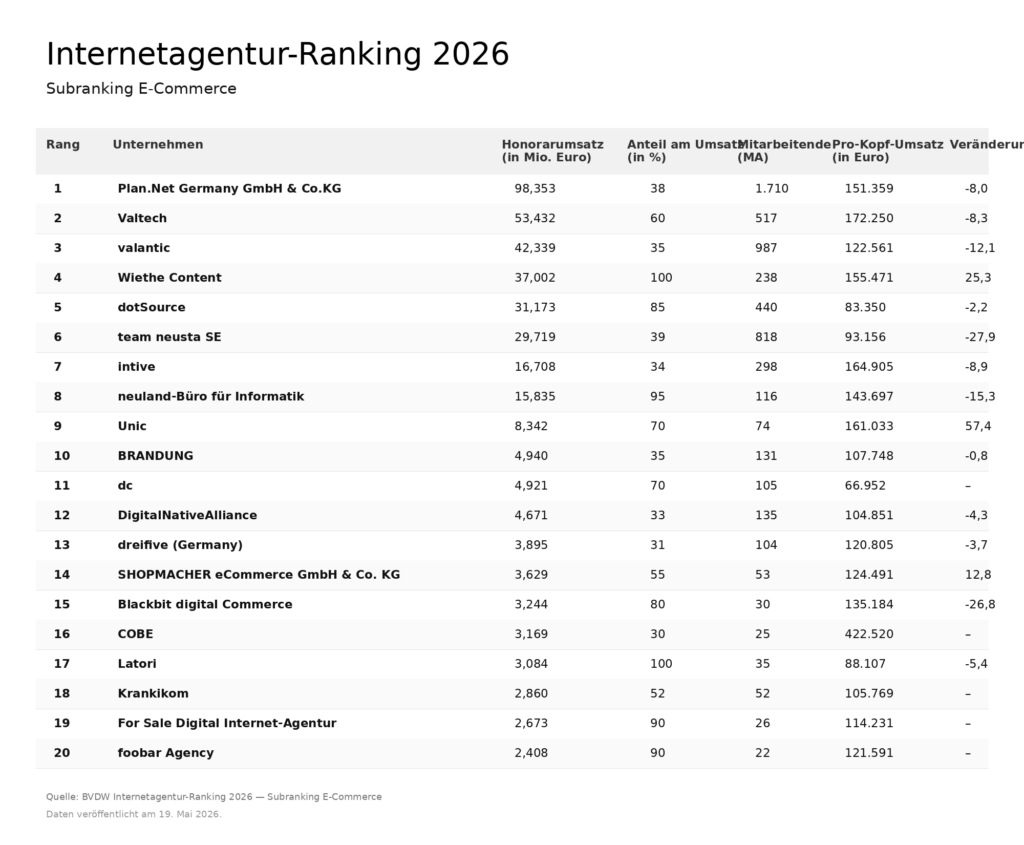
The 20 leading ecommerce agencies in the BVDW 2026 ranking
1. Plan.Net Germany
Good fit for: large companies looking for scale and broad digital capabilities
Ecommerce fee revenue: €98.35 million
Ecommerce share: 38%
Plan.Net takes first place in BVDW’s 2026 ecommerce subranking. Its reported ecommerce fee revenue is almost twice that of the agency in second place.
The 38% ecommerce share also puts the result into perspective. Plan.Net isn’t a niche shop-development studio. It belongs in conversations where ecommerce forms part of a much larger customer experience, marketing and digital transformation program.
2. Valtech
Good fit for: enterprise commerce and customer experience
Ecommerce fee revenue: €53.43 million
Ecommerce share: 60%
Valtech ranks second, with 60% of reported fee revenue attributed to ecommerce.
It is particularly relevant to companies dealing with complicated digital ecosystems rather than one isolated storefront. For buyers planning international commerce, that wider perspective matters: Germany may be the largest part of the region, but our 2026 guide to the DACH ecommerce market shows why Germany, Austria and Switzerland shouldn’t be treated as one identical market.
3. valantic
Good fit for: complex B2B, B2C and D2C commerce
Ecommerce fee revenue: €42.34 million
Ecommerce share: 35%
valantic takes third place in the BVDW ecommerce ranking.
Its scale makes it relevant for commerce projects that go beyond storefront design into connected platforms, customer experience and business systems.
4. Wiethe Content
Good fit for: retailers with large ecommerce content requirements
Ecommerce fee revenue: €37.00 million
Ecommerce share: 100%
Wiethe Content stands out because BVDW attributes 100% of its reported fee revenue to ecommerce.
That specialization makes it particularly interesting for retailers dealing with large quantities of product, campaign and commercial content.
5. dotSource
Good fit for: complex commerce ecosystems and system integration
Ecommerce fee revenue: €31.17 million
Ecommerce share: 85%
dotSource combines relatively high scale with a strong ecommerce concentration. BVDW reports that 85% of its fee revenue comes from ecommerce.
For merchants managing thousands of SKUs, however, storefront technology is only part of the issue. Product data may also need its own infrastructure. Our comparison of PIM software for DACH ecommerce looks at platforms designed for complex product catalogs, supplier workflows and multichannel publishing.
6. team neusta
Good fit for: enterprise commerce tied to wider digital transformation
Ecommerce fee revenue: €29.72 million
Ecommerce share: 39%
team neusta comes sixth in BVDW’s ecommerce subranking, with €29.72 million in reported ecommerce fee revenue.
It belongs in the larger-agency group where commerce can sit alongside wider digital products, consulting and transformation work.
7. intive
Good fit for: companies where ecommerce overlaps with product engineering
Ecommerce fee revenue: €16.71 million
Ecommerce share: 34%
intive comes seventh in the BVDW ecommerce table, with €16.71 million in ecommerce fee revenue and a 34% ecommerce share.
Its position makes it relevant for organizations that see commerce as part of a larger digital product environment rather than a standalone shop.
8. neuland
Good fit for: businesses looking for a highly ecommerce-focused agency
Ecommerce fee revenue: €15.84 million
Ecommerce share: 95%
Few companies in the ranking are as concentrated on ecommerce as neuland.
BVDW attributes 95% of its reported fee revenue to ecommerce. It therefore offers an interesting comparison with the much larger digital consultancies appearing above it.
9. Unic
Good fit for: digital commerce and customer experience
Ecommerce fee revenue: €8.34 million
Ecommerce share: 70%
Unic takes ninth place, with 70% of its reported fee revenue tied to ecommerce.
That puts it between broad digital groups and ecommerce-only specialists.
10. BRANDUNG
Good fit for: brands combining commerce with digital experience work
Ecommerce fee revenue: €4.94 million
Ecommerce share: 35%
BRANDUNG closes BVDW’s ecommerce top 10 with €4.94 million in reported ecommerce fee revenue.
Its 35% share suggests a wider digital proposition rather than an ecommerce-only model.
11. dc
Good fit for: companies looking for meaningful ecommerce specialization
Ecommerce fee revenue: €4.92 million
Ecommerce share: 70%
dc sits just behind BRANDUNG in fee revenue, but ecommerce plays a much larger role in its business.
BVDW attributes 70% of its reported fee revenue to ecommerce.
12. DigitalNativeAlliance
Good fit for: mid-market digital commerce
Ecommerce fee revenue: €4.67 million
Ecommerce share: 33%
DigitalNativeAlliance ranks twelfth with €4.67 million in ecommerce fee revenue.
For mid-market merchants, agency choice often needs to account for more than the ecommerce platform itself. Marketplace connections, product data, operations and marketing can quickly turn a simple store project into a wider system decision.
13. dreifive
Good fit for: brands combining ecommerce and digital marketing
Ecommerce fee revenue: €3.90 million
Ecommerce share: 31%
dreifive is thirteenth in the BVDW subranking. Ecommerce accounts for 31% of its reported fee revenue.
That positions it as a broader digital partner with meaningful commerce work rather than a pure ecommerce boutique.
14. SHOPMACHER
Good fit for: retailers looking for a dedicated ecommerce partner
Ecommerce fee revenue: €3.63 million
Ecommerce share: 55%
SHOPMACHER sits at number 14, with ecommerce accounting for 55% of its reported fee revenue.
For retailers, this is the point in the ranking where smaller agency size can coexist with a much stronger commerce concentration.
15. Blackbit digital Commerce
Good fit for: commerce platform development and growth
Ecommerce fee revenue: €3.24 million
Ecommerce share: 80%
Blackbit has one of the highest ecommerce concentrations in the BVDW top 20, at 80%.
That specialization can matter more than absolute agency size when the brief is tightly centered on digital commerce.
16. COBE
Good fit for: businesses placing UX and digital product experience high on the brief
Ecommerce fee revenue: €3.17 million
Ecommerce share: 30%
COBE ranks sixteenth. Its 30% ecommerce share is among the lower figures in the top 20, so it makes more sense for projects where ecommerce is closely tied to wider digital product and user experience work.
17. Latori
Good fit for: Shopify and Shopify Plus
Ecommerce fee revenue: €3.08 million
Ecommerce share: 100%
Latori is the clearest platform specialist in the ranking.
BVDW attributes 100% of its reported fee revenue to ecommerce.
If Shopify is already a firm platform decision, a deeply specialized agency can make more sense than hiring a much larger consultancy. Merchants still comparing technologies can use our overview of ecommerce platforms in the DACH region as a starting point before choosing an implementation partner.
18. Krankikom
Good fit for: mid-sized and larger ecommerce development projects
Ecommerce fee revenue: €2.86 million
Ecommerce share: 52%
Krankikom crosses the halfway point in ecommerce specialization, with 52% of its reported fee revenue attributed to the category.
That places it among the agencies where commerce is a major business line without being the company’s sole focus.
19. For Sale Digital
Good fit for: companies looking for an ecommerce-heavy agency
Ecommerce fee revenue: €2.67 million
Ecommerce share: 90%
For Sale Digital has one of the highest specialization ratios in the ranking.
BVDW reports that 90% of its fee revenue comes from ecommerce.
20. foobar Agency
Good fit for: ecommerce projects where specialist focus matters more than agency scale
Ecommerce fee revenue: €2.41 million
Ecommerce share: 90%
foobar Agency closes the BVDW ecommerce top 20 with another 90% ecommerce share.
It is a useful reminder that revenue rank and specialization measure different things.
10 specialist ecommerce agencies worth adding to your shortlist
The following agencies are editorial additions, not positions 21 to 30 in the BVDW ranking.
We included them because the German ecommerce agency market is wider than one industry table. Some concentrate on paid acquisition, some on Shopify and others on D2C or marketplace growth.
The distinction is also useful commercially. Germany’s largest online marketplaces now play such a large role in online retail that a marketplace specialist can be more relevant to some brands than a traditional shop-development agency.
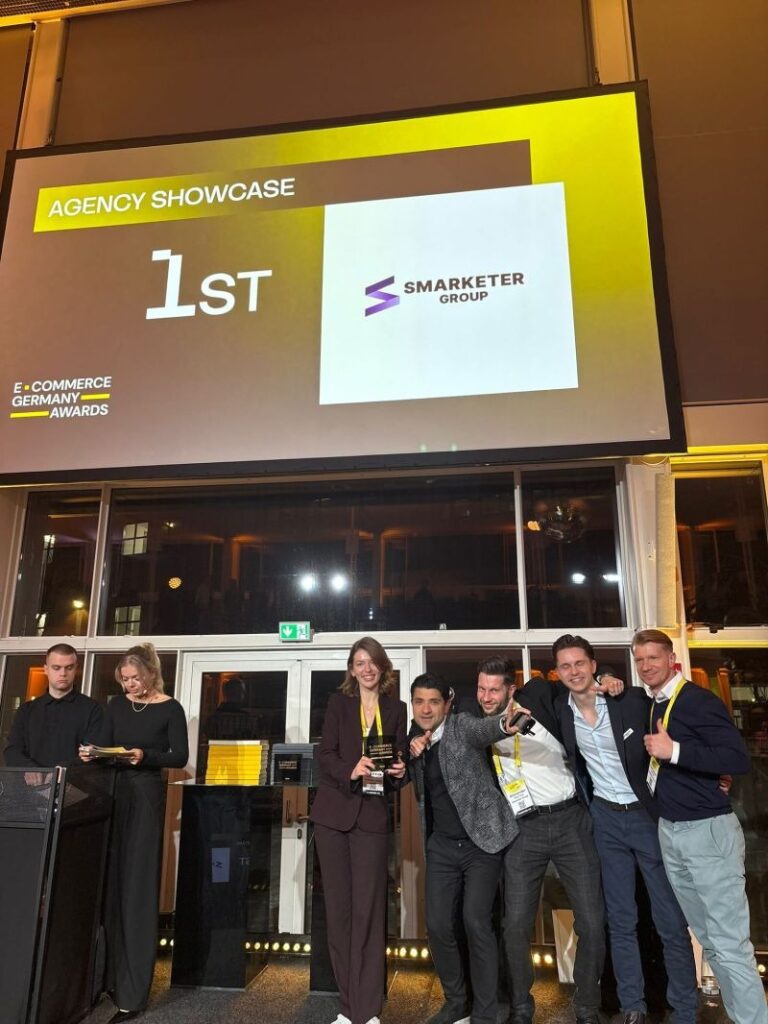
21. Smarketer Group
Good fit for: ecommerce performance marketing and paid acquisition
Smarketer Group won the Agency Showcase category at the E-commerce Germany Awards 2026, ahead of Growthartig and squadt. The finalists were first determined through public voting, followed by evaluation from an expert jury.
It makes particular sense for brands whose main ecommerce problem is customer acquisition rather than building the underlying storefront.
22. Growthartig
Good fit for: D2C growth, paid social and creative testing
Berlin-based Growthartig took second place in the 2026 Agency Showcase.
For an established D2C brand, an agency specializing in acquisition and growth can be more useful than another full-service development team.
23. squadt
Good fit for: D2C ecommerce marketing
squadt finished third in the 2026 E-commerce Germany Awards Agency Showcase.
Its inclusion also illustrates why a useful ecommerce agency shortlist shouldn’t be limited to companies building the actual webshop.
24. Remazing
Good fit for: Amazon, marketplaces and retail media
Not every ecommerce growth problem sits inside your own webshop.
For companies heavily dependent on Amazon or other platforms, marketplace expertise can matter more than traditional web development. Germany remains an especially important Amazon market, as our 2026 overview of Amazon in Germany explains.
Remazing therefore belongs in a different type of shortlist from a conventional development agency.
25. 4TFM E-Commerce Agentur
Good fit for: Shopify migrations and technical store work
4TFM is the type of specialist worth considering when the technology decision has already been made and the requirement is more focused: migration, theme work, integrations or optimization.
A specialist team can be a better match than a giant agency when the scope doesn’t require enterprise-scale transformation.
26. Acceleratiq
Good fit for: Shopify Plus, migrations and international expansion
Acceleratiq fits projects where Shopify work extends into migration, connected systems or international commerce.
Cross-border plans should be considered from the beginning rather than added after launch. Our overview of DACH ecommerce trends for 2026 shows how channel mix, localization and customer expectations continue to change across the region.
27. Shopibrands
Good fit for: Shopify stores that also need marketing support
Shopibrands represents another useful agency model: a platform-focused team that can work beyond development into optimization and ecommerce growth.
That can suit smaller and mid-sized merchants that would rather avoid splitting every part of the store across several suppliers.
28. Slash Themes
Good fit for: Shopify builds, migrations and theme development
Slash Themes is particularly relevant when storefront execution is the central requirement.
A tightly scoped specialist can be preferable to a large transformation consultancy when the underlying business systems are already working well.
29. 3oneseven
Good fit for: Shopify B2B and conversion projects
3oneseven is worth considering when Shopify needs to support more than straightforward consumer ecommerce.
B2B and wholesale introduce different customer accounts, pricing structures and buying flows, so experience with the specific business model should carry more weight than general platform familiarity.
30. Finer Digital Agency
Good fit for: Shopify optimization and international commerce
Finer Digital Agency rounds out the list as another example of why ecommerce agency selection shouldn’t be based on company size alone.
A specialist can be the stronger fit when the brief is clearly defined and doesn’t require dozens of different disciplines.
Which ecommerce agency in Germany should you choose?
The best ecommerce agency isn’t necessarily number one on a ranking.
Start with the problem you actually need to solve.
For large enterprise commerce programs
Start with agencies such as Plan.Net, Valtech, valantic, dotSource or team neusta.
These companies operate at the scale needed for projects involving several markets, multiple systems, complex integrations or broad digital transformation.
It can also help to look at the companies setting customer expectations in the market. Our ranking of the top 100 online stores in Germany shows how varied the country’s leading ecommerce businesses have become across marketplaces, traditional retailers, grocery, pharmacy and specialist verticals.
For an ecommerce-first agency
Look at ecommerce share rather than absolute revenue alone.
Wiethe Content and Latori report 100% ecommerce shares in BVDW’s ranking, neuland 95%, For Sale Digital and foobar Agency 90%, dotSource 85% and Blackbit 80%.
That doesn’t automatically make them better. It tells you how central ecommerce is to their agency business.
For Shopify
Latori is the highest-ranked Shopify-focused specialist in the BVDW ecommerce top 20.
Don’t choose an agency simply because a Shopify logo appears on its site. Compare the team’s work with projects that resemble yours: migration versus greenfield build, D2C versus B2B, one country versus international operations and basic themes versus complicated integrations.
For D2C growth and performance marketing
Consider Smarketer Group, Growthartig and squadt.
All three took podium positions in the Agency Showcase category at the 2026 E-commerce Germany Awards.
Which one belongs on the shortlist then depends on your problem: paid acquisition, creative production, ecommerce strategy, measurement or a combination of them.
For Amazon and marketplaces
Look beyond traditional ecommerce development agencies.
Marketplace specialists become particularly relevant once Amazon, Otto, Zalando, Kaufland or other platforms represent a substantial part of sales.
You can compare the channel landscape in our guide to the 24 leading marketplaces in Germany.
Questions to ask before hiring an ecommerce agency
A polished pitch deck tells you little about how the relationship will work six months into the project.
Before signing a contract, ask:
- Which ecommerce platforms does your team work with every week?
- Can you show projects similar to our business model and technical setup?
- Which work is completed in-house and which is outsourced?
- Who will actually work on our account after the sales process ends?
- How do you handle migrations and SEO risk?
- How do you test checkout, tracking and integrations before launch?
- Can you work with our ERP, PIM, CRM and existing analytics stack?
- What happens after launch?
- Which KPIs will you use to judge commercial performance?
- How are change requests and additional development priced?
Checkout deserves particular attention. Germany, Austria and Switzerland have different payment expectations, so merchants expanding across the region should also compare payment providers and payment methods in DACH before locking in the technical architecture.
For international expansion, add questions about localization, tax, payment coverage, delivery, returns and marketplaces.
Don’t choose an ecommerce agency based on platform expertise alone
Platform expertise matters, but ecommerce projects rarely exist in isolation.
Product data may need to flow from a PIM. Stock and order information may sit in an ERP. CRM data needs to remain usable. Analytics must survive the migration. SEO URLs can’t simply disappear during a replatform.
Delivery is another part of the customer experience that store teams often treat too late. Germany has a mature logistics ecosystem, but fulfillment, returns and carrier integrations still need to fit the store architecture. Our list of fulfillment centres and logistics operators in Germany can help when evaluating that side of the stack.
The right agency should understand the whole commercial setup surrounding your shop, even when it isn’t responsible for every component.
Understand where your customers actually spend
Agency selection should also reflect the category you sell in.
Fashion, electronics, household products, pharmacy and daily essentials don’t produce identical ecommerce requirements. Product content, returns, marketplace dependence and customer acquisition economics vary enormously between categories.
Our current overview of the most popular online shopping categories in Germany helps show where those differences appear.
The same applies to mobile. An agency building for a retailer with substantial app traffic needs a different understanding of customer journeys from one working on a primarily desktop B2B portal. The top shopping apps in Germany in 2026 provide a useful benchmark for what German shoppers increasingly expect from mobile commerce.
Germany’s ecommerce market still leaves plenty to build
German ecommerce is forecast to grow by 4.3% in nominal terms in 2026, faster than physical retail, according to HDE figures covered in our latest market update.
Competition, however, is concentrated. Amazon, eBay, Otto and other large players continue to shape expectations around price, selection, reviews, delivery and returns. Our current ranking of the largest online shops in Germany gives a useful picture of that competitive environment.
For brands, that raises the standard.
An online store has to work technically, but it also has to connect with acquisition channels, product data, marketplaces, payments, logistics and customer expectations.
German businesses expanding further afield also compete within a much larger regional ecosystem. Our European ecommerce overview for 2026 puts Germany’s market into that wider context.
That is why choosing an ecommerce agency in 2026 is less about finding a company that can “build a shop” and more about finding a partner whose strongest capabilities match the bottleneck in your business.
Over to you
Germany has no shortage of ecommerce agencies.
The useful question isn’t who can build a store. It is which agency has already solved the type of problem you have now.
For enterprise transformation, that may lead you toward Plan.Net, Valtech, valantic or dotSource.
For a platform-specific project, a specialist may offer a better fit.
For D2C acquisition, performance-focused agencies belong in a different comparison altogether. And if most of your growth happens through Amazon or another marketplace, marketplace expertise deserves more weight than conventional web development experience.
Use rankings to create the shortlist.
Then let your business model, technology, existing stack and growth priorities decide the winner.
FAQ: ecommerce agencies in Germany
What is the best ecommerce agency in Germany?
There is no single best ecommerce agency for every company.
Plan.Net ranks first in the BVDW 2026 E-Commerce subranking based on reported ecommerce fee revenue. A specialist may still be a stronger fit for a Shopify migration, performance campaign, D2C project or marketplace strategy.
What is the largest ecommerce agency in Germany?
Among companies participating in the BVDW Internet Agency Ranking 2026, Plan.Net Germany has the highest reported ecommerce fee revenue at €98.35 million. Valtech follows with €53.43 million and valantic with €42.34 million.
Which German ecommerce agencies specialize most heavily in ecommerce?
According to BVDW’s 2026 data, Wiethe Content and Latori report 100% of fee revenue from ecommerce. neuland reports 95%, For Sale Digital and foobar Agency 90%, dotSource 85% and Blackbit 80%.
Which ecommerce agency is best for Shopify in Germany?
There isn’t one answer for every Shopify merchant. Latori is the highest-ranked clearly Shopify-focused specialist in BVDW’s ecommerce top 20. The right agency still depends on the scope: migration, theme development, B2B, integrations, internationalization or ongoing growth.
How should I compare ecommerce agencies?
Compare agencies based on relevant client work, platform depth, integrations, business-model experience, post-launch support and the team assigned to your account.
Agency revenue and awards can help create a shortlist, but they shouldn’t replace a technical and commercial fit assessment.
Are ecommerce agencies and ecommerce marketing agencies the same?
Not always.
Some agencies build and operate commerce platforms. Others focus primarily on paid media, SEO, marketplaces, creative or conversion. Smarketer Group and Growthartig, for example, earned recognition in the Agency Showcase category at the 2026 E-commerce Germany Awards, while much of BVDW’s ecommerce ranking is made up of agencies with substantial technology and platform work.