Product discovery software for ecommerce: 8 tools compared
Compare 8 ecommerce product discovery software for search, AI, merchandising and German-language relevance across DACH markets.

Shoppers don’t always arrive with a product name copied from a catalog. They search for “black office chair for a small room,” browse a category, apply filters or follow a recommendation from another product page. Every one of those actions is part of ecommerce product discovery.
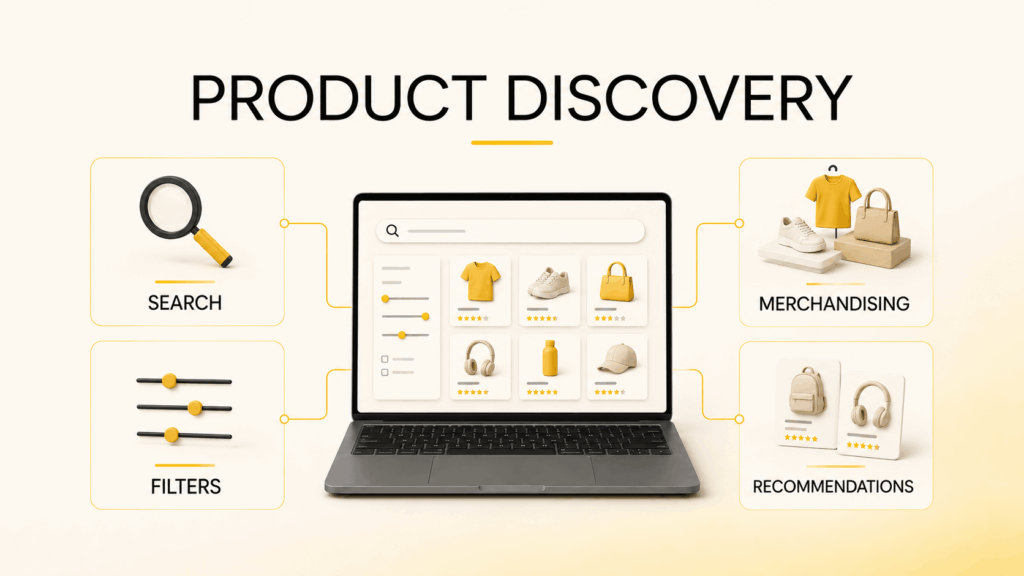
Product discovery software connects search, navigation, merchandising and recommendations so customers can reach suitable products faster. The best system also shows retailers where shoppers get lost and where the catalog fails to reflect real demand.
What product discovery software means in ecommerce
In ecommerce, discovery technology helps shoppers find relevant items across search results, category pages, filters and recommendation blocks. It uses product data, shopper behavior and business rules to decide which products appear and in what order.
The term can create confusion because search results often point to product-management products such as Jira Product Discovery. Those tools help product teams prioritize a roadmap. They don’t improve onsite search or guide shoppers through an online catalog.
An ecommerce product discovery platform usually includes an ecommerce search engine, autocomplete, faceted navigation, merchandising controls, product recommendations and analytics. Some products supply the full stack. Others provide a headless search API that a retailer’s developers use to build a custom experience.
Why onsite search users behave differently
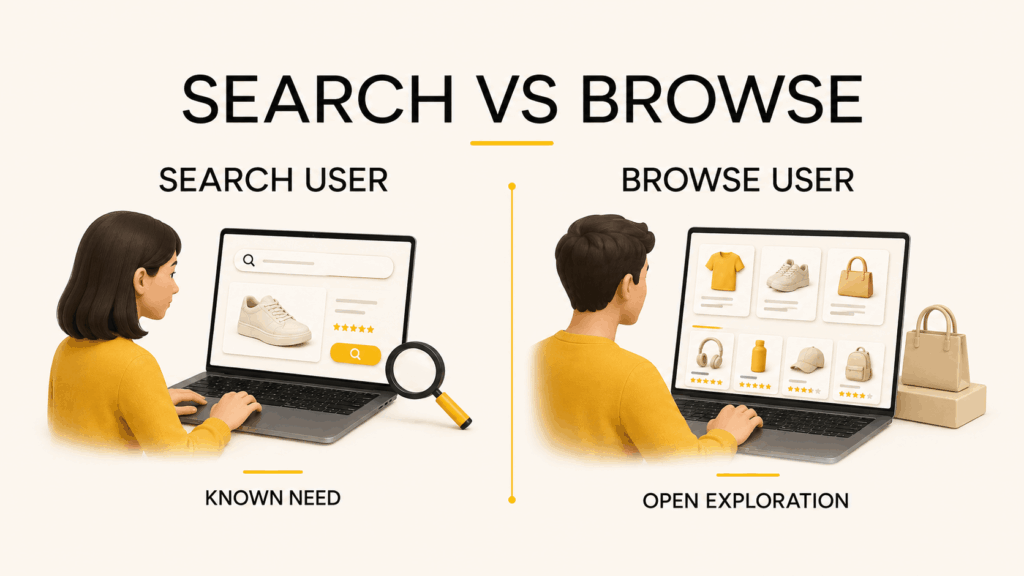
A shopper who opens the search bar has expressed a need. They might know the exact SKU, a use case or only a few desired attributes. A browse user is often exploring a category without the same level of intent.
That difference makes ecommerce site search commercially important. A relevant result can shorten a long user journey, while a weak engine can make an available product look nonexistent. Search should handle how customers describe products, not require customers to learn the retailer’s catalog language.
Conversion rate alone doesn’t tell the full story. Search usage, click-through rate, add-to-cart rate, exit rate and revenue per search user show how well discovery works. Segment those metrics for desktop and mobile because a cramped search interface can hide an otherwise strong engine.
The components of an ecommerce product discovery experience
Site search and query understanding
The search engine retrieves products that match a shopper’s request. A capable system handles typos, synonyms, plurals and natural-language phrases. Query understanding maps “sofa for a narrow living room” to product type, dimensions and use case instead of treating the sentence as an exact keyword string.
Autocomplete
Autocomplete suggests queries, categories and products while the shopper types. It reduces effort and guides people toward terms the product catalog can answer. Strong implementations can also show images, prices and availability without overwhelming a small mobile screen.
Faceted navigation
Faceted search lets shoppers refine results using attributes such as size, material, brand or price. The filters must reflect the current result set. Showing unavailable values or dozens of nearly identical options adds friction rather than control.
Merchandising
Merchandising rules give teams commercial control over ranking. A retailer can boost new arrivals, promote in-stock products or pin a campaign item. The system should make such decisions visible. Otherwise, an old rule can quietly suppress the best product months after a campaign ends.
Recommendations and personalization
A recommender system extends discovery beyond a query. It can offer complementary items, alternatives and recently popular products. Personalization may use session behavior, location or purchase history, but it still needs sensible defaults for anonymous and first-time visitors. Our guide to personalization in ecommerce covers that wider strategy.
AI search, semantic search and vector search
AI appears on nearly every product discovery page, but the label covers different capabilities.
Traditional keyword retrieval finds products through indexed words and configured synonyms. Semantic search tries to understand meaning. Vector search represents a query and products as numerical embeddings, then retrieves items that are close in meaning even when they share few words.
Modern systems often use hybrid retrieval. Keyword search protects exact matches for SKUs, brands and technical specifications. Vector search expands recall for natural-language or conceptual requests. A ranking model then considers relevance, availability, popularity and business rules.
That combination is usually safer than replacing lexical search with a single AI model. Pure semantic matching can return plausible but commercially wrong products. Exact keyword logic can miss a request expressed in unfamiliar language. Merchandisers need controls, explanations and a way to test both paths.
Conversational shopping assistants add another interface, but they don’t repair poor catalog data. If sizes, materials and use cases are missing from the feed, an AI assistant has little trustworthy information to use. Clean attributes remain the base layer for effective product discovery.

Zero-result searches are a merchandising signal
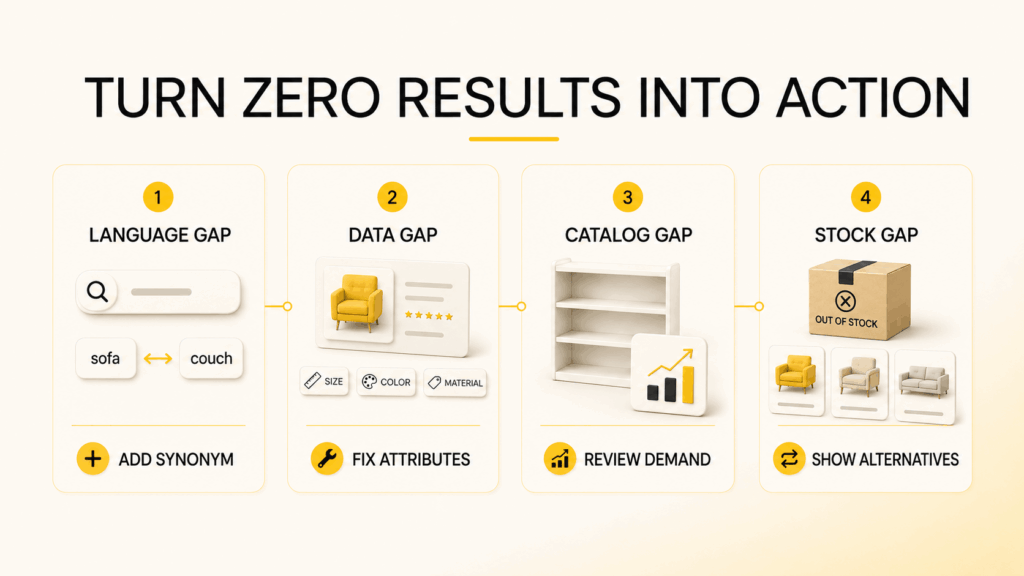
A zero-result page tells the shopper that the store has nothing relevant. Sometimes that’s true. Often the product exists under another name, a catalog attribute is missing or the search engine can’t interpret the query.
Search analytics should group failed and low-performing queries into practical categories:
- Language gap: a synonym, spelling variant or compound form isn’t recognized
- Catalog gap: shoppers want a product, size or feature the retailer doesn’t stock
- Data gap: the item exists, but a missing attribute prevents a match
- Availability gap: matching products are temporarily out of stock
- Experience gap: results appear, but shoppers don’t click or add anything
Don’t “fix” every zero-result query with a broad redirect. Sending a specific request to an unrelated category damages search relevance. Add synonyms when the meaning matches, improve product data when information is missing and use the query as purchasing insight when genuine demand isn’t covered.
Luigi’s Box describes ecommerce search as a loop of indexing, retrieval, ranking and feedback. That final step matters: clicks, purchases and exits reveal which results actually satisfy the query. Search data can influence catalog planning, content and merchandising rather than remaining a dashboard nobody reviews.
Product discovery software comparison
Product names, language capabilities and pricing models were checked in August 2026. Most enterprise vendors price each implementation around traffic, catalog size, modules and service levels.
| Tool | Best for | AI capability | Catalog fit | German-language handling | Pricing model |
| Algolia | Developer-led teams needing fast APIs and headless search | Hybrid keyword and NeuralSearch, AI ranking and personalization | Small stores through very large custom experiences | German decompounding with configurable language settings | Public usage-based plans plus enterprise contracts |
| Bloomreach Discovery | Enterprise retailers combining search and merchandising | Loomi semantic search, ranking, recommendations and conversational discovery | Mid-market and enterprise catalogs | German supported; multi-language semantic search splits compound words | Custom pricing based partly on catalog and usage |
| Klevu, now Athos Commerce | Commerce teams wanting search, merchandising and recommendations together | AI search, automated merchandising, recommendations and assistants | Mid-market and enterprise | Multilingual support; test German compounds and local vocabulary in the trial | Custom annual plans |
| Coveo | Complex enterprise, B2B and multi-brand experiences | Semantic vector search, machine-learning ranking and personalization | Large and highly complex catalogs | Semantic decompounding at index and query time | Custom enterprise pricing |
| Fast Simon | Shopify and platform-led mid-market brands | AI search, visual discovery, merchandising and shopping agents | Small-to-enterprise stores, strongest in Shopify ecosystems | Localized experiences through translation and Shopify Markets integrations | Plan-based and custom implementation pricing |
| Luigi’s Box | European retailers seeking fast deployment and strong analytics | NLP search, recommendations, personalization and shopping assistant | SMB through enterprise | German language processing includes compound-word handling | Quote based on store size and selected products |
| Doofinder | SMB and mid-market stores wanting simple setup | Semantic AI search, recommendations, visual search and assistant | Small and mid-size catalogs, with enterprise tier | German is one of five main interface languages; multilingual and multi-currency setup | Public tiers from around $39 per month, enterprise custom |
| Fredhopper, formerly Attraqt | International enterprise retailers wanting detailed curation | AI search, ranking, recommendations and intelligent merchandising | Large retail catalogs | Built for internationalization and regional merchandising; validate linguistic rules | Custom enterprise pricing |
Netcore Unbxd and Lucidworks are other enterprise options worth evaluating. The strongest shortlist depends on the existing ecommerce platform, available development resources and the amount of control merchandisers need. The wider DACH ecommerce platform landscape helps place discovery tools within the rest of the stack.
German-language search needs its own evaluation
An English-tuned engine can pass a generic demo and still struggle with a German catalog. The problem isn’t only translation. German combines nouns, uses inflection and allows several ways to express the same written form.
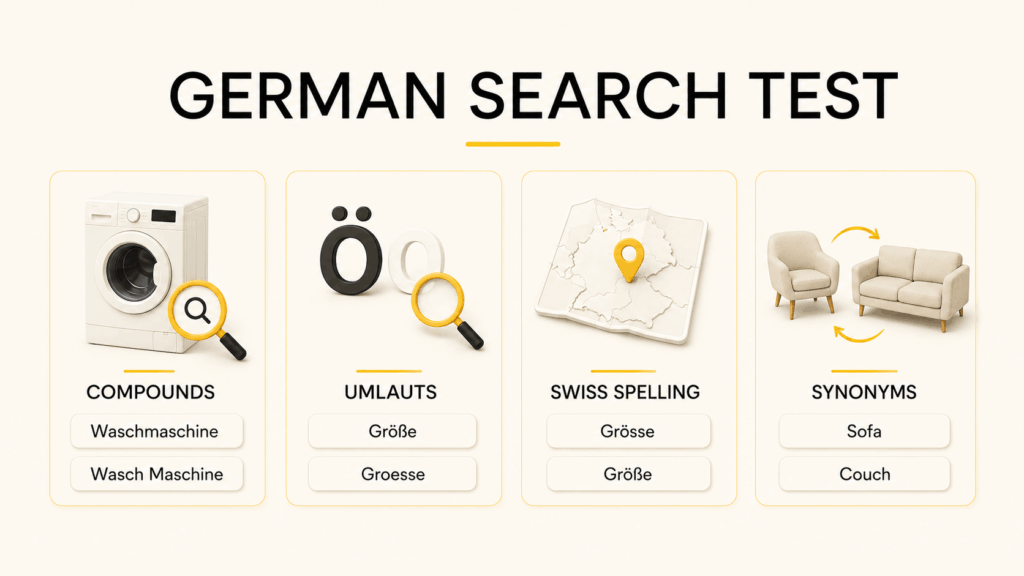
Compound nouns
A shopper may type Waschmaschine, while product data contains Wasch Maschine or a longer term such as Waschmaschinenreiniger. Decompounding should split meaningful parts without breaking brand names and unrelated terms. Algolia, Bloomreach and Coveo all document dedicated compound-word handling for German.
Umlauts and alternative spellings
The engine should connect Größe, Groesse and common keyboard variations. It also needs to treat composed and decomposed Unicode characters consistently. Test Möbel/moebel, Kühlschrank/kuehlschrank and catalog-specific terms instead of assuming typo tolerance covers them.
Germany, Austria and Switzerland
Swiss German usually uses ss instead of ß, so Grösse must reach the same products as Größe. Austrian vocabulary can differ from German usage, while retailers selling across the DACH market may keep separate prices and assortments for each country.
Search also has to work across categories and marketplace feeds. Merchants selling through online marketplaces in Germany may inherit different product titles from each channel. A normalized central catalog makes onsite discovery easier to manage.
How to choose and test a product discovery tool
Start with real query data rather than a scripted vendor demo. Export popular searches, zero-result searches and high-exit queries. Add a test set covering exact SKUs, broad category requests, misspellings, German compounds and mobile autocomplete.
Score each platform on the same outcomes:
- Relevant products in the first five positions
- Zero-result and low-click query rates
- Response speed under normal and peak traffic
- Control over boosts, pins and exclusions
- Quality of filters on category and search pages
- Support for German, Austrian and Swiss variants
- Analytics that connect queries with orders and revenue
- Integration effort for the catalog, storefront and consent setup
Run the test against an unchanged baseline when possible. Search conversion, revenue per search session and add-to-cart rate matter, but guard against easy wins that damage another metric. Aggressively promoting bestsellers may increase short-term clicks while making long-tail products harder to find.
Check how quickly the team can diagnose a bad result. A useful discovery tool lets a merchandiser inspect the query, see applied rules and correct the problem without waiting for a full release. Headless products offer more freedom, but that freedom brings frontend and analytics work.
Timing and inventory also shape relevance. A system that receives availability updates too slowly may recommend products that can’t ship. That matters for retailers competing on convenience, including German retailers offering same-day delivery.
Over to you
The best tools let shoppers express what they want in their own language. They combine precise retrieval with useful exploration and give ecommerce teams enough control to correct poor results.
DACH retailers should treat German-language relevance as a buying criterion, not a configuration task left until launch. Test compounds, umlauts and Swiss spellings against a real catalog. A platform that handles English well may still leave German shoppers staring at the wrong products or an empty page.
FAQ
What is product discovery software?
It helps ecommerce shoppers find suitable items through site search, autocomplete, filters, category ranking and recommendations. The system connects product data with customer behavior and merchandising rules across the shopping journey.
How is it different from a plain search bar?
A search bar is only the interface where a shopper enters a query. The discovery engine behind it indexes product data, interprets language, retrieves matches and ranks results. A broader platform also controls category pages, filters, personalization and recommendation blocks.
How can AI improve ecommerce product discovery?
AI can interpret natural-language requests, retrieve semantically similar products and adapt ranking using behavioral signals. It also powers recommendations and conversational assistants. AI still needs accurate catalog data and merchant controls, especially for exact SKUs, regulated products and local terminology.
How do zero-result searches hurt revenue?
They make available products appear unavailable and often end a high-intent shopping session. Review failed queries for synonyms, missing attributes, stock gaps and unmet demand. The correct fix may involve search configuration, product data or assortment planning.
How much does an ecommerce discovery platform cost?
Pricing ranges from low monthly plans for smaller stores to custom enterprise contracts. Vendors may charge for search requests, records, sessions, modules or implementation. Estimate cost using peak traffic and catalog growth, then include frontend work, analytics and ongoing merchandising time.
Which metrics show if ecommerce search works?
Track search usage, click-through rate, add-to-cart rate, conversion, revenue per search session and search exit rate. Monitor zero-result and low-click queries separately. Segment the results across language, country, device and customer type so one strong average doesn’t hide a weak local experience.