GEO takes over German e-commerce: What is it & what about SEO?
Discover how GEO is transforming the German e-commerce landscape and what it means for SEO strategies. Stay ahead in the digital marketplace with us.
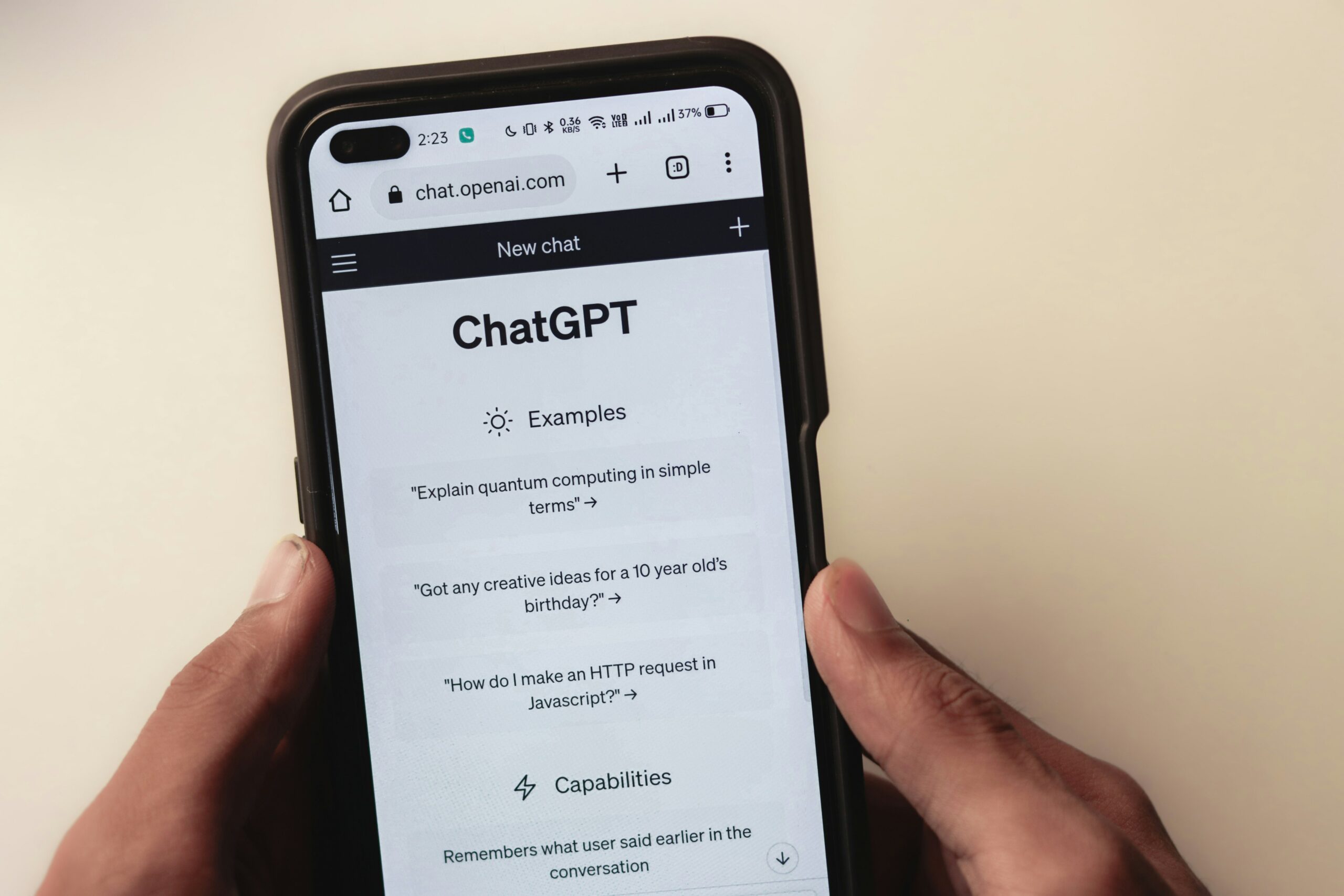
For the past decade, the rule was simple: if you want to be found online, optimise for Google. Understand how its algorithm works, earn the right backlinks, target the right keywords, and you earn your place on page one. Millions of German e-commerce businesses built their entire digital acquisition strategy on exactly this premise.
That premise is now being disrupted — not replaced overnight, but fundamentally complicated — by a shift that is moving faster than almost any previous change in digital marketing history. When a German consumer opens ChatGPT and asks “Was ist der beste Laufschuh für Überpronation unter 150 Euro?”, they are not receiving ten blue links. They are receiving a synthesised recommendation, backed by sources the model has been trained on and weighted by signals that have very little to do with traditional SEO.
Welcome to the era of Generative Engine Optimisation — GEO. And if you’re running or marketing an e-commerce business in DACH, it is already affecting your traffic.
What Is GEO — Generative Engine Optimisation?
Generative Engine Optimisation (GEO) is the practice of optimising your content, brand, and digital presence to appear in — or be cited by — AI-generated responses from large language model-powered search engines and assistants.
Where traditional SEO asks: how do I rank on page one of Google? — GEO asks: how do I get cited when ChatGPT, Perplexity, Google’s AI Overviews, Microsoft Copilot, or Gemini answer a question relevant to my product or brand?
The distinction matters because the mechanism is entirely different. Traditional search engines rank pages. Generative AI engines synthesise answers — drawing on the content they’ve indexed, the entities they recognise, and the authority signals they’ve learned to weight. A brand that ranks number one on Google may not appear in a single AI-generated answer about its own category. A brand with a smaller website but consistent, authoritative, citable content may appear in AI answers dozens of times per day.
This is not a future scenario. ChatGPT Shopping launched in Germany in 2025, enabling direct product recommendations within the chat interface. Google’s AI Overviews are now appearing on a significant share of German product-related queries. Perplexity has established a meaningful user base among younger German consumers. The shift from traditional search to AI-assisted discovery is already underway — and accelerating.
The Rise of AI Search in Germany
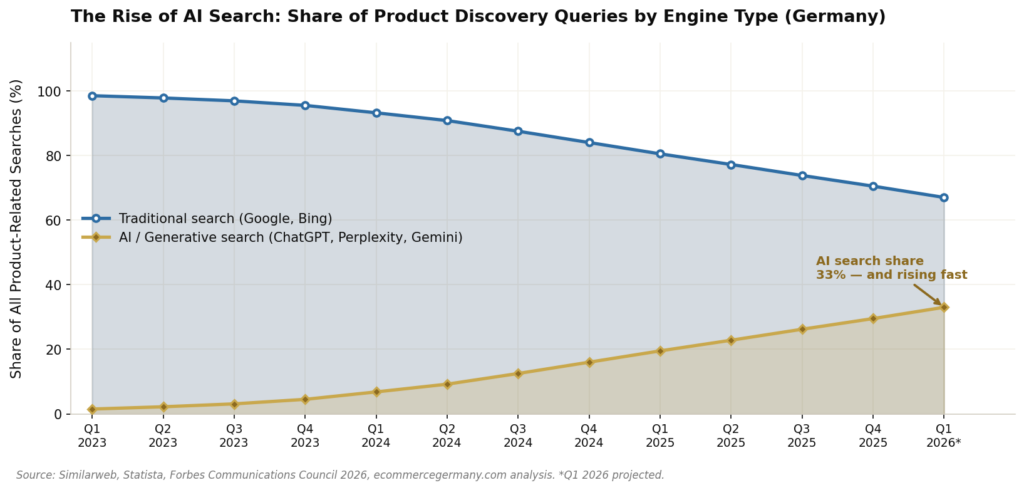
The trend line is unambiguous. AI-powered search engines are capturing an increasing share of product-related queries in Germany, growing from a marginal share in early 2023 to roughly a third of all product discovery queries by early 2026 — with no sign of the growth curve flattening.
Germany is, characteristically, a nuanced market for this shift. German consumers have well-documented concerns about AI — with 81% advocating for clear labelling of AI-generated content in advertising. Trust in AI recommendations is lower among older demographics and higher among 18–34 year olds, who are already using AI tools as a primary research layer before any purchase.
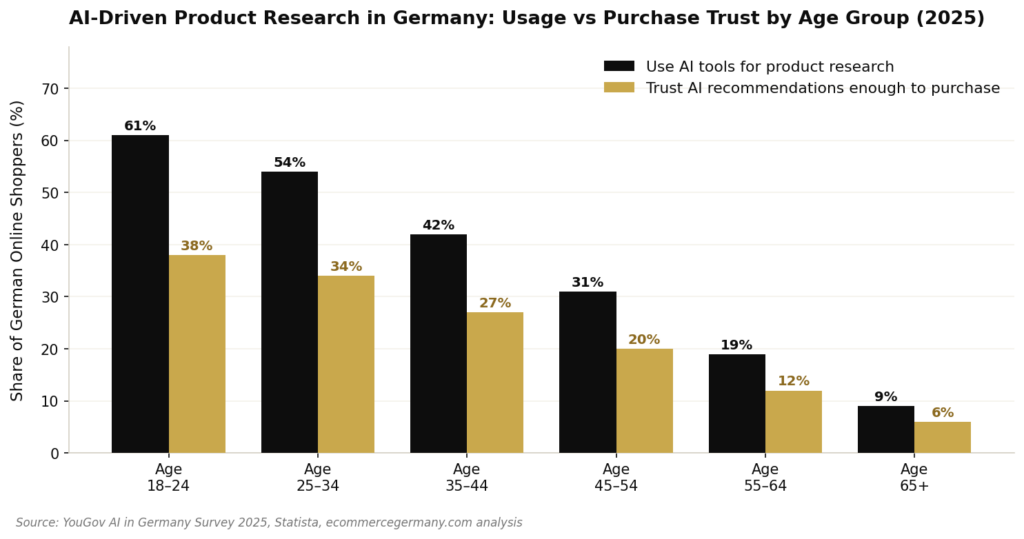
The generational gap here is significant. Among German shoppers aged 18–34, over half already use AI tools for product research — though the gap between usage and purchase trust (the “trust bridge”) remains the key commercial challenge. Closing that bridge — getting consumers to act on AI recommendations rather than just using them for initial research — is the central problem that both AI engine developers and brand optimisers are working on simultaneously.
For DACH e-commerce retailers, the practical implication is clear: if you are not present in AI-generated answers for your category, you are already invisible to a growing and commercially significant segment of German shoppers — and the share is growing quarterly. This connects directly to the agentic commerce shift that is beginning to reshape how products are discovered, compared, and purchased without direct human search behaviour.
SEO vs GEO: What Actually Changes?
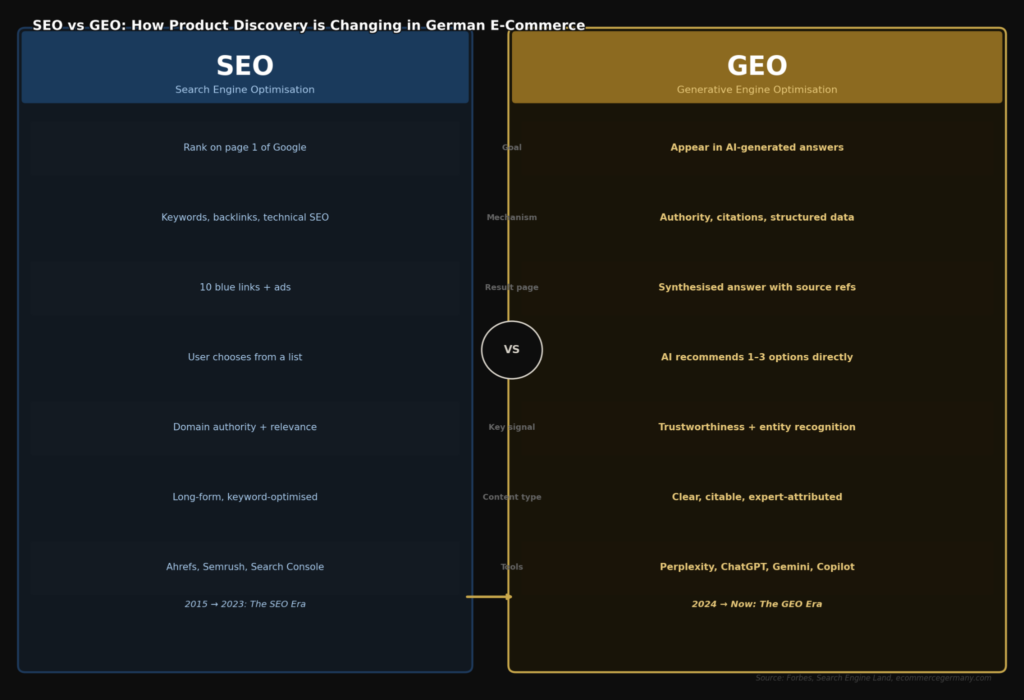
The comparison reveals both the continuity and the disruption. Several SEO fundamentals carry over directly — technical site health, page speed, Core Web Vitals, structured data, and local signals remain important in both paradigms. But the divergence in content strategy, authority signals, and measurement is substantial.
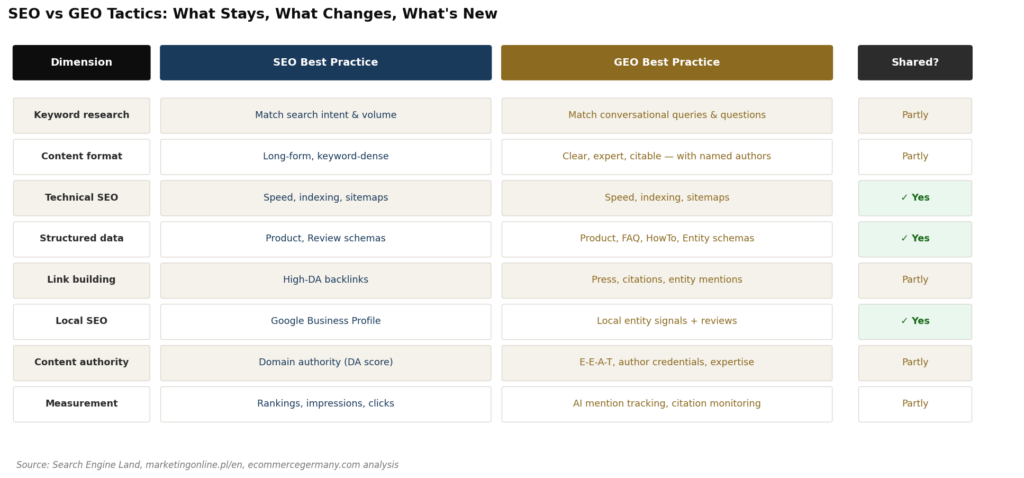
The most significant shifts are:
From keyword density to question-answer clarity. Traditional SEO rewards content that systematically covers a topic with the right keyword frequency and distribution. GEO rewards content that clearly, directly, and authoritatively answers the specific questions users ask conversational AI. The structure is different: not a 2,000-word keyword-optimised article, but a page that answers “What is the best X for Y in Germany?” in a single, citable, unambiguous paragraph — alongside the supporting evidence that makes that answer trustworthy.
From domain authority to entity authority. Search engines measure authority through link equity — the quantity and quality of backlinks pointing at your domain. AI engines weight entity recognition — whether your brand, products, and expertise are clearly defined, consistently described, and widely referenced across the web. A brand that appears consistently in third-party reviews, press coverage, comparison sites, and industry databases is more likely to be cited by AI engines than a brand with a high DA score but weak entity presence.
From traffic measurement to citation monitoring. Traditional SEO is measured through rankings, impressions, and clicks. GEO is measured through how often your brand or content is cited in AI-generated responses — a metric that most analytics tools do not yet track natively. New tools like Perplexity’s Brand Monitoring, and emerging GEO measurement platforms, are beginning to fill this gap.
GEO Tactics: What Signals AI Engines Weight
Understanding what AI engines use to decide which sources to cite is the foundation of any GEO strategy. The signals fall into three categories:
Trustworthiness signals → AI engines are explicitly trained to avoid citing untrustworthy sources. For e-commerce brands, this means that customer review density and recency, press coverage, regulatory compliance markers (Impressum, Datenschutzerklärung in correct German), and third-party certifications all carry weight. The e-commerce trust-building fundamentals that matter for German consumers also happen to be the signals that AI engines weight for citation decisions.
Content clarity and citatibility → AI engines prefer content that makes discrete, specific, citable claims. A product description that says “our hiking boots are comfortable” is not citable. A product description that says “independently tested for 800km of trail use, rated 4.8/5 by 1,247 verified buyers” is. Specificity, attribution, and measurability are the content qualities that AI engines can work with.
Entity consistency → If your brand is described differently across your website, your Google Business Profile, your Trustpilot listing, your Amazon seller page, and your social profiles, AI engines face disambiguation problems that reduce citation likelihood. Consistent brand name, product names, category descriptions, and business information across all indexed properties is essential.
For a deeper look at how AI is already reshaping product discovery, see our overview of AI search as the next frontier for e-commerce SEO and our broader analysis of how generative AI elevates e-commerce operations. For Shopify merchants, storerank.ai focuses on that practical GEO layer: improving structured product data, product content, FAQs, and tracking whether the store appears in AI-generated shopping recommendations.
The GEO Optimisation Checklist
Must Have → the non-negotiable foundation:
- Structured Data (Schema.org) is the single highest-leverage GEO investment available to most e-commerce retailers right now. Product schema, Review schema, FAQ schema, and BreadcrumbList schema give AI engines machine-readable, unambiguous information about what you sell, what others think of it, and how your site is structured. Most German e-commerce platforms — Shopware, Shopify, and others — support structured data natively or via plugins. Validate your current implementation at schema.org/validator before anything else.
- Entity Optimisation means ensuring your brand and products are clearly defined entities in Google’s Knowledge Graph and, by extension, in the training data and retrieval systems of major AI engines. Claim your Google Knowledge Panel. Maintain a consistent Wikipedia or Wikidata presence if your brand is large enough to merit one. Ensure all indexed descriptions of your brand align with a single, clear positioning statement.
- Authoritative Content with Named Authors is increasingly important as AI engines apply E-E-A-T (Experience, Expertise, Authoritativeness, Trust) signals to citation decisions. Anonymous content, even technically excellent content, is weighted lower than content attributed to identifiable human experts with verifiable credentials.
High Value → the amplification layer:
- Conversational keyword coverage requires a rethink of how you approach content planning. Where traditional keyword research starts with search volume, GEO content planning starts with the questions your customers ask AI tools. Map those questions — “Welcher Laufschuh für Überpronation?”, “Gibt es günstige Alternativen zu X in Deutschland?” — and build dedicated answer pages around them. See how product discovery best practices for 2025 align with this approach.
- Clearweb citations and PR — every credible publication, trade site, or comparison platform that references your brand with a link or mention increases your entity authority. For German e-commerce brands, this means actively pursuing coverage on Handelskraft, t3n, Internet World Business, and category-specific trade publications — not just for SEO link equity, but for AI citation probability. Our guide on getting your brand published on media outlets is directly applicable here.
Quick Wins → the fast-implementation tier:
- FAQ and Q&A pages in proper German are among the highest-ROI GEO investments for retailers without large content teams. A well-structured FAQ page — one question, one clear direct answer, no filler — gives AI engines exactly the format they need to generate cited answers. Build FAQ pages around your top 20 customer service questions and your top 10 product comparison queries.
- German-language content depth matters disproportionately. Most AI engines weight content in the language of the query. Thin German-language pages supplemented by deep English-language content underperform compared to genuine German-language expertise. Localisation that goes beyond translation — adapting examples, references, and context to the German market — signals authentic local expertise.
What German E-Commerce Retailers Need to Do Now
The practical action list for a DACH e-commerce retailer starting their GEO journey in 2025–2026:
- Audit your structured data immediately. Use Google’s Rich Results Test and schema.org/validator to identify gaps. Prioritise Product, Review, and FAQ schemas on your highest-traffic pages. This is the single fastest route to improved AI visibility.
- Create a brand entity profile. Document your brand’s canonical name, product names, category positioning, founding story, and key differentiators in a single reference document. Use this as the source of truth for all indexed content — product descriptions, social bios, press releases, directory listings. Entity consistency is a prerequisite for entity authority.
- Build a question-answer content layer. Identify the top 20–30 questions German shoppers ask about your category. Build dedicated, clearly structured pages that answer each one in German. Keep answers concise, specific, and attributed. These pages will feed both AI citation systems and Google’s own featured snippets.
- Start monitoring AI mentions. Set up alerts for your brand name in Perplexity, ChatGPT, and Google AI Overviews. Record which queries surface your brand, which surface competitors, and what content is being cited when your brand does appear. This forms the baseline for ongoing GEO measurement.
- Don’t abandon SEO — integrate it. The shared foundations between SEO and GEO are significant. A technically sound, fast, well-structured, and content-rich website performs well in both paradigms. The e-commerce trends for 2025 consistently place search diversification — covering both traditional and AI-powered discovery — as a top operational priority.
The German Market Specifics: Privacy, Language, and Trust
GEO in Germany comes with three market-specific complications that are worth addressing directly.
Privacy and AI scepticism.
German consumers are more likely than their European peers to question whether AI-generated recommendations can be trusted — a concern reinforced by strong public advocacy for AI transparency. For retailers, this means that GEO visibility alone is not sufficient — the content being cited must itself signal trustworthiness to the German consumer who clicks through from an AI answer. Clear Impressum, Datenschutzerklärung, verified reviews, and transparent return policies are not just SEO signals — they are the trust architecture that converts an AI-referred visitor into a buyer.
German-language AI performance gaps.
Most major AI engines were primarily trained on English-language data. German-language query handling, especially for specific product categories and regional queries (Austria, Switzerland, regional German dialects), is less accurate and less well-resourced than English. This creates both a challenge (AI answers for German queries are sometimes lower quality) and an opportunity (brands that invest in high-quality German-language content have less competition for AI citation share in DE than they would in EN).
GDPR and data collection limitations.
The regulatory landscape governing German e-commerce has implications for how AI-driven personalisation and GEO tracking can be implemented. Monitoring AI citations of your brand raises no GDPR concerns — it’s your own brand you’re tracking. But collecting user data to understand how customers arrive from AI searches requires the same consent architecture as any other behavioural tracking. Build your GEO analytics within your existing GDPR-compliant framework.
Is SEO Dead? The Honest Answer
No.
But it is no longer sufficient on its own — and for a growing segment of German online shoppers, it is no longer the primary channel for product discovery.
The most accurate framing is that we are moving from a single-channel search world (Google) to a multi-engine discovery world — where traditional search, AI-generated answers, marketplace search, social discovery, and voice interfaces all contribute to the path to purchase. The future of e-commerce in Germany is a multi-discovery landscape, and GEO is simply the newest and fastest-growing layer within it.
The good news for DACH retailers who have invested in quality SEO: the foundations transfer. A technically sound site, a strong review profile, consistent structured data, and genuine content expertise are the inputs that both Google and generative AI engines reward. You are not starting from zero. You are adding a new optimisation layer on top of infrastructure that already serves you.
The bad news for retailers who have relied on thin, keyword-stuffed content, bought links, or low-quality product descriptions: the margin for this kind of optimisation is narrowing in both SEO and GEO simultaneously. AI engines are, if anything, even less tolerant of content that exists to game algorithms rather than to genuinely serve readers.
The discipline that GEO demands — clear, authoritative, human-attributed, specifically useful content — is the same discipline that produces excellent e-commerce experiences for the human shoppers who read it. In a market as discerning as Germany’s, that alignment is not a coincidence. It’s the point.