The State of E-Commerce in Central Europe: Diverse Markets, One Direction
Where is Central European e-commerce heading next? Explore key market trends, cross-border dynamics, marketplace growth and the rise of agentic commerce, based on insights from ECDB. (Ad)
By Nadine Koutsou-Wehling, Data Journalist
Central European e-commerce is as diverse as its markets, but a common trend is the increasingly important role of e-commerce in the everyday life of its consumers. For some, the online shopping habit is already at a high level, for others it is getting there.
The future of Central European e-commerce means higher overall revenues. It also means closer interaction between markets, a growing role for marketplaces, and the rise of agentic commerce.
This article examines the state of e-commerce in Central Europe in 2026 and beyond. It is based on the report of the same name, produced in cooperation between ECDB and Mastercard.
Germany Is Central Europe’s Most Significant Revenue Contributor
Central Europe generates €206.5 billion in total e-commerce revenues. A large share of that is concentrated in one market: Germany. The remaining markets follow at a considerable distance. Below is a breakdown of the forces shaping that distribution.
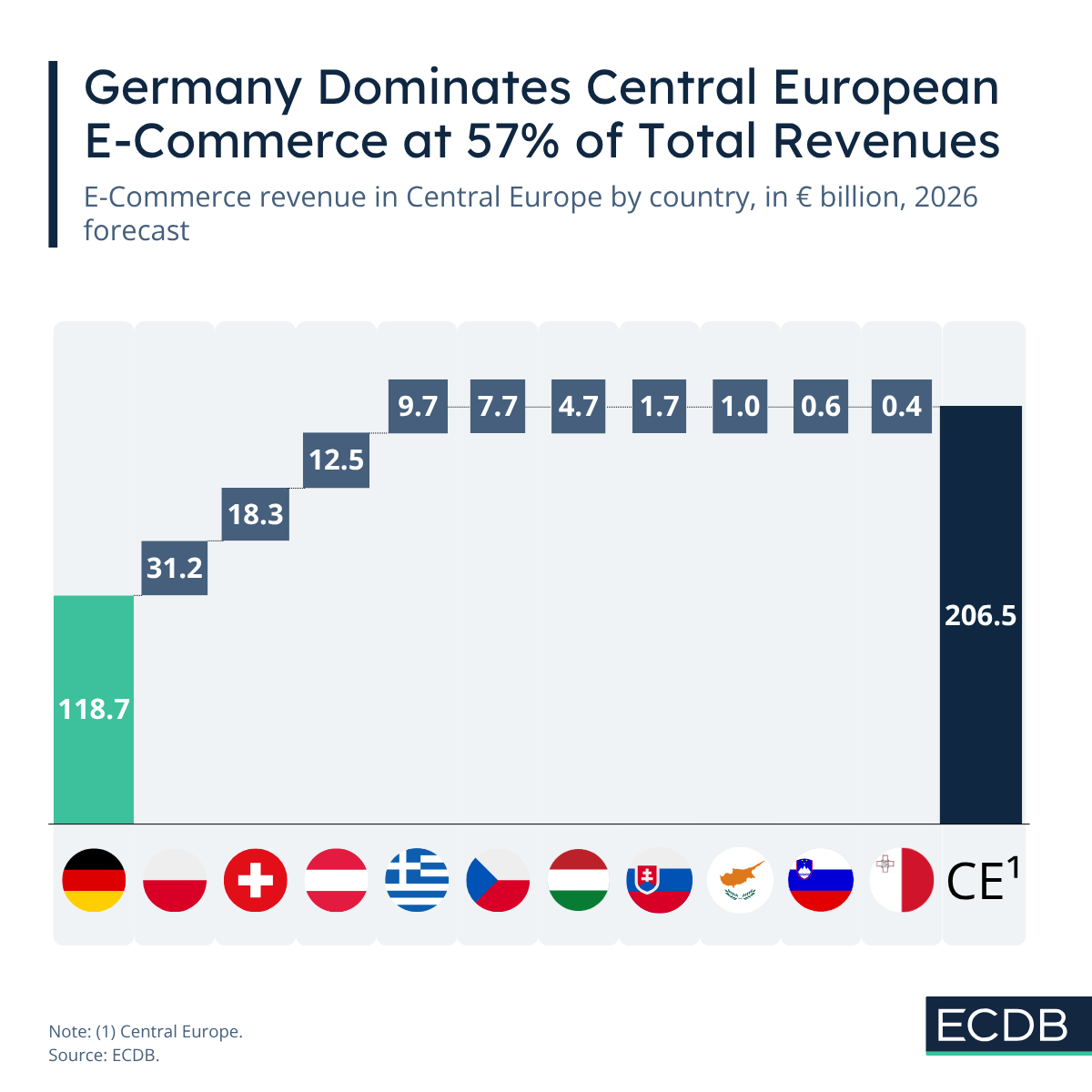
With forecast figures of €118.7 billion in 2026, Germany accounts for more than 57% of Central European e-commerce revenues. No other market comes close.
Germany is the launchpad for some of the most ambitious cross-border retailers operating in Europe today: Otto, Zalando, About You, Kaufland, MediaMarkt. These platforms have expanded far beyond their home market, and their trajectories often set the direction for e-commerce development across the broader region.
Behind Germany, three markets still operate at scale. Poland, with forecast 2026 revenues of €31.2 billion, holds structural significance beyond its regional rank. Its market size supports a domestic platform ecosystem and positions it as a credible expansion target for retailers moving east.
Switzerland and Austria round out this group at €18.3 billion and €12.5 billion respectively. The DACH cluster they form with Germany creates geographic and commercial proximity that continues to attract cross-border volume, making it one of the more coherent sub-regional groups in European e-commerce.
Most of the smaller markets become more important in a next view, examining cross-border shares in e-commerce.
Cross-Border Shares Depend on Domestic Strength and Proximity to Larger Hubs
Austria sits at the top of the ten markets tracked, with 44% of its online spending expected to go to cross-border shops in 2026. Cyprus and Greece follow closely behind at 38% each, meaning shoppers in all three countries will send close to two out of every five e-commerce euros outside their own borders.
Hungary is not far behind at 34%. Switzerland rounds out this more import-reliant group at 23%, a figure worth noting given that Switzerland sits outside the EU entirely and still shows meaningful cross-border dependence. Slovenia and the Czech Republic both land at 19%, with Slovakia slightly lower at 14%.

Malta’s position is the clearest sign that market size alone does not explain cross-border behavior. A small population with limited local retail options might be expected to rely heavily on foreign shops, yet Malta shops almost entirely at home.
Austria shows the opposite pattern. It is a considerably larger and wealthier economy, yet nearly half of its online spending crosses a border. What seems to matter more is proximity to larger retail hubs and how strong domestic platforms are at keeping shoppers close to home.
Proximity and language explain a large part of Austria’s number. Austrian shoppers share a language and, for the most part, a retail culture with Germany, Europe’s largest e-commerce market. That makes crossing into German storefronts close to frictionless, both linguistically and logistically.
Cyprus and Greece point to a different driver: peripheral geography paired with a smaller domestic retail sector. Both are relatively isolated within the EU and have fewer large scale local platforms able to match the range and pricing of retailers based in bigger markets. Where domestic retail cannot cover demand, shoppers fill the gap from abroad, and the EU’s single market removes most of the practical friction in doing so.
Increasingly, a large portion of these revenues flows through one business model in particular: Third-party marketplaces.
The Marketplace Shift Has Reached Central Europe
Marketplaces include benefits for all parties involved. For sellers, the platforms ensure they can reach a wider audience for their merchandise. Marketplace providers can offer more products at minimal held inventory and take fees for placement, while consumers get all merchandise they look for in one place.

But as with the development of increasing concentration of a few large players, these same names contribute to the dominion of marketplaces in global – and Central European – e-commerce. Amazon, eBay and AliExpress all rank among the top online retailers in the region, alongside homegrown platforms like Allegro or Zalando.
Compared to Asia or the world average, Central European revenue splits are significantly behind the trend. Globally, 83.4% of revenues come from marketplaces and in Asia that share is even higher, at 97.0%. It is therefore no coincidence that as cross-border champions are taking hold, the entire structure of e-commerce skews towards world standards.
The gap has structural roots. Much of Asia’s e-commerce grew up inside marketplace ecosystems from the start. Platforms like Alibaba’s Taobao and Tmall, JD.com and Pinduoduo built the shopping habit itself, so a standalone brand website was never the default starting point for most sellers or shoppers in the region. Central Europe took a different path: retailers and brands built direct online stores early, and consumer habits followed.
As it looks now, most of these consumer habits are undergoing a significant shift. Namely, agentic commerce is just around the corner. But its current adoption in the majority of markets shows it is still years until it arrives in the mainstream.
Central Europe’s Early Majority Is in the Research Phase of Agentic Adoption
The expectation is that a fully autonomous agent will predict needs and carry out purchases with only minimal supervision. Where does Central Europe stand when it comes to agentic commerce?
We mapped out six stages of agentic development and clustered Central European markets into groups:

- Ground Zero: No meaningful agentic commerce activity in the market
- Research: Agents search, compare, and recommend products
- Find: Agents locate and match specific products to shopper criteria
- Buy: Agents complete purchases on a shopper’s behalf
- Advanced Buy: Agents manage recurring purchases and replenishment
- Full Autonomy: Agents operate independently across the full purchase journey
Most Central European markets sit at the Research stage. AI agents can search, compare, and recommend products. Their ability to complete purchases is still limited.
The real transformation begins at the later stages. There, agents move beyond recommendations. They buy products, manage recurring purchases, and handle replenishment with only limited human intervention.
That reality is still years ahead. Today’s innovators sit somewhere in the middle. For early adopters, the agent can already add products to the cart, check availability, and compare prices. Innovators go one step further. Here, the agent can complete the payment and checkout process automatically.
The two last stages of development is what today’s players are building towards and what mainstream adoption will look like once all markets have caught up. This shift is already underway. How do consumers view AI assistants?
Most Consumers Are Neutral to Ambiguous Towards AI Shopping Assistants
AI assistants are a buzzword of the moment, but consumer attitudes in Central Europe do not really reflect the hype. In fact, most consumers (56%) are neutral to ambiguous towards an AI agent that can suggest products available online based on the conversation.

Adoption depends on trust, transparency, and consumer control. This differs widely across categories. Consumers report higher willingness to use AI agents in clothing, electronics, and groceries. Categories that require research, comparison, and information processing can become more accessible through AI agents, which help consumers evaluate alternatives and feel more confident in their choice.
This category pattern lines up with what agents already do well. Comparing spec sheets, prices, and reviews suits automation, and consumers appear to recognize that. Research and comparison heavy categories are exactly where willingness runs highest. This runs similar to the average market adoption in Central Europe, where the research phase is the most commonly entered phase right now. Consumer willingness to adopt and market realities therefore seem deeply intertwined.
The picture shifts for higher stakes or more personal purchases. Global research backs this up too. Handing over a full purchase decision on a large or personal item asks for a different level of comfort, one that takes longer to build.
This trust gap connects directly to why adoption in Central Europe stalls before the Buy stage. Research, where an agent only searches, compares, and recommends, asks little of the consumer beyond curiosity. Buy, where an agent completes payment and checkout on its own, asks for something much bigger: letting go of the final check-in.
Central Europe’s wide majority sitting at the Research stage explains much of the comfort seen in the data. Most consumers have only interacted with agents that search, compare, and recommend. That is the extent of what most markets currently offer, and it is also the stage where trust runs highest. Comfort has grown alongside exposure, not ahead of it.
The State of Central Europe: Between Maturity and Development Potential
E-Commerce in Central Europe is shaped by different markets and shopping mentalities coming together. Germany stands out as the number one market for e-commerce revenues in Central Europe, benefiting neighboring countries, particularly those in the DACH region.
At the same time, cross-border becomes more important and is reflected in high shares in countries where the domestic market does not fully capture consumer demand for online products. This includes primarily Austria, Greece, and Cyprus.
Marketplaces account for a majority of e-commerce sales in Central Europe, which mirrors a global shift. By 2025, 60% of Central European e-commerce revenues flow through marketplaces, tendency expected to grow.
Ultimately, the shift goes hand in hand with a propensity to automate, although much of the deepest integration of AI agents is still years ahead. Consumer willingness to adopt is still in the middle range, with many being neutral towards the development.
Taken together, these factors point to a market in the middle of its entry point into a future of e-commerce that will be driven by internationalization, automation, and platform-based solutions.