GPSR explained: guide for ecommerce sellers [2026]

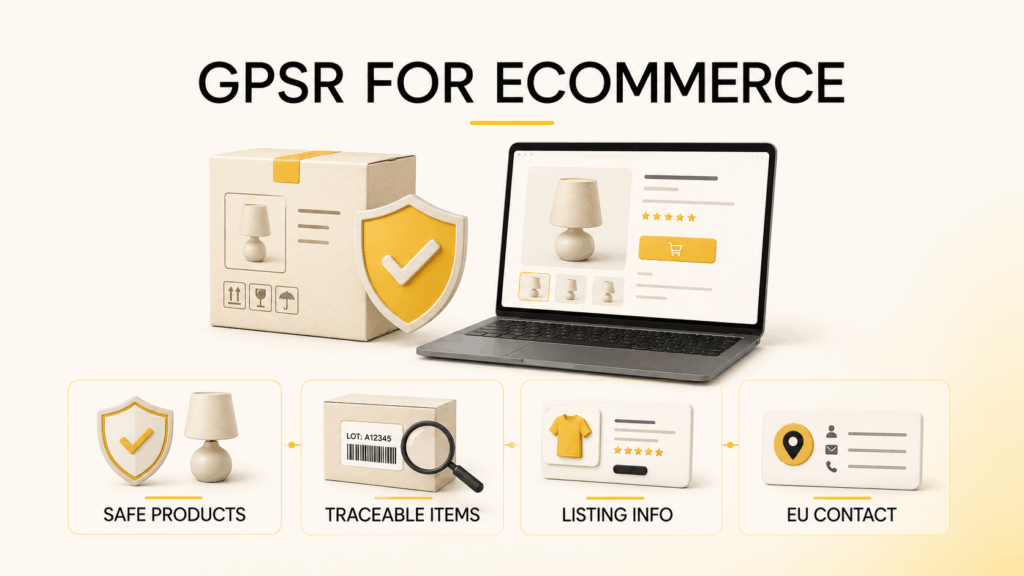
The EU’s General Product Safety Regulation changed what online sellers must show, document and monitor for consumer products. Since 13 December 2024, product safety information can’t sit only in a supplier folder. It has to follow the item through its packaging, online listing and post-sale process.
The rules matter to EU businesses and overseas merchants targeting customers in Germany or another EU country. Marketplaces also collect more structured product safety data and may restrict listings that lack it.
What is GPSR?
GPSR stands for General Product Safety Regulation. Its full legal name is Regulation (EU) 2023/988. It establishes a general safety framework for consumer products placed or made available on the EU market.
The regulation entered into force in June 2023 and has applied since 13 December 2024. It replaced the General Product Safety Directive, or GPSD, and parts of the older framework built around Directive 2001/95/EC.
Unlike a directive, an EU regulation applies directly across member states. National authorities still supervise the market and set penalties under domestic law, but the core obligations come from one EU text.
GPSR acts as a safety net. Product-specific legislation still comes first for risks it already regulates. A toy, electrical product or cosmetic may sit under separate EU rules, yet GPSR provisions can still apply where the sector law doesn’t cover the same matter. Online marketplace duties, recalls and consumer remedies are important examples.
What changed from the old GPSD?
The older directive predated much of today’s marketplace trade and direct-to-consumer importing. GPSR responds to online sales, connected products and supply chains where a seller, platform, manufacturer and fulfillment provider may all operate in different countries.
The main changes include:
- clearer duties for manufacturers, importers and distributors
- a required EU-based responsible economic operator for covered products
- technical documentation supported with an internal risk analysis
- specific safety information on online product offers
- direct consumer notification and standardized recall notices
- formal obligations for online marketplaces
- accident reporting through the Safety Business Gateway
The regulation also takes software updates, cybersecurity and evolving product functionality into account when those elements can affect physical safety.
Which products are covered?
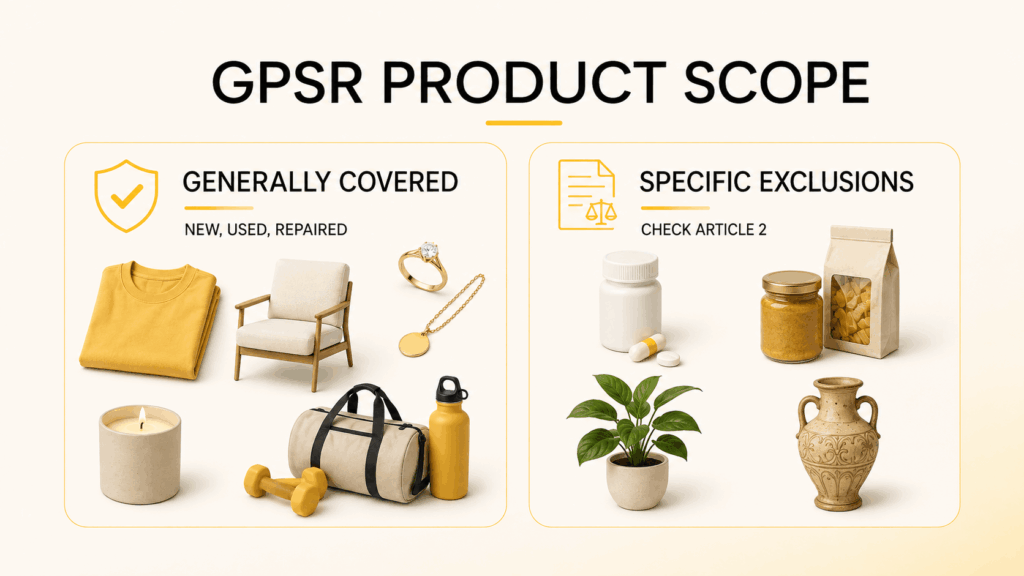
GPSR generally covers consumer products sold in the EU when no product-specific EU rule addresses the same safety risk. It applies to new, used, repaired and reconditioned goods offered through commercial activity.
Typical ecommerce examples include furniture, clothing, jewelry, candles, stationery, sports accessories, household goods and many handmade products. A handmade item doesn’t receive a general microbusiness or craft exemption. The maker may count as the manufacturer and carry the related duties.
Article 2 lists several exclusions:
- medicinal products for human or veterinary use
- food and feed
- living plants and animals
- animal by-products and plant protection products
- specified aircraft and transport equipment operated directly by a service provider
- antiques
- products clearly sold for repair or reconditioning before use
Second-hand goods need careful classification. Used products are generally covered when they re-enter a commercial supply chain. Genuine antiques are excluded, while an ordinary vintage-style item isn’t automatically an antique in the legal sense.
Pure digital content isn’t normally treated as a consumer product under GPSR. A connected physical item, however, may need its software and cybersecurity-related safety risks assessed throughout its expected lifetime.
Who has to comply?
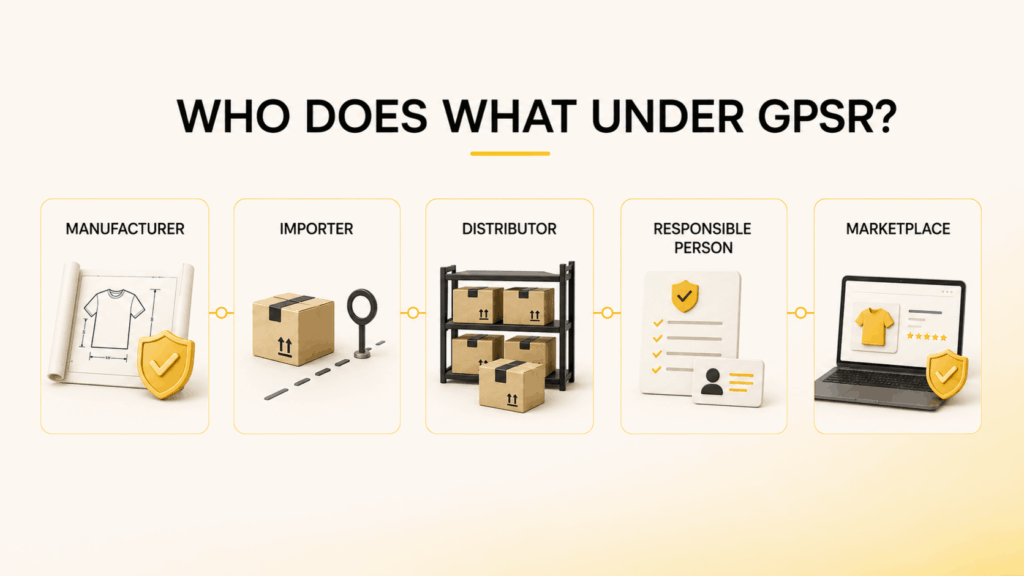
The exact duty depends on each company’s role in the supply chain.
| Role | Main GPSR responsibilities |
| Manufacturer | Design a safe product, complete the risk analysis, maintain technical documentation, label the product and run post-market safety processes |
| Importer | Verify the manufacturer’s work, add importer details where required, retain access to documentation and respond to safety concerns |
| Distributor | Check required markings and information, preserve safety during storage and transport and stop supplying products that appear unsafe |
| Authorized representative | Perform tasks set out in a written mandate and may act as the EU responsible person |
| Fulfillment service provider | May become the responsible economic operator when no EU manufacturer, importer or authorized representative is available |
| Online marketplace | Provide listing fields, register contact points, process product safety notices and cooperate with authorities |
A seller can hold more than one role. A German retailer buying finished stock from an EU wholesaler may be a distributor. The same retailer importing private-label products from China can become the importer and may also be treated as the manufacturer if it sells the goods under its own name or trademark.
Substantial product modifications matter too. A business that changes an item in a way that affects safety may take on manufacturer obligations for the modified product.
The EU Responsible Person requirement
Article 16 says a covered product can’t be placed on the EU market without an economic operator established in the Union. The role is often called the EU Responsible Person, although the legal test focuses on the economic operator responsible for specified tasks.
Depending on the supply chain, that operator can be:
- an EU-based manufacturer
- an EU importer
- an authorized representative appointed in writing
- a fulfillment service provider established in the EU when the other options aren’t present
The responsible person isn’t a mailbox added to a listing. They must be able to check compliance information, cooperate with market surveillance authorities and provide documentation when requested. Their name, postal address and electronic address must appear on the product, packaging, parcel or accompanying document. For distance sales, the details also belong in the product offer when the manufacturer is outside the EU.
UK and US sellers targeting EU consumers may therefore need an EU-based operator before placing covered products on the market. A UK address alone doesn’t satisfy the EU establishment requirement. Northern Ireland has a separate post-Brexit context, so merchants selling there should check marketplace and UK guidance alongside EU rules.
Technical documentation and risk assessment
Manufacturers must complete an internal risk analysis before placing a product on the market. The accompanying technical documentation needs at least a general description of the product and the characteristics relevant to its safety.
Where the risks justify more detail, the file should include identified hazards, mitigation measures, test reports and the standards or other safety references applied. Documentation has to reflect the actual item, not a generic category that ignores materials, intended users or foreseeable misuse.
The manufacturer must keep the technical documentation updated and available to market surveillance authorities for ten years after placing the product on the market. Importers must also keep access to the relevant documentation for ten years.
A practical product file may contain:
- product description, SKU, model, batch or serial identification
- materials, components and intended use
- target user and foreseeable misuse
- hazard analysis and chosen risk controls
- test reports, standards and supplier declarations
- instructions, warnings and label artwork
- manufacturer, importer and responsible-person details
- complaint, incident and corrective-action records
Not every low-risk product needs the same depth of testing. GPSR uses a proportionate framework, but a short document still needs a reasoned safety assessment. A seller shouldn’t mistake “simple product” for “no documentation.”
Labeling and traceability requirements
Products need a type, batch, serial number or another element that allows identification. The identifier should be visible and legible on the item. When the product’s size or nature makes that impossible, the information can move to the packaging or an accompanying document.
The manufacturer’s registered name or trademark, postal address and electronic address must also be present. An importer adds its own details under the importer provisions. If a separate EU responsible person is needed, their information must accompany the item as described above.
Instructions and safety information must be clear and understandable in the member state where the product is sold. A German product page and shipment may therefore need German warnings. Selling the same item in Austria may use the same language in many cases, but national requirements still need checking. French, Polish or Italian sales create separate language work.
Digital access can supplement physical information, but Article 21 doesn’t generally turn a QR code into a replacement for mandatory markings. Packaging, product and accompanying-document rules still apply.
Product safety labeling also sits beside other obligations. Symbols for packaging or waste streams serve a different purpose, as explained in our guide to mandatory recycling symbols in the EU.
What must appear on an online product listing?
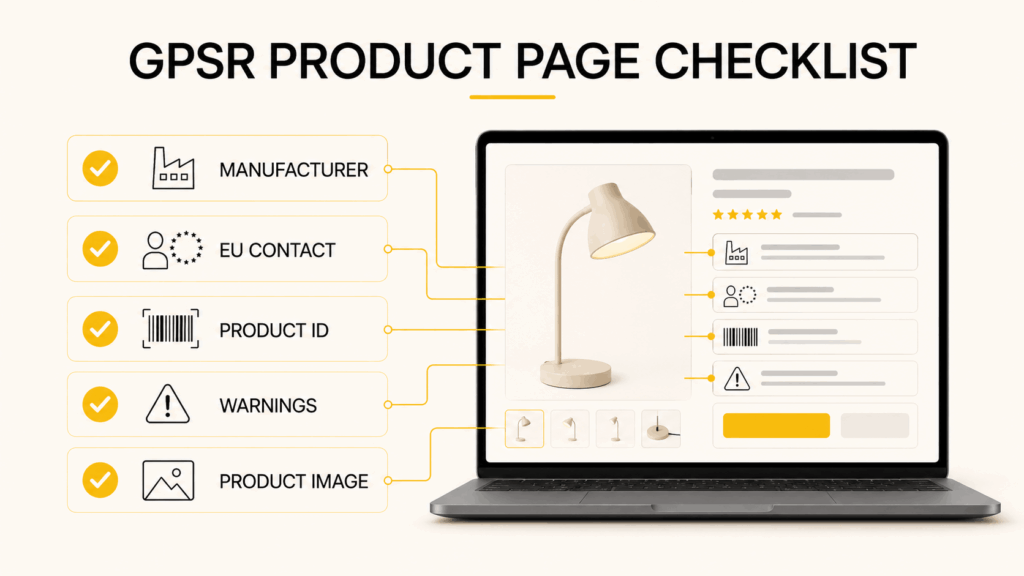
Article 19 contains one of the most important changes for ecommerce. Before purchase, an online offer must clearly and visibly provide:
- The manufacturer’s name, registered trade name or trademark.
- The manufacturer’s postal and electronic address.
- The EU Responsible Person’s name, postal address and electronic address when the manufacturer isn’t established in the Union.
- Information that identifies the product, including a picture, product type and another identifier.
- Required warnings or safety information in a language consumers in the destination country can easily understand.
A footer link to a general safety page won’t necessarily give the product-level information Article 19 expects. Each listing should map to the correct manufacturer, responsible operator, identifier and warnings.
The same principle applies across a merchant’s own store and marketplace channels. Anyone selling on online marketplaces in Germany needs a product information workflow that can feed multiple templates without losing local-language warnings.
How Amazon, eBay, Etsy and German marketplaces handle GPSR
Marketplaces must design interfaces that let traders submit the required product information. Sellers remain responsible for accurate data and safe products.
| Marketplace | Practical seller action |
| Amazon | Submit manufacturer and responsible-person data plus warning and safety information through product compliance fields; label the physical product or packaging consistently |
| eBay | Add manufacturer, responsible-person and product safety disclosures; non-compliant offers may lose visibility to EU buyers |
| Etsy | Determine trader status, add the economic operator and listing information and retain product safety documentation for handmade goods |
| Kaufland Global Marketplace | Complete GPSR attributes for affected non-food products and align offer data with labels and documentation |
| OTTO Market | Prepare the same Article 19 data and follow OTTO’s current category and partner-portal requirements |
Amazon’s GPSR guidance states that responsible-person details must be supplied and placed on the product, packaging, parcel or accompanying document. eBay warns that listings may not be visible to EU and Northern Ireland buyers when required information is missing. Etsy’s seller guidance confirms that handmade products can require an EEA-based economic operator.
Kaufland’s German seller materials also maintain a dedicated GPSR section. OTTO sellers should use the current partner portal rather than copying fields from another marketplace, as category-level implementation can change.
For broader marketplace context, see our overview of Amazon in Germany and our assessment of TikTok Shop safety and buyer protection.
Recalls, accidents and Safety Gate
When a manufacturer believes a product is dangerous, it must take corrective action, inform consumers and notify authorities through the Safety Business Gateway. Serious product-related accidents also require notification without undue delay.
Safety Gate is the public-facing rapid alert system for dangerous non-food products. Marketplaces register product-safety contact points and cooperate with orders or notices from authorities.
Affected consumers who can be identified must receive direct notice without undue delay. A written recall notice must clearly identify the product, describe the hazard without minimizing it and explain what the consumer should do. The operator generally has to offer at least two remedies from repair, replacement and refund, subject to the conditions in Article 37.
These processes need customer records, batch-level traceability and clear ownership. A merchant discovering a safety issue shouldn’t spend the first day working out which team holds supplier data or who can pause listings.
Enforcement and penalties
Market surveillance authorities can investigate products, request documentation, order corrective measures and require withdrawals or recalls. In serious cases, authorities may pursue the removal of online offers or restrictions on sites selling dangerous goods.
There is no single EU-wide GPSR fine that applies identically in every country. Article 44 requires member states to create effective, proportionate and dissuasive penalties under national law. Commercial consequences may arrive sooner through listing suppression, account restrictions, stock blocks, recalls and customer claims.
Product safety duties also interact with Germany’s wider online trading rules. Our Telemediengesetz guide provides historical context, although businesses should check the current German framework relevant to their service and legal role.
A practical GPSR compliance checklist
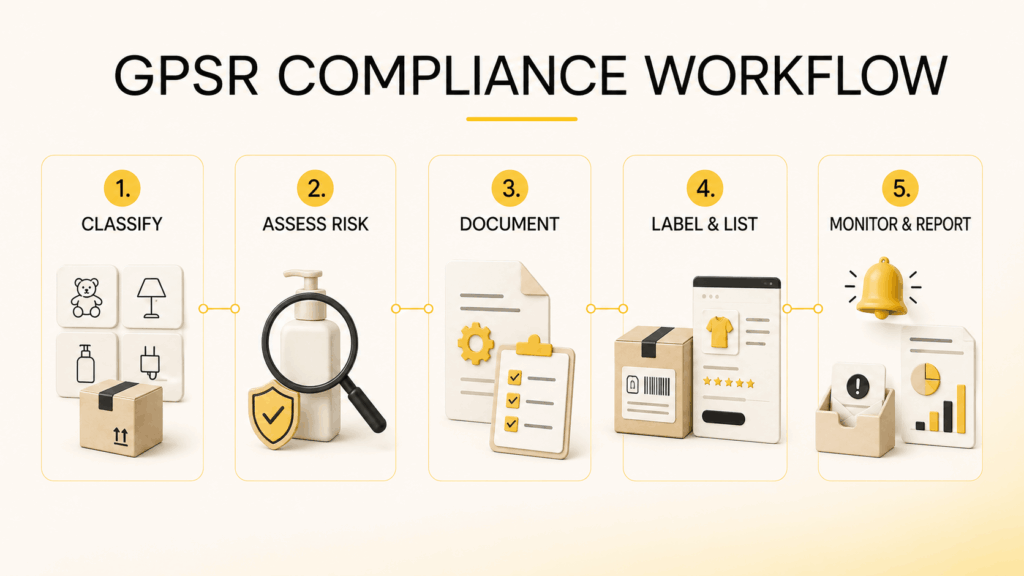
- Classify each product and identify any product-specific EU legislation.
- Record when the product was first placed on the EU market.
- Confirm the manufacturer, importer and distributor roles.
- Appoint a valid EU economic operator where required.
- Complete and retain a product-specific risk analysis.
- Build or collect technical documentation and test evidence.
- Add product identifiers and contact details to labels or packaging.
- Prepare instructions and warnings in destination-market languages.
- Update every online listing with the Article 19 information.
- Test marketplace feeds and check that safety fields remain visible.
- Create complaint, accident, recall and authority-notification procedures.
- Keep supplier and customer traceability records accessible.
Frequently asked questions
What does GPSR mean for small businesses and ecommerce sellers?
Small businesses aren’t generally exempt. A maker may count as the manufacturer and need a risk analysis, technical file, product identification, contact information and suitable warnings. Sellers must also show Article 19 information online. The level of documentation can reflect the product’s complexity and risk, but the core safety duties still apply.
What is an EU Responsible Person and who can act as one?
It is the EU-established economic operator responsible for specified compliance and authority-facing tasks. Depending on the supply chain, it may be the EU manufacturer, importer, authorized representative or, in limited circumstances, a fulfillment service provider. The responsible person needs a real mandate and access to compliance documentation, not only a postal address.
Does GPSR apply to handmade, second-hand and digital products?
Handmade goods and commercially sold second-hand products are generally covered unless a specific exclusion applies. Antiques and goods clearly sold for repair before use are excluded. Standalone digital content isn’t normally a GPSR product, but software affecting the safety of a connected physical product can form part of the safety assessment.
Do UK and US sellers need to comply with GPSR?
Yes, when they target EU consumers with covered products. A non-EU manufacturer needs an EU-based economic operator before placing the product on the Union market. The manufacturer and responsible-person information must appear in the online offer and on the product, packaging, parcel or accompanying documentation as required.
What happens if a seller doesn’t comply?
Possible consequences include blocked or hidden listings, authority requests, withdrawal orders, product recalls and national penalties. Fine levels aren’t uniform across the EU because member states set their own penalty rules. A dangerous product can also create consumer claims and substantial recall costs beyond any regulatory sanction.
Did GPSR apply to products already on the EU market before 13 December 2024?
Article 51 contains a transitional provision. Member states can’t impede products that complied with the old GPSD and were placed on the market before 13 December 2024. The date refers to first placement on the EU market, not merely the date of a later retail sale. Sellers should retain evidence supporting that status.
Disclaimer: This article provides general information and isn’t legal advice. Product classification, market role and national enforcement can change the result for a specific business.