From Demo to Done: Why Most AI Projects in E-Commerce Fail (and How to Make Them Work)
88% organisations adopt AI, but only 31% scale it. Learn why e-commerce AI projects fail and how to move from impressive demos to real business impact with a proven framework. (Ad)

88% of organisations have adopted AI in at least one business function, yet only 31% have managed to scale it. For e-commerce, where the tech stack is complex and the margins are unforgiving, that gap has become one of the defining challenges of the past two years: a graveyard of promising pilots, stalled rollouts, and innovation budgets that never delivered.
Why the AI Graveyard Is Full
What separates the teams that scale AI from the ones that stall? In almost every case, it’s not the technology. It’s everything around it.
The AI pilot was designed to impress, not to operate
Most AI pilots are built in isolation: a small team, a clean dataset, a controlled environment where edge cases are conveniently ignored. The demo works perfectly because it was built to work perfectly. That’s precisely the problem.
The moment the project connects to real systems (ERP, OMS, warehouse management, customer data platforms), the cracks appear. The data isn’t clean, the systems don’t communicate the way the architecture diagram promised and integration turns out to be far more work than anyone scoped. Without governance, monitoring, and proper error handling, there’s no infrastructure to keep things running once the pilot leaves the lab.
Because the pilot was never designed to fit into operational reality, going live isn’t a deployment, it’s a disruption. Teams need retraining, processes need rebuilding, and the rollout becomes a project in its own right, one that nobody scoped, budgeted for, or assigned ownership to. And that is why the project never makes it to production.
Teams didn’t lead with ROI
The most common mistake isn’t technical. It’s starting with a solution and working backwards to justify it.
The teams that get AI into production start with a concrete business problem. They define success in specific, measurable terms before anything gets built, and use that definition to set the priority and scope of everything that follows. When the return is clear from the start, every phase of the project has a defensible answer to one question: is this worth the cost?
What the Projects That Work Have in Common
Across these failure modes, the pattern is consistent: the technology was ready before the organisation was. Yet some e-commerce teams do get it right. They move from pilot to production, demonstrate real value, and build on that momentum. Here is what they have in common.
They start with the obvious problem, not the most exciting
Not the most exciting problem. A specific, high-frequency operational pain point with clear enough scope to actually be solved.
Returns triage, where a rule-based AI routes standard requests automatically while flagging edge cases for human review, is a project that can ship in eight weeks and prove ROI in twelve. Demand forecasting at scale is a compelling ambition, but it is also deeply complex. The most successful e-commerce AI teams apply a simple filter: repetitive, rule-heavy, and high-volume. If a process meets those three criteria and has clean enough data and a defined outcome, it becomes a priority.
They treat integration as the core product
The AI model is not the product, the integrated workflow is. Teams that scale AI in e-commerce think about every upstream and downstream touchpoint from the outset: where the data comes from, what happens when the AI makes a decision, who gets notified, what triggers the next step, and what the fallback looks like when something breaks. They invest heavily in the connective tissue between systems, because that is where most projects quietly fall apart.
According to Workato’s Integration Imperative in the Agentic Era report, governance requirements, orchestration complexity, and security concerns are the factors most consistently preventing agentic use cases from reaching production. Only 6% of organisations report full trust in agentic AI to autonomously manage end-to-end business processes. In e-commerce, where the tech stack is typically a mosaic of acquired platforms, legacy systems, and niche best-of-breed tools, that gap between ambition and infrastructure is the main event.
They defined a “first value” milestone before anything else
Every successful AI rollout starts with a clearly defined first-value milestone. Not the end state, not the full vision. The first specific point at which someone in the business can say: This is working, and it is saving us something real.
This forces clarity about scope. If a team cannot define what the first value looks like, they don’t understand the problem well enough to solve it. And in e-commerce, where every department competes for attention and budget, a visible win in the first 90 days is often what keeps the project alive.
They made data readiness a prerequisite
AI cannot work on data it cannot trust. This is widely understood and routinely ignored because acknowledging it would delay the project.
The teams that scale do the unglamorous work first. They audit what data they have, in what form, and how reliable it is. They define “good enough” for the specific use case. They build pipelines that keep data current and consistent. They do not skip this step in the hope that it won’t matter. In e-commerce, where data flows between commerce platforms, ERP systems, logistics providers, marketing tools, and customer service platforms, often without a unified schema, this work is genuinely hard. But it is also the difference between an AI that performs in a demo and one that performs in production. As a technology leader quoted in Workato’s Integration Imperative in the Agentic Era report, stated: “If your data is not amplified or orchestrated across your different systems, you get a garbage-in, garbage-out solution. And then when it doesn’t work, people blame the AI.”
They had an executive sponsor who cared about the outcome
Every e-commerce AI project that reaches operational scale has a senior leader who can articulate, in business terms, why it matters. Not “we are using AI because our competitors are,” but “we are automating returns triage because it costs us X hours per week, affects our NPS by Y, and this project will recover that.”
That sponsor provides air cover when the project hits obstacles, unlocks cross-functional cooperation from teams who would otherwise deprioritise requests from product or IT, and holds the project accountable to real outcomes. If that person cannot be identified at the start, the search for them should happen before a single line of code is written.
The Practical Framework: Pilot to Production
- Phase 1: Define the obvious problem
Choose one high-frequency, rule-heavy, well-defined process that causes enough pain to justify the investment. Confirm that the data exists and is reliable enough. Define the first value in concrete terms. Assign a business owner accountable for the outcome.
- Phase 2: Map integrations before building the AI
Document every system the use case touches, every data source it depends on, and every downstream process it affects. Identify gaps. Confirm feasibility. Do not proceed until this picture is clear.
- Phase 3: Design fallbacks
Define what happens when the AI is uncertain, what the fallback process looks like, and who handles exceptions. The AI doesn’t need to solve every case, but a clear Human-in-the-Loop process needs to exist and integrate with existing workflows.
- Phase 4: Ship something measurable in 90 days.
If it takes longer to demonstrate the first value, the scope is too large, or the problem isn’t well-defined. Reducing the scope is not a failure. It is discipline.
- Phase 5: Use the first win to earn the second
Scale is earned through demonstrated value. Use the first deployment to refine the approach, build the evidence base, and justify the next initiative.
From Workflow to Orchestration
Once the first use case is in production, the question shifts: what happens when it’s not one workflow, but five or ten, running across different systems simultaneously?
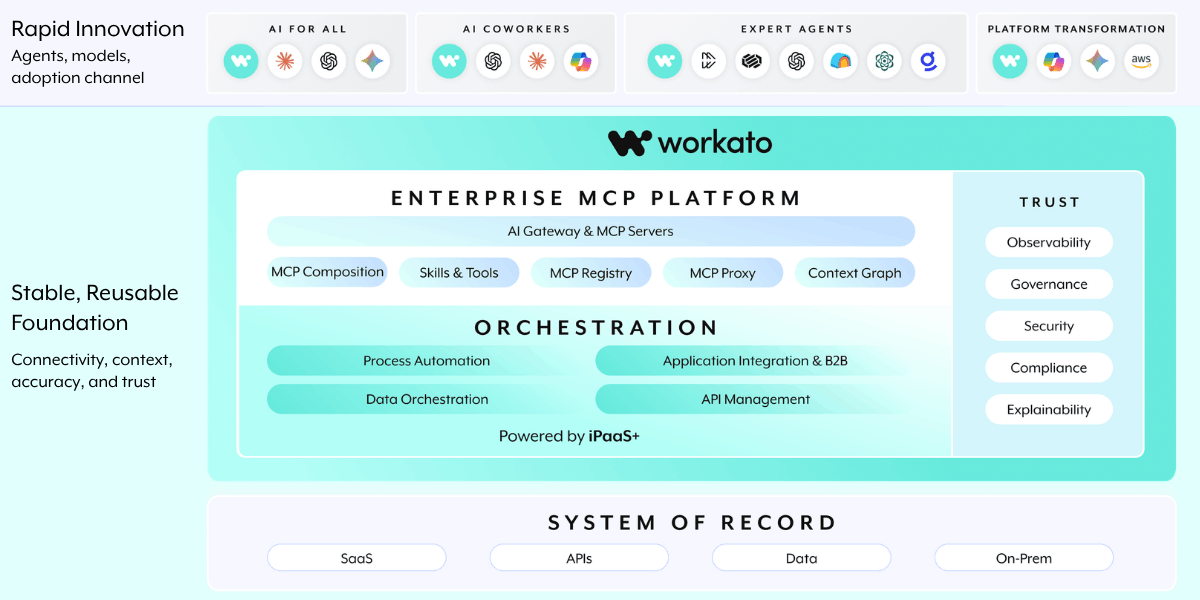
This is where AI orchestration becomes critical: the ability to coordinate AI agents, automated workflows, and human handoffs across systems in a governed, auditable way. AI agents now operate across multiple systems, triggered by real-world events, passing context between tools, and escalating to humans when needed. Standards like Model Context Protocol (MCP) are accelerating this shift, providing a common interface for AI agents to connect with enterprise systems without custom integrations for every connection. For e-commerce, this opens up fully automated order management, intelligent customer service escalation, and dynamic pricing that responds to real-time signals.
The most complex use cases cannot be solved by individual AI tools working in isolation. They require orchestration that coordinates agents, data, and workflows across systems. The teams getting this right understand that intelligence is only half the investment. The other half is the infrastructure that connects, monitors, and governs how AI operates across the business.
Beyond the Demo
AI will not transform an e-commerce business through pretty pilots. It will transform the business when organisations make the harder, less visible investments: in integration, in data readiness, and in clear ownership. When teams choose obvious problems over exciting ones and ship measurable results in weeks, not scalable visions in quarters.
The technology is ready. The question is whether the organisation is ready to do what it takes to put it to work.
Kathleen Jaedtke is Head of Marketing, EMEA Central at Workato, where she is responsible for the go-to-market strategy across the DACH and Benelux regions. Before joining Workato, she led the DACH marketing team at HubSpot and held multiple marketing roles at Zalando.
***
This article is part of a winner’s prize at the E-commerce Germany Awards 2026. If you’d like to learn more about the awards, visit this website: