Quick commerce in Germany: q-commerce market, players and trends in 2026
Explore quick commerce in Germany in 2026: market size, Flink, Wolt, consumer behaviour, delivery expectations and the economics behind q-commerce.
Quick commerce in Germany didn’t disappear when Gorillas and Getir left the market. It changed.
The first q-commerce boom was built around one highly marketable promise: groceries at your door in ten minutes. In 2026, the companies still competing for German shoppers look rather different. Thirty-minute delivery is increasingly normal. Baskets are getting larger. Retailers are teaming up with delivery platforms and fulfilment partners. Expansion is being judged against order density and profitability, not just the number of cities covered.
Most importantly, there is finally evidence that the model can make money. In March 2026, Flink said it had reached EBITDA profitability while delivering an average basket worth more than €45 in approximately 30 minutes.
Germany’s q-commerce story, then, isn’t really about the death of ultra-fast delivery. It’s about what survived after the hype disappeared.
Quick answer: Quick commerce, or q-commerce, is a form of local e-commerce built around delivery within minutes rather than days. In Germany, the market has moved from heavily subsidised 10-minute delivery towards larger baskets, roughly 30-minute fulfilment and tighter control over local unit economics.
For the wider market context, see our overview of German e-commerce statistics.
What is quick commerce?
Quick commerce sits at the fastest end of e-commerce fulfilment.
Instead of shipping an order from a large regional warehouse, inventory is stored much closer to the customer. That can mean a dark store, a small urban fulfilment hub or, increasingly, stock from an existing local retailer.
Orders are picked almost immediately and handed to a courier for local delivery.
Groceries became the category most closely associated with q-commerce because the shopping missions fit the model particularly well. Missing milk, drinks for a party, breakfast for tomorrow or one ingredient for dinner are purchases where getting the item in 30 minutes can have considerably more value than getting it the next day.
The model has expanded beyond food too. Beauty products, pet supplies, pharmacy items, household goods and small electronics can all fit the same “I need it now” behaviour. Current German Wolt services, for example, combine supermarkets and Wolt Market with other local stores through the same delivery platform.
Quick commerce is therefore related to, but not identical with, same-day delivery. A parcel arriving at 8 p.m. after being ordered that morning is same-day delivery. A grocery basket arriving while you’re still cooking dinner is q-commerce.
How big is quick commerce in Germany?
Germany remains an unusually interesting market because online grocery penetration is still relatively low while growth is strong.
HDE’s Online Monitor 2026 puts the online share of German FMCG sales, including food and drugstore goods, at just 4.9% in 2025. At the same time, online FMCG sales grew 10.4% year on year.
Not all of that activity belongs to q-commerce. Scheduled supermarket deliveries, online grocery specialists, click and collect and instant-delivery services operate under different models.
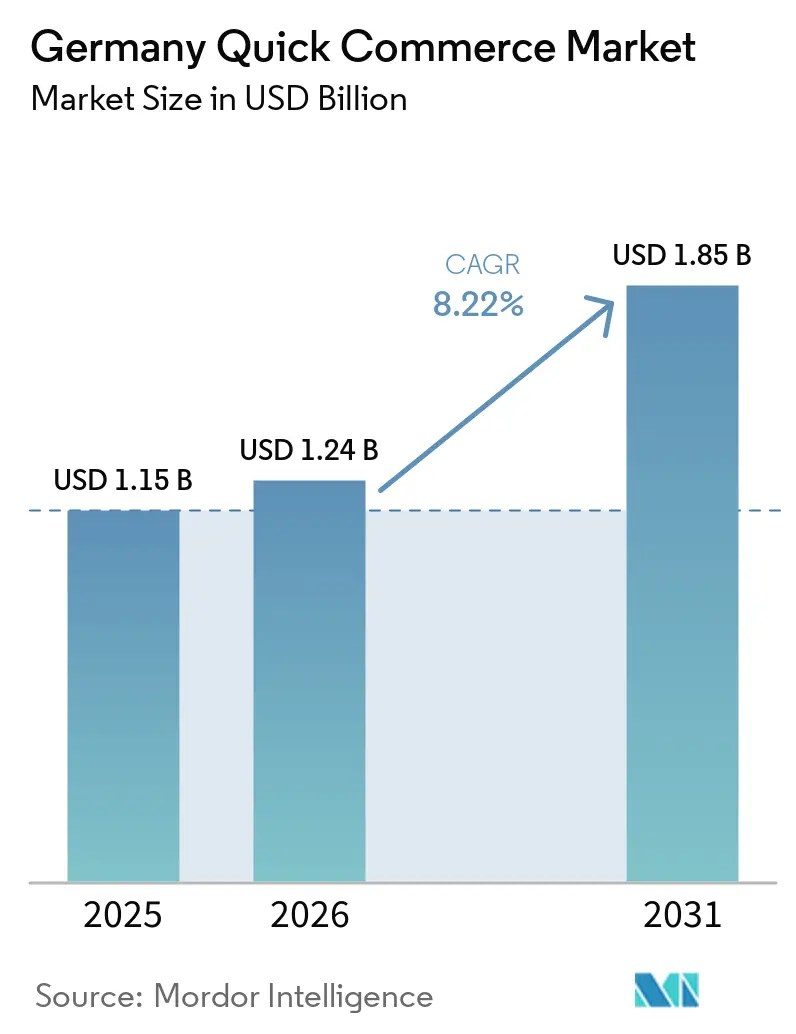
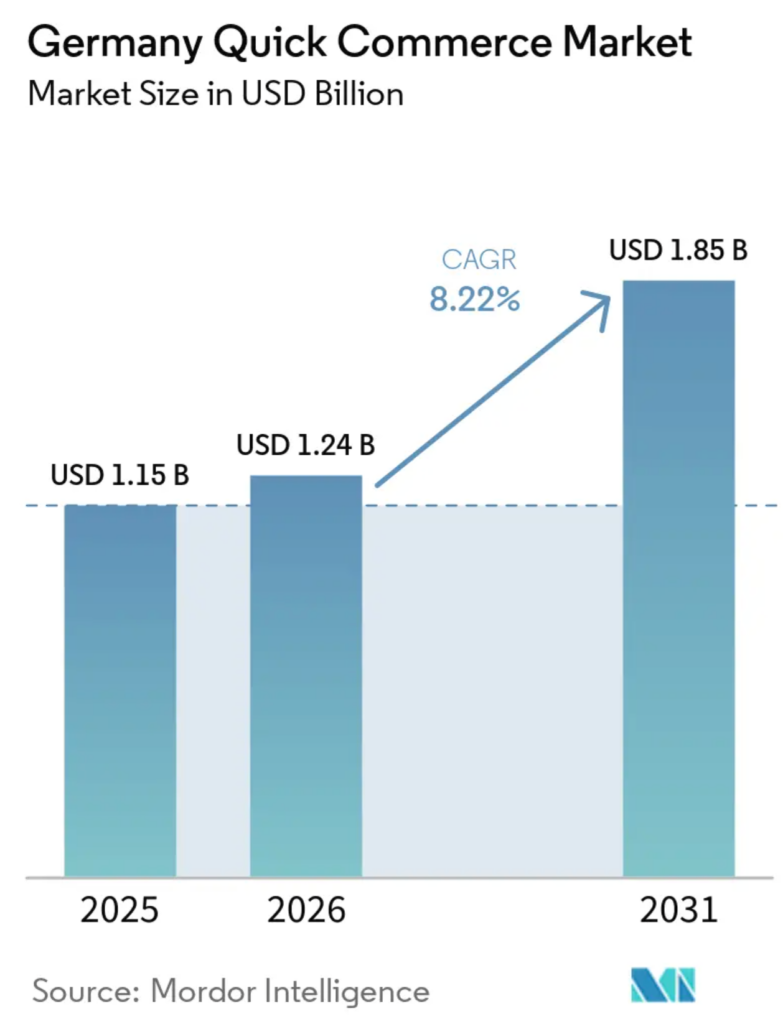
For quick commerce specifically, Mordor Intelligence estimates Germany’s market at $1.24 billion in 2026, up from $1.15 billion in 2025. Its forecast reaches $1.85 billion by 2031, equivalent to an 8.22% CAGR between 2026 and 2031.
There is one caveat worth keeping in mind with any q-commerce market-size number.
Definitions vary.
Some research limits quick commerce mainly to rapid grocery delivery from local fulfilment locations. Broader definitions can include other types of on-demand retail, which produces much larger market estimates.
Rather than treating one forecast as an exact census of German q-commerce spending, it is more useful to look at the direction: the category remains relatively small compared with total German retail, but the surviving model is still growing.
How many Germans use quick commerce?
Quick commerce is far from becoming the default shopping method in Germany, but awareness and usage have clearly increased.
A representative Bitkom survey found that 16% of German internet users had already used a rapid-delivery service, compared with 10% in 2021. Another 33% could imagine using one. The research covered 1,123 internet users aged 16 and older.
Age makes a major difference.
Among 16–29-year-olds, 26% had already used a rapid-delivery service. Adoption reached 22% among people aged 30–49 but only 7% among consumers aged 50 and above.
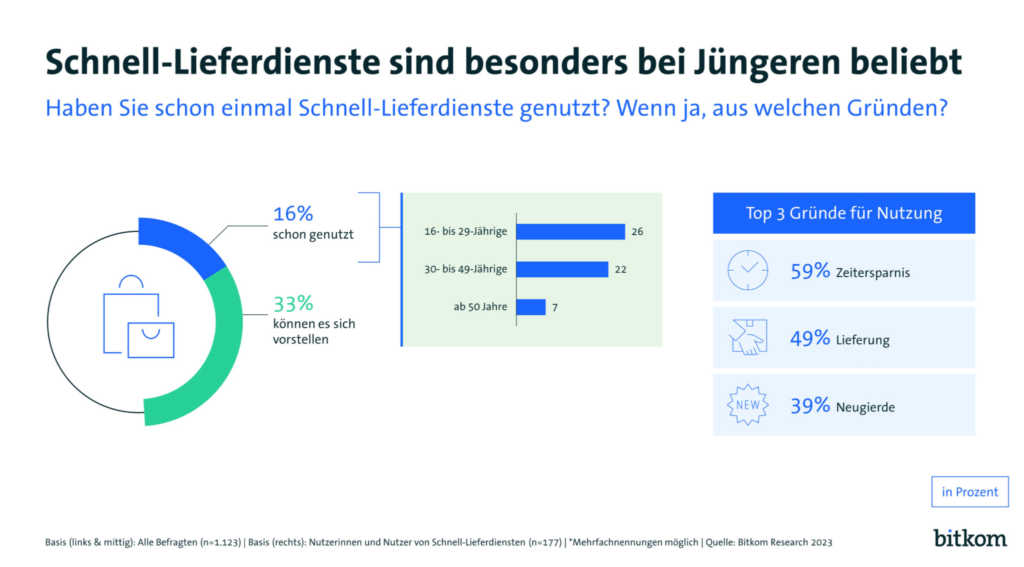
This is an especially useful external visual because Bitkom provides it directly as a downloadable web graphic on its press page.
The geographic picture matters too.
Bitkom found that 29% of people who hadn’t used these services said they simply weren’t available in their area. The association noted that rapid delivery remained concentrated mainly in larger cities, where shorter distances make local fulfilment easier.
That helps explain why Berlin, Hamburg, Munich, Cologne and Frankfurt play such an outsized role in discussions about German q-commerce.
The economics become considerably harder when customers are spread further apart.
Germans want fast delivery – they don’t necessarily need ten minutes, though
One of the most revealing pieces of German q-commerce research has little to do with market size.
It asks a much simpler question: how fast is fast enough?
Software Advice surveyed German q-commerce users and found that only 1% considered a delivery time below 15 minutes appropriate.
Instead, 43% chose 15–30 minutes, while another 37% selected 31–59 minutes. In other words, 80% of respondents in the q-commerce sample considered something between 15 and 59 minutes acceptable.
That is quite a contrast with the branding that defined the early sector.
Ten-minute delivery made a great advertising message. It didn’t necessarily solve a meaningfully bigger problem than 25- or 30-minute delivery.
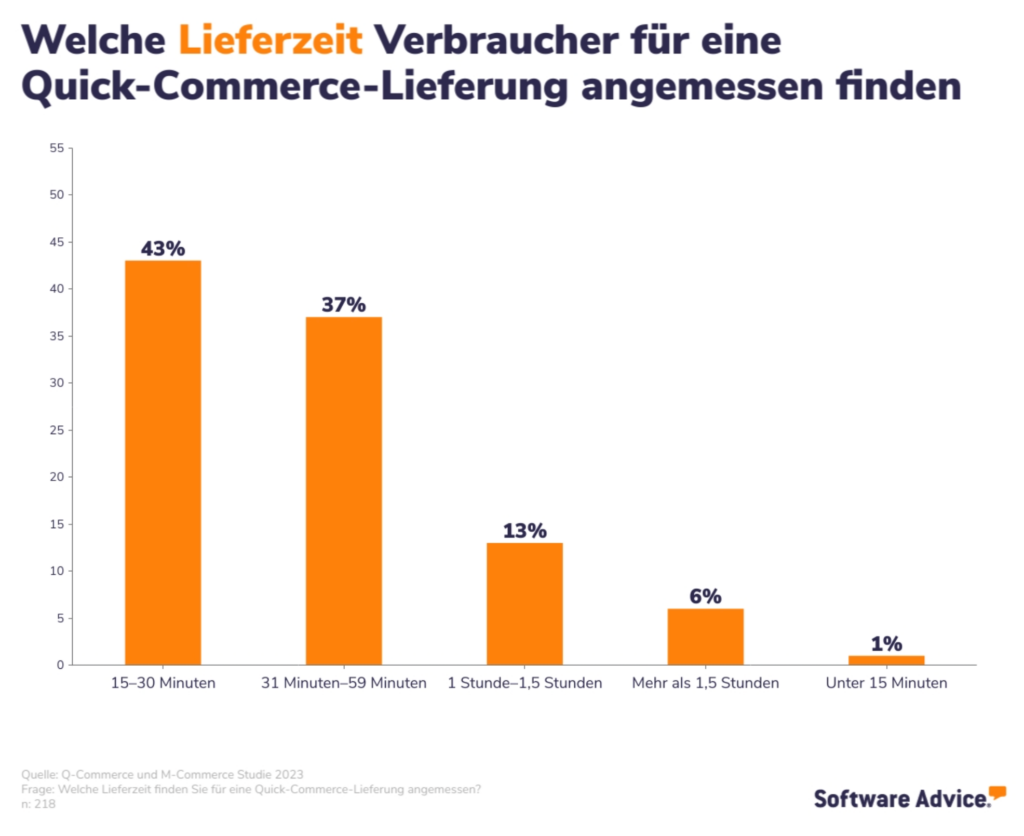
The finding looks even more interesting next to today’s operators.
Flink now reports an average delivery time of approximately 30 minutes, which places its operating model almost exactly inside the most popular delivery-time bracket identified in the earlier consumer research.
Speed hasn’t disappeared as a selling point. The obsession with shaving every possible minute off the journey appears to have weakened.
That’s an important distinction.
If a customer realises at 6:30 p.m. that they’re missing something for dinner, delivery at 7 p.m. still solves the problem. Giving the fulfilment operation those additional minutes, meanwhile, provides more room for picking, order bundling, courier allocation and routing.
For more about the operational challenge at the end of an online order, see our guide to the last mile in e-commerce.
Convenience matters more than cheap prices
Why do Germans use q-commerce in the first place?
Mostly because it saves effort.
Bitkom found that 59% of users cited time savings, while 49% liked having the purchase brought directly to their door. Another 39% had tried rapid delivery out of curiosity, while 37% had used it because illness prevented them from shopping themselves.
Only 10% said cheaper prices than in stores were a reason for using the service.
That’s an important clue about where q-commerce fits in German retail.
Its natural competitive advantage isn’t price.
A dark store, immediate picking and local courier delivery introduce additional costs that a shopper walking into Aldi or Lidl doesn’t have to pay. Instead, q-commerce monetises inconvenience.
The customer is effectively paying to remove a shopping trip.
That also creates a different competitive set. In some situations the alternative isn’t another online supermarket. It is getting dressed, walking or driving to a store, queuing, carrying the shopping back home and losing 30 or 40 minutes in the process.
From Gorillas to Getir to Flink: Germany’s q-commerce shakeout
Germany has already experienced an entire startup cycle around rapid grocery delivery.
Berlin-founded Gorillas launched in 2020 and quickly became one of Europe’s most recognisable q-commerce startups.
Huge amounts of venture capital flowed into the category. Operators opened dark stores rapidly and competed on customer acquisition, promotions and headline delivery times.
Then consolidation arrived.
In December 2022, Turkish delivery company Getir acquired Gorillas in a deal worth around $1.2 billion.
Less than two years later, Getir announced its withdrawal from Germany alongside its other remaining European markets and the US. The company said those international markets accounted for only a small share of its revenue and shifted its focus back towards Turkey.
Gorillas disappeared with it.
That sequence can look like proof that German q-commerce failed.
It is better understood as proof that one version of the business model failed.
Why was the original quick-commerce model so hard to make profitable?
The problem becomes much easier to understand once you look at an individual order.
Strategy& modelled the economics of a representative quick-commerce purchase in its 2024 analysis of European e-grocery.
The example started with an average order value of €31. Adding €1.99 in delivery fees and €1.50 in retail media revenue produced approximately €34.49 in total revenue.
The estimated costs still left the operator with a net operating loss of €5.39 per order. Cost of goods alone came to €21.08, while picking cost €2.52 and delivery another €6.31 before other overheads were included.
The graphic explains why scale alone couldn’t fix the original q-commerce problem.
If each additional order loses money, adding more orders simply increases the loss.
Strategy& calculated that improving delivery and picking costs while also raising the delivery fee could theoretically move its example from a €5.39 loss to a tiny €0.03 operating profit per order.
The details behind q-commerce therefore matter far more than the headline delivery promise.
Where is inventory stored? How quickly can it be picked? How many orders can one hub support? How far does each rider travel? How frequently can deliveries be combined? What is the average basket value?
Our guide to micro-fulfilment in e-commerce explores the broader infrastructure behind local fulfilment, while this list of fulfilment centres and logistics operators in Germany gives a wider picture of the German logistics ecosystem.
Flink suggests q-commerce can work, just with different economics
Flink is the most interesting counterpoint to the collapse of the original market.
In March 2026, the company raised another $100 million in a funding round led by Prosus. More importantly, the announcement said Flink had achieved EBITDA profitability.
The operating metrics tell an equally interesting story.
Flink says its average basket is now above €45 and its average delivery time is approximately 30 minutes. It operates around 160 urban hubs across Germany and the Netherlands. New German locations are being selected specifically against profitability and order-density criteria.
Compare that with the first q-commerce wave.
The goal is no longer simply “deliver faster”.
A larger basket creates more revenue from each customer interaction. A 30-minute window gives fulfilment operations more flexibility. Local expansion has to earn its place rather than simply adding another pin to a map.
That’s much closer to conventional retail discipline.
Comparison of pandemic-era quick commerce and the German q-commerce model in 2026
| Pandemic-era q-commerce | Q-commerce in 2026 |
| 10-minute promise | ~30-minute sweet spot |
| Small emergency orders | Bigger top-up baskets |
| Expansion at all costs | Density-led expansion |
| Standalone startups | Retail + platform ecosystems |
| Heavy customer subsidies | Better unit economics |
| Gorillas / Getir | Flink / Wolt / retailer partnerships |
Today’s quick commerce is becoming an ecosystem
Another big change is who actually provides the service.
The first wave was dominated by dedicated startups trying to own almost every part of the customer journey: brand, app, inventory, dark stores and delivery.
Today’s market contains more partnerships between companies that already own different pieces of the puzzle.
REWE’s partnership with Lieferando is a good example.
The service was launched across more than 40 German cities, offering more than 3,000 REWE products for delivery in roughly 45 minutes. Flink provides fulfilment and logistics behind the operation.
The model makes sense for all sides.
REWE brings purchasing scale, private-label products, supplier relationships and a household retail brand. Lieferando brings a large consumer marketplace and app. Flink brings rapid fulfilment infrastructure.
None has to rebuild all three pieces independently.
For more background on the German grocery landscape, see our overview of the largest supermarket chains in Germany.
Wolt is pushing q-commerce beyond dedicated grocery apps
Wolt illustrates the other route into rapid retail.
Its German service combines restaurants with groceries and local retailers, while Wolt Market promises fresh grocery delivery in around 30 minutes. (
The supermarket selection available through Wolt can also include brands and services such as EDEKA, Flink and Knuspr depending on location.
That matters because it changes what “q-commerce company” means.
A customer doesn’t necessarily need a separate app dedicated to rapid groceries. The same delivery marketplace used for dinner can handle a supermarket top-up, cosmetics or household essentials.
Q-commerce becomes a fulfilment mode rather than a standalone category.
This is particularly relevant in a mobile-first market. See our overview of shopping apps in Germany for the wider app-commerce picture.
What do Germans buy through quick commerce?
Groceries remain the most obvious category, but rapid delivery has never been exclusively about food.
Software Advice found that 57% of surveyed q-commerce users had purchased groceries through these services.
Restaurant or bar food and clothing or shoes were each reported by 37%. Alcohol and electronics followed at 28%, while cosmetics reached 27%, games and toys 26% and pharmacy products 22%.
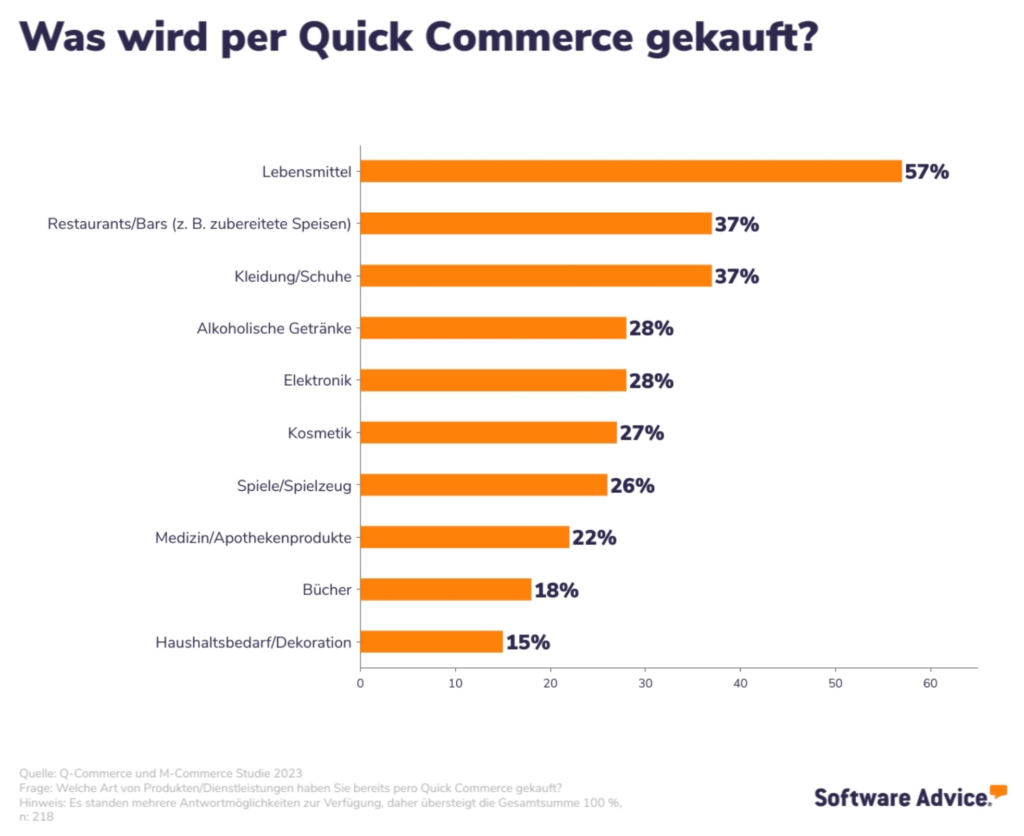
More recent market estimates point towards the same diversification. Mordor Intelligence estimates groceries and staples represented 52.61% of the German q-commerce market in 2025. That still makes grocery the leading category, but it also means a substantial share of the market sits elsewhere.
From an operator’s perspective, that makes sense.
Once a city already has local warehouses, riders, routing software and customer demand, adding another appropriate product category can increase revenue without recreating the delivery network.
The infrastructure built to deliver yoghurt can also deliver shampoo, pet food or a phone charger.
The 30-minute standard may matter more than the 10-minute race
Mordor Intelligence estimates that the 11–30-minute delivery tier accounted for 54.45% of Germany’s q-commerce market in 2025. (Mordor Intelligence)
That aligns neatly with two other pieces of evidence.
Software Advice found 15–30 minutes to be the most popular delivery-time expectation among the German q-commerce users it surveyed. Flink now reports an average delivery time of around 30 minutes.
Three different sources point towards the same idea:
30 minutes may be close to the practical sweet spot between customer convenience and operational reality.
It is fast enough to solve an immediate need but gives the operator more flexibility than a rigid ten-minute promise.
That small difference can matter enormously when repeated across thousands of orders.
Basket size may matter more than shaving off another five minutes
Delivery speed attracts attention.
Basket size helps pay for it.
Flink’s current average basket of more than €45 is therefore one of the most important numbers in its 2026 announcement.
The economics become easier when a customer orders dinner ingredients, breakfast and household essentials together than when a courier travels across a neighbourhood carrying a €6 emergency purchase.
This is another reason why today’s q-commerce looks increasingly like top-up grocery shopping rather than purely emergency shopping.
There is a large middle ground between a €150 weekly supermarket delivery booked for tomorrow and one missing carton of milk delivered in eight minutes.
A €45 basket arriving in half an hour may turn out to be a far better business than winning the race to deliver one item first.
Quick commerce and online grocery aren’t the same thing
Another common mistake is putting every grocery-delivery service into the q-commerce bucket.
Picnic, Knuspr, traditional REWE delivery and other German e-grocery services solve overlapping customer problems, but their operating models differ.
Some services optimise planned delivery routes and larger baskets. Others promise same-day slots. Q-commerce prioritises rapid local fulfilment.
The distinction becomes important when comparing profitability.
Strategy& found that efficiency-focused e-grocery companies weathered the difficult post-pandemic period better than many quick-commerce operators. Larger baskets and optimised middle- and last-mile logistics gave businesses such as REWE, Picnic and Rohlik Group a different economic structure.
You can see more businesses from that side of the market in our overview of online grocery stores in Germany.
The interesting part isn’t deciding which model will replace all the others.
Customers can use several.
A large weekly shop can be scheduled. Drinks can come from a specialist service. A forgotten ingredient can arrive in half an hour. A small local-store purchase can come through Wolt.
Convenience depends on the shopping mission.
What stops more Germans from using q-commerce?
Speed isn’t the main complaint.
In Bitkom’s survey, 86% of existing users said they were satisfied with the speed of rapid-delivery services.
The bigger barriers were elsewhere.
Among people who hadn’t used a rapid-delivery service, 53% simply preferred visiting a supermarket or discounter themselves. Another 33% considered the services unnecessary. Delivery costs were too high for 32%, while 29% said the products themselves cost more than in stores. Another 29% didn’t have such a service available in their region.
That tells operators where the real battle is.
Delivering in 12 minutes instead of 18 does little for someone who thinks the delivery fee is too high.
Expanding the assortment, keeping prices credible, making baskets more economical and increasing geographic availability may do much more.
What can German retailers learn from q-commerce?
Most retailers don’t need to start promising deliveries in 30 minutes.
The lessons are broader.
- Faster isn’t automatically better. Once delivery is fast enough to solve the customer’s problem, further speed improvements can add more operational cost than customer value.
- Local inventory creates options. Stores and micro-fulfilment locations can potentially support click and collect, scheduled delivery, same-day delivery and express orders from the same broader inventory network.
- Partnerships can be more efficient than vertical integration. REWE, Lieferando and Flink show how retailer inventory, marketplace demand and fulfilment infrastructure can work together.
- Density matters. Rapid delivery becomes much easier to operate when many potential customers sit within a small delivery radius.
And finally, the least glamorous lesson may be the most important: unit economics eventually win.
The 10-minute promise generated headlines. Profitable orders keep the service running.
What’s next for quick commerce in Germany?
The next chapter of q-commerce is unlikely to look like 2021.
There will still be competition around convenience and delivery speed, but operators now have much stronger incentives to ask where rapid fulfilment makes financial sense.
Flink’s expansion policy reflects exactly that. Its new German hubs are being targeted only at locations that meet specific profitability and order-density criteria.
At the same time, the addressable online grocery market still has room to move.
Only 4.9% of German FMCG spending happened online in 2025, according to HDE, despite online FMCG growing 10.4% during the year.
Q-commerce doesn’t need to replace supermarkets to become meaningful.
It only needs to capture more shopping occasions where time matters more than visiting the store.
That may mean fewer spectacular startup valuations, fewer promises to deliver everything in ten minutes and much more attention to boring things such as basket size, picking efficiency and delivery density.
For German e-commerce, that would probably be a healthy development.
Quick commerce in Germany: key takeaways
| Area | What the German market tells us |
| German q-commerce market | Estimated at $1.24bn in 2026 |
| Forecast | $1.85bn by 2031 |
| Consumer adoption | 16% had used rapid delivery in Bitkom’s survey |
| Younger users | 26% adoption among 16–29-year-olds |
| Preferred speed | 15–30 minutes was the most popular range in Software Advice’s study |
| Main motivation | Saving time |
| Price motivation | Only 10% cited lower prices |
| Former leaders | Getir and Gorillas left Germany in 2024 |
| Current pure-play | Flink |
| Flink basket | More than €45 on average |
| Flink delivery | Approximately 30 minutes |
| Economics | Strategy& modelled a €5.39 loss on a representative legacy q-commerce order |
| Wider grocery market | Only 4.9% of German FMCG sales were online in 2025 |
| Direction | Larger baskets, retailer partnerships and density-led expansion |
The figures above come from HDE, Bitkom, Software Advice, Strategy&, Reuters, Mordor Intelligence and Flink’s 2026 funding announcement.
FAQ about quick commerce in Germany
What is quick commerce?
Quick commerce, or q-commerce, is local online retail built around delivery within minutes rather than days. Orders are usually picked from nearby stores, dark stores or urban fulfilment hubs and sent to customers through local courier networks.
How big is the quick-commerce market in Germany?
Mordor Intelligence estimates Germany’s quick-commerce market at $1.24 billion in 2026 and forecasts it to reach $1.85 billion by 2031. Market estimates should be treated carefully because research companies use different definitions of q-commerce.
Is q-commerce growing in Germany?
The broader online FMCG market is growing quickly. HDE reports that German online FMCG sales increased 10.4% in 2025, although online still represented only 4.9% of the category. Mordor Intelligence also forecasts further growth in German q-commerce through 2031.
Is Gorillas still operating in Germany?
No. Getir acquired Gorillas in a $1.2 billion deal in December 2022. Getir subsequently withdrew from Germany and its other remaining European markets in 2024.
Is Getir still available in Germany?
No. Getir announced its withdrawal from Germany, the UK, the Netherlands and the US in April 2024 as it refocused on its home market in Turkey.
Is Flink profitable?
Flink announced in March 2026 that it had reached EBITDA profitability. At the same time, the company secured another $100 million in funding in a round led by Prosus.
How fast does Flink deliver in Germany?
Flink reports an average delivery time of approximately 30 minutes, alongside an average basket worth more than €45.
What are the main quick-commerce services in Germany?
Flink remains the clearest dedicated rapid-grocery player. Wolt also provides groceries and Wolt Market alongside local retail delivery, while REWE works with Lieferando and Flink on rapid grocery fulfilment.
Is quick commerce the same as online grocery?
No. Q-commerce focuses on very fast local fulfilment. Online grocery also includes scheduled supermarket deliveries, route-based services and same-day orders. Services such as Picnic, traditional REWE delivery and other e-grocery operators may therefore compete for similar customers without using the same operating model.