Time to rethink your online marketing in DACH? 10 trends for 2026 to get inspired
Ready to boost your online marketing in the DACH region? Explore 9 inspiring trends for 2026 that can transform your approach and drive success.

If your focus is the DACH region (Germany, Austria, Switzerland), now is the moment to really rethink your online marketing in DACH. This market demands clarity, trust, and an authentic voice — and the old playbook of copying global campaigns simply doesn’t cut it.
For 2026, you’ll want to meet your audience where they are: engaging on local terms, fostering meaningful human connection, and building communities rather than just chasing likes.
In this article, we’ll walk through trends that show how you can reset, refresh and win with online marketing trends in DACH — not by blasting generic content, but by building something your audience feels part of.
Trend 1: AI grows up: from tools to trusted partners
AI is finally growing up. It’s no longer that shiny new toy everyone experiments with for headlines — it’s becoming part of how real marketing work gets done. The best brands are learning to treat it less like a clever assistant and more like a trusted partner that helps plan campaigns, spot audience patterns, and sharpen creative ideas.
Still, in the DACH region, you can’t let machines run the show. Authenticity remains non-negotiable. People here have a sharp eye for what feels robotic or off-tone.
Take Nike’s digital ecosystem, for instance. The brand teamed up with Facebook Messenger to deliver content from their websites: Air Jordan blog, Jordan.com, and Jordan News, across three categories – Air Jordan, shop, and watch. Yet everything still feels personal — supported by real athletes’ stories and community voices. It’s tech with a heartbeat.
For online shops across DACH, that’s the real takeaway: Let AI help you read the data and shape dynamic content — emails, web sections, or ad copy that fits each person’s interests — but keep the final say human. And before hitting “publish,” ask yourself, does this sound like us?
Trend 2: Search without Google: the multi-platform discovery shift
Another major shift is that discovery is no longer solely via classic search engines. People in Germany, Austria, and Switzerland increasingly start brand exploration on social short-video platforms, voice assistants, or via AI chatbots. That means your SEO strategy must broaden out.
In DACH, you’ll still optimise for Google, of course, but you’ll also need to optimise for:
- question-based search (“Wie finde ich…?”),
- conversational queries,
- voice search,
- content suited for Reels, Shorts,
- or even for smart speaker answers.
Make sure your content adapts: a short clip on Instagram that deals with a typical search question (e.g., “Welche Kaffeemaschine passt zu kleiner Küche?”) plus a deeper blog post on your site.
Key: Look at your funnel for DACH: how do Germans start discovery? What platforms they trust? Experiment with multi-platform discovery paths and tie the “discovery” piece to your owned channels in a way that reinforces credibility.
Trend 3: The comeback of real storytelling
One of the most important online marketing trends in DACH for 2026 is that audiences crave warmth, authenticity and storytelling rooted in experiences. After some years of “generic AI-copy” flooding the web, brands are returning to human voices. And people respond to stories they recognise, to real user journeys, employee voices, behind-the-scenes content.
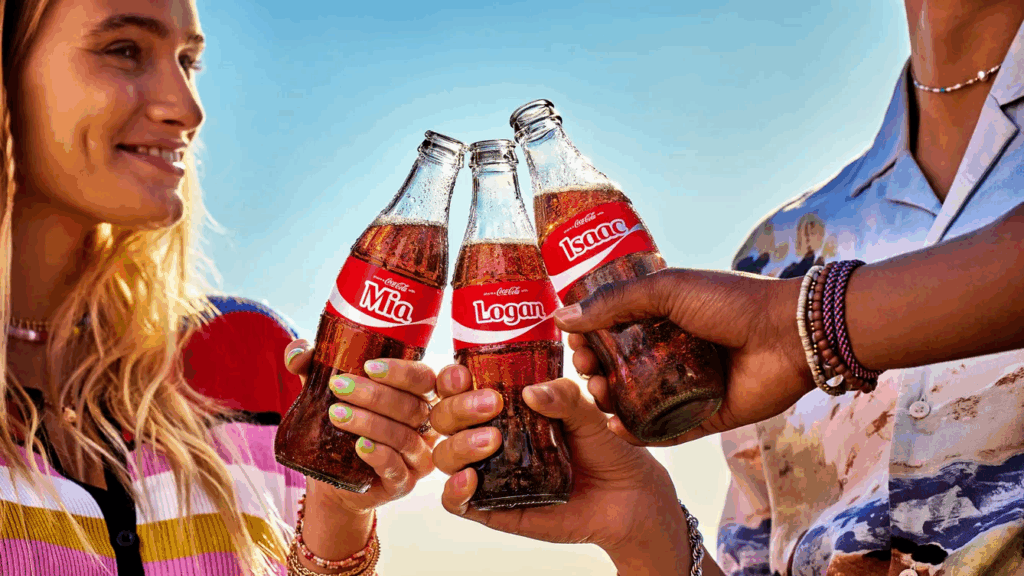
Take Coca-Cola’s iconic Coca‑Cola campaign “Share a Coke” – it invited consumers to be part of the story, to personalise a bottle, to share a moment. Or Nike’s “Can’t Stop Us” campaign, weaving together athletes’ stories, user-generated content and global reach.
Thus, use German (or Swiss-German/Austrian) storytelling, local cultural references, language nuance and voices that reflect your audience. Don’t roll out a global campaign with a generic tag line and expect it to hit the mark. Your brand story should feel rooted, honest, and consistent across touchpoints.
Why this matter? When people feel your story, they stick.
Trend 4: Personalization that respects privacy
Of course, personalisation is a must, but privacy cannot be ignored. Cookies are fading fast, consent and first-party data are becoming the backbone. You can’t just track broadly anymore/ You need to:
- Invite trust
- Give value
- And then personalise
Marketers in DACH should focus on value exchange: what can you give your audience in return for their data?
Maybe exclusive content, early access, loyalty perks. Then ensure your tech stack honours consent, treats data respectfully, and keeps transparency high.
Operationally: set up a data-layer in your website for Germany/Austria/Switzerland that clearly shows data usage, ask minimal required questions, segment behaviour based on what users allow. Then tailor content, email flows, offers based on what you know.
Trend 5: Community beats followers
Followers are nice, but communities (meaningful connections) win. For 2026, brands in DACH should shift focus from “How many followers?” to “How many engaged brand-members?”.
Global brands build sub-communities in their membership ecosystem, so get inspired by them. Use segmentation, leverage community events, and take advantage of UGC or dedicated apps to activate true followers into community members.
So for DACH, your angle should be: build spaces where your audience feels known, value,d and connected to both your brand and to each other. Examples might include:
- A members-only forum or chat for your brand’s users in the DACH region.
- Regular virtual or in-person meetups (depending on sector) in major German/Austrian cities.
- Encouraging user-generated content in the German language with campaigns that reward contributions.
- Employee advocacy locally: empower your German-speaking team to share stories in local channels that resonate.
When you build a community, you also create brand ambassadors — people who talk with you, not at you. That makes all the difference.
Tips for DACH:
- Germans value directness and clarity. Thus, ensure rules, transparency, and moderation in your community.
- Use local trust signals. Highlight local case-studies, testimonials from people in Germany/Austria/Switzerland.
- Invite your community to co-create product features, give feedback on campaigns, and test prototypes.
Trend 6: Short-form meets deep-dive content
Now let’s talk about content length and format. One of the defining shifts in online marketing trends in DACH for 2026 is this: you need both snackable hits and meaningful deep dives.
Short-form video (Reels, Shorts, TikTok clips) works brilliantly for grab-attention, brand personality, and discovery. But your audience still wants substance — long-form blog posts, webinars, podcasts, guides — content that builds trust and expertise.
Example: Beauty brands deploy quick tutorial reels alongside detailed “how-to” articles or IGTV sessions. A report shows that Sephora’s AR mirrors in retail (in-store) — which is a longer and more immersive kind of content experience — boosted conversions by up to 90%.
What this means for DACH:
- Create 20-second social videos answering one sharp question your German-speaking audience often asks.
- Then link from that to an article (in German) on your site with deeper insight.
- And make sure the brand voice remains the same across both formats.
Trend 7: Hybrid experiences: digital meets physical
One of the biggest online marketing trends in DACH for 2026 is blending online and offline. The term “phygital” gets thrown around a lot, and for good reason.
Brands are creating experiences where a customer might scan a QR code in a store, trigger an AR filter, join an online community, and end up with a physical product — all smoothly integrated.
Interactive e-kiosks, touchscreen walls, and AR via smartphones are becoming standard. Also, AR-try-ons in stores (like seating furniture in your living room via your phone) are being used by major global brands too.
Trend 8: Social commerce and frictionless checkout
The growth of social commerce and ultra-smooth checkout flows can’t be ignored. Social commerce means: you scroll, discover, and buy, while staying on the same platform. No transition hell.
So no wonder that shoppable posts, in-app checkout, and live shopping events are growing fast.
Example: Retailers now use Instagram Shopping to tag products directly in images, so followers can tap and buy without leaving the app.
For DACH brands:
- Make sure your German-language social posts (Instagram, Facebook, TikTok) are setup with Tagging/Shop features.
- Consider hosting a live shopping event in German time-zones, with a German-speaking host, product demos, live Q&A, and a special live-only discount.
- Make sure your checkout supports the payment methods popular in DACH (SEPA, PayPal, Klarna, etc.). A slow or clunky checkout will ruin all the effort you put into discovery.
- Add clear shipping/return information. UGC and reviews in German help convert.
Trend 9: Sustainability and transparency win hearts

When we talk about online marketing trends in DACH, one thread runs through many brands’ success: authenticity in values.
Sustainability, transparency, purpose — these are expected. Consumers in Germany, Austria and Switzerland care about what brands stand for, how they operate, and whether they live the values they claim. Greenwashing will get you noticed — but usually for the wrong reasons.
Example: Global brands like Patagonia have built trust by committing to environmental initiatives, being transparent, and involving their community in their mission. Sustainable marketing strategies show that small or large brands alike can benefit from being upfront about their eco-practices.
In DACH context:
- Talk about your sustainability work in the language your customers use. Local case studies carry weight.
- Share measurable data: how much waste you reduced, how many trees planted, how many employees benefited. People like numbers (if they’re real).
- Invite your audience to participate: run a challenge in German-speaking markets (“Wir pflanzen heute mit Euch”, “Die 1000ste Bestellung bekommt eine Baumspende”).
- Avoid vague statements.
When sustainability is integrated into actual business operations and communicated genuinely, it becomes a compelling differentiator — and a solid marketing advantage in DACH in 2026.
Wrap-up: Rethink, don’t rush
So there you have it — 9 key online marketing trends in DACH to get inspired by for 2026.
Here’s what we want you to remember:
- It’s not about chasing every trend. Pick the ones that align with your brand, audience and resources.
- A strong community is better than a huge but passive audience.
- Localisation + authenticity = trust. Speak the language (literally), test local touches, and show real value.
- Tech and tools matter — but only when paired with real human stories, clear values and relevant experiences.
- Measurement is your friend: Set small goals (e.g., community size, live event participation, social commerce conversion) and improve month to month.
As you rethink your online marketing in DACH, think of 2026 not as a year of “doing everything new” but as a year of “doing several things better”. Let your brand voice shine and customers feel heard. Because when those align, you win relevance, engagement and loyalty.