Best online DIY stores in Germany in 2026
The top e-commerce stores in the German DIY market are here! Find everything you need for your next project or learn the best competitors.
Germany’s DIY market is still one of the largest in Europe, but 2026 is not a simple growth story.
DIY and garden retailers are dealing with cautious consumers, pressure on offline sales, high delivery expectations and more selective spending. At the same time, ecommerce keeps changing how people buy tools, paint, building materials, garden products, smart home devices and home improvement supplies.
For retailers, the opportunity is still there. It just looks different now.
German DIY shoppers do not only search for products. They search for projects, instructions, measurements, material lists, availability, delivery options and confidence. A drill is rarely just a drill. It is part of a shelf, a kitchen renovation, a balcony upgrade or a weekend repair.
Below, we look at the best online DIY stores in Germany, what makes them strong, and what ecommerce teams should watch in the German DIY market in 2026.
TL;DR: German DIY ecommerce market in 2026
| Topic | 2026 snapshot |
| Market status | Large, mature and under pressure |
| DIY store sales | German DIY store sales fell in 2025, showing pressure on classic big-box retail |
| Ecommerce role | Online shopping is important for research, price comparison, availability checks and bulky-item delivery |
| Main customer behavior | Shoppers buy for projects, not just products |
| Strong ecommerce categories | Tools, garden, paint, smart home, storage, lighting, renovation materials |
| Key pressure | Cautious spending, delivery costs, product complexity and offline competition |
| Best ecommerce advantage | Helping customers plan, compare and complete projects |
Why DIY ecommerce in Germany is different
DIY ecommerce is not like fashion, beauty or consumer electronics.
In fashion, shoppers often browse. In beauty, they repurchase. In electronics, they compare specs. In DIY, they usually try to solve a practical problem.
A customer may need to repair a door, repaint a room, build a balcony garden, install lighting, replace a bathroom shelf or plan a small renovation. That means the buying journey is longer and more detailed.
DIY customers often need:
- project ideas,
- measurements,
- compatibility information,
- installation advice,
- product comparisons,
- stock availability,
- delivery options,
- click & collect,
- return details,
- customer support.
This is why online DIY retailers cannot rely on product grids alone. A strong DIY ecommerce experience needs content, tools and guidance.
The best online DIY stores in Germany do not only sell products. They help customers understand what they need before they buy.
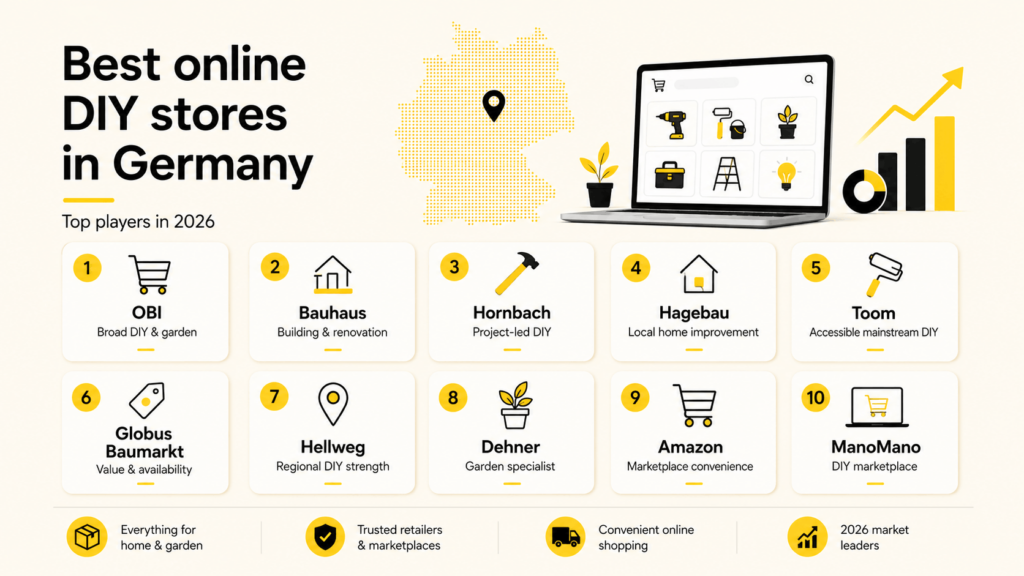
Best online DIY stores in Germany
1. OBI
OBI is one of the most recognizable DIY retailers in Germany and a natural starting point for many home improvement shoppers.
Its online store works well because it connects broad product choice with an omnichannel retail model. Customers can browse products online, check availability, use project content and choose between delivery and store-based options.
OBI is especially strong for mainstream DIY shoppers who need practical products for home, garden, renovation and maintenance.
| Best for | Online strengths | Watch point |
| Broad DIY, garden and home improvement | Strong product range, store network, project guidance | Bulky products need clear stock and delivery information |
OBI’s main ecommerce advantage is familiarity. Customers know the brand, understand the range and can combine online research with offline pickup or store visits.
For DIY ecommerce, that matters. Many customers still want the reassurance of a physical store behind the online purchase.
2. Bauhaus
Bauhaus is another major player in the German DIY market, with a strong focus on home improvement, construction, tools and garden products.
Its online presence supports customers who already know what they need, but also those comparing options for larger projects. Bauhaus is well positioned for shoppers looking for depth across categories such as building materials, workshop equipment, paint, bathroom, lighting and outdoor products.
| Best for | Online strengths | Watch point |
| Building, renovation, tools and garden | Category depth, broad range, strong DIY positioning | Product complexity needs clear filters and guidance |
Bauhaus works well for customers planning bigger projects because the brand feels serious and practical. Ecommerce teams can learn from this: DIY shoppers need confidence, not only inspiration.
The online experience should help customers narrow options quickly. Filters, dimensions, technical details and availability information are critical.
3. Hornbach
Hornbach has one of the strongest DIY identities in Germany.
It is not only a place to buy tools or paint. It is strongly associated with serious DIY work, renovation and hands-on projects. This gives Hornbach a clear position in ecommerce: it speaks to shoppers who want to get something done, not just browse home improvement ideas.
| Best for | Online strengths | Watch point |
| Serious DIY, renovation and project-led shopping | Practical content, strong brand identity, broad range | Large projects need strong planning and delivery support |
Hornbach’s ecommerce strength is project logic. It fits customers who want to compare materials, plan tasks and buy everything in one place.
This is a valuable lesson for any DIY retailer. Customers often need the full project basket, not one product. The retailer that helps them build that basket has a better chance of winning the order.
4. Hagebau
Hagebau combines online shopping with a local DIY and building materials network.
That makes it different from pure ecommerce players. Its strength comes from a mix of regional presence, practical product ranges and online access.
Hagebau is useful for customers who want familiar DIY categories but also value local availability and store connection.
| Best for | Online strengths | Watch point |
| Local DIY, building materials and home improvement | Store network, practical assortment, online browsing | Brand experience may depend on local store execution |
Hagebau’s online offer works best when shoppers can connect product research with local fulfillment. This is important in DIY because many products are heavy, bulky or needed quickly.
A customer repairing a fence or preparing a weekend project may not want to wait a week. Local stock visibility can become a conversion lever.
5. Toom Baumarkt
Toom is a mainstream DIY retailer with strong consumer appeal.
Its online store is a good fit for everyday home improvement, garden, paint, tools, storage and household projects. The brand is accessible, familiar and easy to understand.
| Best for | Online strengths | Watch point |
| Accessible DIY, garden and home improvement | Clear consumer-facing range, store connection, practical categories | Needs to compete with larger marketplaces on convenience |
Toom is useful for shoppers who want a simple, familiar DIY journey. They may not be professional builders or advanced DIY fans. They want to solve a practical problem without getting lost.
For ecommerce teams, the takeaway is clear: not every DIY shopper wants expert-level depth. Some need guidance, simple product grouping and clear next steps.
6. Globus Baumarkt
Globus Baumarkt is a practical DIY option for German shoppers who care about value, availability and a broad product range.
It offers tools, building materials, garden products, paint, home improvement supplies and seasonal ranges. Its appeal often sits close to everyday DIY: useful, accessible and price-aware.
| Best for | Online strengths | Watch point |
| Value-focused DIY and garden shopping | Practical assortment, deals, store connection | Needs strong online clarity around availability and delivery |
Globus Baumarkt can work well for customers who already know what they need and want a reliable place to buy it.
The ecommerce challenge is to make the experience as efficient as possible. DIY shoppers do not want to dig through unclear product categories when they have a project waiting.
7. Hellweg
Hellweg is a long-standing DIY retailer with regional strength in Germany.
Its online store supports customers looking for tools, building materials, garden products, decor and home improvement supplies. It fits shoppers who want a familiar DIY retailer with accessible online ordering.
| Best for | Online strengths | Watch point |
| Regional DIY, garden and home improvement | Practical range, familiar brand, online ordering | Needs strong differentiation against bigger chains |
Hellweg’s position is strongest when it combines regional familiarity with clear online service.
For smaller or regional DIY players, this matters. Competing only on assortment is hard. Competing on local trust, practical support and availability can be more realistic.
8. Dehner
Dehner is not a classic DIY store, but it belongs in this list because garden is one of the most important adjacent DIY categories in Germany.
Gardening overlaps heavily with home improvement. Customers buy plants, soil, planters, tools, outdoor furniture, garden care, balcony products and seasonal decor. Many of these purchases are project-driven.
| Best for | Online strengths | Watch point |
| Garden, plants and outdoor living | Specialist expertise, seasonal relevance, garden range | Plant delivery and quality expectations are harder to manage |
Dehner’s ecommerce advantage is specialist authority.
In garden retail, trust matters. Customers want healthy plants, clear care instructions, good timing and product advice. A generic marketplace listing often cannot provide that level of confidence.
9. Amazon
Amazon is not a DIY specialist, but it is impossible to ignore in German DIY ecommerce.
Customers use Amazon for tools, accessories, screws, storage, small hardware, smart home devices, lighting, garden items and replacement parts. Its strengths are speed, reviews, convenience and range.
| Best for | Online strengths | Watch point |
| Tools, accessories, replacement parts and small DIY purchases | Reviews, speed, range, convenience | Less project guidance and uneven seller quality |
Amazon is often strongest for smaller, known or easily comparable DIY items.
The weakness is project support. A customer can buy a drill bit quickly, but Amazon is not always the best place to plan a bathroom renovation or understand which materials belong together.
For DIY specialists, this is the opening. They may not beat Amazon on speed, but they can beat it on advice, project structure and category trust.
For a broader view of platform competition, see our guide to best online marketplaces in Germany.
10. ManoMano
ManoMano is a specialist marketplace focused on DIY, home improvement and gardening.
That makes it different from general marketplaces. Customers go there with a more specific intent, which can make product discovery more relevant for tools, garden products, renovation supplies and home improvement items.
| Best for | Online strengths | Watch point |
| DIY marketplace shopping | Category focus, marketplace range, home improvement positioning | Needs strong seller quality and reliable product information |
ManoMano is useful because it combines marketplace logic with category specialization.
For shoppers, this can feel more relevant than browsing a general marketplace. For sellers, it can offer access to DIY-focused demand without needing to build a full marketplace presence from scratch.
11. Otto
Otto is not a classic DIY store, but it remains relevant because it connects home, furniture, appliances, tools and household products in one ecommerce environment.
For DIY-adjacent purchases, this can work well. Customers planning home upgrades may buy storage, lighting, furniture, decor, tools and appliances together or close together.
| Best for | Online strengths | Watch point |
| Home, furniture, tools and DIY-adjacent products | Multi-category ecommerce, customer trust, home range | Less specialist authority than DIY retailers |
Otto’s strength is not deep DIY expertise. It is basket-building across home categories.
That makes it relevant for customers who are not doing heavy renovation but want to improve their living space.
12. IKEA
IKEA is not a DIY store in the traditional sense, but it belongs in the wider home improvement journey.
Customers use IKEA for furniture, storage, lighting, organization, kitchens, small home upgrades and inspiration. Many IKEA purchases are DIY-adjacent because customers assemble, install or adapt products themselves.
| Best for | Online strengths | Watch point |
| Storage, furniture, lighting and home planning | Inspiration, planning tools, strong product ecosystem | Not a replacement for classic DIY stores |
IKEA’s ecommerce strength is inspiration.
The brand helps shoppers imagine a room, not only buy a product. DIY retailers can learn from this. Many customers need to see the end result before they commit to the project.
Online DIY stores in Germany: quick comparison
| Store | Best for | Ecommerce strength | Positioning |
| OBI | Broad DIY and garden | Omnichannel, project content, product range | Mainstream DIY leader |
| Bauhaus | Building, renovation, garden | Category depth and strong range | Large-project friendly |
| Hornbach | Serious DIY and renovation | Practical product information, project focus | Strong DIY identity |
| Hagebau | Local DIY and home improvement | Store network and online range | Local/coop strength |
| Toom | Accessible DIY and garden | Clear ranges and mainstream appeal | Consumer-friendly |
| Globus Baumarkt | Value DIY and garden | Practical range and deals | Value and availability |
| Hellweg | Regional DIY and garden | Accessible online shopping | Regional strength |
| Dehner | Garden and outdoor | Garden expertise | Specialist |
| Amazon | Tools and accessories | Reviews, speed and assortment | Marketplace convenience |
| ManoMano | DIY marketplace | Category focus | Specialist marketplace |
| Otto | Home, tools, furniture | Multi-category ecommerce | General retailer |
| IKEA | Storage, furniture, small DIY | Inspiration and home planning | Adjacent home improvement |
What Germans buy in DIY ecommerce
DIY ecommerce covers a wide range of product groups. Some are easy to buy online.
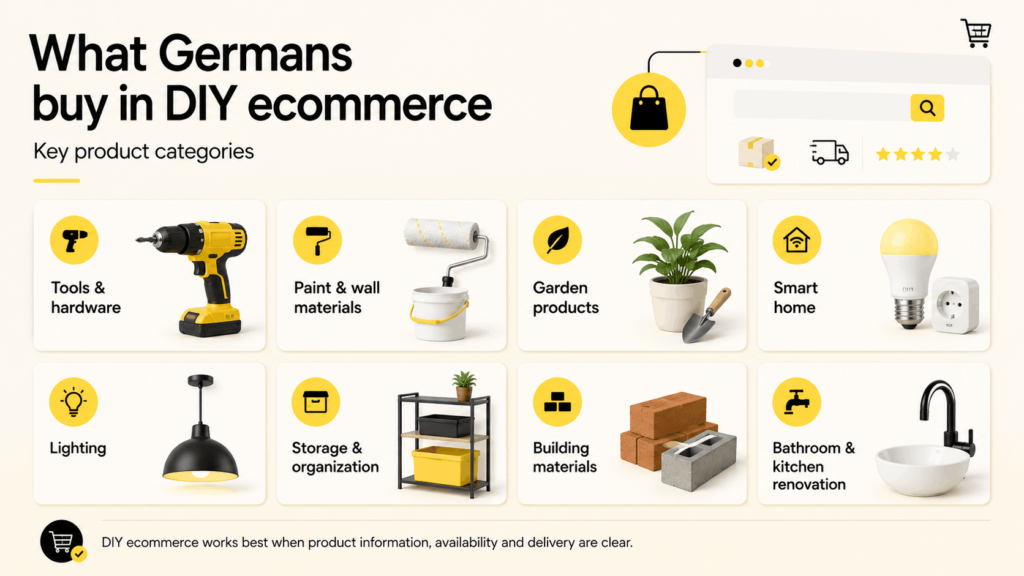
Others need stronger guidance, delivery support or compatibility information.
| Category | Why it works online | Ecommerce challenge |
| Tools and hardware | Easy to compare specs, prices and reviews | Compatibility and quality trust |
| Paint and wall materials | Project-driven and repeatable around renovation | Color accuracy and shipping constraints |
| Garden products | Seasonal demand and bulky products | Timing, delivery and plant quality |
| Smart home | Research-heavy and high-value | Compatibility and installation |
| Lighting | Visual and technical purchase | Specs, imagery and room context |
| Storage and organization | Strong home improvement fit | Dimensions and use-case clarity |
| Building materials | High-value and project-led | Heavy delivery and availability |
| Bathroom/kitchen renovation | High intent and large baskets | Planning support and delivery complexity |
The most ecommerce-friendly DIY categories are not always the easiest to ship.
Tools and small hardware are simple. Garden products, paint, building materials and large renovation items are harder. That is why delivery clarity matters so much in DIY ecommerce.
A customer buying a lamp may accept standard delivery. A customer buying decking boards, soil or tiles needs more detail.
DIY ecommerce customer journey
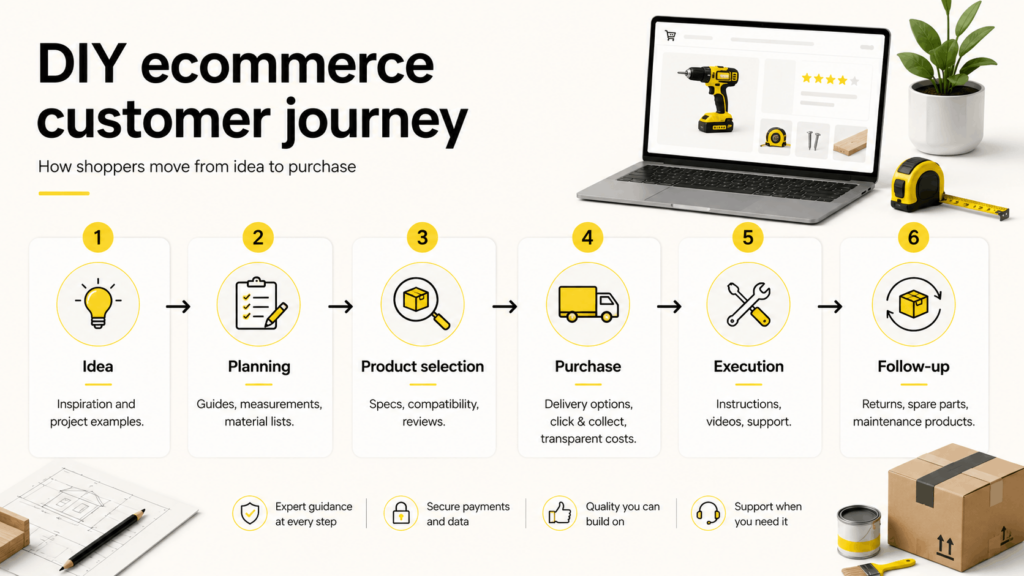
The DIY customer journey is project-led. Retailers that understand this can create better content, better product pages and better conversion paths.
| Stage | What shoppers need |
| Idea | Inspiration, project examples, before/after content |
| Planning | Guides, calculators, measurements, material lists |
| Product selection | Specs, compatibility, reviews, availability |
| Purchase | Delivery options, click & collect, transparent costs |
| Execution | Instructions, videos, customer support |
| Follow-up | Returns, spare parts, maintenance products |
This journey explains why DIY ecommerce needs more than search filters.
A shopper planning a garden bed may need soil calculators, plant advice, tools, edging, watering products and delivery timing. A shopper replacing lighting may need bulb compatibility, installation notes, room examples and return options.
The retailer that supports the whole journey can win more than one item in the basket.
DIY specialists vs marketplaces
German DIY shoppers move between specialist retailers, marketplaces, multi-category retailers and garden specialists.
Each option has a different role.
| Option | Best for | Risk |
| DIY specialists | Project support, category depth, trust | Sometimes less convenient than marketplaces |
| Marketplaces | Speed, reviews, price comparison | Quality inconsistency and less project guidance |
| Multi-category retailers | Home + DIY basket building | Less specialist authority |
| Garden specialists | Seasonal expertise | Narrower DIY range |
This is why online DIY stores in Germany need clear positioning.
A DIY specialist should not try to look like Amazon. It should lean into project help, expertise, local availability and trust.
A marketplace should make quality, delivery and seller information easier to understand.
A garden specialist should own seasonal expertise and care guidance.
A multi-category retailer should make home improvement feel easy and connected to furniture, lighting, storage and decor.
Trends shaping German DIY ecommerce in 2026
Cautious consumers still want value
German consumers are more selective than they were during the pandemic DIY boom.
They may delay large renovations, compare prices harder or choose smaller projects. This does not kill DIY demand, but it changes the type of demand retailers should expect.
Smaller repairs, affordable upgrades, energy-saving products, storage, lighting and garden improvements can stay attractive when people avoid expensive projects.
Project content matters more
DIY shoppers often need help before they need a product.
Retailers should build content around projects, not only categories. Examples include:
- how to paint a small bathroom,
- how to choose balcony plants,
- how to install smart lighting,
- what tools you need for basic home repairs,
- how to calculate paint quantity,
- how to prepare a garden for spring.
This content supports SEO, customer trust and basket building.
Click & collect remains useful
DIY products are often heavy, bulky or needed quickly.
Click & collect can solve several problems at once. It gives customers online convenience, local availability and faster access to the product.
For DIY retailers with strong store networks, this is one of the biggest advantages over pure marketplaces.
Delivery clarity can win or lose the sale
DIY delivery is not always simple.
Customers need to know:
- when the product will arrive,
- how much delivery costs,
- if the item is delivered to the door or curbside,
- if large items need special handling,
- if partial delivery is possible,
- how returns work.
Hiding these details until checkout creates frustration.
Smart home and energy-efficiency projects stay relevant
Smart home products, lighting, insulation, heating-related products and energy-saving upgrades remain important for home improvement shoppers.
These categories need especially clear content because customers often worry about compatibility and installation.
Retailers should explain which products work together, what customers can install themselves and when professional help may be needed.
Marketplace pressure keeps rising
Marketplaces shape customer expectations around reviews, delivery, stock visibility and price comparison.
DIY specialists need to respond with more expertise, stronger content and better project support.
For DACH-wide context, see our article on DACH trends for 2026.
What DIY ecommerce teams should focus on
| Focus area | Why it matters |
| Product data | DIY shoppers need specs, dimensions, compatibility and material information |
| Project content | Customers often buy for a task, not a single product |
| Local stock visibility | Many DIY purchases are time-sensitive |
| Delivery transparency | Bulky and heavy products need clear logistics information |
| Returns clarity | DIY returns can be difficult and expensive |
| Search and filters | Customers need to find the right product fast |
| Reviews | Quality trust matters in tools, smart home and materials |
| Bundles | Projects often need several products together |
| Automation | Order tracking, support and returns can reduce operational pressure |
AI and automation can also help retailers manage repetitive support questions, delivery updates and product recommendations. We covered more practical examples in best e-commerce automations for DACH retailers using AI.
Common mistakes in DIY ecommerce
Selling products instead of projects
DIY customers often need an outcome.
A product grid alone does not answer questions like: “What do I need to repair this?” or “Which products work together?”
Hiding delivery details
Bulky delivery is one of the biggest friction points in DIY ecommerce.
Customers should see delivery costs, delivery type and timing early.
Weak product information
DIY products need detailed descriptions.
Dimensions, material, use case, compatibility, safety notes and installation guidance can all influence conversion.
Treating all customers as experts
Not every DIY shopper is experienced.
Some customers need simple explanations. Others need technical details. Strong ecommerce experiences support both.
Ignoring store network advantages
DIY retailers with stores should use that advantage online.
Local stock, pickup, returns, advice and services can help them compete with marketplaces.
FAQ: online DIY stores in Germany
What are the best online DIY stores in Germany?
The best online DIY stores in Germany include OBI, Bauhaus, Hornbach, Hagebau, Toom, Globus Baumarkt, Hellweg and Dehner for garden-related purchases. Amazon, ManoMano, Otto and IKEA also matter, but they play different roles in the DIY and home improvement journey.
Is Amazon a DIY store in Germany?
Amazon is not a specialist DIY store, but it is a major place for tools, accessories, smart home devices, hardware and small home improvement products. Its strength is convenience, reviews and fast delivery. Its weakness is limited project guidance compared with specialist DIY retailers.
Is ManoMano relevant in Germany?
Yes. ManoMano is relevant because it is a specialist marketplace for DIY, home improvement and garden products. It sits between classic DIY stores and general marketplaces.
What do Germans buy online in DIY ecommerce?
German shoppers buy tools, hardware, paint, garden products, lighting, storage, smart home devices, building materials and home improvement supplies online. The strongest ecommerce categories are often those where customers can compare specs, check availability or avoid carrying heavy products home.
What makes DIY ecommerce different from other categories?
DIY ecommerce is project-led. Customers often need planning content, measurements, compatibility information, delivery details and instructions before buying. That makes content and product data more important than in many simpler retail categories.
What should DIY retailers focus on in 2026?
DIY retailers should focus on project content, better product data, local stock visibility, click & collect, delivery transparency, customer support and returns clarity. These areas reduce doubt and help customers complete projects, not just buy products.
Conclusion
The German DIY market is still huge, but the easy-growth story is over.
Classic DIY stores are under pressure, consumers are more careful and marketplaces keep raising expectations. At the same time, ecommerce gives DIY retailers new ways to win: project content, online planning, better product data, local stock visibility, click & collect, delivery clarity and specialist advice.
The best online DIY stores in Germany are not only the ones with the biggest product ranges.
They are the ones that help customers move from “I have a project” to “I know what to buy, when it will arrive and how to use it.”
That is the real opportunity in German DIY ecommerce in 2026.
***