Top e-commerce companies worldwide in 2026
See the world’s largest e-commerce companies in 2026, ranked by 2025 GMV, including Alibaba, PDD Holdings, Amazon, ByteDance, JD.com and more.

Global ecommerce is enormous, but the market is much more concentrated at the top than a list of thousands of retailers might suggest.
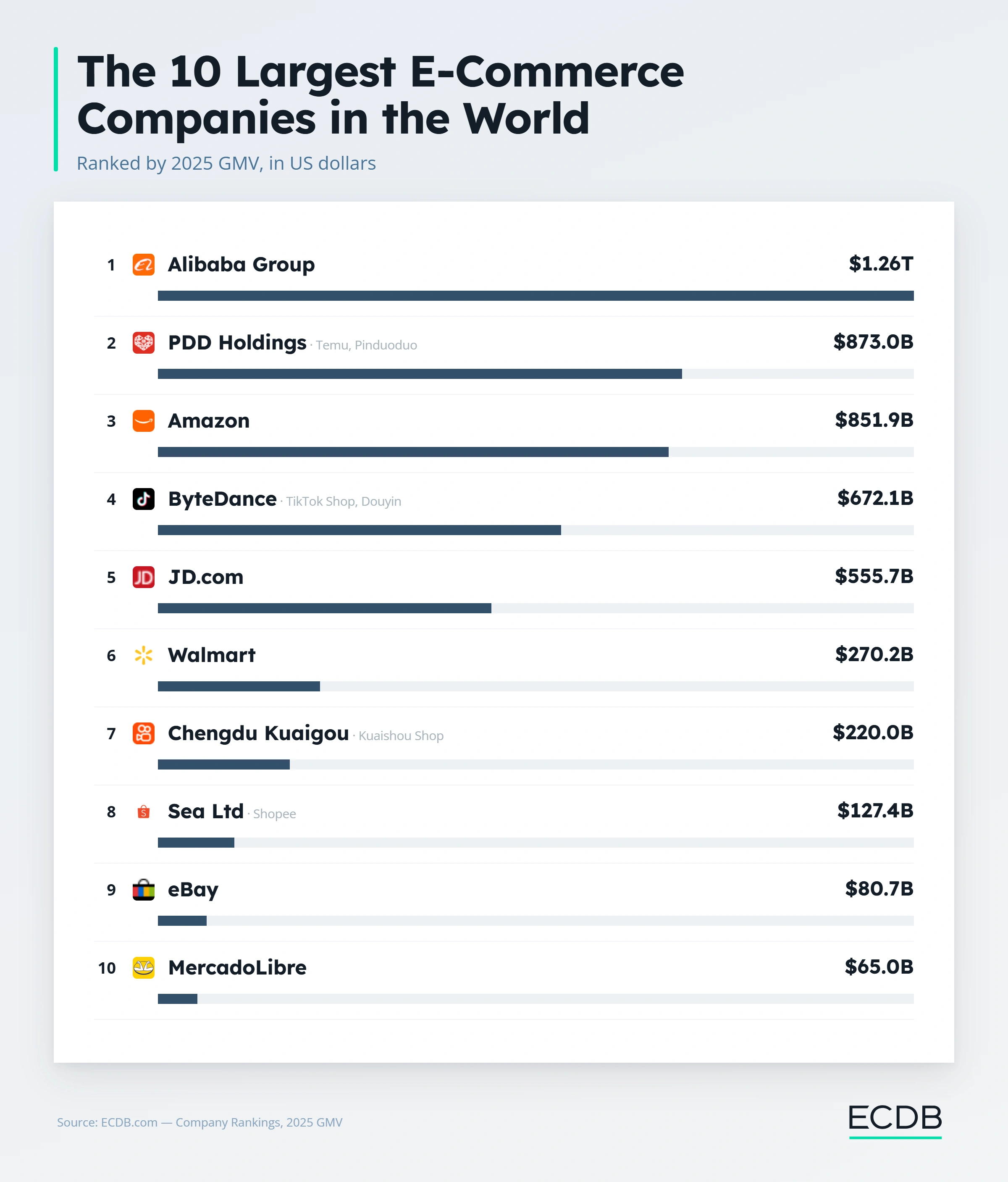
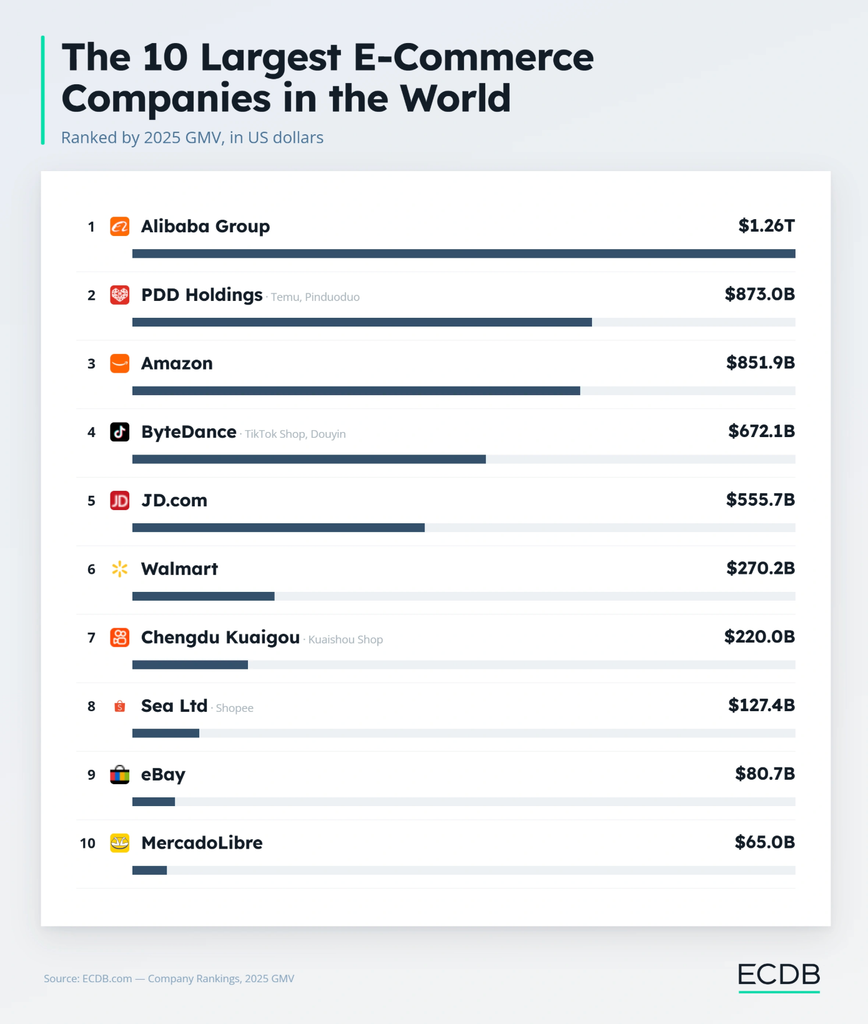
In 2025, worldwide ecommerce generated about $4.9 trillion in revenue. A relatively small group of companies accounted for a substantial share of the merchandise sold online, led by Alibaba, PDD Holdings and Amazon.
For this 2026 update, we are ranking companies primarily by 2025 gross merchandise value (GMV) rather than corporate revenue. That distinction matters. GMV measures the total value of goods sold through an ecommerce platform, while company revenue is the money the company itself records from retail sales, fees, advertising, subscriptions and other services.
Here are the biggest ecommerce companies in the world based on the latest comparable GMV data. For a broader market-level view, see our global e-commerce overview.
Top e-commerce companies in the world at a glance
| Rank | Company | Main ecommerce platforms | 2025 GMV | Core market |
| 1 | Alibaba Group | Taobao, Tmall, AliExpress | $1.26T | Greater China / global |
| 2 | PDD Holdings | Pinduoduo, Temu | $873.0B | China / global |
| 3 | Amazon | Amazon marketplaces | $851.9B | US / global |
| 4 | ByteDance | TikTok Shop, Douyin ecommerce | $672.1B | China / global |
| 5 | JD.com | JD.com | $555.7B | China |
| 6 | Walmart | Walmart ecommerce | $270.2B | US / global |
| 7 | Chengdu Kuaigou Technology | Kuaishou ecommerce | $220.0B | China |
| 8 | Sea Ltd | Shopee | $127.4B | Southeast Asia / Latin America |
| 9 | eBay | eBay marketplaces | $80.7B | US / global |
| 10 | Mercado Libre | Mercado Libre | $65.0B | Latin America |
Methodology note: GMV figures above are based on the latest ECDB ranking published in July 2026 and refer to merchandise sold in 2025. The ranking is designed to compare ecommerce activity rather than total corporate revenue.
What does “largest e-commerce company” actually mean?
There are several ways to rank ecommerce companies, which is why different lists can produce different winners. The market itself is already measured in trillions: the previous edition of this ranking referenced Statista’s global ecommerce revenue forecast, which projected about $4.8 trillion for 2025.
GMV
Gross merchandise value measures the value of goods sold through a platform before deductions such as returns, discounts or marketplace fees.
GMV is especially useful for comparing marketplaces because a platform such as Alibaba or eBay may facilitate a huge amount of commerce without recording the full merchandise value as its own revenue.
Ecommerce revenue
Revenue measures the money a company recognizes in its financial statements. For a first-party retailer, that may include the full value of products it sells. For a marketplace, it may include only commissions, advertising, logistics fees or other services.
Traffic
Some rankings use website or app visits. Traffic is useful for measuring attention but does not tell us how much customers spend.
Market capitalization
Market value can show investor expectations, but it is not a measure of ecommerce activity. A diversified company may have a high appraisal according to business valuation companies because of cloud computing, advertising, fintech or other businesses.
For this article, GMV gives the clearest cross-company view of how much online commerce each group facilitates.
1. Alibaba Group
Alibaba remains the world’s largest ecommerce company measured by GMV.
Its ecommerce ecosystem includes Taobao and Tmall in China as well as international businesses such as AliExpress. Together, Alibaba’s platforms generated about $1.26 trillion in GMV in 2025.
That scale puts Alibaba well ahead of most competitors. It also shows why the company can look very different depending on the ranking methodology. Alibaba does not record the full value of every marketplace transaction as revenue, so a revenue-only comparison can understate the scale of commerce happening across its platforms.
Alibaba’s strength comes from the density of its marketplace ecosystem, merchant base, logistics infrastructure and digital services.
Why it matters: Alibaba remains the benchmark for marketplace scale, especially in Greater China.
For more context on the marketplace ecosystem behind several companies in the ranking, see our 2026 overview of leading marketplaces in Asia.
2. PDD Holdings
PDD Holdings has become one of the most important ecommerce groups in the world.
The company owns Pinduoduo, a major Chinese ecommerce platform, and Temu, which expanded internationally at extraordinary speed.
Combined GMV reached about $873 billion in 2025, placing PDD Holdings slightly ahead of Amazon in the latest ECDB company ranking.
Pinduoduo built its growth around value-focused shopping, recommendation-led discovery and highly competitive pricing. Temu exported a similarly aggressive proposition to markets across North America, Europe and elsewhere.
The result is a company that has moved from being primarily a China story to a major global ecommerce competitor.
Why it matters: PDD demonstrates how quickly cross-border ecommerce can reshape the global leaderboard.
3. Amazon
Amazon is still the world’s largest single ecommerce retailer in many country and store-level rankings, and it remains the company most consumers outside China associate with global online shopping.
Its ecommerce GMV reached about $851.9 billion in 2025.
Amazon combines first-party retail with a huge third-party marketplace. It also supports sellers through fulfillment, advertising, payments and logistics services.
Prime continues to strengthen the ecosystem by connecting fast delivery, entertainment and membership benefits. At the same time, Amazon has been investing heavily in AI-supported shopping, faster fulfillment and automation across its logistics network.
For sellers, Amazon is not simply a storefront. It is an entire commerce infrastructure with discovery, fulfillment and advertising built into one platform.
Why it matters: Amazon remains the most influential global model for marketplace-led retail combined with logistics and membership.
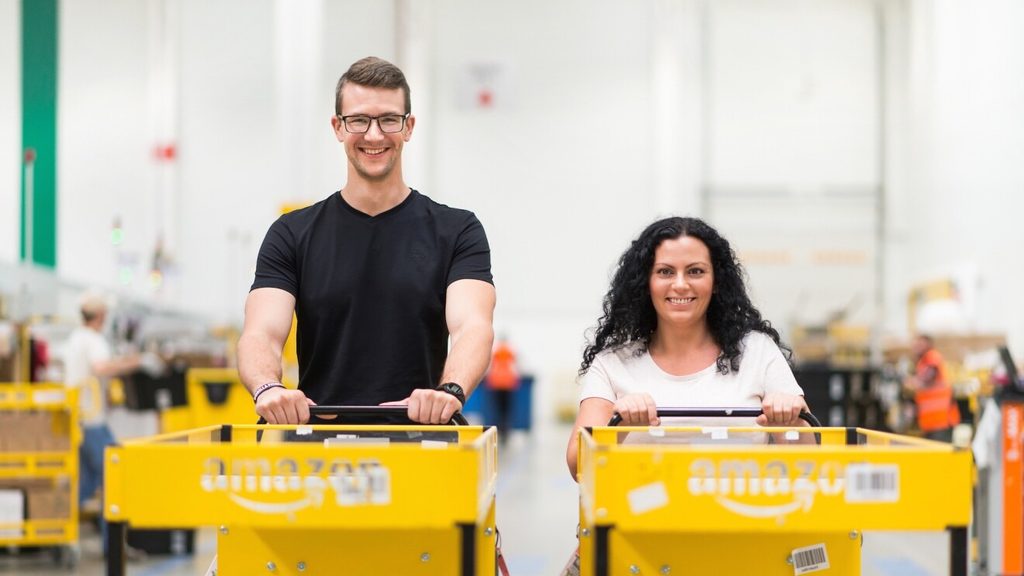
Germany is one of Amazon’s largest international markets. See how Amazon compares with local players in our ranking of the top online stores in Germany.
4. ByteDance
ByteDance is proof that ecommerce no longer needs to begin with a search bar.
The company behind TikTok and Douyin has turned content feeds into major shopping environments. Its ecommerce activity reached roughly $672.1 billion in GMV in 2025 according to ECDB’s company ranking.
Much of that scale is connected to Douyin ecommerce in China, while TikTok Shop continues to expand in international markets.
The model is different from traditional marketplace shopping. Products are discovered through creators, short videos, livestreams and algorithmic recommendations rather than only through category browsing and search.
That makes ByteDance one of the most important companies shaping the future of social commerce.
Why it matters: ByteDance has made entertainment-driven product discovery a core ecommerce channel.
For the German-market angle on content-led shopping, see our guide to social commerce in Germany.
5. JD.com
JD.com remains one of China’s largest ecommerce companies, with approximately $555.7 billion in 2025 GMV.
Its model is often contrasted with marketplace-heavy competitors because JD has historically invested heavily in first-party retail, warehousing and logistics.
That infrastructure gives the company tight control over fulfillment and customer experience in its core market. JD also operates marketplace services and logistics capabilities for external businesses.
The company is particularly strong in categories such as electronics and home appliances.
Why it matters: JD.com shows the advantage of controlling a large part of the logistics stack rather than relying only on third-party sellers and carriers.
6. Walmart
Walmart is a physical retail giant, but it is also one of the largest ecommerce businesses in the world.
ECDB estimates Walmart’s ecommerce GMV at around $270.2 billion in 2025.
Its advantage is the connection between digital commerce and an enormous store network. Customers can combine delivery, pickup and store visits, while Walmart can use physical locations as part of its fulfillment infrastructure.
That omnichannel model has become increasingly important as consumers expect online convenience without giving up local availability.
Why it matters: Walmart demonstrates how a large store network can become an ecommerce asset rather than a legacy burden.
7. Chengdu Kuaigou Technology / Kuaishou ecommerce
Chengdu Kuaigou Technology, associated with Kuaishou’s ecommerce operations, is one of the less familiar names on the global top 10 despite its enormous scale.
ECDB puts its 2025 GMV at around $220 billion.
Kuaishou combines short-form video, livestreaming and ecommerce. Similar to Douyin, it has helped normalize a shopping journey where entertainment, creator content and purchasing happen inside the same digital environment.
Its presence in the ranking is also a useful reminder that Western brand recognition does not always reflect global ecommerce scale.
Why it matters: Kuaishou is another example of China leading the integration of video, livestreaming and commerce.
8. Sea Ltd / Shopee
Sea Ltd is the parent company of Shopee, one of the strongest ecommerce platforms across Southeast Asia and a significant player in Brazil.
ECDB estimates Sea’s ecommerce GMV at around $127.4 billion in 2025. Sea itself reported strong Shopee growth during 2025 and entered 2026 targeting another substantial increase in annual GMV.
Shopee built much of its growth around mobile-first shopping, localized payments, logistics, promotional events and a marketplace model suited to fast-growing digital economies.
Its strength differs by country, but the platform has become a key part of ecommerce infrastructure across markets including Indonesia, Vietnam, Thailand, the Philippines and Brazil.
Why it matters: Shopee shows how localization can be more powerful than trying to run one identical marketplace experience worldwide.
Shopee’s position is easier to understand in the wider regional context. See our updated list of leading marketplaces in Asia.
9. eBay
eBay is no longer the fastest-growing name in global ecommerce, but it remains one of the largest marketplaces in the world.
Its 2025 GMV was about $80.7 billion.
The platform has become more focused on categories where its marketplace structure gives it an advantage, including collectibles, refurbished electronics, automotive parts, luxury products and secondhand goods.
Authentication programs and specialist buyer communities have helped eBay retain relevance even as Amazon, Temu and social commerce platforms changed the market around it.
Why it matters: eBay remains a major global marketplace and a strong example of how specialization can defend a mature ecommerce platform.
10. Mercado Libre
Mercado Libre is the ecommerce leader of Latin America and one of the most important digital companies in the region.
ECDB estimates its 2025 ecommerce GMV at around $65 billion. Mercado Libre also reported very strong growth through 2025 across both commerce and fintech.
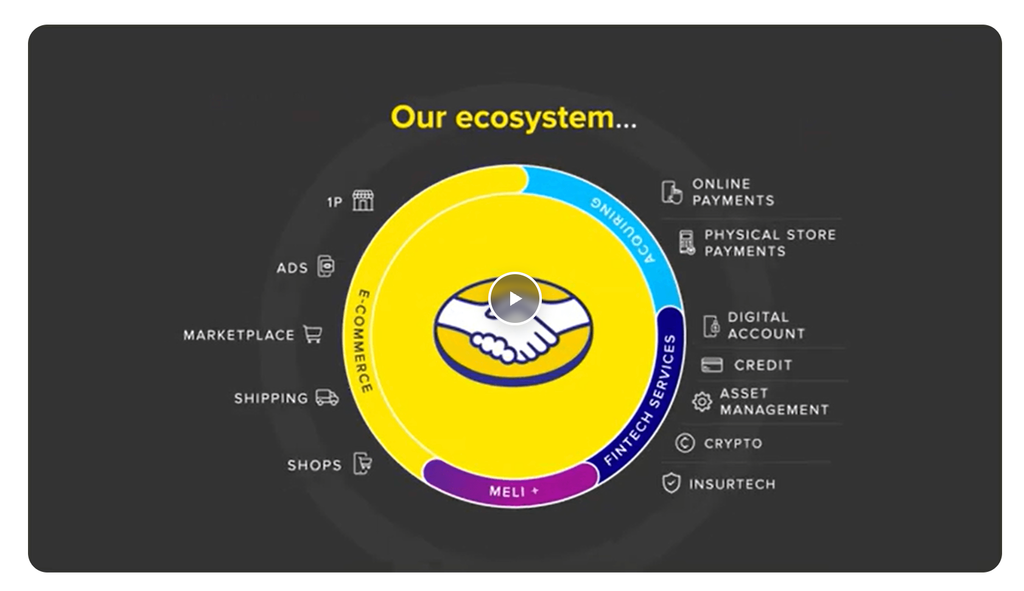
Its advantage comes from an ecosystem that combines marketplace transactions with logistics, advertising and financial services such as Mercado Pago.
That integration is especially important in markets where payments, access to credit and delivery infrastructure can be more fragmented than in Western Europe or the United States.
Why it matters: Mercado Libre is the clearest example of a regional ecommerce leader building an ecosystem around local market needs.
Other major e-commerce companies to watch
The top 10 is not the whole story. Several companies sit outside the latest global GMV top 10 but still have major influence in specific regions or categories.
Coupang
Coupang is one of South Korea’s leading ecommerce companies. It reported $34.5 billion in total net revenue for 2025 and had 24.6 million product-commerce active customers at the end of the year.
Its Rocket Delivery model and dense logistics network have made speed a central part of its customer proposition.
SHEIN
SHEIN remains one of the world’s most visible fashion ecommerce companies. Its data-led product development, app-first shopping experience and cross-border supply chain helped reshape expectations around fast fashion online.
The company also faces growing regulatory, tariff and reputational pressure, making it one of the most closely watched ecommerce businesses in 2026.
Flipkart
Flipkart remains one of India’s most important ecommerce platforms and a major competitor to Amazon in one of the world’s fastest-growing digital retail markets.
Its marketplace spans electronics, fashion, home, grocery and other categories, while Walmart remains its controlling shareholder.
Rakuten
Rakuten is a major ecommerce ecosystem in Japan. Its marketplace sits alongside financial services, mobile, travel and a strong loyalty proposition built around Rakuten Points.
Zalando
Zalando remains one of Europe’s most important online fashion platforms, combining direct retail with marketplace and partner services.
For DACH brands, Zalando is especially relevant because of its strong position in Germany and wider European fashion ecommerce.
Largest ecommerce companies by region
| Region | Companies to know |
| Greater China | Alibaba, PDD Holdings, JD.com, ByteDance, Kuaishou |
| North America | Amazon, Walmart, eBay |
| Latin America | Mercado Libre, Shopee Brazil |
| Southeast Asia | Shopee, Lazada, TikTok Shop |
| South Korea | Coupang, Naver |
| India | Flipkart, Amazon India |
| Europe | Amazon, Zalando, Otto Group |
The regional view matters because there is no single global ecommerce market in practice. Payments, marketplaces, logistics and customer expectations differ substantially between countries.
Closer to home, our DACH trends for 2026 show how some of these global shifts translate into Germany, Austria and Switzerland.
What the ranking tells us about global ecommerce in 2026
China remains central to global ecommerce scale
Five of the top seven companies in the current GMV ranking are Chinese or primarily built around Chinese commerce ecosystems.
That concentration shows how large the Chinese ecommerce market remains and how influential its marketplace, livestreaming and social-commerce models have become.
Social commerce is now part of the top tier
ByteDance and Kuaishou are not traditional online retailers. Their position shows that product discovery is moving beyond search and category pages.
Commerce can now begin inside entertainment feeds and creator content.
Marketplaces still dominate
Most companies in the top 10 operate significant third-party marketplaces.
The model scales because the platform does not need to own every product it sells. Instead, it can build infrastructure around sellers, customers, logistics, advertising and payments.
Regional champions can still win
Shopee and Mercado Libre show that global scale does not require dominating the US, Europe and China simultaneously.
Deep localization can create enormous businesses in markets where a global one-size-fits-all model is less effective.
Logistics remains a competitive advantage
Amazon, JD.com, Walmart, Coupang and Mercado Libre have all invested heavily in making delivery faster and more predictable.
As ecommerce matures, logistics becomes part of the product experience rather than a back-office function.
FAQ
What is the largest ecommerce company in the world?
Alibaba is the world’s largest ecommerce company when measured by 2025 GMV at group level. ECDB estimates that its platforms generated about $1.26 trillion in GMV.
Is Alibaba bigger than Amazon?
Measured by ecommerce GMV in 2025, yes. Alibaba ranked first at approximately $1.26 trillion, while Amazon ranked third at about $851.9 billion. PDD Holdings ranked second at $873 billion.
What is the largest ecommerce retailer in the world?
At retailer level rather than parent-company level, Amazon ranks first in ECDB’s global retailer data, with approximately $847.35 billion in 2025 GMV.
What is GMV in ecommerce?
GMV, or gross merchandise value, is the total value of merchandise sold through an ecommerce platform during a given period. It is not the same as the company’s accounting revenue.
Which country has the biggest ecommerce market?
Greater China remains the world’s largest ecommerce market in ECDB’s global market data, followed by the United States.
Which ecommerce companies are growing fastest?
Growth changes from year to year, but social-commerce platforms, cross-border marketplaces and regional leaders such as PDD Holdings, ByteDance, Shopee and Mercado Libre have been among the companies reshaping the global market.
Final thoughts
The biggest change in the 2026 ecommerce leaderboard is not simply who ranks first.
It is the variety of models now sitting near the top.
Alibaba and PDD Holdings show the scale of marketplace commerce. Amazon and Walmart combine ecommerce with enormous logistics networks. ByteDance and Kuaishou turn content feeds into shopping channels. Shopee and Mercado Libre prove that regional localization can build global-scale businesses.
For retailers, the lesson is clear: ecommerce leadership is no longer only about having the biggest online store. The strongest companies are building ecosystems around discovery, payments, fulfillment, advertising and customer retention.
For the technology layer behind online retail, compare the best e-commerce platforms in DACH in 2026.
***