Best e-commerce platforms in DACH in 2026
Compare the best e-commerce platforms in DACH in 2026, from Shopify, WooCommerce and Shopware to Adobe Commerce, Spryker and commercetools.

Choosing an e-commerce platform in DACH is not only a technology decision.
The right platform affects payments, VAT, fulfilment, marketplaces, language, legal pages, product data, price comparison feeds, B2B workflows and how easily a retailer can scale across Germany, Austria and Switzerland.
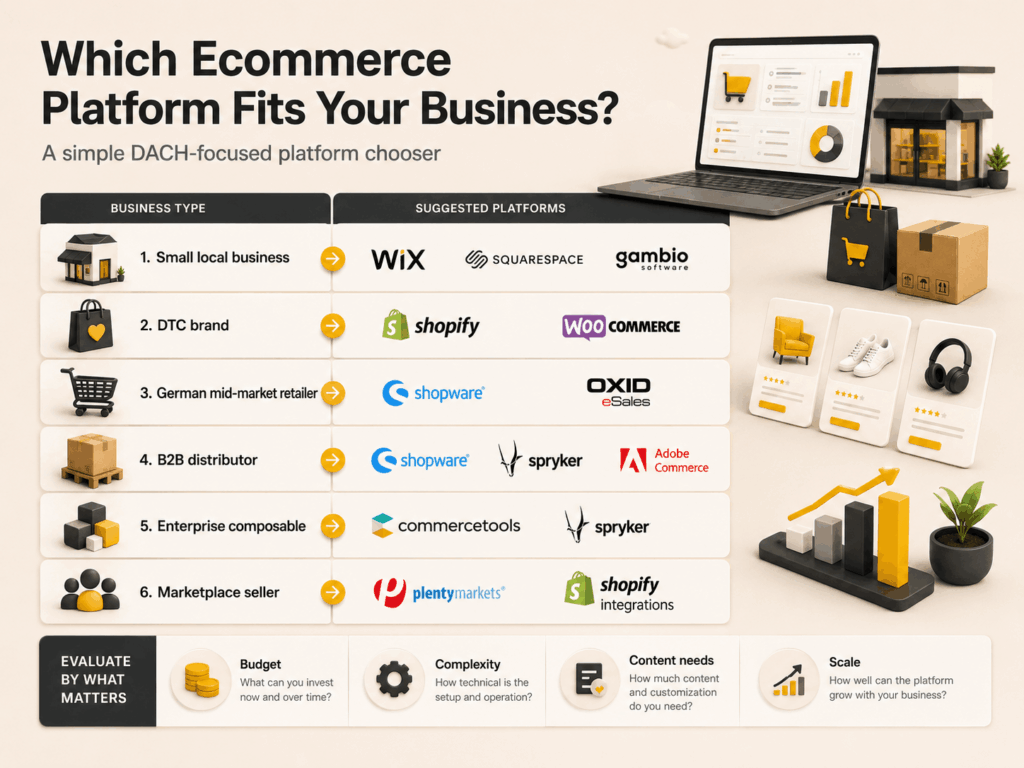
A small DTC brand may need Shopify or WooCommerce. A German mid-market retailer may prefer Shopware. A B2B distributor may need Shopware, Adobe Commerce, OXID eSales or Spryker. A large enterprise with complex architecture may look at commercetools or another composable commerce setup.
This guide compares the best e-commerce platforms in DACH in 2026 by use case, platform type and business model.
For wider market context, read our complete guide to understanding the DACH market.
TL;DR: best e-commerce platforms in DACH by use case
| Use case | Best-fit platforms |
| Fast DTC launch | Shopify, Wix, Squarespace |
| WordPress or content-led store | WooCommerce |
| German-market retail | Shopware, Gambio, OXID eSales |
| B2B commerce | Shopware, Spryker, Adobe Commerce, OXID eSales, Sana Commerce |
| Enterprise composable commerce | commercetools, Spryker |
| Marketplace and multichannel operations | plentymarkets, Shopify, Shopware integrations |
| Open-source flexibility | WooCommerce, PrestaShop, Shopware Community, Magento Open Source |
| Smaller local business | Shopify, WooCommerce, Wix, Gambio |
| Complex multi-store retail | Adobe Commerce, Shopware, commercetools, Spryker |
| Headless commerce | commercetools, Spryker, Adobe Commerce, Shopware |
E-commerce platform market in DACH: what changed in 2026?
The DACH platform landscape is more fragmented than many international merchants expect.
Shopify is strong and growing. WooCommerce remains widely used, especially among WordPress-led stores. Shopware has a special role in Germany and the wider DACH ecosystem. Adobe Commerce, Spryker and commercetools serve more complex enterprise and B2B needs.
Platform market share depends heavily on methodology. Some datasets count every detected store. Some count active stores. Some focus on top retailers. Others track technology installs, domains or traffic-heavy websites.
That means a platform can look dominant in one dataset and smaller in another.
ShopRank’s June 2026 Germany dataset, for example, shows WooCommerce at 38.1% of detected ecommerce stores, Shopify at 22.1% and custom-built stores at 17.4%. ShopRank also notes that its broader view includes all domains where ecommerce signals were detected, which can include inactive or non-transactional stores.
Shopware’s position looks different when you examine Germany’s largest retailers. Shopware says the latest EHI study confirmed it as the leading shop system among Germany’s top 1,000 online shops for the fourth consecutive year.
For enterprise commerce, the numbers tell another story again. commercetools reported that it surpassed a $100 billion GMV run-rate in Q1 2026, with customers generating more than 600 million orders annually.
The lesson is simple: do not choose a platform because a ranking says it is “number one”. Choose it because it fits your operating model.
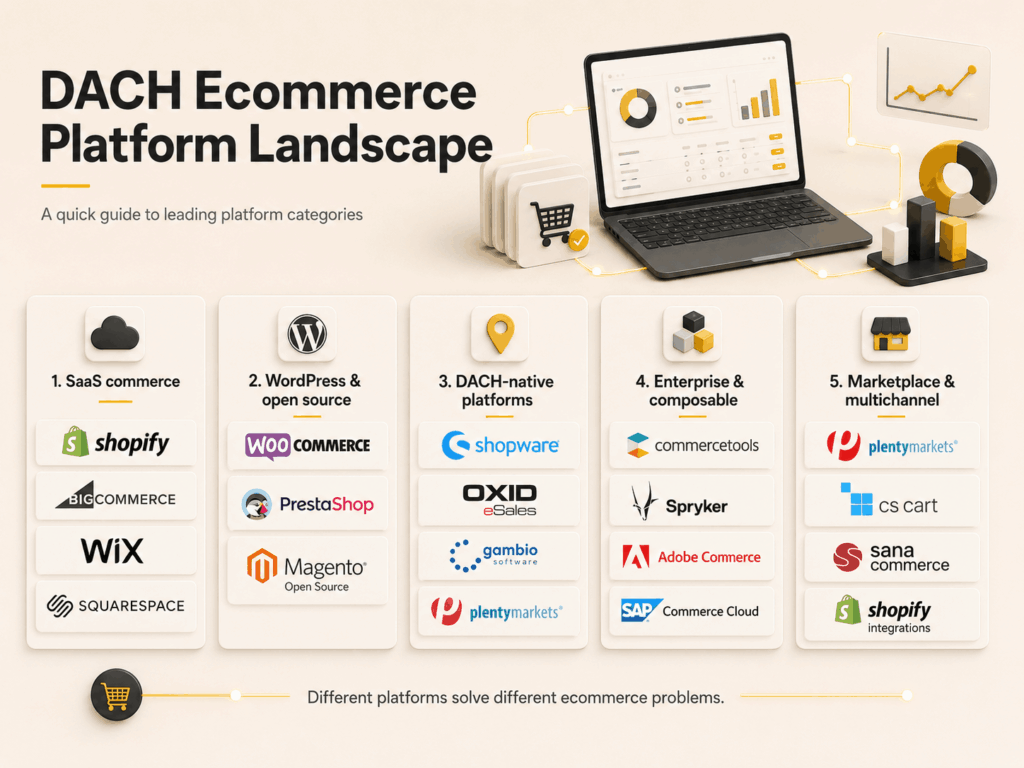
Main types of e-commerce platforms in DACH
Before comparing individual platforms, it helps to understand the main categories.
| Platform type | Examples | Best for | Main trade-off |
| SaaS ecommerce | Shopify, BigCommerce, Wix, Squarespace | Fast launch, managed infrastructure, smaller teams | Less backend control and app dependency |
| WordPress commerce | WooCommerce | Content-led stores, flexible SMB ecommerce | Hosting, plugin quality and maintenance |
| DACH-native commerce | Shopware, OXID eSales, Gambio | German-market retailers, agencies, B2B/B2C | May need stronger local implementation support |
| Enterprise / composable commerce | commercetools, Spryker, Adobe Commerce | Large merchants, B2B, multi-market complexity | Higher cost and implementation complexity |
| Multichannel operations | plentymarkets | Marketplace sellers and inventory-heavy operations | More operations-led than storefront-led |
| Open-source commerce | WooCommerce, PrestaShop, Magento Open Source, Shopware Community | Customization and ownership | More technical responsibility |
For most merchants, the decision is not “Which platform is best?” It is “Which platform fits our current stage and next growth stage?”
How to choose an e-commerce platform in DACH
DACH ecommerce has local requirements that generic platform comparisons often miss.
| Decision factor | Why it matters in DACH |
| German-language support | Product, checkout, legal and support content need proper localization |
| Payment methods | PayPal, cards, Klarna, invoice, SEPA and local Swiss methods can matter |
| VAT and tax logic | Cross-border selling across Germany, Austria and Switzerland needs clean setup |
| Legal pages | Impressum, privacy policy, returns and consumer terms must be handled properly |
| Marketplace integrations | Amazon, eBay, Kaufland, Zalando and other channels may matter |
| Price comparison feeds | idealo, billiger.de and other comparison platforms need clean product data |
| Fulfilment integrations | DACH customers expect reliable delivery and clear returns |
| B2B features | Customer-specific pricing, quoting, ERP integration and approval flows may be needed |
| Agency ecosystem | Many DACH merchants rely on local implementation partners |
| Scalability | Migration is expensive, so choose for the next stage, not only today |
| Data privacy | Consent, tracking and personalization need careful setup |
| Product data | Clean product content supports marketplaces, search, feeds and AI discovery |
For related decisions, see our guides to top payment providers in the DACH region, price comparison platforms in DACH and top fulfilment centres and logistics operators in Germany.
Best e-commerce platforms in DACH: comparison table
| Platform | Best for | Main strength | Watch out |
| Shopify | DTC, SMB, fast scaling | Ease of use, app ecosystem, omnichannel | App costs, customization limits, payment setup |
| WooCommerce | WordPress-led stores | Flexibility, content, ownership | Maintenance, hosting, plugin quality |
| Shopware | DACH retail, B2B/B2C | German ecosystem, flexibility, DACH relevance | More implementation complexity than simple SaaS |
| Adobe Commerce | Enterprise retail, complex catalogues | Customization, multi-store, B2B features | Cost and developer resources |
| commercetools | Enterprise composable commerce | API-first, headless, large-scale architecture | Not for simple stores |
| Spryker | Enterprise B2B/B2C and marketplaces | Modular architecture, complex use cases | High implementation needs |
| BigCommerce | Mid-market SaaS commerce | SaaS convenience with flexibility | Smaller DACH footprint than Shopify or Shopware |
| Wix | Small businesses | Easy setup and templates | Not ideal for complex commerce |
| Squarespace | Visual brands, simple catalogues | Design-led experience | Limited for advanced retail |
| Gambio | German SMEs | Local market fit and easier setup | Smaller global ecosystem |
| OXID eSales | German B2B/B2C | DACH heritage and B2B capabilities | Smaller mindshare than Shopware |
| plentymarkets | Multichannel sellers | Marketplace and inventory connections | More operations-led than storefront-led |
| PrestaShop | Open-source SMB | Cost control and customization | DACH ecosystem weaker than Shopware/WooCommerce |
| CS-Cart | Multi-vendor marketplaces | Marketplace functionality | Less common as a default DACH choice |
| Ecwid | Add-on ecommerce | Adds commerce to existing websites | Not always a full platform replacement |
Best e-commerce platforms in DACH in 2026
1. Shopify
Best for: DTC brands, SMB retailers, fast launches, international selling and teams that want a managed SaaS platform.
Shopify is one of the strongest ecommerce platforms globally and has clear momentum in Germany. ShopRank’s June 2026 Germany dataset estimated Shopify at 22.1% of detected ecommerce stores in the country.
Shopify works well for DACH merchants that want to launch quickly, manage products without heavy technical overhead and connect commerce with channels such as social media, marketplaces, POS and email.
Why it works in DACH:
- fast setup compared with custom builds;
- strong app ecosystem;
- multilingual and multi-market capabilities;
- good fit for DTC and growth-stage brands;
- integrations with many payment, marketing, fulfilment and marketplace tools.
Watch out: Shopify can become expensive when a store depends heavily on paid apps, custom themes or advanced workflows. B2B, custom checkout requirements and complex ERP integrations should be scoped carefully before scaling.
DACH fit: Strong for DTC, SMB and mid-market brands that want speed, stability and international expansion.
2. WooCommerce
Best for: WordPress-led stores, content-heavy brands, publishers, smaller businesses and merchants that want flexibility.
WooCommerce remains widely used in Germany. ShopRank’s June 2026 dataset estimated WooCommerce at 38.1% of detected ecommerce stores in Germany, ahead of Shopify in that broad store-detection view.
WooCommerce is attractive because it sits inside WordPress. That makes it useful for brands where content, SEO, guides, blog posts, education and product discovery are closely connected.
Why it works in DACH:
- strong content and SEO flexibility;
- broad developer ecosystem;
- open-source foundation;
- large plugin marketplace;
- good fit for small and mid-sized stores with content needs.
Watch out: WooCommerce quality depends on hosting, plugin choices, maintenance, security and developer discipline. Poor plugin stacks can create slow sites, checkout issues and technical debt.
DACH fit: Strong for WordPress-first businesses, content-led ecommerce and merchants that want control without moving into enterprise architecture.
3. Shopware
Best for: German and DACH retailers, B2B/B2C commerce, mid-market merchants and businesses that want a strong local ecosystem.
Shopware is one of the most important ecommerce platforms in DACH. It has a special position in Germany, especially among more serious retailers that need flexibility, localization and access to DACH agencies.
Shopware says the latest EHI study confirmed it as Germany’s market leader among shop systems in the top 1,000 online shops for the fourth consecutive year.
Why it works in DACH:
- strong German-market relevance;
- flexible architecture;
- B2C and B2B support;
- strong agency ecosystem in DACH;
- useful for merchants that need more than a simple SaaS storefront.
Watch out: Shopware is more powerful than a basic website builder, but it also needs more implementation planning. Hosting, extensions, agency work and integration scope should be budgeted properly.
DACH fit: Very strong for German and DACH merchants that want a flexible commerce platform with local-market credibility.
4. Adobe Commerce / Magento
Best for: Enterprise merchants, complex catalogues, multi-store setups, international retail and B2B/B2C commerce.
Adobe Commerce, formerly Magento Commerce, remains relevant for large ecommerce organizations with complex requirements.
It can support sophisticated catalogues, multi-store structures, customer groups, B2B features, integrations and custom front-end experiences. It is not usually the simplest or cheapest route, but it remains a serious option for merchants that need heavy customization.
Why it works in DACH:
- strong enterprise feature set;
- multi-store and multi-language support;
- mature partner ecosystem;
- B2B and B2C capabilities;
- flexibility for complex catalogues and custom workflows.
Watch out: Adobe Commerce requires significant development, maintenance and implementation resources. Magento Open Source may still be used in some cases, but new projects should account for security, hosting, extension quality and long-term technical ownership.
DACH fit: Strong for larger retailers with complex architecture, budgets and internal or agency technical support.
5. commercetools
Best for: Enterprise composable commerce, headless architecture, large-scale retailers and complex multi-channel businesses.
commercetools is a German-founded, API-first commerce platform built for composable commerce.
It is not a simple online shop builder. It is designed for enterprises that need to separate commerce services from front-end experiences and connect multiple systems across channels, markets and touchpoints.
In Q1 2026, commercetools reported that it surpassed a $100 billion GMV run-rate and that customers generated more than 600 million orders annually.
Why it works in DACH:
- strong enterprise credibility;
- API-first architecture;
- headless and composable setup;
- suitable for complex international retailers;
- useful where commerce must connect to many front ends and systems.
Watch out: commercetools is not suitable for a simple SMB store. It needs architecture planning, implementation partners and a team that understands composable commerce.
DACH fit: Very strong for enterprise retailers and digital commerce teams with complex architecture needs.
6. Spryker
Best for: Enterprise B2B, B2C, marketplaces, complex commerce workflows and companies that need modular architecture.
Spryker is another major DACH-rooted enterprise commerce platform.
It is especially relevant for B2B, marketplace, B2C and complex transactional models where a simple storefront platform is not enough. Spryker is often considered when merchants need modularity, custom workflows and a flexible commerce operating model.
Why it works in DACH:
- strong B2B and enterprise positioning;
- modular architecture;
- suitable for marketplace and complex commerce models;
- good fit for multi-step buying journeys and advanced business logic.
Watch out: Spryker is not a plug-and-play ecommerce builder. It needs a serious implementation project, budget and technical team.
DACH fit: Strong for enterprise B2B, complex B2C and marketplace-style commerce.
7. BigCommerce
Best for: Mid-market and enterprise SaaS commerce, merchants that want managed infrastructure with more flexibility than a basic builder.
BigCommerce is a SaaS platform positioned between simple website builders and more complex enterprise commerce systems.
It can be useful for merchants that want hosted commerce infrastructure, strong APIs, multi-channel features and flexibility without running an open-source stack.
Why it works in DACH:
- SaaS convenience;
- strong catalogue and API capabilities;
- useful for mid-market retailers;
- supports multi-channel commerce;
- lower infrastructure burden than open-source platforms.
Watch out: BigCommerce has a smaller local footprint in DACH than Shopify, WooCommerce or Shopware, so merchants should check agency availability, integrations and local ecosystem fit.
DACH fit: Good for mid-market merchants that want SaaS commerce with more flexibility than entry-level tools.
8. plentymarkets
Best for: Marketplace sellers, multichannel operations, inventory-heavy merchants and retailers selling across Amazon, eBay and other channels.
plentymarkets is not only a storefront platform. It is more of an ecommerce ERP and multichannel operations system.
It can help merchants manage products, inventory, orders and marketplaces from one environment. That makes it especially relevant for DACH sellers that depend on marketplace visibility and operational control.
Why it works in DACH:
- strong marketplace and multichannel focus;
- useful for inventory and order management;
- relevant for Amazon/eBay/Kaufland-style selling;
- good for sellers that operate beyond one branded storefront.
Watch out: plentymarkets may be more operations-led than brand-experience-led. Merchants should decide whether they need an operations platform, a storefront platform or both.
DACH fit: Strong for marketplace and multichannel sellers.
9. OXID eSales
Best for: German B2B and B2C merchants, businesses with local implementation needs and companies that want DACH heritage.
OXID eSales is a German ecommerce platform with a long presence in the DACH market.
It is relevant for merchants that need B2B features, customer-specific logic, ERP connections and localized ecommerce workflows.
Why it works in DACH:
- German-market heritage;
- B2B and B2C capabilities;
- local partner ecosystem;
- good fit for custom German commerce projects.
Watch out: OXID has less global mindshare than Shopify, WooCommerce, Shopware or Adobe Commerce. Before choosing it, merchants should check available partners, roadmap, integrations and internal fit.
DACH fit: Good for German-market B2B/B2C projects where local ecosystem and customization matter.
10. Gambio
Best for: German SMEs, smaller retailers and merchants that want a locally relevant ecommerce platform.
Gambio is a German ecommerce platform often used by smaller and mid-sized businesses.
It can suit merchants that want a more local platform than international website builders, while avoiding the complexity of enterprise systems.
Why it works in DACH:
- German SME orientation;
- local-market fit;
- easier setup than enterprise platforms;
- useful for smaller retailers and local businesses.
Watch out: Gambio has a smaller international ecosystem than Shopify or WooCommerce. Merchants should check extension availability, design flexibility and long-term scalability.
DACH fit: Good for smaller German-speaking merchants that want a local ecommerce setup.
11. Wix
Best for: Small businesses, local retailers, service providers and simple ecommerce catalogues.
Wix is not the first choice for complex ecommerce, but it can be useful for businesses that need a simple website with basic selling features.
A local shop, consultant, small workshop, event business or service provider may not need Shopware or Adobe Commerce. It may need a clear website, a few products, bookings or simple checkout.
Why it works in DACH:
- fast website setup;
- easy templates;
- low technical barrier;
- good for simple stores or local businesses.
Watch out: Wix is not ideal for complex catalogues, advanced B2B logic, marketplace-heavy operations or sophisticated international commerce.
DACH fit: Good for small businesses and simple ecommerce needs.
12. Squarespace
Best for: Visual brands, creators, consultants and simple product catalogues.
Squarespace is strongest when design and presentation matter more than complex ecommerce operations.
It can work for artists, small premium brands, service providers, creators, studios and simple product businesses with a limited catalogue.
Why it works in DACH:
- strong visual templates;
- simple content and product presentation;
- useful for premium-looking small sites;
- low technical barrier.
Watch out: Squarespace is limited for advanced ecommerce, B2B, marketplace feeds, complex operations and multi-market retail.
DACH fit: Good for visual brands and simple stores, not for serious retail complexity.
13. PrestaShop
Best for: Open-source SMB commerce, merchants that want customization and cost control.
PrestaShop remains a relevant open-source ecommerce platform in parts of Europe.
It can work for merchants that want control and customization without moving into enterprise-grade systems. It may be attractive when budgets are limited but technical support is available.
Why it works in DACH:
- open-source flexibility;
- cost control;
- custom development options;
- suitable for certain SMB stores.
Watch out: In DACH, PrestaShop’s ecosystem is generally less central than WooCommerce, Shopware or Shopify. Merchants should check local agency support and extension quality.
DACH fit: Useful for specific open-source projects, but not always the default choice.
14. CS-Cart
Best for: Multi-vendor marketplace projects.
CS-Cart is most relevant when a business wants to build a marketplace with multiple sellers rather than a standard single-merchant online store.
That makes it different from Shopify, WooCommerce or Gambio.
Why it works in DACH:
- built for multi-vendor marketplace setups;
- useful where seller onboarding, commissions and marketplace workflows matter;
- can support more complex marketplace use cases than standard storefront tools.
Watch out: Marketplace businesses are difficult. Technology is only one part. Merchants also need seller acquisition, trust, compliance, payments, dispute handling and operations.
DACH fit: Useful for marketplace projects, not a general default ecommerce platform.
15. Ecwid
Best for: Adding ecommerce to an existing website, small catalogue selling and lightweight commerce.
Ecwid can be useful when a business already has a website and wants to add shopping functionality without rebuilding everything.
That makes it more of an add-on ecommerce solution than a full replacement for more serious retail platforms.
Why it works in DACH:
- easy to add to existing websites;
- suitable for small catalogues;
- relatively simple setup;
- useful for testing online sales.
Watch out: Ecwid should not be treated as the default choice for all DACH ecommerce. For larger catalogues, B2B, complex shipping, advanced data workflows or marketplace scaling, other platforms may be stronger.
DACH fit: Good for lightweight ecommerce and small businesses testing online sales.
Shopify vs Shopware vs WooCommerce in DACH
These three platforms are often compared by DACH merchants.
They can all work, but they are not the same choice.
| Question | Shopify | Shopware | WooCommerce |
| Fastest to launch | Strong | Medium | Medium |
| Best for German retail ecosystem | Good | Strong | Good |
| Best for content-led sites | Medium | Medium | Strong |
| Best for custom development | Medium | Strong | Strong |
| Best for B2B | Improving | Strong | Plugin-dependent |
| Best for non-technical teams | Strong | Medium | Medium |
| Ownership and control | Medium | Strong | Strong |
| DACH agency ecosystem | Strong | Very strong | Strong |
| Best for DTC | Strong | Good | Good |
| Best for complex mid-market retail | Good | Strong | Medium to strong |
When to choose Shopify
Choose Shopify when speed, usability, app ecosystem and managed infrastructure matter most.
It is often a good fit for DTC brands, modern retail teams, small businesses and international sellers that want to move quickly.
When to choose Shopware
Choose Shopware when DACH relevance, flexibility, B2B/B2C support and local agency depth matter.
It is often a strong fit for German and DACH merchants with more complex requirements than a simple SaaS store.
When to choose WooCommerce
Choose WooCommerce when WordPress, content, SEO flexibility and ownership matter most.
It is often a strong fit for publishers, content-led brands, smaller merchants and businesses with existing WordPress infrastructure.
SaaS vs open-source vs headless commerce
The platform model matters as much as the platform name.
| Model | Best for | Trade-off |
| SaaS | Speed, managed infrastructure, low technical overhead | Less backend control |
| Open-source | Customization, ownership and developer flexibility | More maintenance |
| Headless / composable | Enterprise flexibility, multi-front-end experiences | Higher complexity |
| Marketplace / multichannel suite | Sellers across many channels | Operational setup can be complex |
| Custom build | Highly specific business logic | Expensive and risky if not justified |
Most small merchants should not start with headless commerce.
Most enterprises should not force a simple website builder into a complex global operating model.
The right architecture depends on catalogue size, team size, market count, B2B needs, integration complexity and budget.
Best ecommerce platforms for B2B in DACH
B2B ecommerce is especially important in DACH because the region has a strong base of manufacturers, wholesalers, distributors and technical businesses.
B2B merchants often need features that simple DTC stores do not need.
| B2B requirement | Why it matters |
| Customer-specific pricing | Different customers may have negotiated terms |
| Quote workflows | Buyers may need approvals before ordering |
| ERP integration | Stock, orders and invoices need to sync |
| Account hierarchies | Companies may have many buyers and approval levels |
| Repeat ordering | B2B buyers reorder known products |
| Technical catalogues | Product data, compatibility and documentation matter |
| Payment terms | Invoice, purchase order and credit terms may apply |
| Multi-user accounts | Teams buy together, not as single consumers |
Strong B2B platform options include:
- Shopware;
- Spryker;
- Adobe Commerce;
- OXID eSales;
- commercetools;
- Sana Commerce;
- SAP Commerce Cloud.
For B2B sellers, platform choice should start with ERP, catalogue complexity and customer-specific pricing.
Best ecommerce platforms for small businesses in Germany
Small businesses usually need speed, clarity and manageable costs.
They do not need an enterprise replatforming project.
| Business type | Good platform options |
| Local retailer | Shopify, WooCommerce, Gambio, Wix |
| Service provider selling products | Wix, Squarespace, WooCommerce |
| Content-led brand | WooCommerce, Shopify |
| DTC product brand | Shopify, WooCommerce |
| Small German shop | Gambio, Shopify, WooCommerce |
| Simple visual catalogue | Squarespace, Wix |
| Dropshipping or supplier-led store | Shopify, WooCommerce |
If you are starting a small ecommerce business, also review our guide to top dropshipping companies in Germany.
Best enterprise commerce platforms for DACH
Enterprise commerce platforms are for larger organizations with complex requirements.
They are usually relevant when the business has:
- multiple markets;
- multiple storefronts;
- B2B and B2C models;
- large catalogues;
- complex integrations;
- ERP, PIM, CRM and OMS requirements;
- multiple brands;
- headless front ends;
- marketplace or omnichannel needs.
| Platform | Enterprise fit |
| commercetools | Composable, API-first, enterprise-scale commerce |
| Spryker | Complex B2B/B2C, marketplace and modular commerce |
| Adobe Commerce | Enterprise retail, multi-store and B2B/B2C |
| SAP Commerce Cloud | Large SAP-centric organizations |
| Shopware Enterprise | DACH-focused enterprise and mid-market retail |
For enterprise teams, the platform is only part of the stack. You may also need PIM, OMS, search, personalization, pricing, payment orchestration, fulfilment, analytics and customer service tools.
Platforms to know, but not always shortlist
Some platforms may still appear in audits, legacy projects or niche comparisons, but they are not always the strongest default choice for DACH merchants in 2026.
| Platform | How to treat it |
| Zen Cart | Legacy open-source option; usually not a modern default |
| Shift4Shop | More US-oriented; check DACH fit carefully |
| Weebly | Basic website commerce; limited for serious ecommerce |
| Volusion | Less common in DACH today |
| CoreCommerce | Niche option |
| OpenCart | Open-source option, but local ecosystem varies |
| xt:Commerce | DACH legacy relevance in some cases |
| Smartstore | German-market option worth checking for specific projects |
| ePages | Local commerce and SMB relevance in some contexts |
| Sana Commerce | Stronger for B2B and ERP-driven commerce |
| SAP Commerce Cloud | Enterprise, especially SAP-heavy organizations |
Do not choose a platform because it appears on a long list.
Choose it because it matches the business model.
DACH ecommerce platform checklist
Before choosing a platform, ask these questions.
| Area | Question to ask |
| Language | Can we manage German, Austrian and Swiss content properly? |
| Checkout | Does the platform support local payment expectations? |
| Tax | Can we handle VAT, Swiss complexity and cross-border sales? |
| Legal | Can we support Impressum, privacy, return and consumer-rights pages? |
| Payments | Can we support PayPal, cards, Klarna, invoice, SEPA or TWINT where relevant? |
| Fulfilment | Does it integrate with our warehouse, carrier or 3PL? |
| Marketplaces | Can we connect Amazon, eBay, Kaufland, Zalando or other channels? |
| Price comparison | Can we export clean product feeds? |
| B2B | Can we support quotes, account pricing and ERP workflows? |
| Product data | Can we manage attributes, variants, translations and structured content? |
| SEO | Can we control URLs, metadata, schema and content? |
| Analytics | Can we measure performance cleanly and legally? |
| Scalability | Will this still work two years from now? |
| Agency support | Can we find qualified DACH implementation partners? |
This checklist matters because DACH ecommerce is not only a storefront problem.
It is also a trust, operations and localization problem.
FAQ: ecommerce platforms in DACH
What is the best e-commerce platform in DACH?
There is no single best platform for every merchant. Shopify is strong for fast DTC and SMB launches. WooCommerce is strong for WordPress-led stores. Shopware is especially relevant for DACH retail. Adobe Commerce, Spryker and commercetools are better suited to complex enterprise needs.
Is Shopify popular in Germany?
Yes. Shopify has strong adoption in Germany. ShopRank’s June 2026 Germany dataset estimated Shopify at 22.1% of detected ecommerce stores.
Is WooCommerce popular in Germany?
Yes. WooCommerce remains widely used, especially among WordPress-led stores. ShopRank’s June 2026 Germany dataset estimated WooCommerce at 38.1% of detected ecommerce stores, although platform-share data depends on methodology.
Is Shopware good for DACH ecommerce?
Yes. Shopware is one of the most important ecommerce platforms in the DACH region, especially in Germany. Shopware says the latest EHI study confirmed it as the leading shop system among Germany’s top 1,000 online shops for the fourth consecutive year.
Should small businesses use Shopify or WooCommerce?
Shopify is often better for teams that want a managed SaaS platform and a faster launch. WooCommerce is often better for businesses already using WordPress or prioritizing content and customization.
Which ecommerce platform is best for B2B in DACH?
Shopware, Spryker, Adobe Commerce, OXID eSales, commercetools, Sana Commerce and SAP Commerce Cloud can all be relevant for B2B in DACH. The right choice depends on ERP integration, pricing logic, customer accounts, approvals and catalogue complexity.
Is headless commerce worth it for small businesses?
Usually not. Headless commerce can be powerful for enterprise teams with multiple front ends and complex architecture, but it adds cost and complexity. Most small businesses should start with a simpler platform.
Which ecommerce platform is best for marketplace sellers?
plentymarkets is especially relevant for multichannel and marketplace-heavy sellers. Shopify and Shopware can also support marketplace integrations, depending on the setup.
What should DACH merchants check before choosing a platform?
Merchants should check payment methods, VAT logic, German-language support, legal pages, marketplace integrations, price-comparison feeds, fulfilment integrations, B2B features, data privacy, SEO and local agency support.
Conclusion
The best ecommerce platform in DACH is not the one with the longest feature list.
It is the one that matches your business model.
Shopify is strong for speed and DTC growth. WooCommerce is strong when content and WordPress flexibility matter. Shopware has deep relevance in the German and DACH retail ecosystem. Adobe Commerce, Spryker and commercetools serve more complex enterprise needs. plentymarkets is useful for multichannel sellers. Gambio and OXID eSales still have local relevance for specific German-market use cases.
Do not choose a platform only for today’s store.
Choose the platform that can handle the next stage: local payments, product data, fulfilment, price comparison, marketplaces, B2B requirements and expansion across Germany, Austria and Switzerland.