Global e-commerce in 2026: market size, regional trends and expansion guide
Dive into our global e-commerce overview for 2026 and learn about the trends and insights that are going to influence the online shopping you already know.
Global ecommerce is still growing, but the useful question is no longer only how big the market is.
Retailers need to know where growth is profitable, which channels control discovery, what customers expect before they trust an unfamiliar seller, and what operational gaps can ruin a cross-border launch.
A brand can have a strong product, good pricing and plenty of traffic. It can still lose the sale because checkout does not support the right payment method, delivery takes too long, taxes appear too late, returns feel risky or a local marketplace already owns the customer relationship.
This guide looks at global ecommerce in 2026 through that lens: market size, regional growth, customer behavior, marketplaces, mobile commerce, AI, logistics and international expansion.
TL;DR: global ecommerce in 2026
| Topic | What matters in 2026 |
| Market size | Global ecommerce estimates differ because analysts measure different scopes |
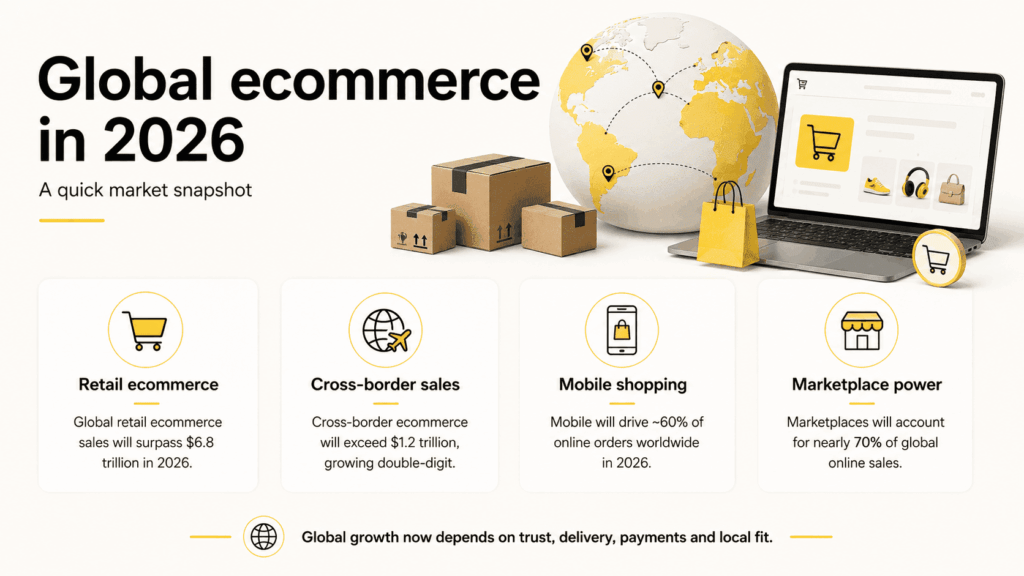
| Retail ecommerce | Global retail ecommerce sales are forecast to reach around $6.88 trillion in 2026 |
| Online penetration | Ecommerce is expected to represent around one-fifth of global retail sales, with further growth through 2028 |
| Regional growth | Asia-Pacific remains the largest ecommerce region, while Latin America remains one of the fastest-growing |
| Marketplaces | Marketplaces still shape discovery, price expectations and customer trust |
| Mobile | Mobile is now a core transaction channel, not only a browsing device |
| Cross-border | Growth opportunity depends on payments, delivery, returns, taxes and local trust |
| AI | AI is shortening product research and comparison, while autonomous purchasing remains early-stage |
| Customer experience | Delivery choice, returns, total price transparency and payment fit often matter more than new features |
What is global ecommerce?
Global ecommerce refers to the sale of goods or services online across national borders.
For a retailer, it can mean selling from one country into another through a branded store, a marketplace, a social commerce platform, a wholesale partner or a mix of several channels.
Global ecommerce includes more than shipping internationally. It also involves:
- localized language and product content,
- local payment methods,
- currency display,
- taxes and customs,
- delivery expectations,
- return routes,
- consumer protection rules,
- marketplace selection,
- customer service,
- product compliance.
A store can technically sell worldwide from day one. That does not mean it is ready for worldwide demand.
Global ecommerce market size in 2026
Global ecommerce figures often look contradictory because different sources measure different things.
One forecast may count retail ecommerce sales. Another may focus on consumer physical goods. A third may include B2B transactions, marketplace GMV, digital services or wider online business activity.
That difference matters.
| Metric | What it measures | Why figures differ |
| Retail ecommerce sales | Consumer purchases made online | Usually focused on retail and consumer spending |
| B2C physical-goods ecommerce | Consumer purchases of physical products | Can exclude services, B2B, returns and digital products |
| Marketplace GMV | Total value sold through a marketplace | Can include third-party sales and different accounting rules |
| B2B ecommerce | Online transactions between businesses | Much larger than consumer retail ecommerce |
| Business ecommerce sales | Wider online sales activity across companies | May include B2B and B2C transactions |
| Digital economy sales | Broad online economic activity | May include digital services and platform activity |
Shopify, using EMARKETER forecasts, estimates global retail ecommerce sales at around $6.88 trillion in 2026, up from roughly $6.42 trillion in 2025. The same forecast expects ecommerce to account for around 21.1% of worldwide retail sales in 2026.
ECDB uses a narrower market definition and reports global ecommerce revenue of around $4.89 trillion in 2025, with further growth projected for 2026. It also identifies fashion as the largest global ecommerce category and estimates ecommerce’s online share at 20–25% in 2025, rising toward 25–30% in 2026.
UNCTAD provides a much broader perspective. Its latest international business ecommerce dataset estimated nearly $27 trillion in ecommerce sales across 43 economies in 2022. Most of that value came from B2B activity rather than consumer retail.
The lesson is simple: there is no single global ecommerce number that fits every business question.
If you are benchmarking a consumer retail store, use retail ecommerce estimates. If you are looking at supply chains, wholesale, procurement or online business activity, B2B ecommerce figures are more relevant.
Why ecommerce numbers often conflict
A market forecast is only useful when you understand what it includes.
A retailer might see one source report $4.9 trillion, another report $6.9 trillion and a third report almost $27 trillion. Those figures are not automatically wrong. They often describe different levels of the same economy.
| Question | Best metric to use |
| How large is online consumer retail? | Retail ecommerce sales |
| How large is the physical-goods ecommerce market? | B2C physical-goods ecommerce |
| How powerful are marketplaces? | Marketplace GMV and platform revenue |
| How large is digital business trade? | B2B or business ecommerce sales |
| How important is online retail in one country? | Ecommerce share of total retail |
| Should we expand into a country? | Category demand, logistics, payments and local platform data |
This distinction should appear near the start of any global ecommerce strategy document.
Otherwise, teams can overestimate opportunity, compare incompatible markets or expect retail growth figures to match broader digital trade numbers.
Where global ecommerce growth is happening
Growth is not evenly spread.
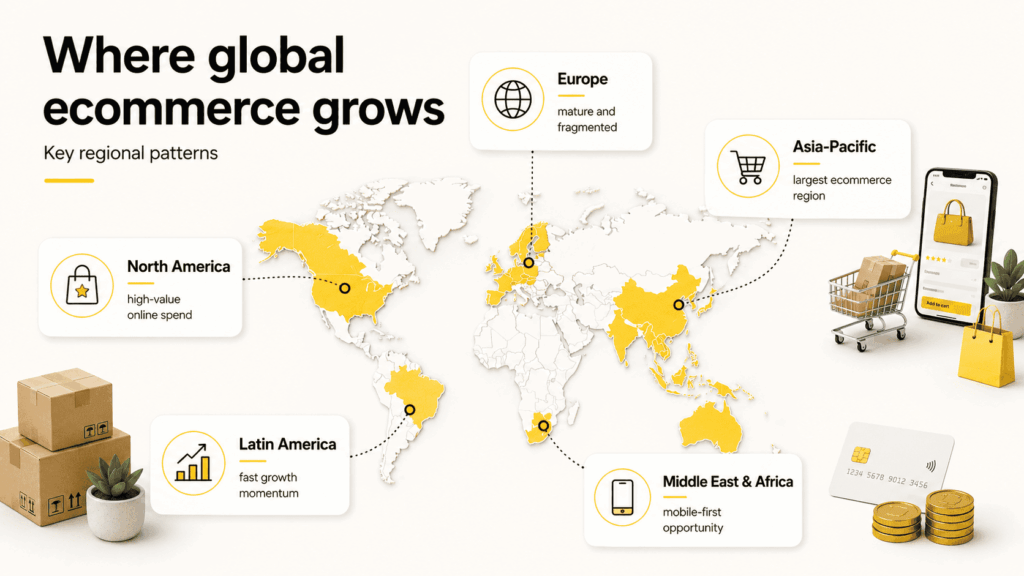
Some regions offer massive consumer demand but high competition. Others grow faster from a smaller base. Some are marketplace-led. Others still leave more room for direct-to-consumer brands.
A fast-growing market is not always an easy market to enter.
| Region | Growth story | Main opportunity | Main friction |
| Asia-Pacific | Largest ecommerce region, strong mobile and marketplace behavior | Marketplace access, social commerce and high-volume demand | Local platform competition and localization complexity |
| Europe | Mature, high-value and fragmented | Cross-border retail, premium categories and regional expansion | Regulation, payment fragmentation and multilingual markets |
| North America | Large spending base and mature online behavior | Brand-led DTC, subscription models and omnichannel retail | High acquisition costs and marketplace competition |
| Latin America | One of the fastest-growing retail ecommerce regions | Mobile-first growth, marketplaces and digital payments | Delivery reliability, tax complexity and local infrastructure |
| Middle East | High mobile usage and strong demand in selected markets | Premium, cross-border and rapid-delivery categories | Local payment preferences and country-specific logistics |
| Africa | High long-term potential and mobile-first adoption | Emerging marketplaces and digital commerce models | Payment access, logistics, trust and data availability |
Asia-Pacific remains the largest ecommerce region, largely because of China’s scale. Shopify’s 2026 market overview notes that China, the United States and Western Europe account for more than 80% of global ecommerce sales.
Latin America is one of the most important growth stories. Shopify, citing EMARKETER, estimates regional retail ecommerce growth above 12% year over year, supported by markets such as Brazil, Mexico and Argentina.
But expansion should not begin with a growth-rate chart.
It should begin with a market-readiness assessment.
Global ecommerce expansion readiness
Before entering a new market, retailers need to assess more than traffic potential.
| Question | Why it matters |
| Is the category already marketplace-led? | Marketplace entry may be more realistic than launching a local store |
| Which payment methods do customers trust? | Payment mismatch can reduce conversion at checkout |
| Does the market prefer home delivery, lockers or pickup points? | Delivery expectations shape trust |
| Are returns frequent and affordable? | Fashion, electronics and home categories need separate planning |
| Is shopping mobile-first, desktop-led or app-led? | Channel strategy changes |
| Are local languages essential? | Translation alone may not create trust |
| Are taxes and customs clear? | Cross-border costs can erase margin |
| Are local marketplaces dominant? | Customers may not start their search on Google |
| Is customer support expected in the local language? | Poor service can damage a new brand quickly |
| Do product rules differ by category? | Compliance can delay or block expansion |
For DACH-specific planning, see our complete guide to understanding the DACH market.
For a closer look at regional checkout expectations, see our guide to top payment providers in the DACH region.
Who is shopping and how?
More than three billion people were expected to make online purchases globally in 2025, according to EMARKETER estimates cited by Shopify.
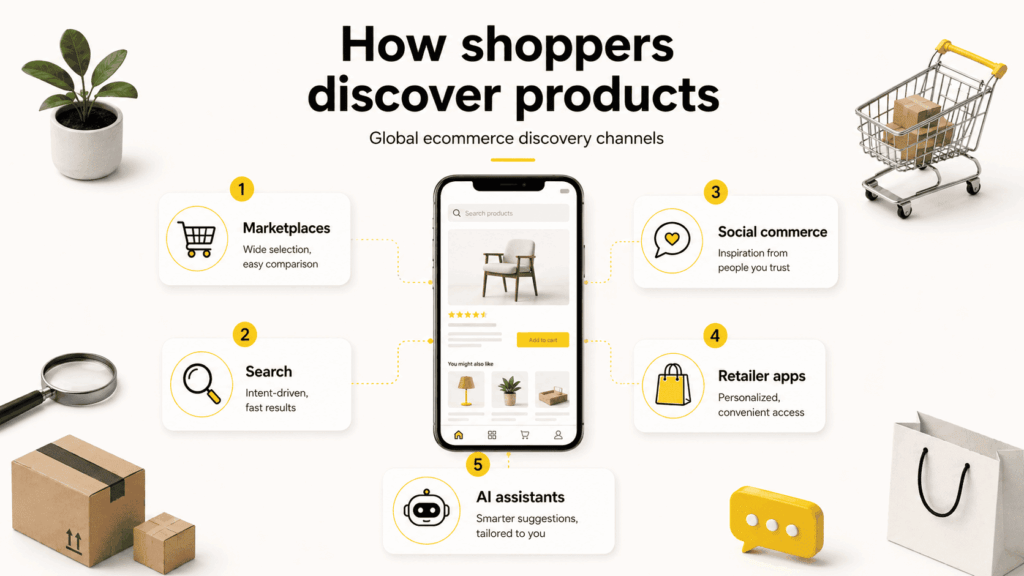
But the way people shop differs sharply between countries.
In some markets, mobile is the main shopping environment. In others, consumers still use desktop for research-heavy purchases. Some shoppers start with marketplaces. Others begin with social content, search engines, retailer apps or price comparison platforms.
The global direction is clear: mobile shopping has become a transaction channel, not only a discovery channel.
| Shopping behavior | Strongest examples | What retailers should do |
| Mobile-first checkout | Parts of Asia, Latin America, the Middle East and Africa | Prioritize fast mobile UX, wallets and one-hand checkout |
| Marketplace-led discovery | Asia, Latin America and many European categories | Treat marketplaces as acquisition channels, not only competitors |
| Social-led discovery | China, Southeast Asia, Brazil, the US and parts of Europe | Build video, creator and product-demo workflows |
| Price-led research | Germany, the UK, the US and many European markets | Improve product feeds, delivery clarity and total-price transparency |
| Recommerce behavior | Europe, the US, Japan and South Korea | Consider resale, trade-in or refurbished models |
| Loyalty-led shopping | Grocery, drugstore, beauty and convenience retail | Build repeat-purchase and rewards mechanics |
| App-led retail | China, Germany, South Korea and parts of Latin America | Make apps useful beyond basic checkout |
Mobile does not remove the need for strong ecommerce fundamentals.
A mobile-first market still needs clear product pages, fast loading, reviews, familiar payment methods, transparent delivery and easy returns.
What people buy online globally
Product demand changes by region, income level, logistics quality and local culture.
Still, some categories remain globally important.
ECDB identifies fashion as the largest global ecommerce category, contributing around 27% of global ecommerce revenue in 2025.
| Category | Global strength | What changes by market |
| Fashion | High-frequency, visual and marketplace-friendly | Strongly affected by returns, social commerce and fast-fashion pressure |
| Consumer electronics | High-value and research-heavy | Reviews, comparison tools, warranties and delivery trust matter |
| Beauty and personal care | Repeat purchase and social discovery | Claims, authenticity and subscriptions matter |
| Grocery | Convenience-led and routine-heavy | Local logistics decides success |
| Home and furniture | Higher order values and lower frequency | Delivery, visualization and returns affect conversion |
| Hobby and leisure | Community-driven and interest-led | Content and niche authority can outperform price-only selling |
| Pet products | Repeat demand and heavy-item delivery needs | Subscriptions and replenishment can work well |
| Health and wellness | High repeat potential | Compliance, claims and trust are critical |
Fashion remains powerful because it combines frequent demand, social discovery and broad marketplace availability.
Electronics are research-heavy. Customers compare specifications, reviews, seller ratings, delivery dates and warranties before buying.
Grocery and daily essentials continue to expand online, but the category depends heavily on local delivery economics. A grocery model that works in Seoul or London may not work the same way in smaller European cities.
Furniture and homeware often need stronger product content than other categories. Dimensions, materials, delivery options, room inspiration and return conditions can matter as much as price.
What drives online purchases in 2026?
Global shoppers still respond to convenience, value and trust.
But convenience means more than free delivery.
DHL’s 2026 E-Commerce Trends Report found that flexible payments, easy returns, delivery choice and out-of-home options are becoming expected parts of ecommerce. Its research covered 29,000 shoppers and 5,800 ecommerce businesses across 29 countries.
| Purchase driver | What shoppers expect |
| Total price transparency | No surprise delivery, tax or handling fees |
| Delivery choice | Home delivery, lockers, pickup points or local alternatives |
| Easy returns | Clear instructions, low friction and timely refunds |
| Familiar payments | Cards, wallets, invoice, pay-later or local payment methods |
| Product confidence | Reviews, images, fit data, specifications and stock visibility |
| Trust | Clear seller identity, support access and realistic delivery estimates |
| Convenience | Saved details, fast checkout and order tracking |
| Sustainability proof | Specific evidence rather than vague green claims |
A retailer does not need to offer every possible feature in every market.
It does need to avoid the obvious reasons people leave.
Hidden fees, unclear delivery dates, forced account creation, weak product information and unfamiliar payments can all interrupt a purchase that was otherwise ready to happen.
Delivery, returns and the global trust problem
Cross-border ecommerce often fails after checkout, not before it.
A customer may accept a higher price from an unfamiliar international store if delivery looks clear and returns feel safe. But a low price does not help if the shopper cannot estimate arrival time, cannot find return instructions or suspects that a refund will be difficult.
| Customer concern | What retailers should show clearly |
| “When will it arrive?” | Delivery date range, carrier and tracking |
| “Can I return it?” | Return window, cost, route and refund timing |
| “What will I pay in total?” | Duties, VAT, shipping and handling charges |
| “Can I trust this store?” | Reviews, local support, policies and secure payment |
| “Will this fit or work?” | Accurate dimensions, compatibility, guides and reviews |
| “Where can I pick it up?” | Delivery options, lockers, collection points or stores |
For logistics planning in Germany and Europe, see our guide to top fulfillment centers and logistics operators in Germany.
For out-of-home delivery trends, see smart parcel lockers and why they are popular in DACH.
Marketplaces, social commerce and AI-led discovery
Ecommerce discovery is becoming more fragmented.
Customers no longer begin every journey with a search engine or retailer website. They may start on Amazon, Mercado Libre, Shopee, TikTok, Instagram, Temu, Vinted, YouTube, a price comparison platform or an AI assistant.
| Commerce model | Examples | What it changes |
| Marketplace commerce | Amazon, Mercado Libre, Shopee, JD.com | Discovery, price comparison, seller trust and platform rules |
| Social commerce | TikTok Shop, Instagram shopping, livestreaming | Shorter path from content to checkout |
| Recommerce | Vinted, eBay, regional resale platforms | Value, circularity and second-hand discovery |
| AI-assisted shopping | AI search, product assistants and recommendation tools | Faster research and more structured comparison |
| Agentic commerce | Emerging AI systems that can execute parts of shopping | Requires cleaner data, guardrails and human oversight |
| Brand-owned commerce | DTC websites, apps and loyalty ecosystems | More control over customer experience and repeat purchase |
Marketplaces remain central because they solve discovery and trust at the same time.
A shopper may not know a retailer, but they may trust the marketplace’s reviews, payment flow, delivery promise and buyer protection.
That creates a trade-off.
Marketplaces can provide reach and customer confidence. They can also reduce margin, increase price comparison and weaken direct ownership of customer relationships.
For Germany-specific marketplace analysis, see best online marketplaces in Germany.
For a closer look at major players, see top online stores in Germany.
Social commerce is growing, but not evenly
Social commerce is becoming more important, especially in product categories that benefit from visual discovery.
Fashion, beauty, accessories, homeware, fitness products, hobby products and low-ticket impulse purchases often work well through social content.
But social commerce does not look the same everywhere.
In China, livestream commerce and platform-native shopping are deeply integrated. In Southeast Asia, social discovery and marketplace behavior overlap heavily. In Europe and North America, social commerce is growing, but retailer websites and marketplaces still remain important purchase destinations.
Retailers should avoid assuming that social commerce is a universal replacement for traditional ecommerce.
It is a channel. Its value depends on the product, market, creator ecosystem, checkout flow and customer trust.
AI-assisted shopping in 2026
AI is changing ecommerce first through research and support.
Customers use AI to compare products, summarize reviews, ask about fit, find alternatives, understand technical specifications and narrow down options.
DHL’s 2026 report found that nearly one-third of surveyed shoppers would be willing to let AI make buying decisions within five years.
That does not mean autonomous shopping is already normal.
It means retailers should prepare for product discovery that is less dependent on browsing dozens of product pages manually. To adapt to this shift, brands must align their feed and content structure using dedicated AEO vs GEO strategies for e-commerce to ensure their products get cited in AI answers and recommended across AI-generated shopping carousels.
| AI use case | What retailers need |
| Product comparison | Consistent specifications and product attributes |
| AI search visibility | Clear titles, structured data and useful descriptions |
| Review summaries | Real reviews and strong product information |
| Automated customer support | Accurate policies, order data and escalation paths |
| Personalized recommendations | Reliable behavioral data and privacy controls |
| Dynamic merchandising | Clean inventory and pricing data |
| Assisted checkout | Clear delivery, payment and returns logic |
AI cannot fix weak product data.
If a retailer has vague descriptions, inconsistent specifications, poor inventory accuracy or hidden delivery fees, AI will only make those weaknesses easier to surface.
Cross-border ecommerce: the largest opportunity and the largest operational risk
Cross-border ecommerce can help retailers reach new customers without opening local stores.
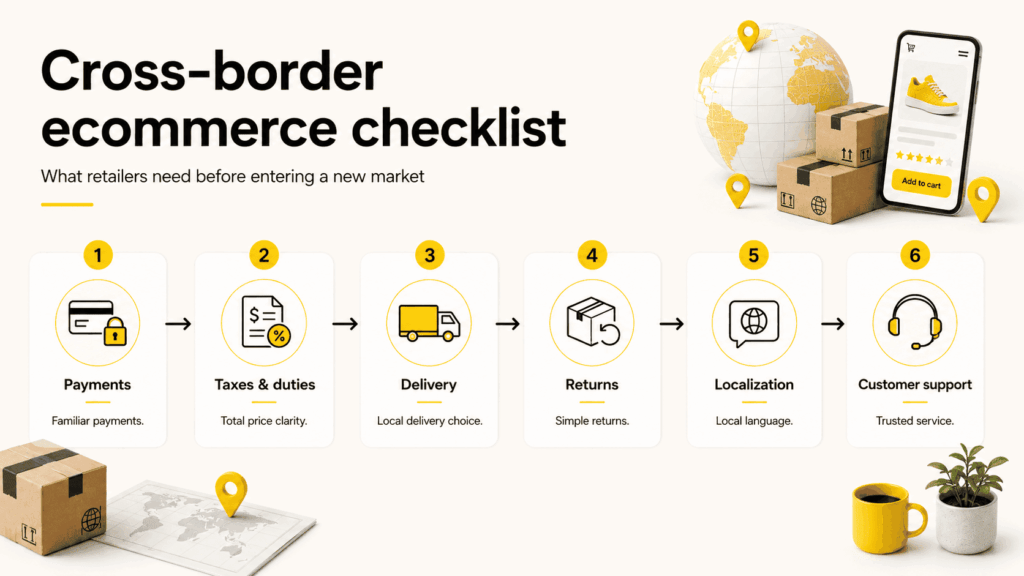
It can also expose every operational weakness at once.
| Cross-border advantage | Cross-border friction |
| Access to new demand | Customs, duties and VAT |
| Portfolio diversification | Local payment expectations |
| Marketplace reach | Returns costs |
| Seasonal balancing | Delivery-time trust |
| Brand expansion | Consumer protection rules |
| Higher average order values in selected markets | Currency and pricing complexity |
| Demand testing before physical expansion | Localization and customer support needs |
A good cross-border strategy should answer five questions before launch:
- Where will demand come from?
- Which channel will customers trust?
- How will payment work locally?
- How will delivery and returns work in practice?
- Can the business keep its margin after tax, shipping, support and refunds?
Too many international launches start with translated product pages.
The stronger launches start with operating model decisions.
Own store vs marketplace vs hybrid ecommerce
There is no universal best ecommerce model.
The right model depends on product type, brand strength, customer acquisition cost, category competition and market maturity.
| Model | Best for | Strength | Trade-off |
| Own store | Brand-led products, premium positioning and repeat purchase | Control over brand and customer data | Higher acquisition burden |
| Marketplace | New-market testing, price-led categories and broad reach | Existing traffic and customer trust | Fees, rules and lower brand control |
| Hybrid | Scaling brands | Combines marketplace reach with owned customer relationships | More operational complexity |
| Social commerce | Visual, impulse and creator-led categories | Fast discovery and content-to-checkout journeys | Content demands and platform dependence |
| Wholesale or retail partnerships | Local market entry | Existing distribution and trust | Lower margin and less control |
| Subscription model | Replenishment and routine categories | Predictable revenue and repeat purchase | Requires strong retention and logistics |
A hybrid model often makes sense for established brands.
A retailer may use marketplaces to reach first-time buyers, then build loyalty through a branded site, email, app, subscription or customer service experience.
Global ecommerce trends for 2026
AI moves from content support to commerce operations
AI is moving beyond product descriptions and ad copy.
Retailers are using it for search, customer support, merchandising, forecasting, localization, campaign attribution and product comparison. AI-assisted shopping is becoming more visible, but agentic commerce remains early and needs human oversight.
Convenience beats novelty
Customers may enjoy new shopping features, but conversion still depends on basic execution.
Flexible payments, clear delivery dates, easy returns, accurate stock information and transparent total cost remain stronger conversion drivers than most gimmicks.
Marketplaces keep shaping customer expectations
Even brands that sell through their own websites are judged against marketplace standards.
Customers expect reviews, delivery clarity, reliable payments, strong search and clear return policies because marketplaces trained them to expect those things.
Cross-border expansion becomes more operationally demanding
Selling into a new market is easier than it was ten years ago.
Running a profitable cross-border operation is not.
Taxes, product regulations, returns, local payment methods, delivery costs and customer support can decide whether an expansion succeeds.
Recommerce becomes a normal retail layer
Second-hand, refurbished, trade-in and resale models are becoming more mainstream.
Retailers do not all need to launch their own resale marketplaces. But they should understand why customers are drawn to recommerce: value, sustainability, product access and lower price risk.
Product data becomes a commercial asset
Clean product data supports almost every growth channel.
It helps marketplaces match listings. It improves AI-assisted discovery. It reduces returns. It makes localization easier. It improves product comparison. It helps customers trust what they are buying.
Sustainability needs proof
Vague green messaging is losing value.
Customers, regulators and marketplaces increasingly expect specific information: materials, durability, repairability, delivery impact, packaging choices and evidence behind sustainability claims.
Global ecommerce action checklist
| Action | Why it matters |
| Define which market metric you are using | Avoid comparing incompatible market figures |
| Choose markets based on category fit, not growth rate alone | Fast growth does not guarantee profitability |
| Audit local marketplaces | They may own discovery in the target country |
| Localize payments before scaling ads | Payment mismatch can reduce conversion |
| Model delivery, returns, taxes and customs early | Cross-border costs can erase margin |
| Improve product data | Supports AI, marketplaces, search and lower returns |
| Build trust signals for unfamiliar markets | Reviews, support and clear policies matter |
| Test one channel before launching everywhere | Reduce expensive expansion mistakes |
| Track total contribution margin | Revenue growth can hide poor logistics economics |
| Plan customer service in the local language where needed | Trust often depends on support quality |
FAQ: global ecommerce in 2026
How big is the global ecommerce market in 2026?
The answer depends on methodology. Shopify, using EMARKETER forecasts, estimates global retail ecommerce sales at around $6.88 trillion in 2026. ECDB uses a narrower ecommerce market definition and reported around $4.89 trillion in worldwide ecommerce revenue in 2025, with further growth expected in 2026.
Why do global ecommerce market figures differ?
Different sources include different types of transactions. Some count retail sales only. Others include physical goods, digital products, marketplace GMV, services or B2B sales. The figure is only useful when the underlying definition is clear.
Which region has the biggest ecommerce market?
Asia-Pacific is the largest ecommerce region, mainly because of China’s scale. China, the United States and Western Europe together account for the majority of global retail ecommerce sales.
Which region is growing fastest in ecommerce?
Latin America is among the fastest-growing retail ecommerce regions. Growth is also strong in parts of Southeast Asia, the Middle East and Africa, although infrastructure, payments and logistics differ sharply between countries.
Is mobile commerce more important than desktop ecommerce?
Mobile commerce is now a major transaction channel in many markets, especially across Asia, Latin America and the Middle East. Desktop still matters for research-heavy, high-value and business purchases, but retailers should treat mobile checkout as a core experience.
Are marketplaces better than online stores?
Neither is automatically better. Marketplaces offer demand, trust and discovery. Brand-owned stores offer more control over customer relationships, positioning and retention. Many successful retailers use a hybrid model.
What matters most in cross-border ecommerce?
Payments, total price transparency, delivery, returns, taxes, product compliance, local support and marketplace fit are usually more important than simple translation.
How is AI changing ecommerce?
AI is helping shoppers compare products, summarize reviews, search more naturally and get support faster. For retailers, it increases the value of accurate product data, structured content, reliable pricing and clear policies.
Conclusion
Global ecommerce is still growing, but growth is no longer the whole story.
The strongest retailers will not win simply because they ship internationally or launch on another marketplace. They will win because they understand where demand exists, how customers discover products, what local trust looks like and where operational friction can destroy a sale.
The next stage of global ecommerce is less about being everywhere.
It is about choosing the right market, the right channel and the right customer experience for each place you enter.
***