Top 100 online stores in Germany [2026]
Looking for a list of top 100 online stores in Germany? Look no further – we covered them for you, along with the overview of the German e-commerce stage. Read more!
Germany is one of Europe’s strongest ecommerce markets, but it is not an easy market to read from a simple ranking.
Amazon still dominates. Otto and Zalando remain major local forces. Marketplaces keep gaining power. Shein, Temu, Rewe and Shop Apotheke show how fast the market mix can change. Grocery, pharmacy, recommerce and low-price cross-border platforms are now part of the German ecommerce mainstream.
That is why this 2026 update looks at the top online stores in Germany in two ways: first through the latest market signals, then through a practical list of 100 major and notable online stores across key ecommerce categories.
TL;DR: Germany’s top online stores in 2026
| Key finding | What it means |
| Germany’s top 1,000 online stores generated €84.7bn in 2025 | The market has recovered beyond pandemic levels and is growing again |
| Amazon remains the clear leader | The gap between Amazon and other players is still massive |
| Otto and Zalando remain core German ecommerce names | Local trust, category depth and platform models still matter |
| Shein entered Germany’s top 10 online stores | Cross-border ultra-fast fashion is now mainstream |
| Rewe entered the top 10 | Grocery ecommerce is no longer a side category |
| Shop Apotheke climbed further | Pharmacy and health ecommerce are now top-tier categories |
| Temu became one of Germany’s largest marketplaces | Low-price marketplace competition is getting stronger |
| Marketplaces shape more customer expectations | Retailers need a marketplace strategy, not only an own-store strategy |
What counts as an online store in this article?
A true ranking of the largest German online stores should use a clear methodology.
For this update, an online store means a website, app or platform where customers can directly buy products or book transactional services online. Pure media portals, corporate news pages, informational websites and content-only destinations should not be mixed into a list of ecommerce stores.
That distinction matters because Germany has many high-traffic websites that are not online stores. A news portal, recipe site or corporate information page can have strong traffic, but it should not be treated the same way as Amazon, Otto, Zalando, Rewe or Shop Apotheke.
| Include | Exclude or separate |
| Retailer online stores | News portals |
| Brand-owned ecommerce stores | Corporate information pages |
| Marketplaces | Pure content sites |
| Hybrid retail platforms | Government or education websites |
| Recommerce platforms | Non-transactional automotive pages |
| Online pharmacies | Media properties with no clear ecommerce function |
| Travel, ticketing and experience platforms | Blogs and editorial websites |
This article is designed as a practical market map of 100 major online stores in Germany. It is not a licensed revenue ranking. For strict revenue rankings, ECDB and EHI’s E-Commerce-Markt Deutschland study remains the strongest benchmark.
Germany ecommerce market in 2026: quick snapshot
Germany’s ecommerce market has moved past its post-pandemic correction.
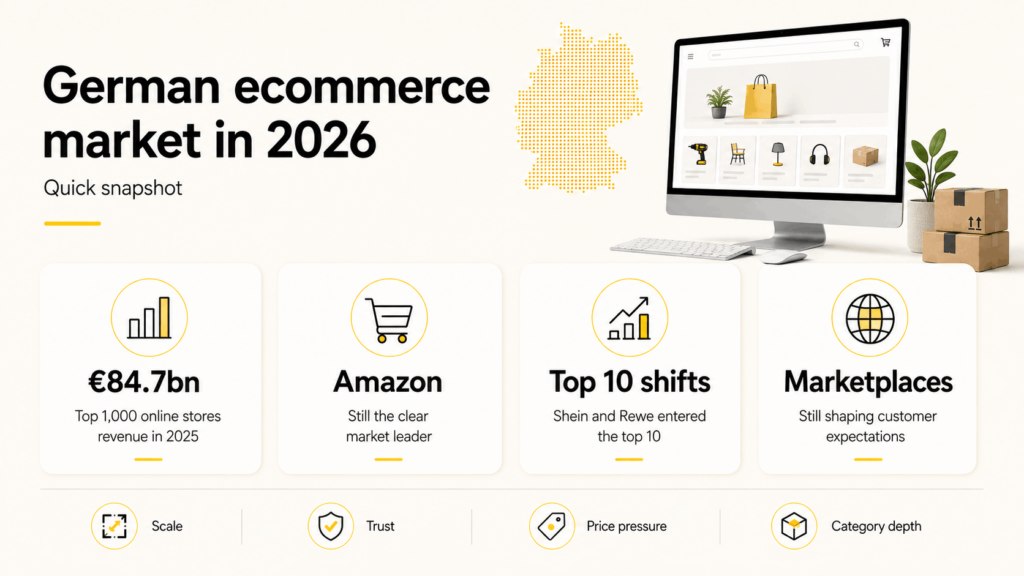
The top 1,000 online stores in Germany generated €84.7 billion in 2025, surpassing pandemic-era levels. The market is still under pressure from cautious consumer spending, inflation sensitivity and tough competition, but the strongest players are growing again.
The top of the market is also changing.
Shein and Rewe entered Germany’s top 10 online stores, pushing H&M and Lidl out of the top 10. Shop Apotheke continued to climb, supported by stronger online pharmacy demand and the digitalization of prescriptions. Amazon stayed far ahead in the number one position, while Otto and Zalando remained major German ecommerce names.
For a deeper data-led view of the market, see our article on Germany’s ecommerce market generating €84.7 billion in 2025. For a shorter ranking view, see our top 30 online shops in Germany.
Top 10 online stores in Germany: what changed
The top 10 matters because it shows which shopping habits are becoming mainstream.
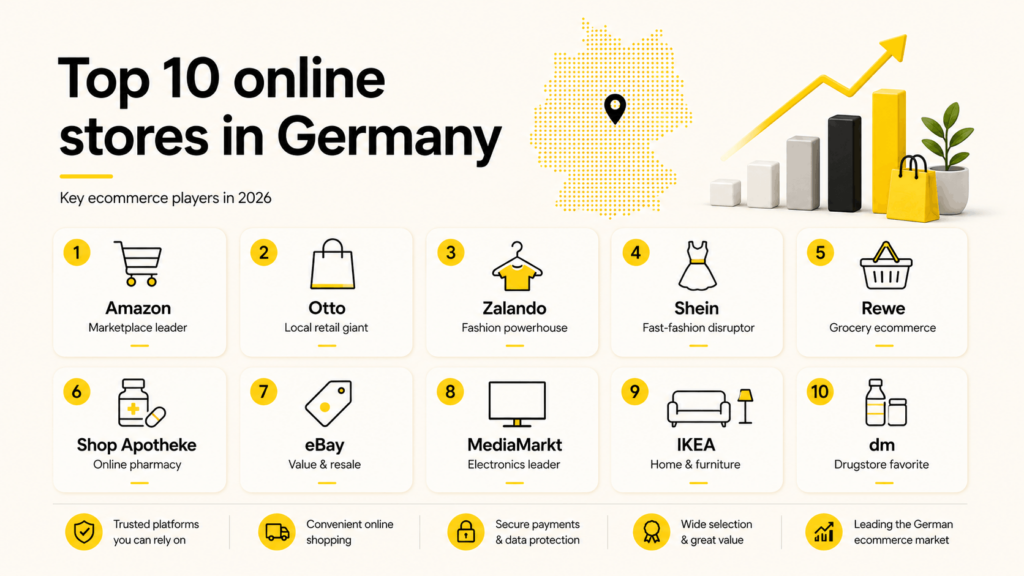
Amazon, Otto and Zalando still sit at the center of German ecommerce. But the newer movements are more interesting: Shein, Rewe and Shop Apotheke show that German ecommerce is no longer only about fashion, electronics and general retail.
| Store | What changed | Why it matters |
| Amazon | Still the clear leader | Sets expectations for delivery, price, selection and reviews |
| Otto | Remains a strong local platform | Shows the value of German trust, payment fit and category depth |
| Zalando | Still a fashion leader | Fashion remains huge, but competition is tougher |
| Shein | Entered the top 10 | Cross-border low-price fashion is now mainstream |
| Shop Apotheke | Climbed further | Health and pharmacy ecommerce are now major categories |
| Rewe | Entered the top 10 | Grocery ecommerce is becoming serious business |
| H&M | Dropped out of the top 10 | Brand awareness alone is not enough in fashion |
| Lidl | Dropped out of the top 10 | Grocery and general retail are getting more competitive |
| Temu | Became one of Germany’s largest marketplaces | Low-price marketplace competition is reshaping shopper behavior |
| eBay / Kaufland / Otto marketplace | Still relevant as marketplace options | German shoppers want price comparison, variety and trusted platforms |
The key lesson is simple: German ecommerce is widening. Fashion and electronics still matter, but pharmacy, grocery, recommerce, marketplaces and low-price cross-border platforms are now core parts of the market.
Top 100 online stores in Germany in 2026
The list below highlights 100 major and notable online stores in Germany across ecommerce categories. It is grouped by market segment so readers can understand the structure of the German ecommerce landscape, not just scan a flat list of names.
General retail and marketplaces
1. Amazon.de
Amazon is the dominant ecommerce platform in Germany. It sets the benchmark for product range, reviews, price comparison, delivery speed and marketplace convenience.
Amazon is not only an online store. It is also Germany’s most important marketplace, which means it shapes customer expectations even when shoppers buy elsewhere.
2. eBay.de
eBay remains important because German shoppers are price-aware and open to used, refurbished and hard-to-find products.
It fits the recommerce and value-shopping mood especially well.
3. Otto.de
Otto is one of Germany’s strongest local ecommerce players.
It combines retail, marketplace logic, home goods, fashion, furniture and appliances with strong local trust. Otto also benefits from understanding German expectations around payments, returns and customer service.
4. Kaufland.de
Kaufland has become a stronger marketplace player in Germany.
It gives sellers an alternative to Amazon and offers German shoppers a familiar retail brand with marketplace-style range.
5. Temu
Temu is one of the biggest disruptors in German ecommerce.
Its growth shows that low prices, endless assortment and gamified shopping can gain attention quickly. It also shows how much pressure local retailers face from cross-border platforms.
6. AliExpress
AliExpress remains relevant for low-price cross-border shopping.
It competes on range and price, although trust, delivery times and product quality can vary.
7. Lidl.de
Lidl is one of Germany’s best-known retail brands.
Its online store reaches beyond grocery into household goods, fashion basics, tools, furniture, garden products and promotions.
8. Tchibo.de
Tchibo is a strong example of curated general retail.
It sells coffee, fashion, home goods, lifestyle products and seasonal ranges. Its strength comes from familiarity and a clear promotional rhythm.
9. Galeria.de
Galeria represents department-store ecommerce in Germany.
It offers fashion, beauty, home, toys and lifestyle categories, although it competes in a difficult segment.
10. Baur.de
Baur is a long-standing German distance-selling and ecommerce brand.
It is especially relevant in fashion, home, furniture and lifestyle categories.
11. Netto-online.de
Netto Online combines discount retail with ecommerce.
It fits shoppers looking for deals across household goods, garden products, tools, electronics and everyday categories.
12. QVC.de
QVC remains relevant because it combines retail, product storytelling and direct-response shopping.
It is not a classic marketplace, but it still plays a role in Germany’s online retail landscape.
Fashion and shoes
13. Zalando.de
Zalando is Germany’s leading fashion ecommerce name.
It combines wide selection, strong brand awareness, easy returns and marketplace-style expansion. For more category context, see our article on fashion retail trends in DACH.
14. Shein.com
Shein’s rise into Germany’s top 10 shows how much pressure low-price cross-border fashion now creates.
It competes through speed, price, variety and trend turnover.
15. AboutYou.de
About You is a strong fashion discovery platform.
It works well for shoppers who browse styles, brands and outfits rather than searching for one exact item.
16. Bonprix.de
Bonprix is a value fashion retailer with strong German recognition.
It appeals to price-conscious shoppers looking for accessible clothing and basics.
17. H&M.com
H&M remains a major fashion player, even after losing top-10 momentum.
It still has strong brand recognition, but competition from Shein, Zalando and other fashion platforms is intense.
18. C&A.de
C&A is a familiar fashion retailer in Germany.
Its ecommerce presence benefits from offline recognition and mainstream family fashion positioning.
19. Breuninger.com
Breuninger is a premium fashion and lifestyle retailer.
It serves a different customer segment than Shein or Bonprix, with stronger emphasis on brands, service and premium assortment.
20. Peek-Cloppenburg.de
Peek & Cloppenburg is a well-known fashion retailer with an online store that supports brand-led fashion shopping.
It is relevant for shoppers looking for apparel, shoes and occasionwear.
21. Deichmann.com
Deichmann is one of the strongest shoe retailers in Germany.
It combines affordability, wide selection and offline familiarity.
22. Snipes.com
Snipes is a strong player in sneaker, streetwear and youth fashion.
It competes in a more style-driven and brand-sensitive part of the fashion market.
23. Adidas.de
Adidas is one of Germany’s strongest brand-owned ecommerce stores.
It benefits from sportswear demand, brand loyalty and direct-to-consumer sales.
24. Nike.com/de
Nike’s German online store is a major destination for sportswear and sneakers.
It is not German-owned, but it is highly relevant in the German ecommerce market.
25. BestSecret.com
BestSecret shows that members-only fashion ecommerce can work in Germany.
Its model relies on exclusivity, brand access and value perception.
26. Lascana.de
Lascana is relevant in lingerie, swimwear and women’s fashion.
Its online model fits a category where brand trust, fit and product presentation matter.
27. Ernstings-family.de
Ernsting’s family is important for family fashion and value-led clothing.
It combines offline familiarity with online convenience.
28. Zara.com/de
Zara remains a major fashion ecommerce player in Germany.
It competes through trend-led fashion, brand strength and strong mobile shopping behavior.
Grocery, drugstore, pharmacy and beauty
29. Rewe.de
Rewe’s rise into Germany’s top 10 is one of the strongest signals in the market.
Grocery ecommerce is no longer a side story. Rewe shows that food delivery, pickup and everyday essentials are moving online.
30. dm.de
dm is one of Germany’s most trusted drugstore retailers.
Its online store supports repeat purchase in beauty, baby products, health, household and personal care.
31. Rossmann.de
Rossmann is another major German drugstore player.
It competes with dm in everyday essentials, beauty, household care, baby products and health-related categories.
32. Shop-Apotheke.com
Shop Apotheke is one of Germany’s most important online pharmacy players.
Its growth shows how pharmacy and health ecommerce have entered the mainstream.
33. DocMorris.de
DocMorris is another major online pharmacy.
It benefits from rising digital health habits and the growth of e-prescription-related shopping.
34. Medpex.de
Medpex is a well-known online pharmacy and health products store.
It fits German shoppers looking for medication, supplements, personal care and pharmacy products online.
35. Müller.de
Müller connects drugstore, beauty, toys, media and household categories.
Its online store benefits from wide category reach and strong brand familiarity.
36. Douglas.de
Douglas is Germany’s leading beauty retailer.
Its ecommerce strength comes from beauty brands, fragrance, skincare and strong customer loyalty.
37. Flaconi.de
Flaconi is a strong online beauty specialist.
It competes through fragrance, skincare, cosmetics, promotions and a dedicated beauty ecommerce experience.
38. Notino.de
Notino is relevant in fragrance, cosmetics and beauty ecommerce.
It appeals to price-aware beauty shoppers who compare offers and brands.
39. Sephora.de
Sephora serves the premium and discovery-led beauty segment.
Its strength lies in international beauty brands and a more curated shopping experience.
40. Flaschenpost.de
Flaschenpost is important because it shows how fast delivery and beverages can work online.
It fits the wider shift toward groceries and daily essentials online.
41. Picnic.app/de
Picnic is a grocery delivery player with a route-based delivery model.
It represents a different way to think about online food retail in Germany.
42. Bringmeister.de
Bringmeister is relevant in online grocery delivery, especially in larger cities.
It fits urban customers looking for delivery convenience.
43. Edeka24.de
Edeka24 offers online grocery and food products from one of Germany’s most recognized supermarket groups.
It supports the broader move from offline supermarket visits to online basket building.
44. MyTime.de
MyTime is an online supermarket focused on groceries and everyday products.
It is relevant for shoppers who want broader online food selection.
45. Medikamente-per-Klick.de
Medikamente-per-Klick is another online pharmacy destination.
It competes on price, range and convenience.
46. Aponeo.de
Aponeo is relevant in pharmacy ecommerce.
It serves shoppers looking for medication, health products and pharmacy-related categories online.
Electronics and appliances
47. MediaMarkt.de
MediaMarkt is one of Germany’s most important electronics retailers.
Its online store matters because German electronics shoppers compare specs, prices, delivery and warranty details before buying.
48. Saturn.de
Saturn is another major electronics retailer.
Together with MediaMarkt, it remains a major force in consumer electronics and appliances.
49. Apple.com/de
Apple’s German store is one of the most important brand-owned ecommerce destinations.
It benefits from direct-to-consumer sales, premium positioning and ecosystem loyalty.
50. Samsung.com/de
Samsung is highly relevant in smartphones, TVs, appliances and connected devices.
Its brand-owned store competes with retailers and marketplaces.
51. Cyberport.de
Cyberport is a specialist electronics retailer.
It is especially relevant for computers, notebooks, components, accessories and business tech.
52. Notebooksbilliger.de
Notebooksbilliger is one of Germany’s best-known computer and notebook specialists.
It competes on price, technical range and electronics expertise.
53. Alternate.de
Alternate is a specialist ecommerce player for hardware, components, gaming and electronics.
It serves more research-heavy and technical shoppers.
54. Conrad.de
Conrad is known for electronics, components, tools and technical products.
It has relevance for both consumers and business buyers.
55. Expert.de
Expert connects electronics retail with local store presence.
Its online store supports omnichannel shopping for electronics and appliances.
56. Mindfactory.de
Mindfactory is relevant for computer components and PC hardware.
It serves a more technical audience than general electronics retailers.
57. Miele.de
Miele is a premium appliance brand with direct ecommerce relevance.
It benefits from trust, durability and high-value household appliance demand.
58. Bosch-home.com/de
Bosch is another major appliance brand.
Its ecommerce presence supports research, product information and direct purchase across household appliances.
Home, furniture, DIY and garden
59. IKEA.de
IKEA is one of Germany’s most important home and furniture ecommerce destinations.
It combines inspiration, planning tools, home delivery, click & collect and strong brand trust.
60. Home24.de
Home24 is a furniture ecommerce specialist.
It fits shoppers looking for home, furniture and decor online.
61. Wayfair.de
Wayfair is relevant in home and furniture ecommerce.
It competes on selection, style variety and online discovery.
62. Westwing.de
Westwing is a home and interiors ecommerce brand focused on inspiration, design and lifestyle.
It serves customers looking for curated home products rather than pure utility.
63. XXXLutz.de
XXXLutz is a major furniture retailer with an online presence in Germany.
Its ecommerce role is tied to large-item purchases, home delivery and furniture comparison.
64. Roller.de
Roller is a value-focused furniture and home goods retailer.
It appeals to price-conscious home shoppers.
65. Hoeffner.de
Möbel Höffner is a major furniture retailer.
Its online store supports furniture research, home planning and large-item shopping.
66. Porta.de
Porta is another important furniture and home retail brand.
It fits German shoppers who want familiar furniture retail online.
67. OBI.de
OBI is one of Germany’s leading DIY and garden retailers.
Its ecommerce strength comes from project content, local availability, click & collect and broad DIY range. For more on this category, see our updated guide to best online DIY stores in Germany.
68. Hornbach.de
Hornbach is especially strong for serious DIY and renovation projects.
Its online store supports project-led shopping, tools, materials and garden products.
69. Bauhaus.info
Bauhaus is a major German DIY retailer.
It is relevant for building materials, tools, renovation, garden and home improvement.
70. Toom.de
Toom is a mainstream DIY and garden retailer.
It appeals to consumers looking for accessible home improvement products and local store support.
71. Hagebau.de
Hagebau combines local DIY retail with online shopping.
It is relevant for building materials, garden, tools and home improvement.
72. Hellweg.de
Hellweg is a regional DIY and garden retailer.
Its online store supports practical home improvement shopping.
73. Globus-baumarkt.de
Globus Baumarkt is a value-oriented DIY and garden retailer.
It is relevant for practical DIY shoppers looking for affordability and availability.
74. Dehner.de
Dehner is a garden specialist.
It belongs in the wider DIY and home improvement map because garden products are a major adjacent ecommerce category.
75. ManoMano.de
ManoMano is a specialist marketplace for DIY, home improvement and garden.
It sits between classic DIY retailers and general marketplaces.
76. Butlers.com
Butlers is relevant in home decor, tableware and lifestyle products.
It supports the home category from a more decorative angle.
Books, media and recommerce
77. Thalia.de
Thalia is Germany’s leading bookseller online.
It competes through books, ebooks, games, gifts and strong brand recognition.
78. Hugendubel.de
Hugendubel is another important book retailer.
It combines online shopping with a well-known offline bookstore presence.
79. Medimops.de
Medimops is a major recommerce player for books, media and second-hand products.
It fits Germany’s price-aware and sustainability-aware shopping behavior.
80. Momox.de
Momox is closely connected to recommerce.
It supports buying and selling used books, media, fashion and other second-hand goods.
81. Rebuy.de
Rebuy is relevant in refurbished electronics, used media and recommerce.
It appeals to shoppers looking for lower prices and more sustainable purchases.
82. Kleinanzeigen.de
Kleinanzeigen is one of Germany’s most important classifieds and second-hand platforms.
It is not a classic online store, but it is highly relevant to German online commerce behavior.
83. Vinted.de
Vinted is now one of the key recommerce platforms in fashion.
Its growth reflects the demand for second-hand, lower prices and peer-to-peer shopping. See also our article on Vinted connecting Germany and Austria.
84. Booklooker.de
Booklooker is relevant for used books and media.
It serves a more specialist resale audience.
85. JPC.de
JPC is a specialist retailer for music, film and books.
It remains relevant in physical media and entertainment ecommerce.
86. GameStop.de
GameStop is relevant in gaming retail, consoles, games and accessories.
It fits the broader entertainment and electronics ecommerce space.
Sports, outdoor, bikes and pet products
87. Decathlon.de
Decathlon is one of Germany’s strongest sports retailers online.
It competes through price, own-brand products and wide sports category coverage.
88. Intersport.de
Intersport is a major sports retailer with online and offline presence.
It is relevant for sportswear, equipment and seasonal sports demand.
89. SportScheck.com
SportScheck has long been associated with sports and outdoor retail in Germany.
It remains relevant as a known name in sports ecommerce.
90. Bergfreunde.de
Bergfreunde is a strong outdoor specialist.
It serves hikers, climbers, campers and outdoor enthusiasts.
91. Bergzeit.de
Bergzeit is another important outdoor ecommerce specialist.
It competes through technical product depth and outdoor expertise.
92. Bike24.de
Bike24 is a major cycling ecommerce player.
It is relevant for bikes, cycling parts, accessories and performance gear.
93. Rosebikes.de
Rose Bikes is a strong bike retailer with direct ecommerce relevance.
It combines brand, specialist knowledge and cycling product range.
94. Canyon.com/de
Canyon is a direct-to-consumer bike brand with strong German roots.
It shows how brand-owned ecommerce can work in high-value specialist categories.
95. Tennis-Point.de
Tennis-Point is a specialist sports ecommerce player.
It serves tennis shoppers looking for rackets, shoes, apparel and accessories.
96. Zooplus.de
Zooplus is one of Germany’s strongest online pet retailers.
It benefits from repeat purchase, pet food delivery and subscription-like shopping behavior.
97. Fressnapf.de
Fressnapf is a major pet retail brand.
Its online store connects pet products, offline trust and recurring needs.
98. Bitiba.de
Bitiba is a pet ecommerce store focused on value and recurring pet product purchases.
It competes strongly in food, litter and pet supplies.
99. ZooRoyal.de
ZooRoyal is another relevant pet ecommerce player.
It serves shoppers looking for pet food, accessories and specialist pet products.
100. Equiva.com
Equiva is a specialist retailer for equestrian products.
It fits a niche, high-intent ecommerce segment where specialist range and trust matter.
Top online stores in Germany by category
The strongest German ecommerce players do not all compete in the same way.
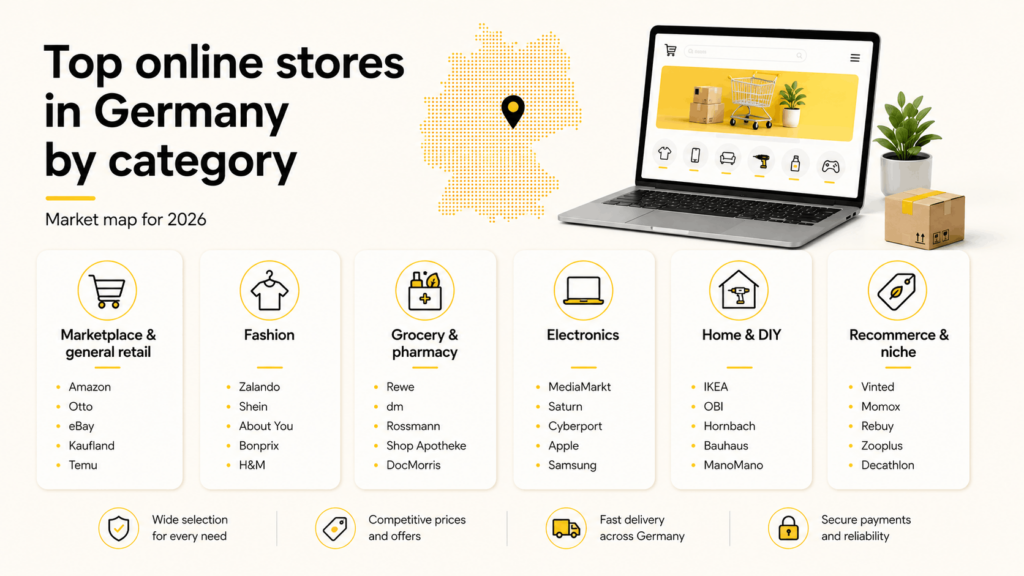
Amazon, Otto and Kaufland compete through platform logic. Zalando and About You compete through fashion discovery. Rewe and Shop Apotheke show the rise of daily essentials and health. Vinted, Momox and Rebuy show that recommerce is now part of the mainstream.
| Category | Leading players | 2026 trend |
| General retail / marketplaces | Amazon, eBay, Otto, Kaufland, Temu | Marketplace dominance and price pressure |
| Fashion | Zalando, Shein, About You, Bonprix, H&M | Returns, fast-fashion pressure and platformization |
| Grocery | Rewe, Flaschenpost, Picnic, Edeka24 | Daily essentials moving online |
| Drugstore / pharmacy | dm, Rossmann, Shop Apotheke, DocMorris | Repeat purchase, trust and digital health |
| Beauty | Douglas, Flaconi, Notino, Sephora | Brand discovery and loyalty |
| Electronics | MediaMarkt, Saturn, Cyberport, Notebooksbilliger | Price comparison and product data |
| Home / furniture | IKEA, Home24, Wayfair, Westwing | Large-item logistics and inspiration |
| DIY / garden | OBI, Hornbach, Bauhaus, Dehner | Project-led shopping |
| Recommerce | Vinted, Medimops, Momox, Rebuy | Price sensitivity and sustainability |
| Pet products | Zooplus, Fressnapf, Bitiba, ZooRoyal | Subscriptions and retention |
For a deeper look at what German shoppers buy online, see our guide to most popular online shopping categories in Germany.
Online stores vs marketplaces: don’t mix them
One of the biggest mistakes in German ecommerce analysis is treating every ecommerce destination as the same type of business.
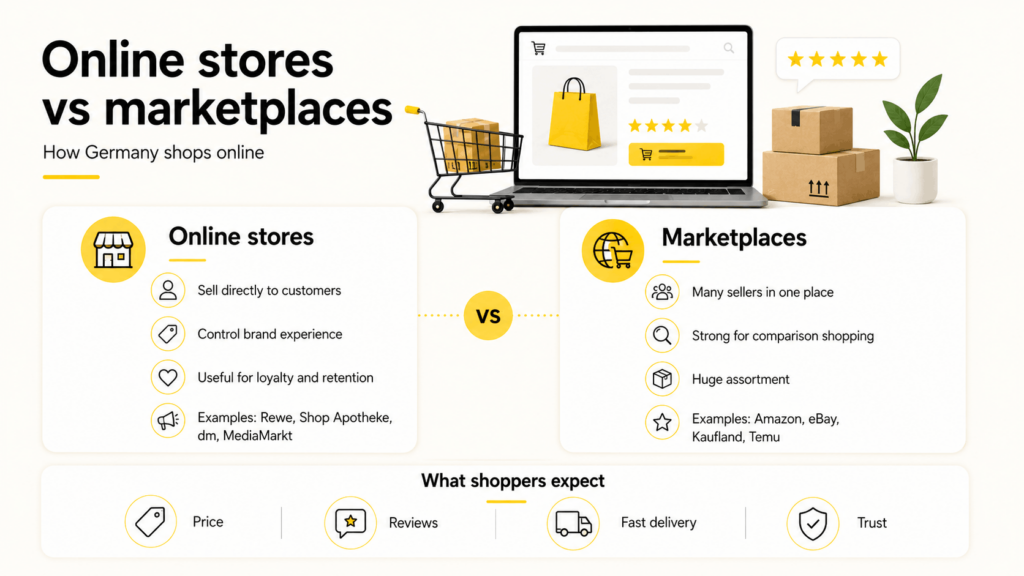
An online store, marketplace, hybrid platform and recommerce platform can all generate online sales, but they work differently.
| Type | Examples | Why it matters |
| Online store | Rewe, Shop Apotheke, dm, MediaMarkt | Retailer or brand sells directly to customers |
| Marketplace | Amazon, eBay, Temu, Kaufland | Many sellers transact on one platform |
| Hybrid platform | Otto, Zalando | Mix of own retail and partner sellers |
| Recommerce platform | Vinted, Momox, Medimops, Rebuy | Second-hand, resale or refurbished model |
| Specialist store | Bergfreunde, Bike24, Zooplus | Strong category authority and repeat demand |
This distinction matters because customers use these models differently.
They may go to Amazon for range, Otto for trust, Zalando for fashion, Rewe for groceries, Shop Apotheke for pharmacy, Vinted for second-hand fashion and Bergfreunde for outdoor expertise.
For more platform-specific context, see our guide to best online marketplaces in Germany.
Why Shein, Temu, Rewe and Shop Apotheke matter
The most interesting German ecommerce story is not only who ranks first.
Amazon has been first for years. The more important question is: who is changing customer behavior?
| Player | Signal |
| Shein | Cross-border ultra-fast fashion has entered the German mainstream |
| Temu | Low-price marketplace shopping is becoming harder to ignore |
| Rewe | Grocery ecommerce is now a top-tier category |
| Shop Apotheke | Pharmacy and health ecommerce are becoming routine |
| Vinted | Recommerce is part of everyday fashion shopping |
| Flaschenpost | Fast delivery can change beverage and grocery behavior |
These players show four major shifts.
First, price pressure is getting stronger. Shein and Temu prove that many shoppers will try new platforms when prices are low enough.
Second, everyday essentials are moving online. Rewe, dm, Rossmann, Shop Apotheke, DocMorris and Flaschenpost all benefit from this shift.
Third, recommerce is now mainstream. Vinted, Momox, Medimops and Rebuy show that second-hand and refurbished shopping are no longer niche.
Fourth, German shoppers still value trust. Otto, dm, Rewe, MediaMarkt, Thalia and Fressnapf show that familiar local brands still have power.
Marketplaces are no longer optional
Marketplaces shape German ecommerce even when retailers sell through their own online stores.
German shoppers are used to comparing prices, reading reviews, checking delivery dates and seeing multiple sellers in one place. This has changed what people expect from every ecommerce experience.
Retailers need to decide how marketplaces fit into their strategy.
They can use marketplaces for reach, discovery and international expansion. But they also need to protect their own customer relationships, margin and brand experience.
For German retailers thinking beyond their own store, see our article on how German brands are expanding to international marketplaces.
What smaller online stores can learn from Germany’s top players
Smaller retailers cannot copy Amazon’s scale or Zalando’s fashion infrastructure. They do not need to.
The more useful question is: which behaviors from top online stores can smaller ecommerce teams adapt?
| Top-store behavior | What smaller retailers can copy |
| Clear category ownership | Own a niche instead of trying to sell everything |
| Fast delivery communication | Show delivery cost, timing and return rules early |
| Familiar payment options | Add PayPal, invoice or BNPL, cards and local methods where relevant |
| Strong product data | Use specs, reviews, FAQs, dimensions and comparison content |
| Marketplace presence | Use marketplaces for discovery, not total dependency |
| Retention mechanics | Use reminders, subscriptions, loyalty and replenishment flows |
| Trust signals | Add reviews, contact details, guarantees and transparent policies |
| Better search | Help customers find products quickly with filters and structured data |
Payments are especially important in Germany, where checkout trust can make or break conversion. See our guide to top payment providers in the DACH region for a more detailed breakdown.
What this ranking says about German ecommerce in 2026
Germany is still a strong ecommerce market, but the easy wins are gone.
The market is bigger, but also more competitive. Marketplaces dominate attention. Low-price international platforms put pressure on local retailers. Daily essentials are moving online. Recommerce is growing. Shoppers compare more, expect clearer information and punish weak checkout or delivery experiences quickly.
The strongest online stores in Germany usually have at least one of these advantages:
- massive product range,
- local trust,
- sharp category focus,
- marketplace reach,
- strong delivery promise,
- familiar payment options,
- repeat-purchase logic,
- strong product data,
- clear price positioning.
That is also why generic mid-market ecommerce is under pressure. A store that is not the cheapest, fastest, most trusted, most specialized or most convenient needs a better reason to exist.
FAQ: top online stores in Germany
What is the biggest online store in Germany?
Amazon.de is the biggest online store and marketplace in Germany. It leads because of its huge product range, delivery infrastructure, marketplace model, customer reviews and strong price-comparison role.
What are the top online stores in Germany?
The most important online stores and platforms in Germany include Amazon, Otto, Zalando, MediaMarkt, Saturn, Shein, Shop Apotheke, Rewe, Kaufland, eBay, IKEA, dm, Rossmann, Douglas, Zooplus and Vinted.
Is Otto still important in German ecommerce?
Yes. Otto remains one of Germany’s strongest local ecommerce players. It combines retail, marketplace logic, trust, local payment expectations and strong categories such as furniture, fashion, home and appliances.
Why is Shein important in Germany?
Shein is important because it shows how much German shoppers respond to low prices, trend speed and mobile-first fashion discovery. Its rise into the top 10 shows that cross-border ultra-fast fashion is now part of the German mainstream.
Is Temu one of the biggest online marketplaces in Germany?
Temu has become one of the major online marketplaces in Germany. Its growth shows that low-price marketplace competition is getting stronger, although the platform also faces scrutiny around product quality, compliance and consumer protection.
Which categories are growing in German ecommerce?
Fashion and electronics remain important, but grocery, pharmacy, beauty, pet products, recommerce and daily essentials are becoming much more relevant. Rewe and Shop Apotheke entering or climbing in the top rankings show this shift clearly.
Are marketplaces more important than online stores in Germany?
Marketplaces are extremely important in Germany, but they do not replace online stores completely. Many of the strongest players combine marketplace reach with own-store trust, category depth or brand recognition.
What can smaller online stores learn from Germany’s top ecommerce players?
Smaller stores should focus on category clarity, trustworthy product pages, strong delivery communication, familiar payment methods, reviews, search filters and retention. They should not try to copy Amazon. They should copy the discipline behind top ecommerce execution.
Conclusion
The top online stores in Germany in 2026 show a market in transition.
Amazon still dominates. Otto and Zalando remain powerful. MediaMarkt, Saturn, IKEA, dm, Rossmann, Rewe and Shop Apotheke show the strength of trusted local and category-led players. Shein and Temu show the force of low-price cross-border competition. Vinted, Momox, Medimops and Rebuy show the rise of recommerce.
German ecommerce is no longer only about who sells the most products online.
It is about who owns customer trust, convenience, category intent, price perception, payment fit and repeat purchase.
For retailers, the message is clear: Germany is still one of Europe’s best ecommerce markets, but it rewards precision. The top players win because they know exactly what customers expect from them. Smaller stores need the same clarity, even without the same scale.