The Road to US$7 Trillion: Four Forces Reshaping Global E-Commerce Through 2030
World e-commerce is racing toward $7.14 trillion by 2030 – and the road there runs through emerging markets, cross-border trade, and a new force nobody saw coming: AI agents doing the shopping for us. Curious which milestones hit first, which regions are growing fastest, and why ChatGPT-driven traffic is already outconverting Google? Click through to see how it all connects in this article with insights from ECDB. (Ad)

By Nadine Koutsou-Wehling, Data Journalist
By 2030, e-commerce is set to surpass some significant milestones, and revenue is only one of them. According to our research at ECDB, world e-commerce is going to reach US$7.14 trillion by 2030. Several factors shape the e-commerce landscape as it unfolds over the next four to five years.
These developments include emerging market expansion, cross-border e-commerce, agentic commerce and AI, as well as the shift towards everyday consumable goods. Each topic is covered in more detail in this article.
For more insights like these, ECDB recently published a report Future of Commerce 2026/27, which illuminates each of these following aspects further.
New E-Commerce Milestones Landing Two Years Apart
Global e-commerce is reaching new milestones. In 2026, the market is projected to surpass US$5 trillion in revenue for the first time. But this is only another step in a much larger transformation.
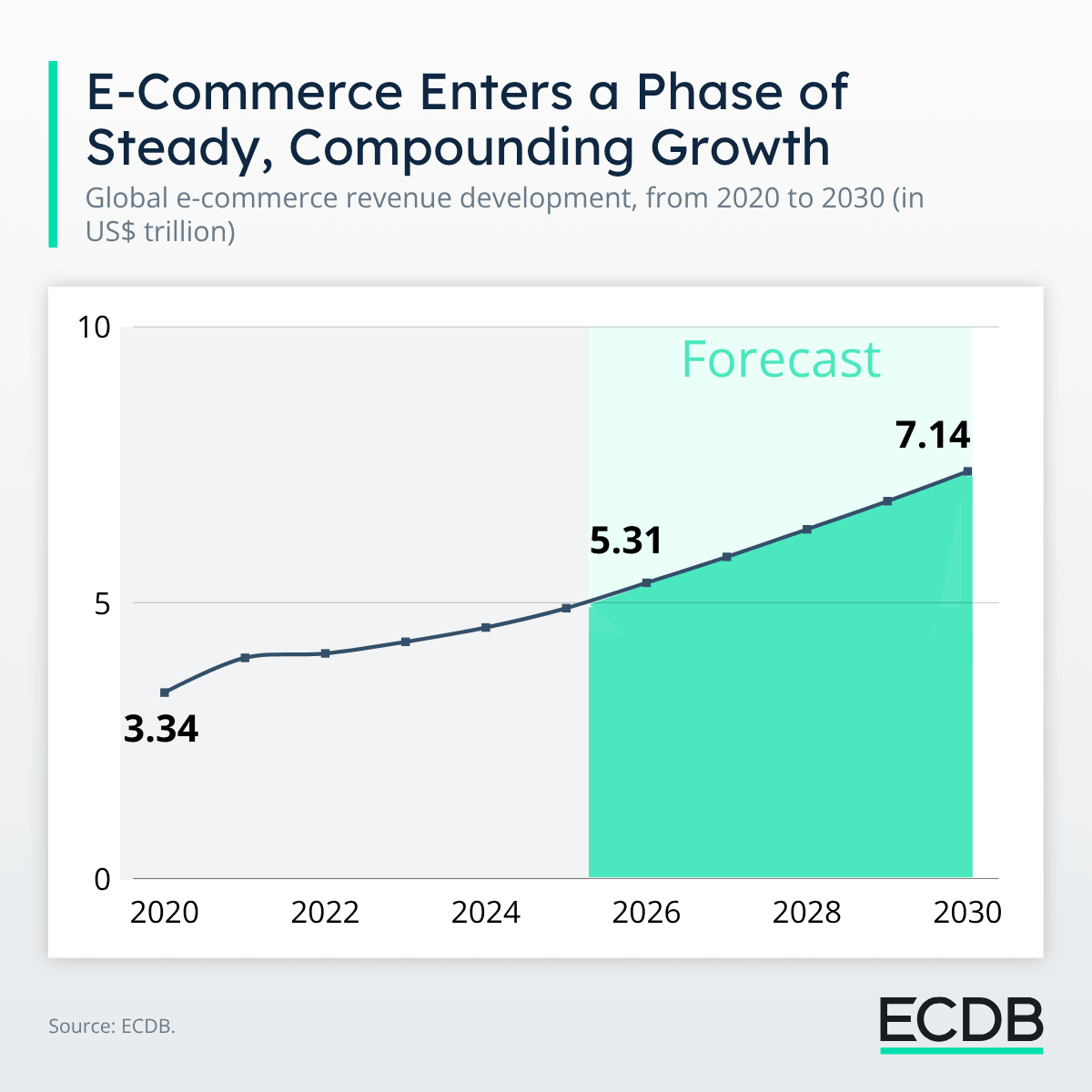
Each consecutive milestone lands two years apart: US$6 trillion by 2028, US$7 trillion by 2030. This growth will be driven by a combination of structural developments that reshape how consumers discover, purchase, and receive online products.
Emerging Regions Account for Fastest Growth Rates
This growth is not evenly distributed among regions. The rule of thumb is: The more developed a region or country, the slower its growth trajectory.
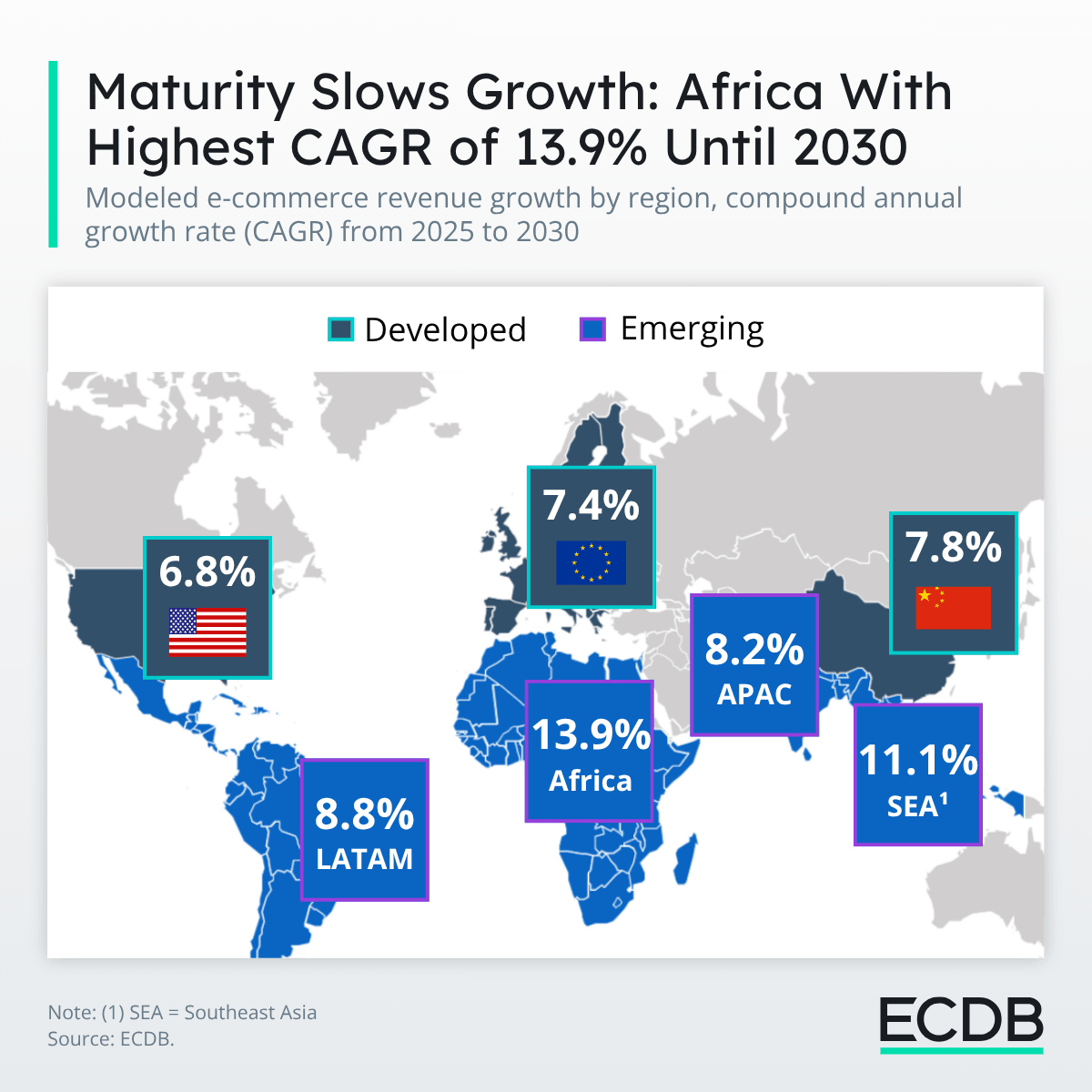
Basically, it comes down to saturation and base effects. In less developed markets, a larger share of consumers shop offline, often because of limited internet or smartphone access, weaker delivery infrastructure, or lower card and digital payment penetration.
Africa is a case in point for that relationship: From 2025 to 2030, the region is projected to grow at the highest CAGR of all world regions, at 13.9%. The EU follows at 7.4%, a little behind China’s 7.8% but ahead of the USA’s 6.8%.
At the same time, the 13.9% CAGR in Africa or 11.1% CAGR in Southeast Asia are growing from a much smaller base than the USA or China. A high growth rate on a small base still produces a small number in absolute terms, which is why global e-commerce revenue keeps concentrating where it already sits, rather than shifting toward the fastest-growing region.
Cross-Border E-Commerce as a Key Revenue Driver
Cross-border e-commerce is one of the global growth drivers in e-commerce, expanding consumer bases and improving access through better infrastructure.
By now, cross-border e-commerce roughly matches total US online market revenue. That makes it a little larger than the world’s second-largest e-commerce market. And it keeps climbing. By 2026, cross-border online revenue is expected to surpass US$1.2 trillion.
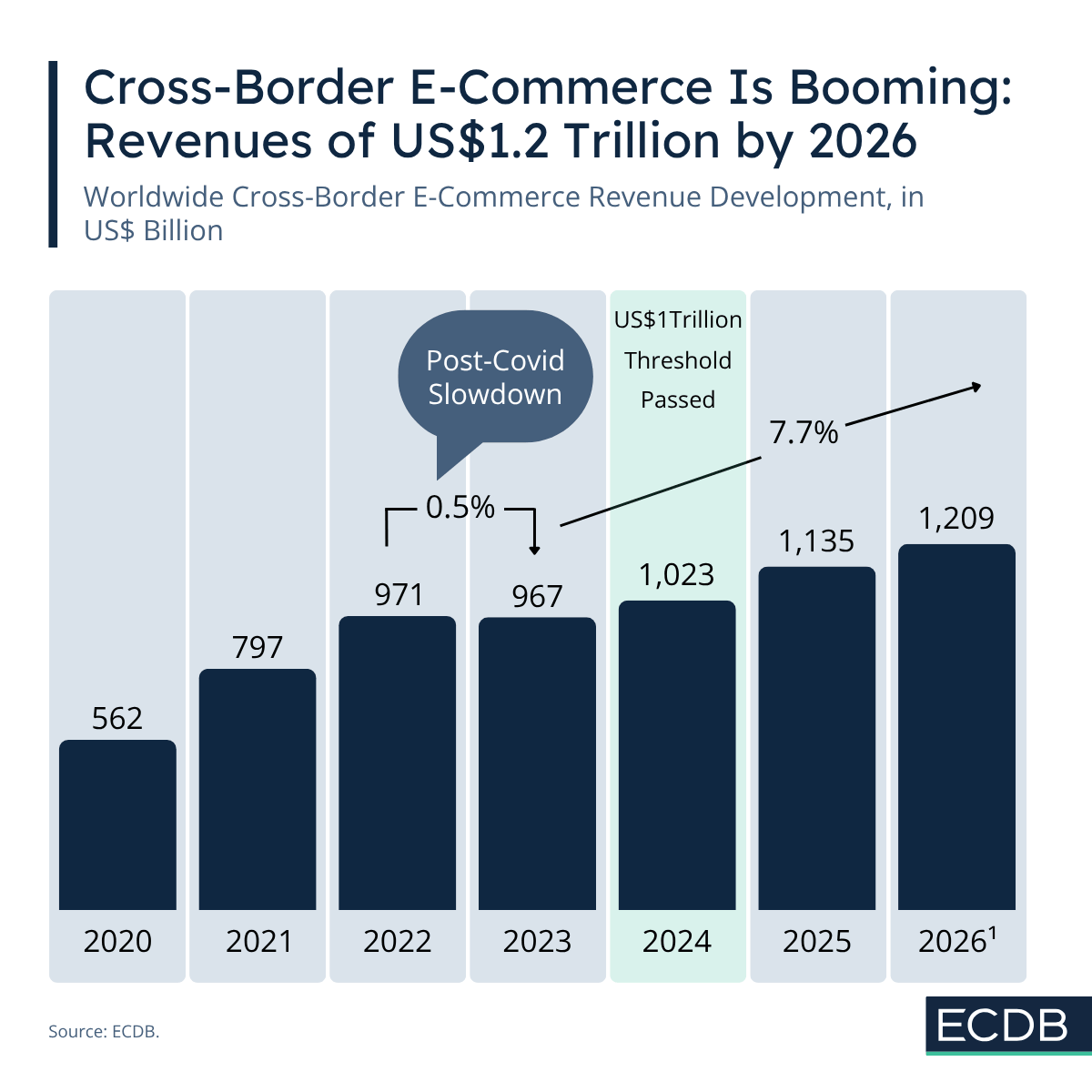
Cross-border revenues here follow a headquarters logic: The domestic market is set by where a retailer’s headquarters are located. So, for example, everything Amazon generates outside the USA counts as an export.
Following this logic, cross-border e-commerce passed the US$1 trillion threshold in 2024, recovering from a brief post-Covid dip that had pushed global revenues down to US$967 billion in 2023.
Cross-border e-commerce continues to grow, even as tariffs target the low-cost Chinese platforms undercutting domestic offerings.
Across regions, different players contribute to the trend. They include Shopee in Southeast Asia, MercadoLibre in Latin America, and multiple platforms like Zalando, Carrefour, IKEA and Allegro in and across Europe.
As of now, comparison shopping across borders is becoming easier still: Through AI and agentic commerce.
AI Agents Are Going to Take Over as Traffic Sources
AI has changed the way we interact with the world around us. One of the ways in which this shift becomes palpable is in shopping.
While it is still in its infancy, agentic commerce is expected to overhaul search traffic and conversion metrics to become the dominant channel for product discovery and a key driver of purchase decisions.
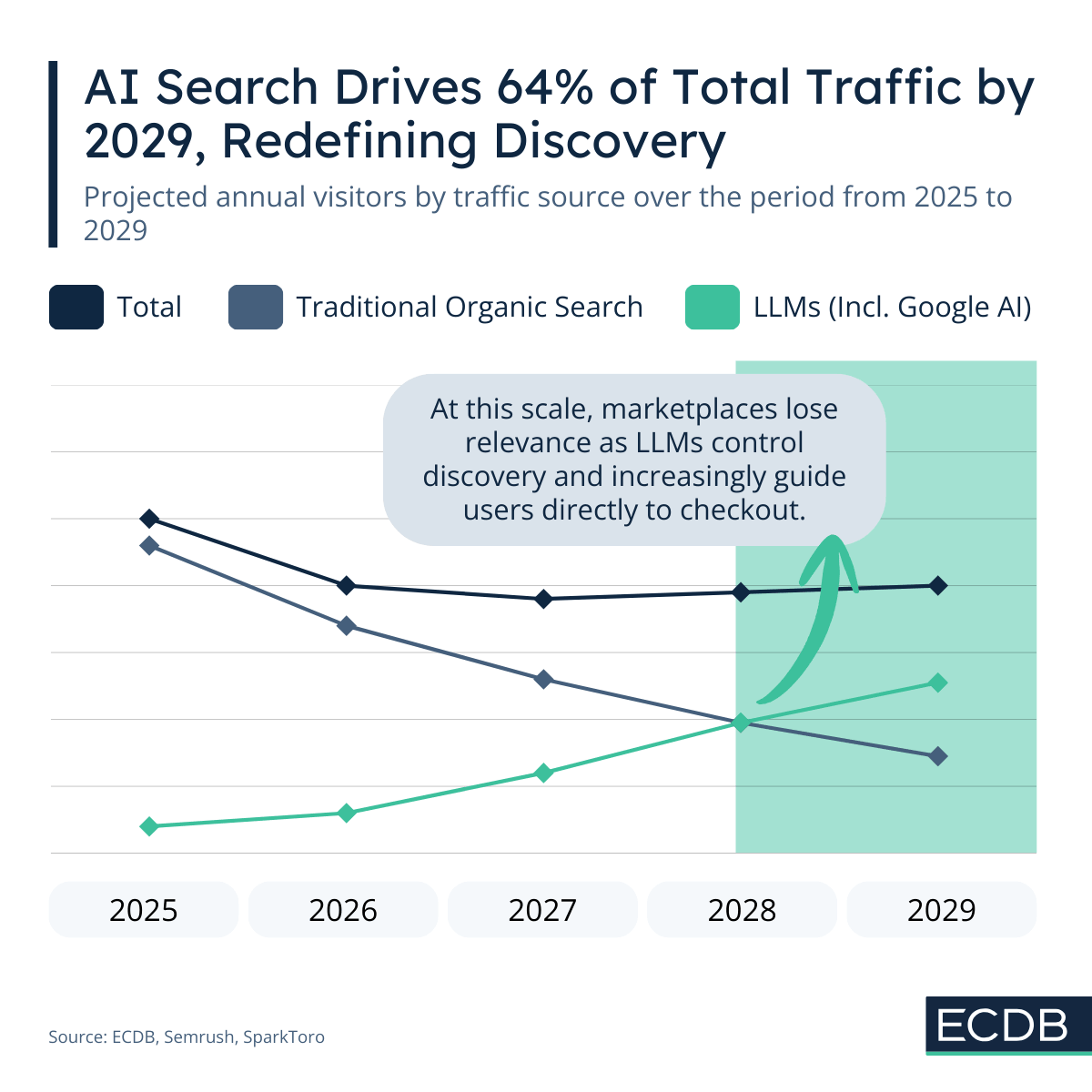
Currently, annual visitor numbers to retail sites generated by large language models (LLMs) like ChatGPT, Gemini, and Claude remain far below those from traditional organic search. But this is going to change in the coming years. The question is not whether, but rather when the shift is going to become evident.
Projections by traffic analysts pinpoint 2028 as the year in which agentic commerce is going to surpass traditional organic search like Google and Bing to become the main driver of retail online traffic. By 2029, the share of total traffic is expected to reach 64%.
The Effects of ChatGPT Conversion Are Already Visible
Already, ChatGPT is outperforming other traffic sources in driving engagement and conversions. Since 2025, traffic generated by ChatGPT has shown higher conversion rates than direct search, paid search, organic search, email, display advertising and social media.
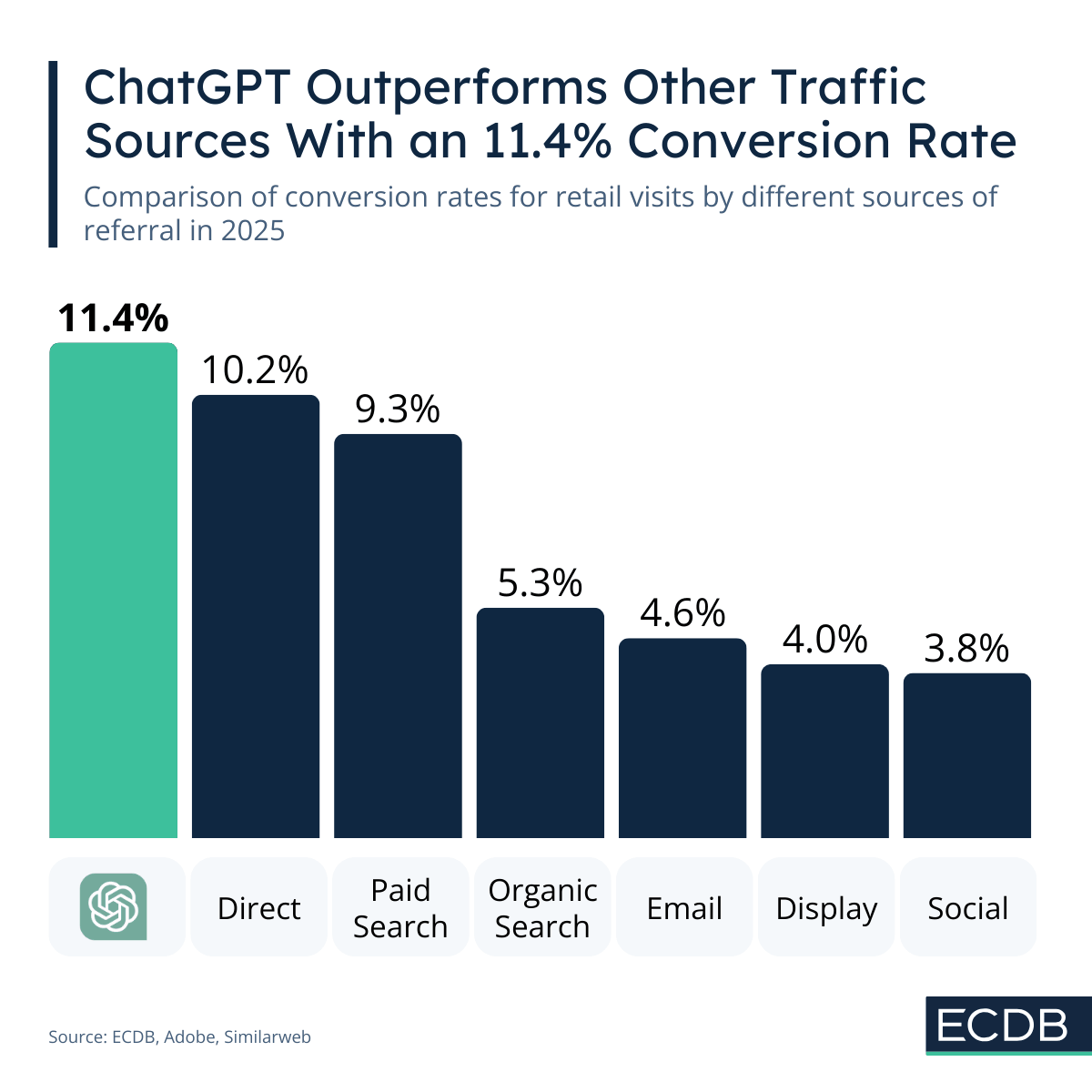
At a conversion rate of 11.4%, ChatGPT-driven traffic converts significantly better than traditional channels. That shift is expected to become more prominent in the coming years.
One factor is conversational refinement: chatbot dialogue helps users narrow down what they want, which increases the chance of a sale.
Beyond how people shop, what they buy is shifting too. Everyday essential goods are the fastest-growing category through 2030.
Everyday Essential Goods Grow Highest Through 2030
Through 2030, the fastest-growing product categories are not occasional purchases but everyday essentials that consumers buy repeatedly. Rather than one-off transactions, these categories benefit from recurring demand, making them well positioned for long-term e-commerce growth.
That is because purchasing these products becomes a habit, which improves retention and lifetime customer value.
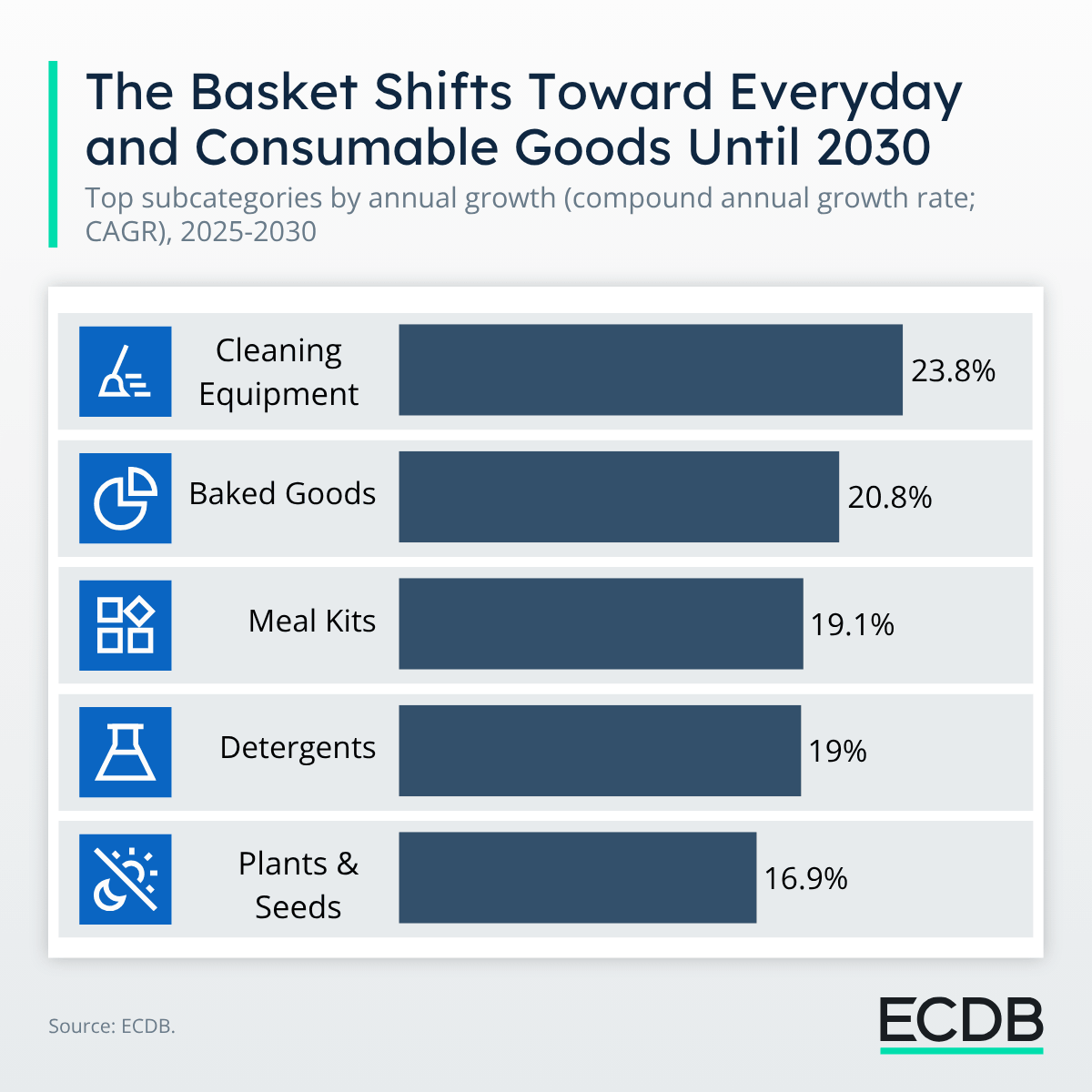
A keyword across these fast-growing categories is replenishment. As e-commerce grows and becomes ingrained into everyday life, consumers prefer the convenience of ordering products online and receiving them to their doorstep rather than visiting multiple stores physically.
A few clicks are often enough to place an order, while expanding quick commerce networks and faster delivery services make waiting less of a barrier than ever before.
With improving delivery speeds and maturing online grocery ecosystems, recurring household purchases are becoming a larger share of overall e-commerce spending. This includes better price comparison as well, as online offers tend to be more transparent in that regard.
This concerns the following categories in particular:
- Cleaning Equipment with a CAGR (2025-2030) of 23.8%
- Baked Goods at 20.8%
- Meal Kits with 19.1%
- Detergents close behind at 19.0%
- And Plant & Seeds, at a CAGR of 16.9%.
Assuming automated reordering becomes a fixture of everyday e-commerce by 2030, a combination of these factors will determine what comes next.
Outlook
The next phase of e-commerce growth is driven by all of the previous factors: Improving infrastructure worldwide benefits both emerging regions and cross-border e-commerce, even as trade policy tries to slow one side of it down. Agentic commerce is layering on top of all of it, compressing how quickly a browsing session turns into a purchase. And the categories gaining the most ground are the ones people reorder without thinking about it, which is what ties discovery, habit, and retention into the same story.