Generative engine optimization case study: How Weimob increased a Chinese tea franchise’s AI search visibility from 2.5% to 56%
Chinese buyers ask AI, not Google. See how generative engine optimization increased a Chinese tea franchise’s AI visibility from 2.5% to 56% across major AI platforms. Bonus: Want to see models like this live in China? Learn more about the trip with E-commerce Berlin Expo and Expanding Together at the end of article.

Written by Zheng Xu
At a glance: This case study was written by Zheng Xu, an expert with 18 years of experience as a Customer Relationship Architect, helping brands create authentic connections with their customers across Europe and Asia. It explores what the West can learn from Chinese e-commerce based on a meeting with one of the innovative companies offering solutions for this industry there. The article shows how Weimob, a Chinese cloud-based business and marketing solutions provider, applied generative engine optimization to improve the AI search visibility of Gu Ren Shuo, a Chinese healthy tea franchise. As a result, Weimob increased its AI visibility from 2.5% to 56% across major AI platforms and moved it from position 98 to position 2 in category ranking.
When a customer wants to know something in China today, they increasingly do not open a search engine – they ask an AI. That single behavioural shift is redrawing the rules of digital marketing, and it is exactly the shift that Weimob’s generative engine optimization system is built to exploit. This case study looks at how Weimob helped a healthy tea franchise, Gu Ren Shuo, move from near-invisibility to the top of AI-generated answers, and what that means for brands everywhere.
When search dies, AI answers take over
The clearest signal of how far China has moved came from an everyday moment. On a visit to Shanghai in April, I asked my mother where I could get a pair of shoes repaired. Instead of typing the question into a search box, she picked up her phone and asked an AI assistant.
That small story captures a large truth: in China, traditional search is fading fast, and asking AI for information has become the default. For brands, the implication is uncomfortable. If your customers no longer search, then the channels you have optimised for over the past decade are quietly losing their reach and the brands that adapt first will own the answers everyone else is only beginning to compete for.
What Weimob does?
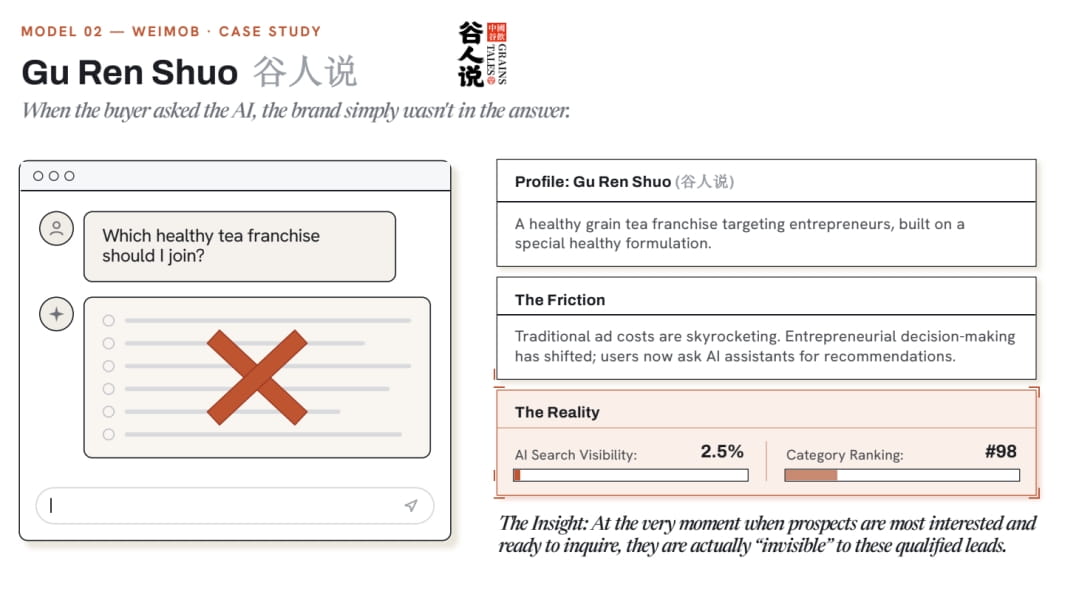
Weimob describes itself as an operating system that digitizes everything a brand touches: the platform aims to digitalize every one of a brand’s customer touchpoints. The company has made a heavy investment in generative engine optimization system: a dedicated system designed to help brands appear inside the answers that AI platforms give to users.
That focus matters because the buyer’s journey now often begins and ends inside an AI conversation. If a brand is not present in that answer, it may never enter the customer’s consideration set at all.
The challenge: Gu Ren Shuo and the vanishing customer
A market where entrepreneurs ask AI, not Google
Tea is close to a national obsession in China, there is not only bubble tea, but many variants of healthy teas, and a constant churn of new tea-shop concepts. It is entirely normal to walk down a single street and find five different tea shops within 300 meters. Competition for both customers and franchisees is intense.
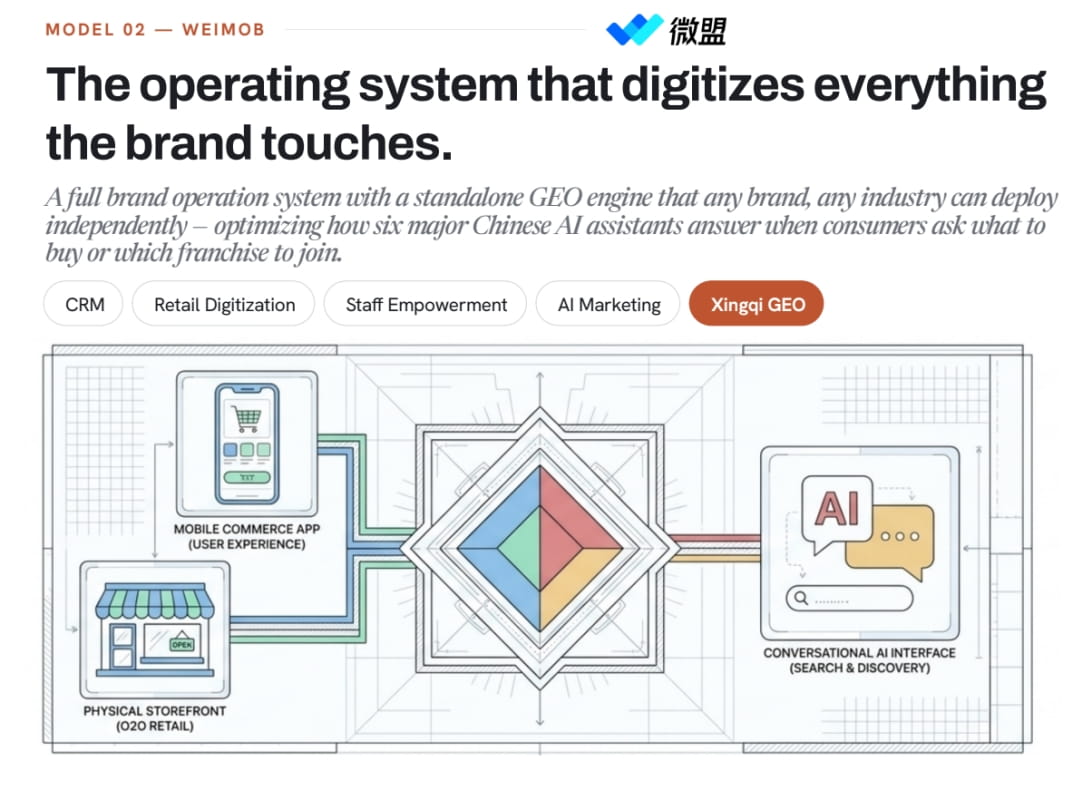
Gu Ren Shuo, a healthy tea franchise, wanted to reach a specific audience: entrepreneurs looking to start business in this category. But the way those entrepreneurs make decisions has changed. They no longer search, so traditional advertising struggles to reach them. Instead, a prospective business owner might ask an AI, “What would be a great business idea for me to start this year?” and, if tea franchising comes up, follow it with, “What are the top three tea franchises in China?”.
A brand that is not already present in those AI answers faces a hard choice: spend double or triple the ad budget to reach the same customer another way, or accept being left out of the conversation entirely.
The starting point: 2.5% visibility, ranked #98
Before working with Weimob, Gu Ren Shuo’s AI search visibility sat at just 2.5%, with their ranking positioning around number 98. To put that in familiar terms: in classic SEO, if a user has to click through two pages of Google results to find you, you effectively do not exist for that prospect. In the age of AI answers, being ranked 98th is arguably worse. AI tends to surface a short, confident shortlist, and everything below it is invisible.
Inside Weimob’s system
Weimob applied their proven framework to improve Gu Ren Shuo’s visibility:
Step 1 – Capture across six AI platforms
The first step is capture: Weimob assesses a brand’s current standing across the six major AI platforms in China. Western observers may know DeepSeek, but the Chinese landscape includes several more, such as Doubao, among a total of six. Simply monitoring a brand’s presence across all of them is a substantial task in itself and a reminder that “AI search” is not one destination but many.
Step 2 – Transform data into high-trust, machine-readable knowledge
Next, Weimob converts a brand’s information – PDFs, text, websites, and other data – into a high-trust, machine-readable knowledge base.
This step rests on an important insight. Most company documents, and the best sales letters in particular, are written by emotion. In traditional marketing that is a strength: the best sales copy connects emotionally with the reader. But AI does not respond to emotion; it works from facts, or more precisely from how the text represents those facts. Weimob calls the reworked, fact-led version “high-trust data.” Turning persuasive, human-written material into something an AI can trust and cite is central to the entire generative engine optimization approach.
Step 3 – Build a question-led strategy
With clean, machine-readable knowledge in place, Weimob turns it into a strategy organised around real questions. Rather than starting from what a brand wants to say, the system asks what a real-world user would actually ask an AI, for example, “What is the best next business idea for me?” or, in another market, a young parent asking, “What kind of stroller should I buy for my baby?”. The strategy is then designed so the brand shows up, credibly, in the answers to those questions.
Step 4 – Execute around the clock
Finally, the strategy is put into execution, with continuous, around-the-clock optimisation working to keep the brand listed within AI answers as the platforms and their responses evolve.
The results
The outcome for Gu Ren Shuo was dramatic. After going through the process:
- AI search visibility rose from 2.5% to 56%,
- The position in ranking climbed from number 98 to number 2.
Higher visibility in AI answers means the brand reaches more of its potential customers at the exact moment they are making a decision and, because it no longer has to buy its way in front of buyers who have stopped searching, it also means a lower customer acquisition cost.
The lesson it leaves us with: your customer is now using AI, so you need to get a step in front of them, rather than a step behind.
Why this matters for e-commerce brands
We can frame the takeaway around two layers that every commerce business now has to win.
The first is transactions. The e-commerce ecosystem, even in the West, has become genuinely complicated, with customers spread across many different platforms. Being findable everywhere, with enough manpower and time to do it well, is a real challenge in its own right.
The second is AI answers. When a customer asks an AI, is the brand named in the response or not? This is not only a question for brands selling directly online. It is equally relevant for service providers, who can use the same thinking to develop new offers, helping their own clients become the answer, not just an option buried beneath it.
This case study shows both layers converging. Winning the transaction increasingly depends on first winning the answer, and using generative engine optimization can be the way to make that happen.
Want to explore other e-commerce case studies from China? Read this one: How Youzan uses AI to turn one-time buyers into repeat customers.
See models like Weimob live in China
Models like Weimob are often easier to grasp in context than on paper. For those who want to see them first-hand, E-commerce Berlin Expo and Expanding Together are organizing the E-Commerce Networking Trip: seven days total, visits in Beijing, Shanghai, and Hangzhou in November 2026, bringing Europe’s e-commerce community into direct contact with the people building China’s next wave.
What to expect on the trip:
- No factory tourism or generic show sessions – instead, closed-door conversations with operational decision-makers, exclusive networking sessions with potential partners, and a fully tailored programme built around who is in the room;
- All networking sessions run in German and English, with professional interpreters throughout;
- A lot of inspiration from seeing models that are two to three years ahead of Europe, live and in context;
- A concrete action plan for your business for the 30–90 days after you land back in Europe.
Thinking about joining us in November?
Source
This case study is based on information shared during Zheng Xu’s meeting with Weimob. The results and descriptions reflect the information presented during that exchange.
About the author

Zheng Xu is an International Expansion Architect with 18 years of Germany-China experience. She architects strategic relationships across cultural boundaries – systematically, authentically, and with long-term impact.
Frequently Asked Questions
Q: What is generative engine optimization?
A: Generative Engine Optimization is the practice of getting a brand named and recommended inside the answers that AI platforms generate for users – the AI-era counterpart to traditional search engine optimisation.
Q: How is generative engine optimization different from SEO?
A: Classic SEO aims to rank a page high in a list of search results that the user then clicks. Generative Engine Optimization aims to get the brand included in a single AI-generated answer, where the “list” is often just a top few names.
Q: Why does emotional marketing copy underperform with AI?
A: Traditional sales writing is built to connect emotionally with a reader. AI systems, by contrast, work from facts and from how text represents those facts.