Most Valuable German Brands in 2026: Top 10 Ranked
Discover Germany’s most valuable brands in 2026, led by Telekom, SAP and Siemens, plus the biggest movers and key shifts across tech, retail and automotive.
Last updated: August 2026
Germany is famous for automotive brands, engineering and the long-standing promise behind “Made in Germany.” But the country’s most valuable brands in 2026 tell a broader story.
Telecom and technology now sit at the top. Retail brands are gaining ground. Financial services are among the fastest growers. And while German carmakers remain global heavyweights, they no longer dominate the brand ranking as clearly as many might expect.
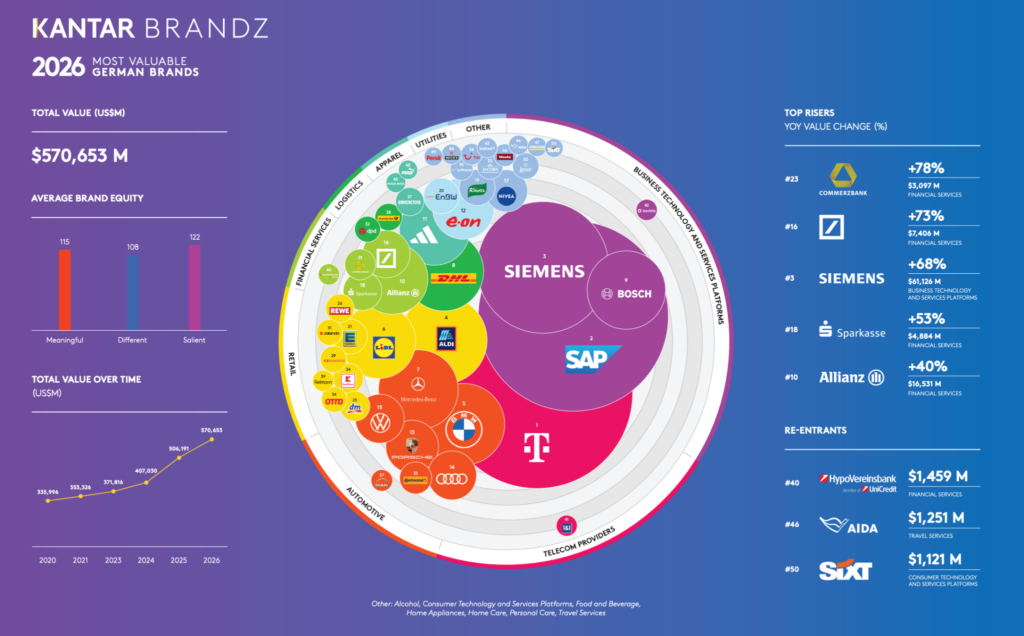
According to the latest Kantar BrandZ ranking, Telekom is Germany’s most valuable brand in 2026, valued at $124.6 billion. SAP follows at $98.2 billion, while Siemens takes third place at $61.1 billion. Germany’s 50 most valuable brands are now worth a combined $571 billion, up 13% year over year.
Germany’s most valuable brand in 2026: quick answer
Telekom/T-Mobile is the most valuable German brand in 2026.
Kantar values the brand at $124.6 billion, an 18% increase from 2025. A separate Brand Finance ranking also puts Deutsche Telekom’s T brand at number one in Germany, with a 2026 valuation of €83.4 billion.
The exact figures differ because the two organizations use different brand valuation methods. More on that later.
Top 10 most valuable German brands in 2026
The 2026 Kantar BrandZ ranking puts technology, telecom and retail brands alongside Germany’s better-known automotive names.
| Rank | Brand | Category | Brand value 2026 | YoY change |
| 1 | Telekom / T-Mobile | Telecom | $124.6B | +18% |
| 2 | SAP | Business technology | $98.2B | +6% |
| 3 | Siemens | Business technology | $61.1B | +68% |
| 4 | Aldi | Retail | $27.7B | +18% |
| 5 | BMW | Automotive | $21.8B | +8% |
| 6 | Lidl | Retail | $21.0B | +36% |
| 7 | Mercedes-Benz | Automotive | $20.7B | -1% |
| 8 | DHL | Logistics | $20.6B | +12% |
| 9 | Bosch | Business technology | $20.2B | -11% |
| 10 | Allianz | Financial services | $16.5B | +40% |
Source: Kantar BrandZ Most Valuable German Brands 2026.
The ranking is quite different from a list of Germany’s largest companies by revenue. Volkswagen, for example, is one of Germany’s biggest businesses, but company revenue and brand value measure very different things.
Brand value attempts to isolate the economic power associated with the brand itself.
What changed from 2025 to 2026?
The top of the ranking is relatively stable. The movement below it is much more interesting.
Telekom, SAP, Siemens and Aldi retained the first four positions. After that, the order changed considerably.
In 2025, Kantar’s top 10 looked like this:
- Telekom
- SAP
- Siemens
- Aldi
- Bosch
- Adidas
- Mercedes-Benz
- BMW
- DHL
- Lidl
By 2026:
- BMW moved from #8 to #5
- Lidl jumped from #10 to #6
- Bosch fell from #5 to #9
- Allianz entered the top 10 at #10
- Adidas dropped out of the top 10
- Mercedes-Benz remained at #7
The biggest difference is growth in actual brand value.
Siemens increased by 68%, Lidl by 36% and Allianz by 40%. At the same time, Bosch lost 11% of its brand value and Mercedes-Benz slipped 1%.
Across the full Top 50, the combined value rose from $506 billion in 2025 to $571 billion in 2026. Kantar reports that 38 German brands increased in value during 2026, compared with 31 a year earlier.
That growth is happening while Germany’s wider economy remains under pressure, making the performance of its biggest brands even more notable.
1. Telekom: $124.6 billion
Telekom remains comfortably ahead.
Its brand value increased 18% to $124.6 billion, giving it a gap of more than $26 billion over SAP.
Kantar links the growth to investment in 5G infrastructure, digital services, international expansion and continued investment in brand communication. Telekom has also become an increasingly global business rather than a brand dependent only on its home market.
Brand Finance reaches the same conclusion about the leader. Its Germany 150 ranking values the T brand at €83.4 billion, up 9% year over year.
2. SAP: $98.2 billion
SAP remains Germany’s second most valuable brand.
Its brand value rose 6% to $98.2 billion in 2026 after much faster growth during the previous year.
The company’s position also highlights a bigger shift in Germany’s brand economy. Software, AI, cloud infrastructure and industrial technology now sit much closer to the center of the country’s global brand identity.
That shift extends beyond SAP.
Business Technology & Services Platforms account for almost 32% of the combined value of Germany’s Kantar Top 50, making the category the largest contributor to the ranking.
3. Siemens: $61.1 billion
Siemens is arguably the standout story near the top.
Its brand value surged 68% in one year, from $36.4 billion to $61.1 billion.
Kantar points to Siemens’ repositioning around AI-driven industrial technology, strong global demand and strong financial performance.
The result puts Siemens much closer to SAP and leaves a huge gap between Germany’s top three brands and the rest of the ranking.
This also fits the broader German corporate picture. Industrial companies are investing heavily in AI, automation and digital infrastructure as they deal with labor shortages, international competition and pressure on manufacturing costs.
4. Aldi: $27.7 billion
Aldi is Germany’s most valuable retail brand in the Kantar ranking.
Its value increased 18% to $27.7 billion, keeping Aldi at #4 overall.
The strength of Aldi and Lidl makes sense in the current consumer environment. German shoppers remain highly price-conscious, while discount retailers have become much more sophisticated in branding, private-label products and digital customer acquisition.
The same behavior can be seen across Germany’s most popular online shopping categories, where customers frequently compare retailers, marketplaces and specialist sellers before buying.
5. BMW: $21.8 billion
BMW climbed three positions to become Germany’s highest-ranked automotive brand in the Kantar 2026 top 10.
Its brand value increased 8% to $21.8 billion.
BMW now ranks slightly ahead of Mercedes-Benz under Kantar’s methodology, but that does not mean BMW is universally considered Germany’s most valuable automotive brand.
Brand Finance arrives at a different result. Its global automotive study places Mercedes-Benz ahead of BMW, illustrating how much methodology can influence brand rankings. German manufacturers still hold four of the five most valuable automotive brand positions in Brand Finance’s global 2026 automotive ranking.
6. Lidl: $21.0 billion
Lidl recorded one of the strongest performances in the top 10.
Its brand value jumped 36% to $21 billion, moving it from tenth place in 2025 to sixth in 2026.
Kantar highlights Lidl’s combination of low prices and perceived product quality. Its international footprint also helps. The retailer now operates across 31 countries.
Aldi and Lidl together are now worth almost $49 billion in the Kantar ranking.
Their strength also mirrors what is happening online. German e-commerce remains highly price-sensitive and marketplaces account for a growing share of online spending. Price comparison and value shopping increasingly influence customer journeys even when the final purchase happens elsewhere.
7. Mercedes-Benz: $20.7 billion
Mercedes-Benz remains one of Germany’s most recognized global brands, but 2026 has been a tougher year for its valuation.
Kantar puts the brand at $20.7 billion, down 1%.
Brand Finance paints an even more challenging picture, estimating that Mercedes-Benz lost 15% of its brand value to reach €40.4 billion. It nevertheless ranks third among all German brands under Brand Finance’s methodology.
Pressure on the wider automotive industry comes from weaker demand in some markets, EV competition, tariffs and rapid changes in the Chinese automotive sector.
Still, automotive remains a huge part of Germany’s economy and international reputation.
8. DHL: $20.6 billion
DHL increased its brand value 12% to $20.6 billion.
Its presence in the top 10 shows how valuable logistics infrastructure has become in an economy shaped by global trade and e-commerce.
DHL is also Germany’s largest logistics operator by revenue, far ahead of domestic competitors. You can see the wider competitive landscape in our ranking of Germany’s top logistics companies.
For online retailers, logistics has become part of the customer-facing brand experience too. Delivery options, tracking and returns increasingly affect conversion and loyalty, a trend also visible in recent DHL e-commerce research.
9. Bosch: $20.2 billion
Bosch slipped from fifth to ninth place after its brand value declined 11% to $20.2 billion.
That does not remove Bosch from the group of Germany’s most valuable brands. It does, however, show how quickly the ranking is changing below the top four.
Bosch is also an interesting example of the blurred line between Germany’s traditional engineering strength and its growing technology sector. Kantar categorizes Bosch within Business Technology & Services Platforms rather than automotive.
10. Allianz: $16.5 billion
Allianz is the new entrant to Kantar’s top 10.
Its value increased 40% to $16.5 billion, one of the strongest growth rates among Germany’s largest brands.
And Kantar is not alone in seeing momentum.
Brand Finance goes much further, ranking Allianz as Germany’s second most valuable brand overall, behind Telekom and ahead of Mercedes-Benz. It values Allianz at €52.6 billion after an 18% year-over-year increase.
The difference between #10 in one ranking and #2 in another makes Allianz a perfect example of why brand valuation lists should never be compared without looking at their methodology.
Germany’s fastest-growing brands in 2026
Some of the biggest winners sit outside the top 10.
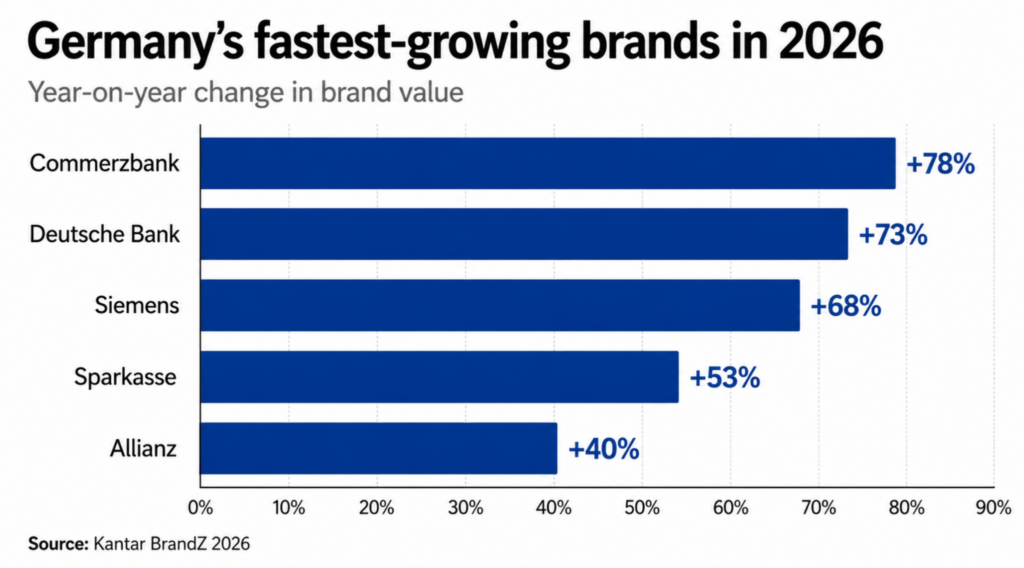
According to Kantar, the fastest-growing German brands in 2026 include:
- Commerzbank: +78%
- Deutsche Bank: +73%
- Siemens: +68%
- Sparkasse: +53%
- Allianz: +40%
Three of the five are financial brands.
Financial Services brands now contribute $33.4 billion, or around 6%, of the total value of Kantar’s German Top 50.
Brand Finance identifies another extraordinary mover: Rheinmetall, whose brand value increased 98% to €4.1 billion, making it the fastest-growing brand in its Germany 150 ranking.
The result reflects the changing structure of Germany’s economy. Defense and infrastructure spending are becoming much more important, something also visible when looking at the country’s largest companies in 2026.
Technology now contributes almost one-third of German Top 50 brand value
Germany is still associated with cars abroad, but Kantar’s numbers show how incomplete that picture has become.
Four Business Technology & Services Platform brands in the Top 50 are collectively worth $180.9 billion.
That represents almost 32% of the entire ranking.
Telecom adds another 22%.
Automotive, meanwhile, accounts for around 12% of Kantar’s Top 50 brand value.
So while Mercedes-Benz, BMW and other German automakers remain globally important, a larger share of Germany’s most valuable brand equity now sits in telecom, enterprise software and industrial technology.
Aldi and Lidl show the growing power of German retail brands
Retail has more brands in Kantar’s German Top 50 than any other category.
Ten retail brands generate a combined $69.4 billion, or 12% of total ranking value. Aldi and Lidl dominate that group.
Their rise overlaps with changes happening across German commerce.
Germany’s online retail market is forecast to grow 4.3% in 2026, faster than physical retail. Marketplaces now account for more than half of online sales.
At the same time, Germany’s top 100 online stores include a much broader mix of marketplaces, grocery sellers, pharmacies, fashion platforms and specialist retailers than they did a few years ago.
For a revenue-based view, our top online shops in Germany ranking shows how Amazon, eBay, Otto, Temu and Zalando compare.
Brand value and e-commerce revenue are different metrics, but both point toward the same competitive reality: scale alone is not enough. German consumers move between brands, marketplaces, search engines, price comparison sites and emerging AI tools before making many purchases.
German brands are unusually global
One of the most striking Kantar findings has little to do with the domestic German market.
Germany’s Top 50 brands generate an average of 73% of their business outside Germany.
SAP, Siemens, DHL, BMW, Mercedes-Benz, Adidas and other German names rely heavily on international markets.
That global footprint helps explain why brand value can remain strong even when Germany’s domestic economy is weak.
It also explains the long-term value of “Made in Germany.” Quality, engineering, reliability and manufacturing expertise continue to influence how German brands are perceived abroad.
International businesses entering the region face the reverse challenge. Germany is a large market, but consumer expectations around trust, payments, privacy, pricing and delivery can differ from neighboring countries. Our Germany e-commerce market overview covers those differences in more detail.
Kantar vs Brand Finance: why are the rankings different?
Search for Germany’s most valuable brands and you may find several different answers.
The two most useful 2026 rankings come from Kantar and Brand Finance, and they agree on one thing:
Telekom is number one.
After that, their rankings diverge.
Kantar’s top three:
- Telekom: $124.6B
- SAP: $98.2B
- Siemens: $61.1B
Brand Finance’s top three:
- T / Deutsche Telekom: €83.4B
- Allianz: €52.6B
- Mercedes-Benz: €40.4B
The difference comes from methodology, not an error in either list.
Kantar BrandZ combines financial analysis with large-scale consumer research to estimate how much value a brand contributes to a business. Its 2026 German ranking draws on more than 117,000 consumer interviews.
Brand Finance uses a Royalty Relief method. It estimates the royalty a company would theoretically need to pay to license its brand, then applies that rate to forecast brand-related revenues and discounts future earnings to present value.
For that reason, the numbers should be treated as estimates created under different models rather than interchangeable market prices.
Most valuable does not mean strongest
Brand Finance also separates brand value from brand strength.
And Germany’s strongest brand in 2026 is not Telekom, SAP or Mercedes-Benz.
It is Edeka.
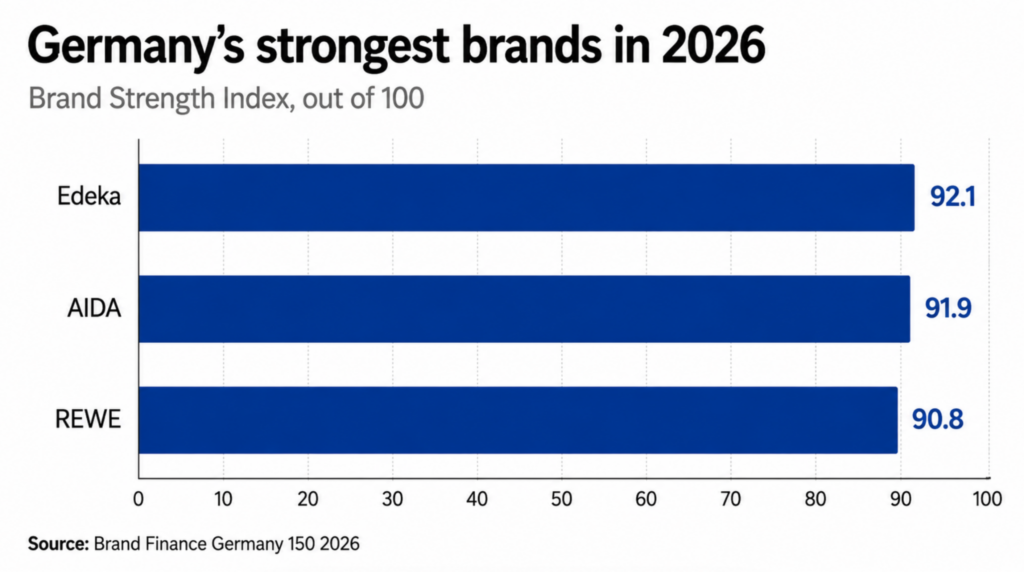
The grocery retailer received a Brand Strength Index score of 92.1 out of 100 and an AAA+ rating.
AIDA ranked second with 91.9, followed by REWE with 90.8.
Brand strength considers factors such as familiarity, reputation, preference and customer engagement rather than simply calculating financial brand value.
For retailers, that distinction matters.
A company does not need to be one of Germany’s biggest businesses to build unusually strong customer preference.
German consumers are also famously careful about unfamiliar sellers. Reviews alone often do not close the trust gap. Legal transparency, payment methods, recognizable delivery partners and other trust signals in the German market can have a direct effect on buying confidence.
What Germany’s most valuable brands tell us about the market
The 2026 ranking shows a German brand economy in transition.
Cars remain important, but technology has become a much larger source of brand value.
Discount retailers are growing faster than many traditional consumer brands.
Financial companies are recovering brand momentum.
And the biggest German brands increasingly make most of their money outside Germany.
At the consumer level, brand competition is changing too.
Customers no longer discover products through one predictable path. Search, marketplaces, social platforms, recommendations and AI-assisted shopping now overlap. Our analysis of how German consumers discover e-commerce brands looks at that shift in more detail.
German online retail is growing again as well. The market is forecast to expand 4.3% in 2026, with marketplaces accounting for roughly 57% of sales. Older consumers are also becoming a stronger source of growth.
For brands selling into Germany, being recognizable still matters. But recognition now needs to work alongside price competitiveness, distribution, trust and a buying experience that fits local expectations.
Key takeaways
- Telekom is Germany’s most valuable brand in 2026, according to both Kantar and Brand Finance.
- Kantar values Germany’s Top 50 brands at $571 billion, up 13% year over year.
- SAP and Siemens put business technology firmly among Germany’s most valuable brand categories.
- Aldi and Lidl show how strongly retail and value positioning are performing.
- BMW overtook Mercedes-Benz in Kantar’s ranking, although different valuation methods produce different automotive rankings.
- Allianz entered Kantar’s top 10 and ranks second overall according to Brand Finance.
- Financial brands are among Germany’s fastest growers.
- Edeka is Germany’s strongest brand according to Brand Finance, despite not being its most valuable.
FAQ
What is the most valuable German brand?
Telekom/T-Mobile is Germany’s most valuable brand in 2026. Kantar BrandZ values it at $124.6 billion, while Brand Finance values Deutsche Telekom’s T brand at €83.4 billion. Both major rankings place it at number one.
What are the top five German brands?
According to Kantar BrandZ 2026, Germany’s five most valuable brands are Telekom, SAP, Siemens, Aldi and BMW. Their estimated brand values range from $124.6 billion for Telekom to $21.8 billion for BMW.
What is Germany’s strongest brand?
Edeka is Germany’s strongest brand according to Brand Finance’s Germany 150 2026 ranking. It received a Brand Strength Index score of 92.1/100 and an AAA+ rating, ahead of AIDA and REWE.
Is BMW or Mercedes-Benz more valuable?
It depends on the methodology. Kantar values BMW at $21.8 billion and Mercedes-Benz at $20.7 billion, putting BMW slightly ahead. Brand Finance ranks Mercedes-Benz higher in its own valuation model.
Why do Kantar and Brand Finance give different brand values?
They use different valuation models. Kantar combines financial data with consumer research. Brand Finance uses a Royalty Relief model that estimates the economic value associated with licensing a brand. The rankings should be compared as separate estimates rather than identical financial measurements.
How valuable are Germany’s top brands combined?
Kantar estimates that Germany’s 50 most valuable brands are worth $571 billion in 2026, up 13% year over year. Brand Finance values the 150 brands included in its Germany 150 ranking at a combined €640.6 billion.
***