Top 10 best dropshipping companies in Germany [2026]
Looking to start dropshipping in Germany? Check out our list of the top 10 best companies!
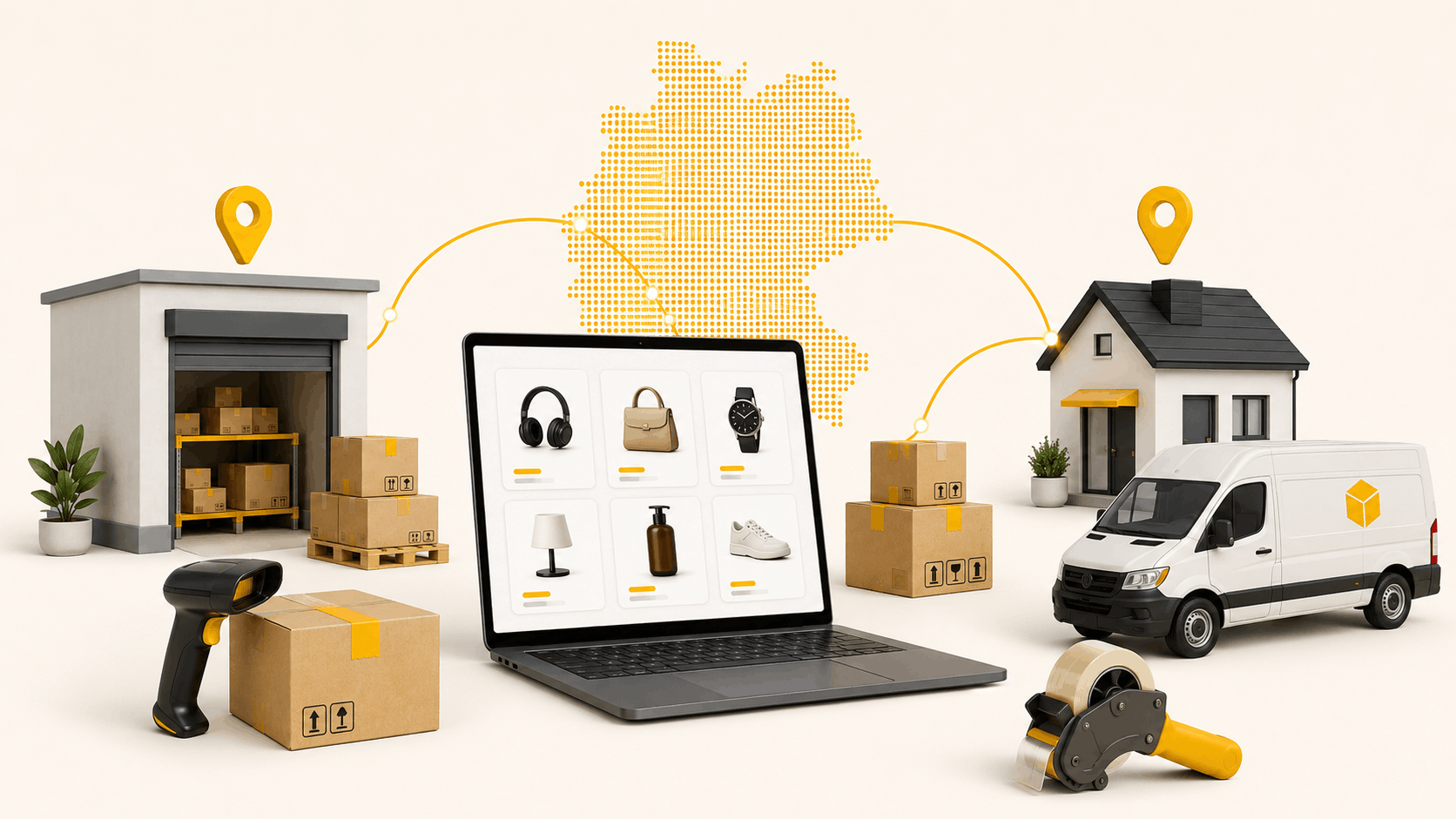
Dropshipping in Germany is still growing, but the easy version of the model is gone.
In 2026, sellers need more than a supplier list. They need reliable products, realistic delivery promises, clear returns, compliant product information and enough margin to survive marketplace pressure. A store selling the same generic product customers can find on Amazon, Temu, AliExpress or eBay in two clicks has a problem before ads even start.
That does not mean dropshipping is dead in Germany.
It means the model has matured. Dropshipping can still work when sellers choose the right niche, work with trustworthy suppliers, control product data, understand legal obligations and build a store customers have a reason to trust.
Below, we compare the top dropshipping companies in Germany, explain what changed in 2026, and show how to choose suppliers without falling into the usual margin, compliance or delivery traps.
TL;DR: dropshipping in Germany in 2026
| Topic | 2026 snapshot |
| Market outlook | Germany’s dropshipping market is expected to grow strongly through 2030 |
| Best-fit model | Niche, branded, category-led or print-on-demand dropshipping |
| Biggest risk | Generic products with weak margins and strong marketplace competition |
| Compliance | GPSR, VerpackG, returns, VAT, product claims and marketplace rules |
| Best supplier type | Germany/EU-based supplier with clear product data, returns and documentation |
| Main selection criteria | Delivery, returns, quality, integrations, documentation, margin and support |
| Stronger categories | Fashion, print-on-demand, beauty, personal care, accessories, home and specialist niches |
| Harder categories | Electronics, batteries, food, supplements, cosmetics and bulky furniture unless compliance is handled well |
Is dropshipping legal in Germany?
Yes, dropshipping is legal in Germany.
But legal does not mean effortless. Sellers are still responsible for what they sell, how products are described, how customers are treated and how legal obligations are handled.
In Germany, dropshipping sellers need to think about product safety, consumer rights, returns, packaging obligations, VAT, delivery promises and accurate product information. If a supplier ships the product, that does not automatically remove the seller’s responsibility toward the customer.
| Area | Why it matters for dropshipping in Germany |
| Product safety | Products sold to EU consumers must meet safety requirements |
| GPSR | Online sellers need proper product, manufacturer and responsible-person information |
| Packaging Act / VerpackG | Sellers placing packaged goods on the German market may need LUCID registration and packaging licensing |
| Returns | German shoppers expect clear return rights and refund handling |
| VAT / tax | Cross-border sellers need a proper tax setup |
| Delivery promises | Long or unclear delivery times damage trust |
| Product claims | Supplements, cosmetics, electronics and health-related products need extra care |
| Marketplace rules | Amazon, eBay, Kaufland and others may require compliance proof |
| Customer support | The seller still owns the customer relationship |
| Product data | Wrong images, specs or materials can create refund and compliance problems |
The main point is simple: dropshipping changes your inventory model, not your responsibility.
Dropshipping in Germany: what changed in 2026
Dropshipping used to be marketed as a quick way to start an online store with little upfront investment.
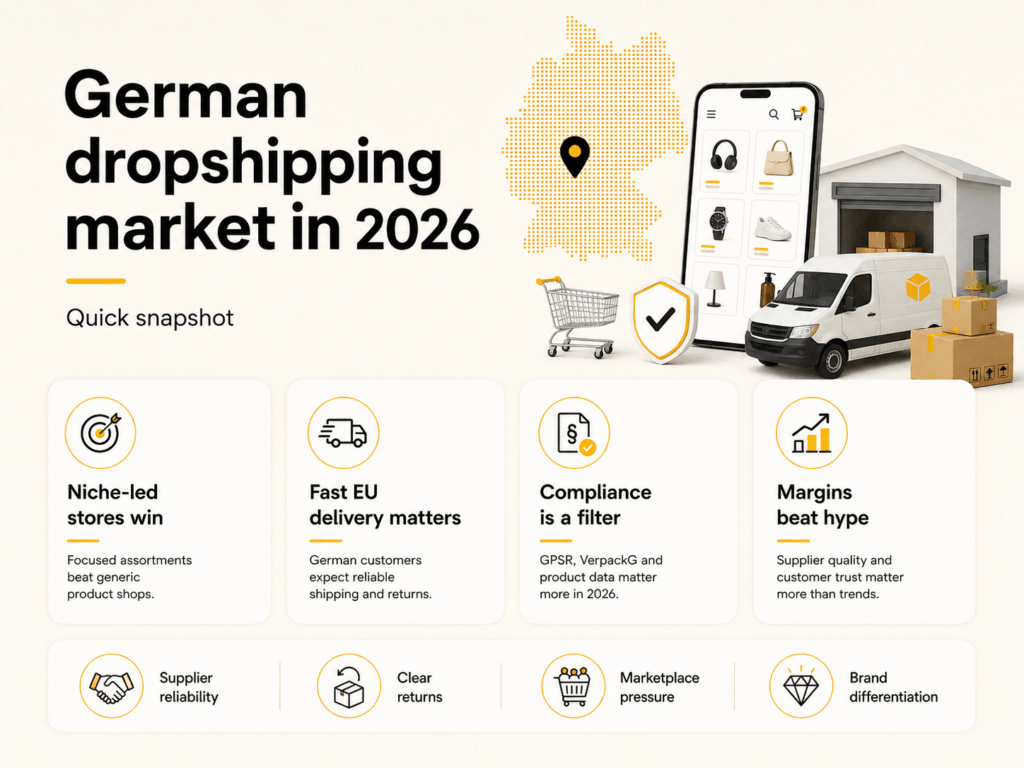
That is only half the story now.
German ecommerce keeps growing, but competition is tougher. Marketplaces dominate product discovery. Price comparison is part of the shopping journey. Temu, SHEIN, AliExpress, Amazon, eBay and Kaufland put constant pressure on generic products. German shoppers also care about delivery, returns, payment trust and product reliability.
For broader market context, see our guides to top online stores in Germany and best online marketplaces in Germany.
Dropshipping in Germany now works best when a store has one of these advantages:
- a clear niche,
- stronger product presentation,
- faster local or EU delivery,
- reliable returns,
- customized products,
- exclusive supplier access,
- strong content,
- brand trust,
- better bundles,
- better customer support,
- clear compliance documentation.
The weak model is the opposite: random products, vague suppliers, long delivery, no product expertise, no returns plan and paid ads doing all the work.
Types of dropshipping suppliers in Germany
Not all dropshipping suppliers do the same job.
A print-on-demand supplier, luxury fashion supplier, furniture supplier and electronics supplier create very different business risks. Before choosing a company, sellers should understand the type of supplier they are dealing with.
| Supplier type | Examples | Best for | Main risk |
| Print-on-demand | Podbase, Shirt-King | Custom products, low inventory risk | Quality consistency, narrow margins |
| Category supplier | buXtrade, Emporium, Gallay, CLP | Niche stores | Compliance and return complexity |
| Supplier marketplace | Dropshipping Marktplatz | Testing product categories | Supplier quality varies |
| Luxury dropshipping | BrandsGateway | Premium fashion | Brand trust, high customer expectations |
| Electronics supplier | Manolya, AGI AKKU | Tech accessories and electronics | Product safety, warranty, battery rules |
| General supplier | Trends 4 Cents | Broad assortment | Weak positioning and commodity pressure |
This is why a single “best dropshipping supplier” rarely exists.
The right supplier depends on the business model. A personalized phone case store needs different operations than a luxury fashion boutique or a furniture dropshipping store.
Top dropshipping companies in Germany: quick comparison
| Company | Main category | Best for | Watch out |
| Podbase | Print-on-demand tech accessories | Custom phone cases and accessories | Category is narrow |
| BrandsGateway | Luxury fashion | Premium fashion stores | High AOV, but high customer expectations |
| buXtrade | Supplements, spices, food ingredients | Food and wellness stores | Compliance and product claims need care |
| Dropshipping Marktplatz | Supplier marketplace | Product sourcing across categories | Supplier quality needs checking |
| Shirt-King | Print-on-demand apparel | Custom textile stores | Product quality and print expectations |
| Emporium | Perfume and cosmetics | Beauty and fragrance shops | Brand authenticity and returns |
| Gallay | Jewelry | Accessories stores | Materials, product descriptions and returns |
| Manolya Electronics | Electronics | Consumer electronics stores | Warranty, returns and product safety |
| Trends 4 Cents | Mixed products | General product testing | Risk of scattered positioning |
| CLP | Furniture | Home and garden stores | Bulky delivery and returns |
| AGI AKKU Service | Batteries and power products | Electronics/accessories niches | Safety, recycling and battery compliance |
Top dropshipping companies in Germany
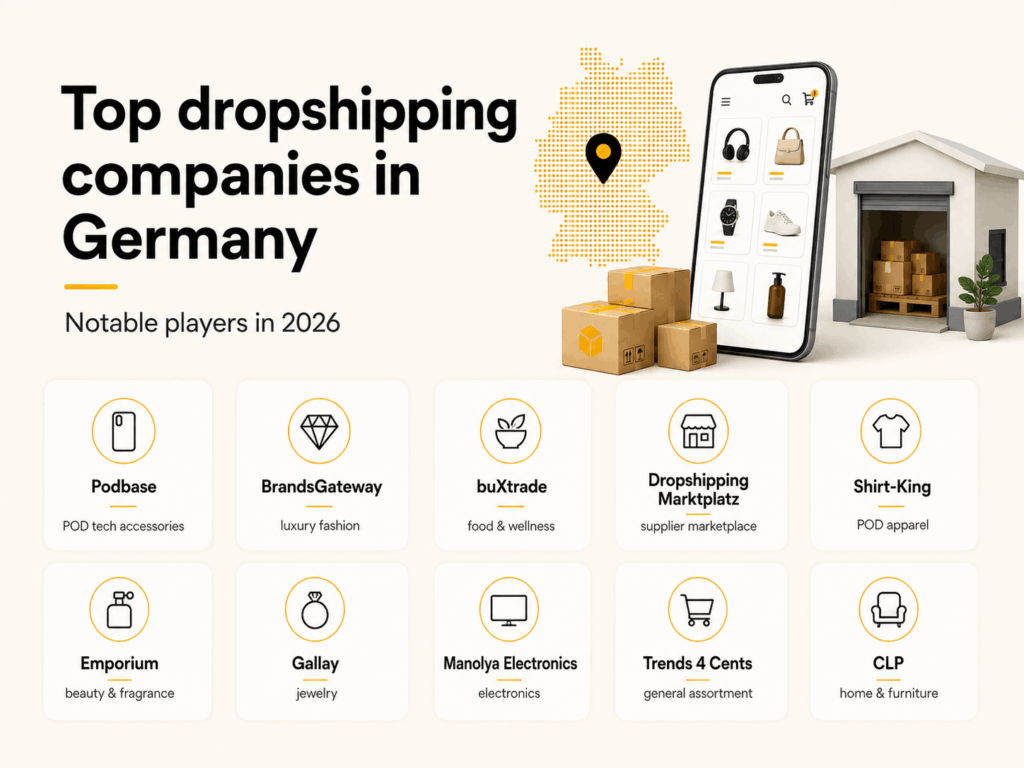
1. Podbase
Podbase is a print-on-demand supplier focused mainly on custom tech accessories such as phone cases and related products.
| Best for | Category | Watch out |
| Personalized product stores | Print-on-demand tech accessories | Narrow product range and quality consistency |
Podbase can be useful for sellers who want to build a brand around customized products rather than generic marketplace goods. This is one of the safer dropshipping directions because personalization makes direct price comparison harder.
The challenge is category depth. A store built only around phone cases or small accessories needs strong creative direction, good product mockups and a clear audience. Otherwise, it becomes another low-margin accessory shop.
2. BrandsGateway
BrandsGateway focuses on luxury and premium fashion dropshipping.
| Best for | Category | Watch out |
| Premium fashion ecommerce | Luxury fashion and accessories | High expectations around authenticity, returns and service |
BrandsGateway is interesting because premium fashion can create better average order values than generic product dropshipping. It may appeal to retailers that want a more curated fashion store instead of low-ticket impulse products.
But premium also raises the bar. Customers expect accurate sizing, authentic products, reliable delivery, premium packaging and smooth returns. If the customer experience feels cheap, the positioning breaks quickly.
For wider fashion context, see our article on fashion retail trends in DACH.
3. buXtrade
buXtrade supplies products such as food ingredients, spices, supplements and related goods.
| Best for | Category | Watch out |
| Food, wellness and specialty stores | Food ingredients, supplements, spices | Product claims, ingredients, compliance and expiry dates |
buXtrade can fit niche stores focused on food, wellness, ingredients or specialty consumables.
This category can be attractive because food and personal care are repeat-purchase areas. But it also requires caution. Sellers need to be careful with health claims, ingredient information, expiry dates, storage requirements and product safety.
This is not the right category for vague product pages or aggressive advertising claims.
4. Dropshipping Marktplatz
Dropshipping Marktplatz works as a supplier marketplace for merchants looking for dropshipping products across different categories.
| Best for | Category | Watch out |
| Product sourcing and category testing | Supplier marketplace | Supplier quality and consistency vary |
A supplier marketplace can help sellers discover products without negotiating with every supplier one by one.
The risk is quality control. Sellers should not assume that every supplier, product description or image is ready for a serious German ecommerce store. Each supplier still needs to be checked for delivery time, returns, stock accuracy, product data and documentation.
Dropshipping Marktplatz is best treated as a sourcing tool, not a shortcut around supplier due diligence.
5. Shirt-King
Shirt-King is a print-on-demand and textile fulfillment provider.
| Best for | Category | Watch out |
| Custom apparel stores | Print-on-demand apparel and textiles | Print quality, sizing and return expectations |
Shirt-King can work for sellers building custom clothing, merch, niche apparel or branded textile products.
Print-on-demand is useful because sellers do not need to hold inventory. It also gives the store a chance to sell something differentiated. But apparel still comes with fit, sizing, color and return challenges.
A strong Shirt-King setup needs good designs, clear size charts, honest product visuals and a brand angle that is not easy to copy.
6. Emporium
Emporium is relevant for perfume, cosmetics and beauty-related dropshipping.
| Best for | Category | Watch out |
| Beauty and fragrance shops | Perfume, cosmetics and beauty | Authenticity, product claims, returns and shelf life |
Beauty and fragrance can be attractive categories because shoppers buy repeatedly and brands influence purchase decisions.
But beauty dropshipping also comes with trust issues. Customers care about authenticity, expiry dates, ingredients, packaging condition and returns. Sellers should be careful with claims and product descriptions.
For German shoppers, beauty products need to feel safe and legitimate, not like random stock from an unknown supplier.
7. Gallay
Gallay is a jewelry supplier that can be used for accessories-focused ecommerce stores.
| Best for | Category | Watch out |
| Jewelry and accessories stores | Jewelry | Material accuracy, images, returns and customer expectations |
Jewelry can work well for niche dropshipping because products are often lightweight, visual and suitable for gifting.
The challenge is trust. Product materials, measurements and images need to be accurate. If customers expect one quality level and receive another, returns and negative reviews can rise quickly.
Jewelry stores also need strong branding. Without it, products can feel generic and easy to compare elsewhere.
8. Manolya Electronics
Manolya Electronics is relevant for electronics and tech-related dropshipping.
| Best for | Category | Watch out |
| Consumer electronics stores | Electronics | Warranty, returns, safety and technical documentation |
Electronics can be profitable, but they are also risky.
Customers expect products to work, warranties to be clear and technical details to be accurate. Poor quality electronics create support tickets, refunds and safety concerns. Sellers also need to check CE marking, instructions, product safety documentation and return handling.
This category should not be approached casually.
9. Trends 4 Cents
Trends 4 Cents offers mixed products and can be used for general dropshipping product testing.
| Best for | Category | Watch out |
| Product testing and general stores | Mixed products | Weak positioning and commodity pressure |
General product suppliers can help sellers test many categories.
But this can also become a trap. A store with unrelated products often has no clear reason to exist. Customers may not trust it, and ads become harder to optimize because the audience keeps changing.
Trends 4 Cents may be useful for testing, but long-term stores usually need a sharper niche.
10. CLP
CLP is relevant for furniture, home and garden products.
| Best for | Category | Watch out |
| Home, garden and furniture stores | Furniture and home products | Bulky delivery, damage, returns and assembly expectations |
Furniture dropshipping can create higher order values, but logistics are more complicated.
Bulky products cost more to ship. Returns can be expensive. Damage during delivery is a real issue. Product dimensions, materials, colors and assembly information need to be clear.
CLP may fit home and garden stores, but sellers should calculate delivery, returns and damage handling before launching.
For wider home and DIY context, see our guide to best online DIY stores in Germany.
11. AGI AKKU Service
AGI AKKU Service focuses on batteries and power-related products.
| Best for | Category | Watch out |
| Electronics and battery niches | Batteries and power products | Safety, recycling, shipping and compliance |
Battery-related products can serve strong niche demand, but they come with additional responsibility.
Sellers need to check safety documentation, recycling obligations, transport restrictions, compatibility information and warranty handling. Wrong product data can create serious customer problems.
This supplier type is best for sellers with category knowledge, not beginners looking for an easy product.
How to choose a dropshipping supplier in Germany
A supplier should be chosen around product-market fit, not only product cost.
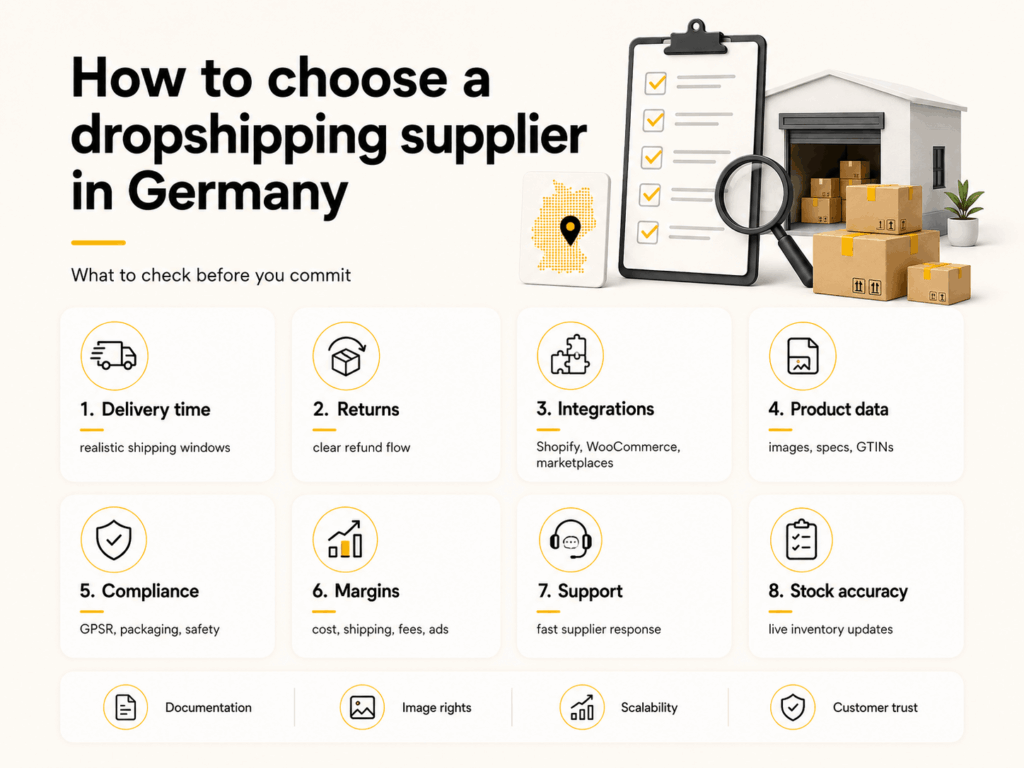
Cheap stock is not useful if delivery is slow, returns are unclear or documentation is missing.
| Factor | What to check |
| Product category | Does the supplier fit one clear niche? |
| Delivery time | Can they deliver in Germany within a realistic customer-friendly window? |
| Returns | Who handles returns, refunds and damaged items? |
| Integration | Shopify, WooCommerce, Amazon, eBay, Kaufland, Etsy |
| Product data | Titles, images, GTINs, dimensions, materials, safety info |
| Compliance | GPSR, CE, packaging, product claims, battery rules where relevant |
| Margins | Product cost + shipping + ads + returns + payment fees |
| Support | How fast does the supplier respond? |
| Scalability | Can they handle peak season and higher order volume? |
| Documentation | Invoices, supplier terms, product documentation |
| Stock accuracy | How often is inventory updated? |
| Image rights | Can you legally use supplier photos and descriptions? |
Ask these questions before signing or uploading products:
- Where is the stock located?
- What are the real delivery times to Germany?
- Who is responsible for returns?
- What happens when inventory is wrong?
- Can I use your product images legally?
- Do you provide safety documentation?
- Do you support German-language product data?
- What happens with damaged products?
- Are packaging obligations covered, or do I need to register?
- Do you support marketplace requirements?
- Can you provide invoices and product documentation?
- What happens during peak season?
A supplier that cannot answer these questions clearly may become a customer service problem later.
Dropshipping compliance checklist for Germany
Dropshipping sellers often underestimate compliance because they do not physically handle stock.
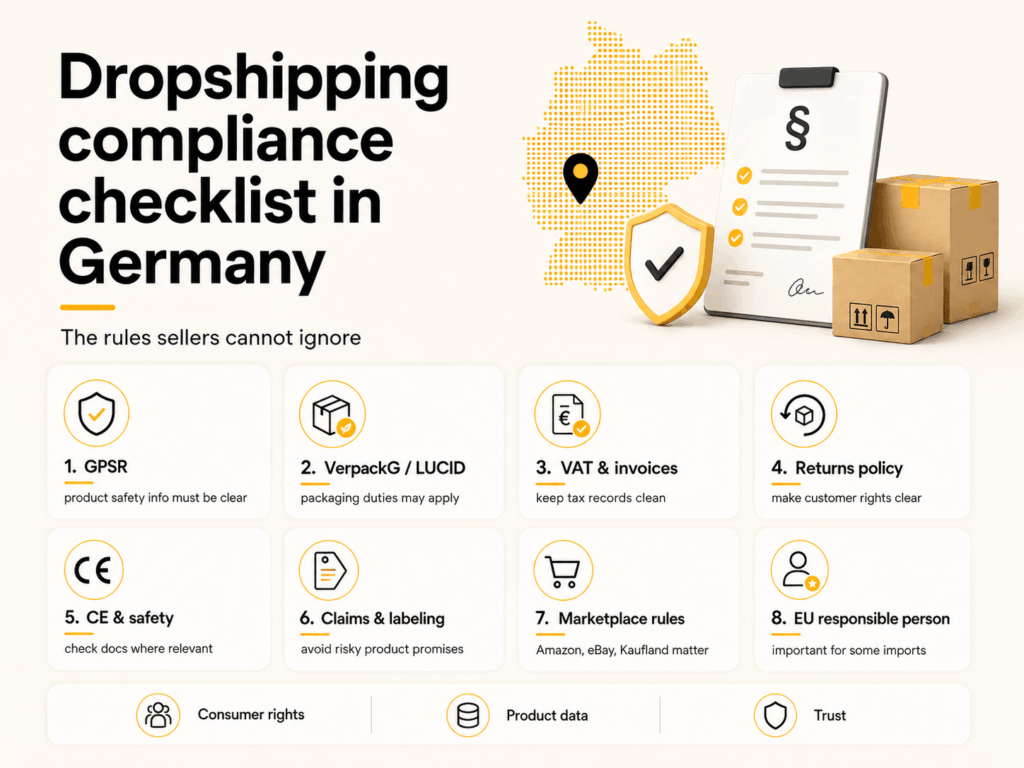
That is risky.
If you sell to German customers, you need to understand which obligations apply to your business and product category.
| Check | Why it matters |
| Is the supplier based in Germany or the EU? | Easier delivery, returns and compliance communication |
| Who is the seller of record? | Determines legal responsibility |
| Is the product GPSR-ready? | EU product safety information must be clear |
| Is there an EU responsible person where needed? | Important for non-EU products |
| Are packaging obligations covered? | LUCID / VerpackG can apply to online retailers |
| Are product claims safe? | Supplements, cosmetics and electronics need extra care |
| Are return terms clear? | German shoppers expect transparent returns |
| Can the supplier provide invoices and documentation? | Important for accounting, VAT and disputes |
| Are delivery times realistic? | Misleading delivery promises damage trust |
| Are images and descriptions licensed? | Avoid copyright and misleading product content |
| Are CE, battery or textile rules relevant? | Certain categories need extra checks |
| Are marketplace requirements covered? | Amazon, eBay and Kaufland may ask for proof |
This is especially important for sellers using non-EU suppliers.
A product may look profitable until compliance, returns and customer support are included.
Dropshipping in Germany vs marketplace selling
Dropshipping can happen through an owned store, marketplace channels or a mix of both.
Each route has different advantages and risks.
| Channel | Advantage | Challenge |
| Own dropshipping store | Brand control, niche positioning, customer data | Harder to earn trust and traffic |
| Amazon / eBay / Kaufland | Existing demand and customer trust | Fees, rules, competition and compliance proof |
| Temu / AliExpress-style competition | Low-price benchmark | Very hard to beat on price |
| Print-on-demand store | Differentiated products | Needs strong creative angle |
| Niche supplier store | Better category focus | Needs expertise and compliance |
| Social commerce / paid ads | Fast product testing | Margins can disappear quickly |
A marketplace can bring traffic, but it also brings rules and direct price comparison.
An owned store gives more control, but it needs stronger trust signals, content, customer service and acquisition strategy.
For related market context, see our guides to top shopping apps in Germany, top price comparison platforms in DACH and top payment providers in the DACH region.
When dropshipping does not work in Germany
Dropshipping is not a magic business model.
It fails quickly when the seller has no product edge, no brand trust and no control over customer experience.
| Problem | What happens |
| Generic product | Customers compare it on Amazon, Temu, AliExpress or idealo |
| Slow delivery | German shoppers lose trust before the parcel arrives |
| Weak returns | Support workload and refund disputes rise |
| Poor product data | Ads may convert badly, and compliance risk grows |
| No niche | Store becomes another random product shop |
| No margin model | Paid ads eat the profit |
| Unknown supplier | Product quality becomes your customer service problem |
| Risky claims | Supplements, cosmetics or health products can create legal issues |
| Bad packaging setup | VerpackG obligations may be missed |
| No customer support plan | Every supplier mistake becomes your ticket backlog |
Dropshipping works best when the seller is not just reselling products, but building a better buying experience around them.
That can mean better content, better bundles, better guides, better targeting, better post-purchase communication or better support.
Delivery and returns: the part dropshippers cannot ignore
German shoppers care about delivery and returns.
A dropshipping store that hides delivery times or makes returns difficult will struggle. Even if the first order converts, repeat purchase and reviews can suffer.
| Delivery / return issue | Why it matters |
| Long delivery times | Customers may choose Amazon or a local retailer instead |
| No tracking | Support tickets rise quickly |
| Unclear return address | Customers lose trust |
| International returns | Costs can destroy margin |
| Slow refunds | Negative reviews and disputes increase |
| Damaged goods | Seller owns the customer problem |
| No replacement workflow | Customer experience breaks after the first issue |
For a deeper logistics view, see our guide to top fulfillment centers and logistics operators in Germany.
Payment trust also matters
Dropshipping stores often focus on products and ads, but checkout matters too.
German shoppers are used to familiar payment methods such as PayPal, cards, invoice or pay-later options. If checkout feels unfamiliar, risky or limited, customers may leave even if the product looks good.
A dropshipping store selling into Germany should review:
- PayPal,
- cards,
- Klarna or invoice / pay-later options where relevant,
- transparent payment terms,
- clear refund communication,
- trust badges only when legitimate,
- privacy and data handling.
Payment trust is part of the full customer experience, not a small checkout detail.
Best product categories for dropshipping in Germany
The best category depends on supplier quality, margins, delivery and compliance.
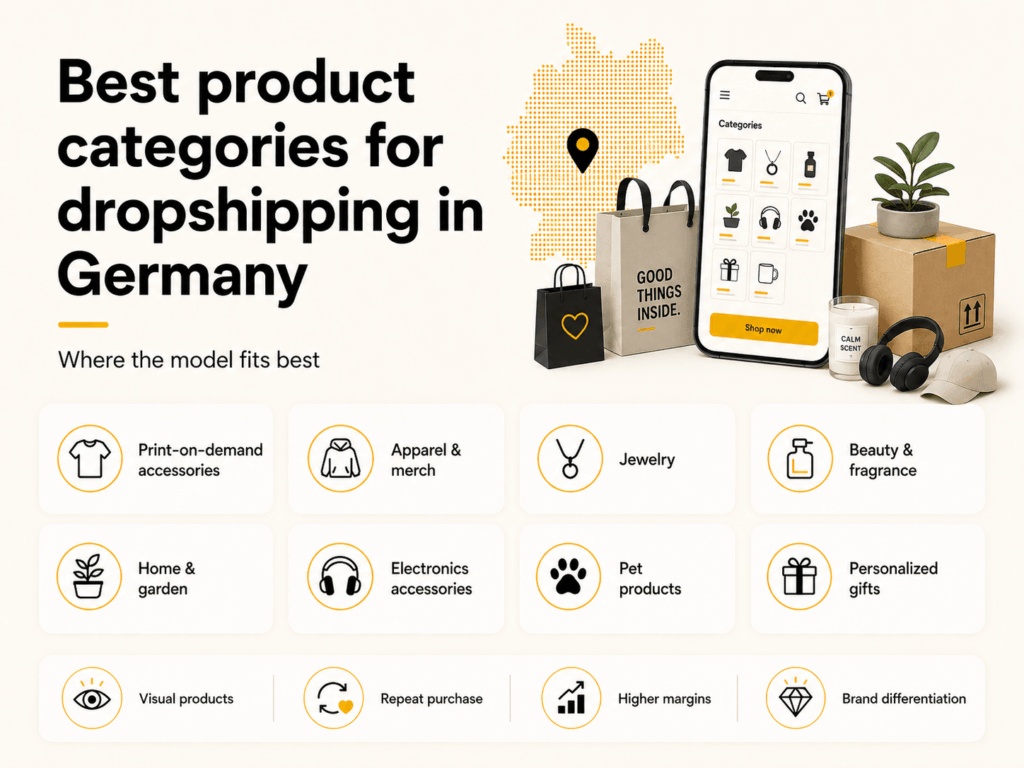
Still, some categories fit the dropshipping model better than others.
| Category | Dropshipping potential | Watch out |
| Print-on-demand accessories | Strong if designs are unique | Needs creative angle and quality control |
| Apparel / merch | Good for niche communities | Sizing and returns |
| Jewelry | Lightweight and visual | Materials, images and trust |
| Beauty / fragrance | Repeat purchase potential | Authenticity, claims and returns |
| Food / wellness | Can grow in niche segments | Claims, ingredients and compliance |
| Home and garden | Higher AOV possible | Bulky delivery and damage |
| Electronics accessories | Strong demand | Warranty, CE, battery and compatibility |
| Furniture | Higher basket value | Expensive returns and delivery issues |
| Pet products | Repeat purchase potential | Product safety and supplier reliability |
| Personalized gifts | Good differentiation | Seasonal demand and production speed |
For more category ideas, see our article on most popular online shopping categories in Germany.
Dropshipping trends in Germany for 2026
Print-on-demand and personalization are safer than generic products
Generic products are easy to compare.
Personalized products are harder to compare directly, which helps sellers protect margin and build a clearer brand. Print-on-demand is not automatically profitable, but it gives sellers a better chance to differentiate.
Local and EU suppliers matter more
German customers expect reasonable delivery times and clear returns.
Germany/EU-based suppliers can make delivery, returns, communication and compliance easier than distant suppliers. That does not mean non-EU suppliers are impossible, but they need more due diligence.
Compliance becomes a selling filter
GPSR, VerpackG, product claims, marketplace requirements and product documentation are now part of supplier selection.
Sellers that ignore compliance may face marketplace restrictions, customer disputes or legal problems.
Food, personal care and beauty grow, but need caution
Food, supplements, cosmetics and personal care can be attractive because they include repeat-purchase behavior.
They also create more responsibility. Product claims, ingredients, expiry dates, storage and safety information need to be handled properly.
Marketplaces increase price pressure
Amazon, eBay, Kaufland, Temu, SHEIN and AliExpress make it easier for shoppers to compare products and prices.
Dropshipping sellers need more than a product listing. They need positioning.
Dropshipping stores need content and trust
A simple product page and paid ads are no longer enough.
Stores need guides, FAQs, reviews, comparison content, strong product photography, clear policies and a reason for customers to trust them over a marketplace.
For wider German ecommerce context, see our complete guide to understanding the DACH market.
FAQ: dropshipping companies in Germany
Is dropshipping legal in Germany?
Yes, dropshipping is legal in Germany. Sellers still need to follow consumer protection, product safety, packaging, tax, return and advertising rules. The supplier ships the product, but the seller still owns the customer relationship.
What are the best dropshipping companies in Germany?
Relevant dropshipping companies and suppliers for Germany include Podbase, BrandsGateway, buXtrade, Dropshipping Marktplatz, Shirt-King, Emporium, Gallay, Manolya Electronics, Trends 4 Cents, CLP and AGI AKKU Service. The best choice depends on product category, delivery, returns, integrations and compliance.
Is dropshipping profitable in Germany?
Dropshipping can be profitable in Germany, but it is not easy. Profit depends on product margin, ad costs, delivery, returns, payment fees, supplier quality and competition from marketplaces. Generic products are harder to profit from because shoppers can compare prices quickly.
Do I need a German supplier for dropshipping?
You do not always need a German supplier, but Germany or EU-based suppliers can make delivery, returns, customer support and compliance easier. Non-EU suppliers need stronger checks around delivery time, product safety, customs, responsible-person information and returns.
What products work best for dropshipping in Germany?
Products with a clear niche, strong visuals, repeat purchase or personalization often work better. Print-on-demand accessories, custom apparel, jewelry, beauty, pet products, home items and specialist accessories can work when supplier quality and margins are strong.
What regulations affect dropshipping in Germany?
Important areas include EU product safety rules, GPSR, German packaging obligations under VerpackG, LUCID registration where relevant, VAT/tax setup, consumer return rights, product claims, CE marking for certain products and marketplace compliance requirements.
Can I dropship on Amazon or eBay Germany?
Yes, sellers can use dropshipping models on marketplaces, but they must follow marketplace rules. Amazon, eBay, Kaufland and other platforms may require clear seller responsibility, delivery standards, valid tracking, compliance documentation and proper return handling.
How do returns work in dropshipping?
Returns depend on the supplier and seller setup. A good supplier should explain where returns go, who pays for return shipping, how refunds are processed, how damaged products are handled and how quickly returned stock is inspected or restocked.
Is print-on-demand better than classic dropshipping?
Print-on-demand can be better for differentiation because products are customized or design-led. It still needs strong creative work, quality control and clear delivery expectations. It is not automatically profitable, but it can avoid some generic-product price pressure.
Conclusion
Dropshipping in Germany is not dead. Lazy dropshipping is.
The model can still work when sellers choose the right supplier, build around a clear niche, check compliance, offer realistic delivery, handle returns properly and create a store customers trust.
The strongest German dropshipping setups in 2026 will not be random product shops. They will be focused, documented, compliant and built around a customer experience that feels safer than buying from an unknown seller.
A supplier can help with stock and shipping.
But the seller still has to build the business.