Top Shopping Apps in Germany [2026]
What are the top shopping apps in Germany, and why are they installed by so many users? Read our analysis to find out!
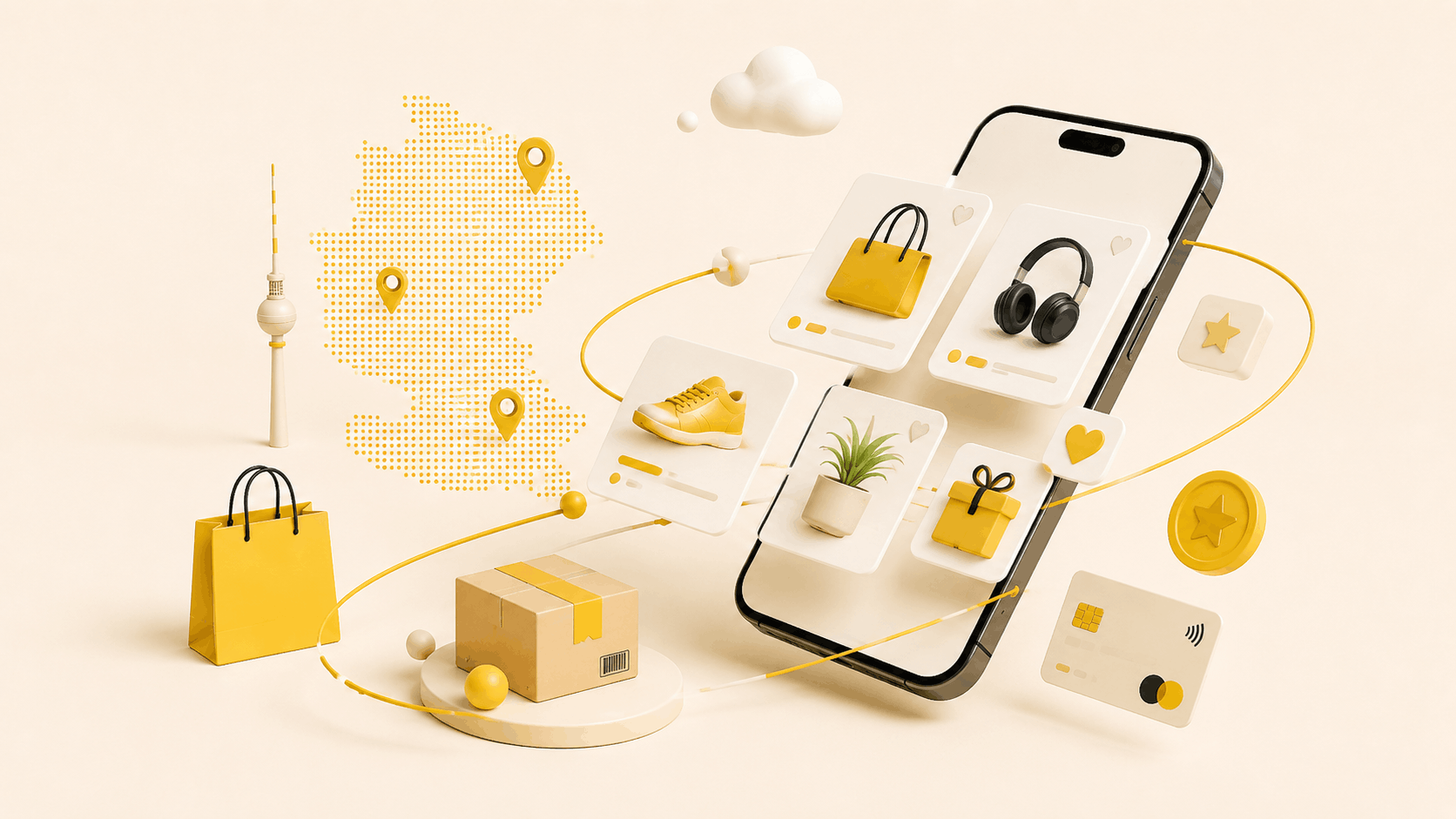
Shopping apps in Germany are no longer just mobile versions of online stores.
They now shape marketplace discovery, grocery planning, loyalty programs, coupons, recommerce, fashion browsing, price comparison and post-purchase tracking. A German shopper may open Amazon to compare reviews, Kleinanzeigen to find a local second-hand deal, Lidl Plus to check coupons, Vinted to browse fashion, PAYBACK to collect points, and idealo or mydealz to check if an offer is actually good.
That makes Germany’s shopping app market more complex than a simple top 50 ranking.
App rankings also move quickly. A download ranking can look different from a usage ranking. Android rankings can differ from iOS rankings. A short campaign can push one app up for a week, while a loyalty app can stay powerful because customers open it repeatedly in store.
Below, we look at the top shopping apps in Germany in 2026, grouped by how people use them: marketplaces, recommerce, fashion, grocery and drugstore, loyalty, deals and shopping support.
TL;DR: Germany’s shopping app market in 2026
| Segment | Leading apps | What it says about the market |
| Marketplaces | Amazon, eBay, Temu, AliExpress, Kaufland, OTTO | Price, range and convenience still dominate mobile shopping |
| Recommerce and classifieds | Kleinanzeigen, Vinted, eBay, momox, reBuy | Second-hand and peer-to-peer buying are now mainstream |
| Fashion | Zalando, SHEIN, ABOUT YOU, H&M, Zara, bonprix | Discovery, returns and trend speed shape app value |
| Grocery and drugstore | Lidl Plus, Kaufland, Mein dm, Netto, ALDI SÜD, Rossmann, Picnic | Loyalty and everyday essentials drive repeat use |
| Deals and loyalty | PAYBACK, Klarna, idealo, mydealz, Stocard | Value-seeking is built into German mobile behavior |
| Shopping support | Bring!, Listonic, kaufDA, MeinProspekt, marktguru | Planning, leaflets and local retail still matter |
Top shopping apps in Germany: 2026 market map
Germany’s mobile commerce landscape is broad.
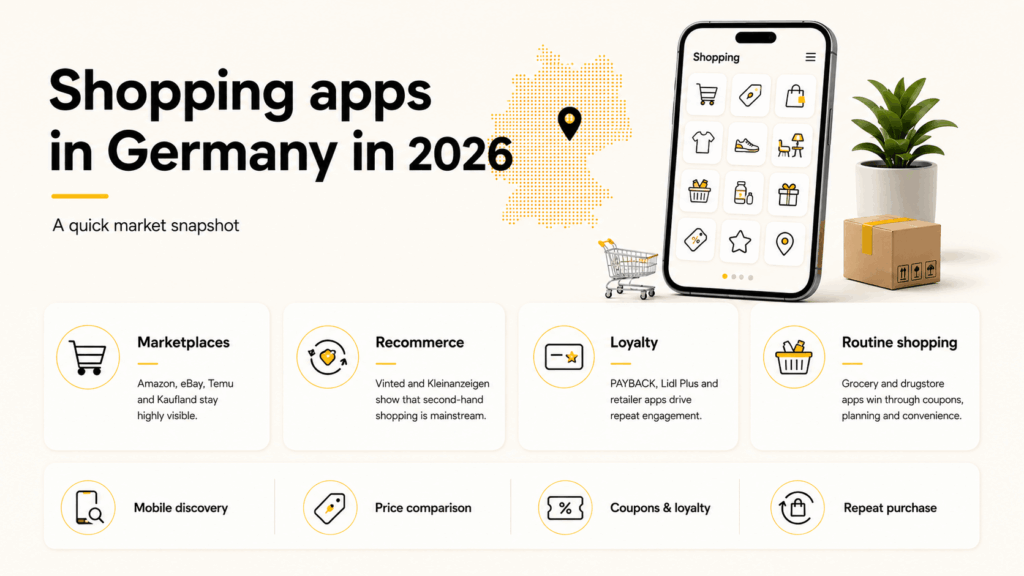
Some apps are pure marketplaces. Some are loyalty wallets. Some support offline shopping. Some exist mainly for second-hand commerce. Others drive fashion discovery, grocery repeat purchase or deal hunting.
The most useful way to understand the market is to group apps by shopper intent.
How to read shopping app rankings
Shopping app rankings should always be read with context.
A “top app” list can mean many different things. Some rankings show free downloads. Some show active usage. Some show grossing apps. Others rank apps within one store, operating system or date range.
That is why a Germany shopping app ranking can show Amazon or Kleinanzeigen at the top in one snapshot, while another ranking may highlight MediaMarkt, Lidl Plus, Temu, Netto, dm or the Shopify Shop app.
The difference is not necessarily a contradiction. It is a methodology issue.
| Ranking type | What it tells you | What it does not tell you |
| Top free downloads | Which apps are gaining installs | Not necessarily usage, loyalty or revenue |
| Usage ranking | Which apps people actively open | Not necessarily new growth |
| Grossing ranking | Which apps monetize strongly | Not total ecommerce GMV |
| Android ranking | Google Play behavior | Not iOS behavior |
| iOS ranking | Apple App Store behavior | Not Android behavior |
| Category ranking | Performance inside “Shopping” | Not wider retail influence |
For that reason, this article is a market map, not a permanent hierarchy. It highlights the most relevant shopping apps and app categories in Germany in 2026.
Top marketplace and broad shopping apps

1. Amazon Shopping
Amazon Shopping remains one of the most important shopping apps in Germany.
It combines product search, reviews, marketplace sellers, one-click convenience, Prime delivery and strong customer trust. For many German shoppers, Amazon is not only a place to buy. It is also a place to check product availability, compare reviews and benchmark prices.
Amazon sets expectations for every other ecommerce app in Germany. Customers get used to clear delivery dates, reviews, saved payment methods, order tracking and easy returns.
That does not mean every retailer should copy Amazon. It means every retailer app needs to understand the standard Amazon has trained customers to expect.
For a wider look at Germany’s top ecommerce players, see our guide to top online stores in Germany.
2. eBay
eBay remains important in Germany because it combines marketplace shopping, auctions, used goods, refurbished products and hard-to-find items.
It sits between classic ecommerce and recommerce. Shoppers use it to find better prices, compare sellers, buy used items or search for products that may not be available in ordinary retail apps.
eBay is also relevant because German shoppers are price-aware. The app supports comparison behavior without forcing shoppers into a single retail model.
3. Temu
Temu is one of the biggest disruptors in Germany’s mobile shopping landscape.
Its appeal is simple: low prices, huge range, gamified shopping and constant deals. The app has changed customer expectations around discount intensity and product variety, especially in low-cost categories.
For retailers, Temu is not only a competitor. It is a signal.
German shoppers are willing to try new shopping apps when the perceived value is strong enough. At the same time, Temu also creates pressure around product safety, platform governance, delivery expectations and fair competition.
For more marketplace context, see our guide to best online marketplaces in Germany.
4. AliExpress
AliExpress remains relevant for low-price cross-border shopping.
It appeals to customers who are willing to trade faster delivery for lower prices, broader selection or niche products. It competes with other marketplace apps on range and affordability.
AliExpress also shows why delivery transparency matters. If shipping takes longer, the app needs to make timing and tracking clear.
5. Kaufland
Kaufland’s app and online ecosystem matter because Kaufland has become a stronger marketplace player in Germany.
The app connects retail familiarity with marketplace-style assortment. For customers, that can feel safer than buying from an unknown marketplace brand.
Kaufland is a good example of how German retail brands use marketplace logic without losing local brand recognition.
6. OTTO
OTTO remains one of Germany’s strongest local ecommerce brands.
Its app is relevant for fashion, furniture, appliances, home goods and lifestyle shopping. OTTO also benefits from local trust, payment familiarity and long-standing brand recognition.
The lesson for retailers is simple: German shoppers still value local confidence. International apps can grow quickly, but trusted German brands still have room to defend customer relationships.
7. Etsy
Etsy is relevant in Germany for handmade, creative, custom and giftable products.
It serves a different shopping intent than Amazon or Temu. Customers often use Etsy when they want something more personal, niche or design-led.
That makes Etsy a useful reminder that not every shopping app competes on speed or price. Some compete on uniqueness.
8. Shop app
The Shopify Shop app is relevant because it supports order tracking, brand discovery and repeat purchase across Shopify-powered stores.
It is not a traditional retailer app, but it matters because many independent brands use Shopify. For customers, Shop can become a central place to track orders and rediscover brands.
For smaller merchants, this also shows that mobile commerce is not always about building a standalone app. Sometimes, being visible inside a larger app ecosystem can be more realistic.
Top recommerce and second-hand apps
9. Kleinanzeigen
Kleinanzeigen is one of Germany’s most important mobile shopping apps because it owns a very specific behavior: local classifieds.
German shoppers use it to buy and sell second-hand items, furniture, electronics, bikes, home goods, baby products, cars, local services and more. It is highly practical and deeply embedded in everyday life.
Kleinanzeigen works because it combines price, local proximity and peer-to-peer negotiation.
It also proves that not all shopping app behavior ends in traditional checkout. Chat, trust, location and pickup are part of the transaction.
10. Vinted
Vinted is one of the strongest recommerce apps in Germany, especially for fashion.
It has made second-hand fashion feel normal, mobile-first and easy to browse. Many users open it without a specific product in mind, which makes it closer to social shopping than traditional ecommerce.
Vinted matters because recommerce is not a niche anymore. It is part of how younger shoppers and price-aware consumers discover fashion.
For more regional context, see our article on Vinted connecting Germany and Austria.
11. momox
momox is relevant in Germany’s recommerce landscape because it helps customers sell and buy used goods, especially books, media and fashion.
It serves a more structured resale experience than peer-to-peer classifieds. That can be useful for shoppers who want convenience instead of negotiation.
12. medimops
medimops, connected to the momox ecosystem, is especially relevant for used books, media and entertainment products.
It shows that recommerce is not only about fashion. Books, games, DVDs, CDs and second-hand media remain important parts of German online shopping behavior.
13. reBuy
reBuy focuses on refurbished and used electronics, media and other pre-owned products.
It fits shoppers who want lower prices but still prefer a more structured buying experience than peer-to-peer platforms.
For electronics, trust is important. A refurb app needs to make condition, warranty and returns especially clear.
Top fashion shopping apps
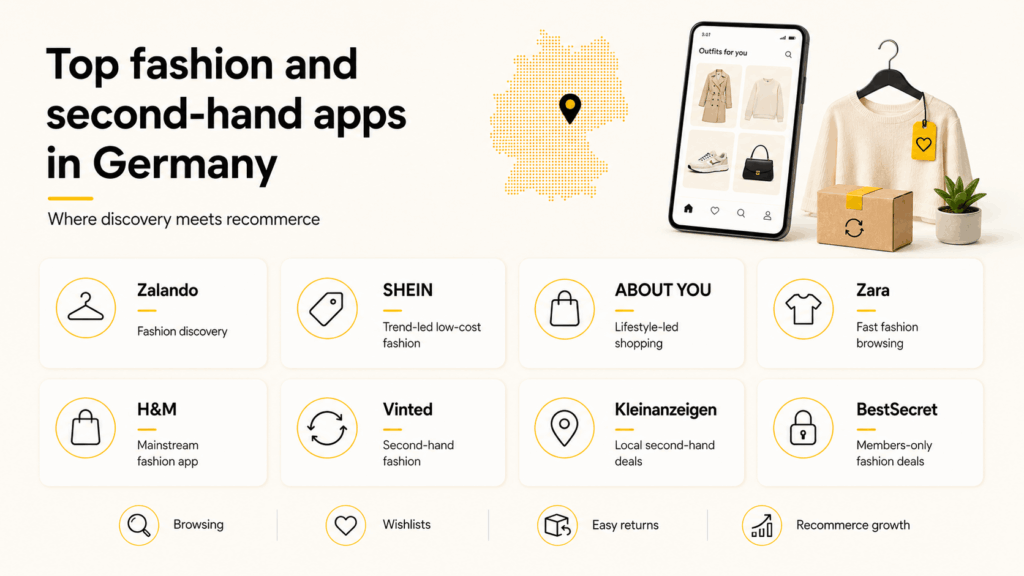
14. Zalando
Zalando remains one of the most important fashion shopping apps in Germany.
The app is built around browsing, discovery, brand choice, personalization, returns and convenience. German fashion shoppers often use Zalando because it reduces the friction of buying clothes online.
Fashion apps need more than product images. They need size guidance, reviews, filters, wishlists, delivery clarity and easy return flows.
For more on the category, see our article on fashion retail trends in DACH.
15. SHEIN
SHEIN is one of the most influential fashion apps in Germany because it has changed expectations around price, trend speed and assortment depth.
Its app is designed for constant discovery. Users browse new products, follow micro-trends and respond to low prices.
For German fashion retailers, SHEIN creates pressure on speed and price. But it also creates a trust gap. Local retailers can still compete through quality, fit, returns, delivery, sustainability, brand values and better product information.
16. ABOUT YOU
ABOUT YOU is a strong German fashion app focused on discovery, inspiration and brand browsing.
It competes with Zalando, SHEIN and brand-owned apps, but its positioning is more lifestyle-led. The app supports shoppers who want curated fashion rather than pure search.
17. H&M
H&M’s app remains relevant because of brand recognition, loyalty features, product browsing and store connection.
It is an example of a global fashion brand trying to keep customers inside its own mobile ecosystem rather than relying only on marketplaces.
18. Zara
Zara’s app is important for trend-led fashion shoppers.
The app supports fast browsing, stock checks, mobile purchase and connection to store inventory. Zara’s strength is brand pull: customers open the app because they already know the style and product rhythm.
19. bonprix
bonprix is relevant in Germany because it serves value-conscious fashion shoppers.
Its app fits customers looking for accessible clothing, size range and practical fashion rather than trend-only browsing.
20. C&A
C&A has strong brand recognition in Germany and remains relevant for family fashion, basics and mainstream clothing.
The app can support loyal customers who already shop with C&A and want a more convenient mobile route.
21. BestSecret
BestSecret is a members-only fashion app with a more exclusive positioning.
It appeals to shoppers who want access to discounted branded fashion, but in a closed environment. That makes the app feel different from general fashion marketplaces.
22. Lounge by Zalando
Lounge by Zalando is focused on deals and limited-time fashion offers.
It blends fashion discovery with discount mechanics. That can work well in Germany because value-seeking is a major shopping behavior.
23. limango
limango is relevant for families, fashion, kids’ products and lifestyle deals.
It has a strong deal-led model, which can encourage repeat app openings when users expect new campaigns.
Top grocery, drugstore and discount apps

24. Lidl Plus
Lidl Plus is one of the most important grocery and discount shopping apps in Germany.
It is not only an ecommerce app. It is a loyalty and coupon app that connects mobile behavior to offline shopping.
That matters because German retail is still strongly omnichannel. Many shoppers use apps before or during store visits, not only for online checkout.
25. Kaufland app
Kaufland’s app matters for offers, loyalty, weekly shopping and connection to the broader Kaufland ecosystem.
It sits between grocery retail, discount shopping and marketplace behavior. That makes it a good example of how grocery apps can support both offline and online retail.
26. Mein dm
Mein dm is one of Germany’s strongest drugstore apps.
It supports coupons, product search, online ordering, loyalty behavior and everyday replenishment. Drugstore apps work well because the category has repeat purchase built in.
Customers buy skincare, baby products, household items, vitamins and personal care again and again. A good app makes those purchases easier.
For category context, see our guide to most popular online shopping categories in Germany.
27. Netto-App / Netto plus
Netto’s app is relevant for coupons, discount shopping and weekly retail behavior.
It shows how discount retailers use apps to create repeat engagement. Customers open the app for offers, loyalty benefits and shopping planning.
28. ALDI SÜD Angebote & Prospekte
ALDI SÜD’s app is more about offers, brochures and store-related shopping than pure ecommerce.
That still matters in Germany. Many shoppers plan grocery trips around weekly offers. Mobile apps now replace printed leaflets for part of that behavior.
29. Rossmann
Rossmann is another important drugstore app in Germany.
Like dm, it benefits from repeat purchase, coupons and everyday categories. A strong drugstore app needs convenience, not only promotions.
30. Müller
Müller’s app connects drugstore, beauty, toys, media and household categories.
It has broader category reach than a pure beauty app, which can support both planned purchases and browsing.
31. Picnic
Picnic is relevant in online grocery delivery because it offers a different model from traditional supermarket apps.
It is mobile-first, delivery-led and routine-driven. That makes it important for the future of grocery app behavior, even if coverage varies by region.
32. Action
Action has become more visible in mobile shopping rankings and is relevant because it combines low prices, variety and store discovery.
The app supports a retail model where customers look for deals, availability and inspiration before visiting or buying.
Top loyalty, deal and price comparison apps
33. PAYBACK
PAYBACK is one of Germany’s most important loyalty apps.
It is not a retailer, but it influences shopping behavior across many retailers. Customers use it to collect points, activate coupons and make repeat purchases feel more rewarding.
PAYBACK matters because it sits across brands. That gives it a different role from single-retailer loyalty apps.
34. Klarna
Klarna is known mainly as a payment and BNPL provider, but its app also supports shopping discovery, deals, saved items and payment management.
In Germany, Klarna is relevant because payment habits and trust matter strongly. Customers may use Klarna not only to pay later, but also to manage purchases.
For more on checkout behavior, see our guide to top payment providers in the DACH region.
35. idealo
idealo is one of Germany’s most important price comparison apps.
Customers use it to compare offers, check price history and decide whether a product is fairly priced. It is especially useful in categories like electronics, appliances, home goods and branded products.
For a deeper view, see our guide to top price comparison platforms in DACH.
36. mydealz
mydealz is a deal community app where users share and vote on deals.
It is powerful because the community acts as a filter. Weak deals get challenged quickly, while strong offers can spread fast.
For retailers, mydealz can create visibility, but it also exposes pricing. The offer needs to be genuinely good.
37. Stocard
Stocard is a loyalty-card wallet app.
Its role is simple but useful: it reduces card clutter and helps shoppers carry loyalty cards digitally. Apps like this show that mobile shopping behavior often starts before checkout.
38. kaufDA
kaufDA helps customers browse brochures, offers and local retail deals.
It connects mobile shopping with offline retail planning. That is still important in Germany because many purchases remain store-based, especially in grocery, drugstore and discount retail.
39. MeinProspekt
MeinProspekt is another leaflet and offer app.
It is part of the wider shift from printed brochures to mobile planning. For retailers, these apps help keep weekly offers visible.
40. marktguru
marktguru focuses on offers, cashback and retail promotions.
It fits shoppers who like deal hunting across grocery, drugstore and consumer categories.
Top specialist shopping apps
41. MediaMarkt
MediaMarkt’s app is important in electronics retail.
Customers use it to browse products, compare specs, check availability, buy online and connect with store pickup. Electronics shoppers are research-heavy, so product data and reviews matter.
42. Saturn
Saturn’s app plays a similar role in electronics retail.
Like MediaMarkt, it connects online browsing with store availability, product research and delivery options.
43. IKEA
IKEA’s app is relevant for furniture, storage, home planning and product discovery.
It is not only a checkout tool. Customers use it to plan rooms, browse ideas, check products and connect online research with store visits.
44. Decathlon
Decathlon’s app matters in sports, fitness and outdoor shopping.
It benefits from strong private-label products, broad category coverage and repeat purchase across sports.
45. AUTODOC
AUTODOC is relevant in car parts and automotive ecommerce.
It serves a high-intent audience looking for specific parts, fitment and price. For specialist categories like automotive, search and compatibility are critical.
46. Fressnapf
Fressnapf’s app is relevant in pet products, food and recurring purchases.
Pet retail is a strong category for loyalty because customers often buy the same food, treats and supplies repeatedly.
47. Zooplus
Zooplus is another important pet ecommerce app.
It works well because pet products are recurring and often heavy, which makes home delivery attractive.
48. Douglas
Douglas is one of Germany’s strongest beauty retail apps.
It supports beauty discovery, loyalty, promotions and repeat purchase in skincare, fragrance and cosmetics.
49. Flaconi
Flaconi is a beauty-focused ecommerce app and store.
It competes in fragrance, skincare and cosmetics, where reviews, brand trust and promotions influence buying decisions.
50. Thalia
Thalia is Germany’s leading bookstore app and ecommerce destination for books, ebooks, gifts, games and media.
It is a good example of a specialist retailer app that survives because it owns category trust.
Shopping support and list apps
51. Bring!
Bring! is a shopping list app rather than a pure ecommerce app.
It matters because not every shopping app needs to process the transaction. Some apps influence planning before the purchase happens.
Bring! is especially relevant for groceries and household routines.
52. Listonic
Listonic is another shopping list app.
It supports pre-shopping planning and routine purchases. Apps like Listonic show that mobile commerce includes preparation, not only checkout.
53. That Shopping List
That Shopping List supports simple grocery and household planning.
It belongs in the wider shopping app landscape because it helps customers organize what they need before they choose where to buy.
What Germans actually use shopping apps for
German consumers use shopping apps for many different tasks.
Some open apps to buy. Others open apps to compare, save, plan, check coupons, track deliveries or browse second-hand items.
| Use case | Example apps | Retailer implication |
| Marketplace shopping | Amazon, Temu, eBay, Kaufland | Price, reviews and delivery must be clear |
| Local second-hand buying | Kleinanzeigen | Trust, chat, location and negotiation matter |
| Fashion discovery | Zalando, SHEIN, ABOUT YOU, Vinted | Product visuals, sizing and returns matter |
| Coupons and loyalty | Lidl Plus, PAYBACK, Netto, dm | App value must be repeatable |
| Grocery planning | Bring!, Listonic, Picnic | Convenience and routine matter |
| Price comparison | idealo, mydealz, Klarna | Total cost and deal quality matter |
| Electronics research | MediaMarkt, Saturn, idealo | Specs, availability and reviews matter |
| Pet replenishment | Zooplus, Fressnapf | Repeat purchase and reminders matter |
The lesson is clear: shopping apps win when they give users a reason to come back.
That reason can be price, convenience, trust, habit, loyalty, entertainment, discovery or planning. But it has to be clear.
Shopping apps vs mobile websites vs marketplace apps
Retailers often ask whether they need their own app.
The answer depends on repeat purchase, loyalty potential and category fit.
| Channel | Best for | Weakness |
| Shopping app | Loyalty, repeat purchase, push notifications, personalization | Harder to get installs |
| Mobile website | Discovery, SEO, one-off purchases | Less retention control |
| Marketplace app | Reach and customer trust | Lower brand control |
| Loyalty app | Coupons and repeat store visits | Needs frequent value |
| Recommerce app | Habit, browsing and peer-to-peer supply | Trust and moderation challenges |
| Shopping list app | Planning and routine categories | Not always transactional |
A retailer with low repeat purchase may not need a standalone app. A retailer with frequent purchases, loyalty mechanics, replenishment or strong community value may benefit from one.
In Germany, grocery, drugstore, fashion, pet products, electronics and recommerce are stronger app categories because users have reasons to return.
Features German shoppers expect from shopping apps
A shopping app needs to earn space on the user’s phone.
German shoppers are unlikely to keep an app just because a retailer wants another marketing channel. The app needs to make shopping easier, cheaper, safer or more convenient.
| Feature | Why it matters |
| Clear search and filters | Helps users find products fast |
| Product reviews | Builds confidence before purchase |
| Saved items / wishlists | Supports browsing and later purchase |
| Price alerts or coupons | Gives users a reason to return |
| Delivery date visibility | Reduces uncertainty before checkout |
| Order tracking | Lowers support friction |
| Easy returns | Supports trust, especially in fashion |
| Familiar payments | Reduces checkout hesitation |
| Digital loyalty card | Connects offline and online behavior |
| Stock availability | Supports click & collect and store visits |
| Privacy-friendly personalization | Makes recommendations useful without feeling invasive |
| Customer support access | Helps when delivery, payment or returns fail |
Delivery and returns are especially important. For more on that side of ecommerce, see our guide to top fulfillment centers and logistics operators in Germany.
What retailers can learn from Germany’s top shopping apps
The strongest shopping apps are not all the same, but they follow similar principles.
| App pattern | Why it works |
| One-tap repeat purchase | Reduces friction for groceries, drugstore and pet products |
| Personalized deals | Makes the app worth opening again |
| Delivery and return visibility | Builds trust before checkout |
| Price alerts and deal feeds | Helps price-sensitive shoppers |
| Recommerce mechanics | Makes browsing useful even without a purchase |
| Loyalty wallet | Keeps coupons, cards and rewards in one place |
| Push notifications | Works only when the value is real |
| Strong search | Makes large assortments usable |
| In-store connection | Helps grocery, drugstore and electronics retailers |
| Clear payment flow | Supports trust at the final step |
The biggest mistake is building an app that simply mirrors the mobile website.
A strong app should do something better than the website. It can make repeat purchase faster, coupons easier, returns clearer, product discovery more personal or in-store shopping more useful.
Why Temu, SHEIN and Vinted changed German shopping apps
Temu, SHEIN and Vinted show how fast German app behavior can shift.
They do not represent the same business model, but each one changed expectations in a different way.
| App | What it signals |
| Temu | Low-price, gamified marketplace shopping is now mainstream |
| SHEIN | Ultra-fast fashion keeps pressure on fashion apps |
| Vinted | Recommerce is part of everyday mobile shopping |
| Amazon | Trust and convenience remain the benchmark |
| Lidl Plus / PAYBACK | Loyalty and coupons are core mobile habits |
Temu shows how aggressively price and gamification can drive app adoption.
SHEIN shows that fashion discovery can be mobile-first, fast and low-cost.
Vinted shows that second-hand shopping can feel habitual, social and easy.
For German retailers, the takeaway is not to copy these apps directly. It is to understand what user behavior they changed.
Shopping app trends in Germany for 2026
Recommerce is mainstream
Kleinanzeigen, Vinted, momox, medimops and reBuy show that second-hand shopping is now part of normal ecommerce behavior.
German shoppers use recommerce for price, sustainability, local availability and access to products that may no longer be sold new.
Low-price marketplaces keep pressure high
Temu, AliExpress and SHEIN put pressure on price perception.
Local retailers do not always need to match those prices, but they need to explain why the total offer is better: delivery, returns, quality, trust, warranty or local support.
Grocery and drugstore apps drive routine behavior
Lidl Plus, Kaufland, dm, Rossmann, Netto and Picnic show that mobile apps are powerful when they connect to weekly habits.
Coupons, loyalty, product search and repeat purchases work well in routine categories.
Loyalty apps remain powerful
PAYBACK, Lidl Plus, Stocard and retailer apps show that loyalty is still a major mobile use case in Germany.
But loyalty apps need real value. A digital card alone is not enough.
Price comparison moves into the app journey
idealo, mydealz, Klarna and marketplace apps make price comparison part of mobile shopping.
Customers can check offers, reviews and payment options before they buy. Retailers need to compete on total value, not only product price.
Privacy-friendly personalization matters
Personalization can help, but DACH shoppers are sensitive to trust and data use.
A good shopping app should make recommendations useful without feeling intrusive. For more on this balance, see our article on data privacy vs personalization in DACH online retail.
Delivery and returns become app features
Tracking, returns and delivery options are no longer backend features.
They are part of the app experience. The more transparent the delivery and return flow, the more confident customers feel.
FAQ: top shopping apps in Germany
What is the most popular shopping app in Germany?
The answer depends on ranking method and date. Amazon Shopping, Kleinanzeigen, Temu, Lidl Plus, MediaMarkt, dm and other apps can appear high in different app-store snapshots. For a practical market view, Amazon, Kleinanzeigen, Temu, Lidl Plus, PAYBACK, Vinted, Zalando, SHEIN and dm are among the most important shopping apps in Germany.
Is Amazon still one of the top shopping apps in Germany?
Yes. Amazon remains one of Germany’s most important shopping apps because it combines product range, reviews, marketplace sellers, Prime delivery, saved payment methods and strong customer trust.
Why is Kleinanzeigen so popular in Germany?
Kleinanzeigen is popular because it supports local second-hand buying, selling, negotiation and pickup. It fits German shoppers who want better prices, local deals and peer-to-peer transactions without a traditional retail checkout.
Is Temu popular in Germany?
Yes. Temu has become highly visible in Germany’s mobile shopping market. Its popularity comes from low prices, large assortment, promotions and gamified shopping, although the platform also faces scrutiny around product safety, compliance and fair competition.
Which fashion shopping apps are popular in Germany?
Popular fashion shopping apps in Germany include Zalando, SHEIN, ABOUT YOU, H&M, Zara, bonprix, C&A, BestSecret, Lounge by Zalando and Vinted. Each app serves a different shopping behavior, from fast fashion to recommerce and premium discounts.
Which grocery and drugstore apps are popular in Germany?
Popular grocery, discount and drugstore apps include Lidl Plus, Kaufland, Mein dm, Netto, ALDI SÜD, Rossmann, Müller and Picnic. Many of these apps are used for coupons, loyalty, weekly offers, product search and repeat purchases.
Do German retailers need a mobile app?
Not every retailer needs a mobile app. A standalone app makes more sense when customers buy often, use loyalty benefits, track orders, reorder products or need in-store support. For one-off purchases, a strong mobile website may be more important.
What features should a shopping app have in Germany?
A strong shopping app in Germany should include clear search, filters, reviews, delivery dates, tracking, easy returns, familiar payment options, digital loyalty features, stock availability and privacy-friendly personalization. The app should make repeat shopping easier than the mobile website.
Conclusion
Germany’s top shopping apps show how broad mobile commerce has become.
Amazon still sets the benchmark for convenience. Kleinanzeigen and Vinted prove that recommerce is mainstream. Temu and SHEIN show the force of low-price mobile shopping. Lidl Plus, PAYBACK, dm, Netto and Kaufland show that loyalty and coupons remain powerful. Zalando, ABOUT YOU and Zara show that fashion discovery still belongs on mobile. idealo and mydealz prove that comparison and deals influence purchase decisions long before checkout.
For retailers, the lesson is simple: a shopping app needs a clear job.
It can help customers save money, discover products, repeat purchases, manage loyalty, track orders, compare prices or shop second-hand. But it cannot just exist because mobile commerce is growing.
In Germany, the strongest shopping apps earn repeat attention. That is the real benchmark for 2026.