Trade show marketing strategy: How Pickware generated 40+ meetings and 30+ qualified leads at E-commerce Berlin Expo [case study]
Most companies treat trade show marketing strategy as an afterthought, a booth, some branded merchandise, and hope for foot traffic. Pickware took a different approach. At E-commerce Berlin Expo 2026, they combined pre-event outreach, a masterclass, a side event, and a carefully designed booth concept to generate 40+ meetings and 30+ qualified leads.
For many e-commerce service providers, trade fairs still sit somewhere between “brand visibility” and “nice-to-have networking.”
Pickware approaches them very differently.
For the team behind the warehouse and ERP platform built for Shopware and Shopify merchants, trade show marketing has become a serious growth channel. One capable of generating enough qualified pipeline to influence an entire quarter.
Their appearance at E-commerce Berlin Expo 2026 is a strong example of what happens when exhibiting is treated not as a two-day presence, but as a multi-layered trade show marketing strategy.
What made the difference was not a single activation. It was the combination of preparation, visibility, personality, and timing – executed with unusual consistency. With a larger booth, a masterclass, a side event, coordinated outreach, and a highly memorable on-site concept helped Pickware to get the most out of their trade show experience.
Berlin Expo is the one event in DACH where – if you show up properly: stand, masterclass, side event, the full programme – you walk away with a pipeline that carries an entire quarter.
Pickware’s results at E-commerce Berlin Expo 2026
- 40+ pre-booked meetings
- 30+ qualified new leads generated
- 60+ attendees at the post-masterclass booth activation
- Booth for 2027 upsized and secured immediately after the event
Why E-commerce Berlin Expo became Pickware’s priority
Pickware had already exhibited at the E-commerce Berlin Expo for several years. But after hosting their first masterclass in 2025, the team realised they had underestimated the event’s potential.
“EBE has become the gathering point for exactly the audience we want to reach: D2C brands that are scaling and hitting a wall in their warehouse,” Samuel explains.
The lesson was immediate: a booth alone was no longer enough.
For 2026, Pickware started to prepare for their trade show success and expanded everything – larger stand, larger team, another masterclass, a co-hosted side event, and a much more aggressive visibility strategy around the expo itself.
“We weren’t there to be one of many ERP logos,” Samuel says. “We were there so that every founder in Hall 27 knew Pickware existed.”
How to build your trade show marketing strategy 8 weeks out
What looked spontaneous on-site was actually highly structured behind the scenes.
Preparation began roughly two months before the event, with weekly cross-functional alignment between sales and marketing. The team focused on three key pillars:
1. Personal outreach before the event
Instead of relying on booth traffic alone, Pickware proactively invited customers, prospects, and target accounts.
Two weeks before the expo, personalised invitations started going out with clear calls to action: book a meeting, claim a VIP code, attend the session.
The objective was simple: arrive in Berlin with a calendar already full.
By day one, they had already secured over 40 meetings.
2. Create your own event programme around the trade show
Rather than treating the booth as the centrepiece, Pickware created multiple touchpoints around it.
Together with Beyond Beer, they organised a masterclass and supported a pre-event activation promoted through newsletters, social media, and the EBE app.
This extended their visibility far beyond stand traffic and positioned them as active contributors to the event experience itself.
3. CRM And Matchmaking Alignment
The team also integrated EBE matchmaking data directly into their targeting process.
Attendee lists were cross-referenced against existing CRM accounts so the sales team knew exactly who would be attending, which conversations mattered most, and where proactive outreach would have the highest value.
How to design a trade show booth that stops foot traffic
What remained was turning all that preparation into presence – something attendees would notice immediately when walking into hub 27.
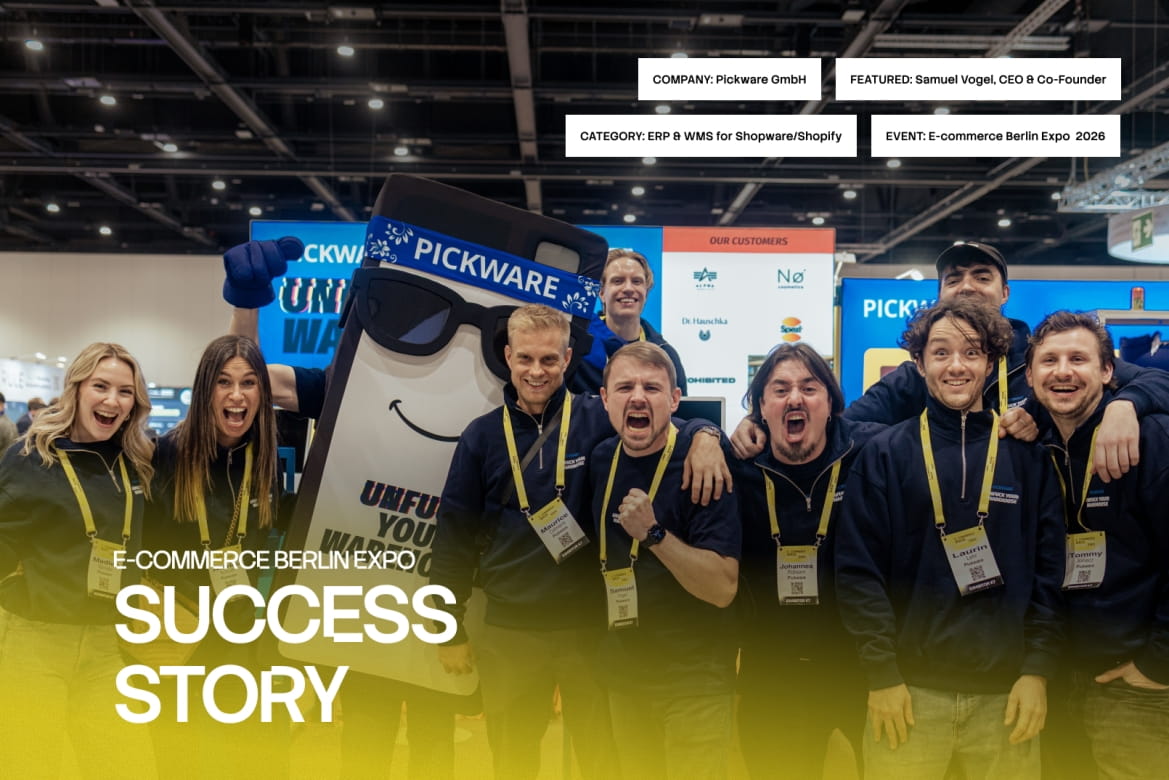
Pickware had no intention of blending into a sea of software vendors. The internal brief was intentionally simple: “We are not a boring software stand.” And they delivered on it.
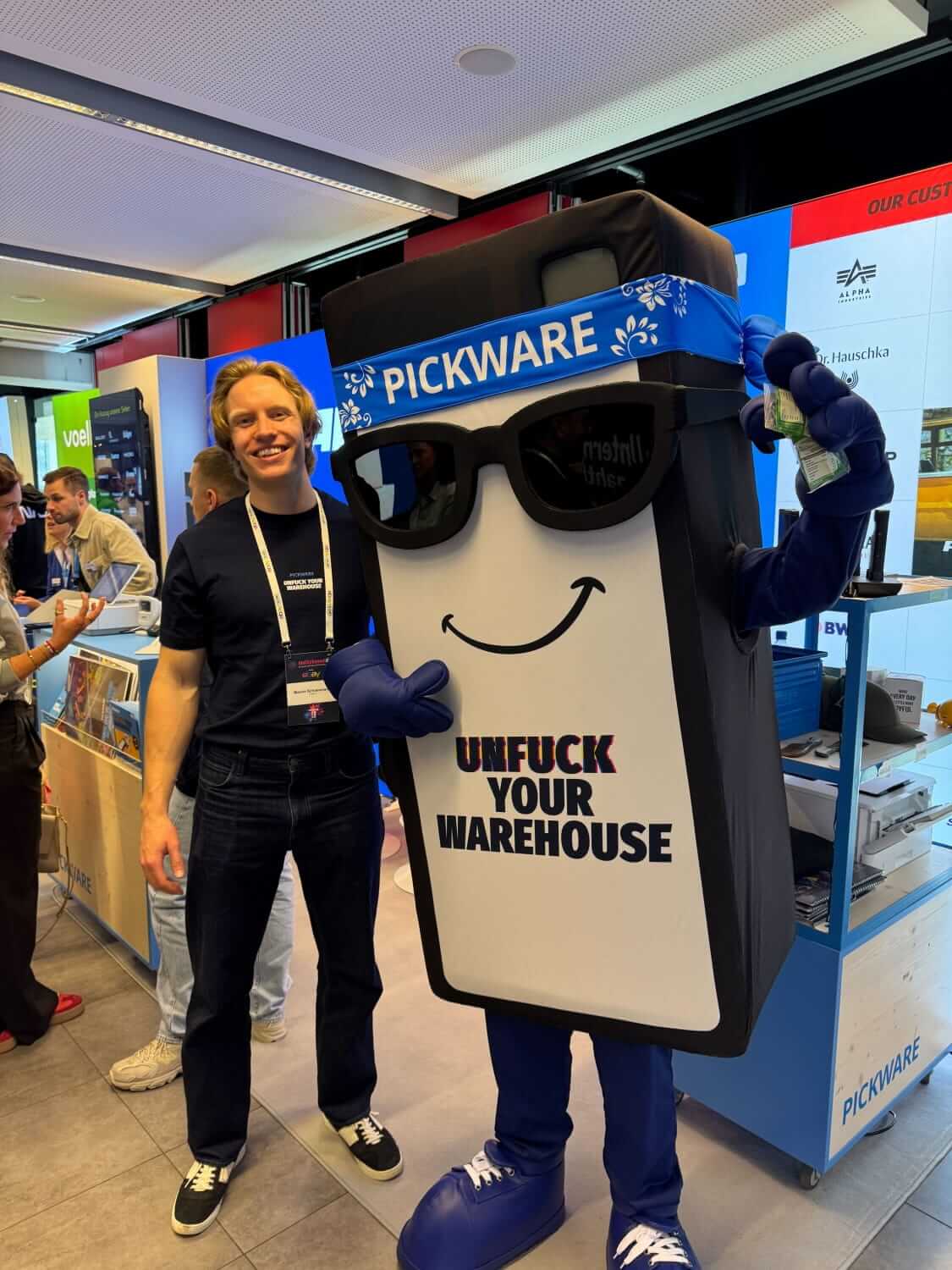
At stand K7, visitors were greeted by “Picki” – a two-metre mascot version of Pickware’s barcode scanner. Next to it stood a boxing machine where attendees could win branded prizes. Chocolate bars designed to resemble weed packaging added another unexpected detail.
The visual humour drew attention. But the booth worked because entertainment was paired with substance.
Behind the spectacle, the team ran live warehouse demos on real hardware, showing the entire fulfilment process in action. Visitors could see how the system functioned operationally – not just on slides.
That balance between energy and credibility became one of Pickware’s biggest advantages during the expo.
By the first afternoon, demo slots were consistently full.
Why education-led activations outperform passive exhibiting
One of the defining moments of Pickware’s EBE26 presence happened outside the booth itself.
Samuel Vogel and Christof Plasse hosted a 30-minute masterclass discussing operations inside fast-growing D2C brands. Afterwards, attendees were invited back to the Pickware stand for a beer tasting.
What happened next exceeded expectations.
The audience moved almost directly from the session to the booth. More than 60 people gathered around demo stations while beer was poured, conversations continued, and visitors queued to interact with the team.
“Ten people just told me this was the best session of the entire expo,” Christof reportedly told Samuel afterwards.
For Pickware, it became the clearest proof that memorable event experiences are rarely created through passive exhibiting alone.
How to use sponsorship and side events as a trade show strategy
Pickware also sponsored the official after-party – but with a focused approach.
Instead of distributing guest passes randomly, they strategically offered invitations to high-priority prospects and existing relationships.
The result was a completely different quality of conversation compared to traditional lead-generation tactics.
Longer discussions. Warmer introductions. Stronger context.
The after-party became an extension of the sales process rather than a separate networking activity.
Trade show marketing tips from Pickware’s CEO
Following E-commerce Berlin Expo 2026, the team identified clear takeaways for successful B2B trade show marketing.
1. A booth is only 30% of the strategy
“The booth is the visible part,” Samuel says. “The other 70% is the masterclass, the side event, the after-party, and the outreach happening before the expo even starts.”
Companies that simply arrive, set up a stand, and wait for traffic are missing most of the opportunity.
2. Invite people personally
One of Pickware’s strongest recommendations is surprisingly simple: actively ask people to come.
Relevant leads, customers, and prospects should receive direct invitations before the event – ideally with meeting slots, VIP codes, or a concrete reason to visit.
“Don’t rely on random traffic,” Samuel advises.
3. Be impossible to forget
In a hall filled with software vendors, memorability matters.
Whether it is a mascot, a surprising activation, or a bold creative concept, exhibitors need something attendees will still remember days later.
But creativity alone is not enough.
The memorable element needs to lead naturally into meaningful conversations and a product experience strong enough to sustain them.
That combination is what transformed Pickware’s EBE26 presence from visibility into pipeline.
What this says about modern B2B trade show marketing
What Pickware demonstrated at EBE26 is a broader evolution in trade show marketing strategy across the e-commerce ecosystem.
The strongest results no longer come from presence alone, but from the orchestration of multiple layers – preparation, programming, activation, and follow-up – all aligned toward a single commercial outcome.
E-commerce Berlin Expo increasingly functions as the framework for that orchestration. Within that framework, outcomes differ significantly depending on how deliberately exhibitors design and activate their presence.
In Pickware’s case, that intent translated into measurable pipeline impact and a level of execution that turned visibility into results.
| For companies planning their 2027 strategy, E-commerce Berlin Expo sales are now open – and the earlier the preparation begins, the closer the outcome gets to what Pickware achieved in 2026. |
About Pickware
Pickware’s positioning is refreshingly direct: “Unfuck your Warehouse.”
Built for merchants running on Shopware and Shopify, the company combines ERP and warehouse management into one operational system covering picking, shipping, returns, and POS. Their setup is designed for scaling D2C brands operating their own warehouses – especially those that have outgrown spreadsheets and disconnected tools.
One of Pickware’s defining advantages is simplicity: warehouse staff can begin using their iPhone barcode scanning workflow within minutes.
That operational clarity also shaped the way they approached E-commerce Berlin Expo 2026.
See Pickware’s profile in E-commerce Germany News service providers section.
FAQ
Q: What is a trade show marketing strategy?
A: A trade show marketing strategy is a structured plan for turning event participation into measurable business results. It goes beyond having a booth – it includes pre-event outreach, educational programming, side events, and post-event follow-up. Pickware’s approach at E-commerce Berlin Expo 2026 is a strong example: eight weeks of preparation across sales and marketing translated into 40+ pre-booked meetings and 30+ qualified leads.
Q: How far in advance should you prepare for a trade show?
A: If possible, at minimum, eight weeks. Companies that start preparing only days before the event miss most of the pipeline opportunity.
Q: How do you generate leads at a trade show?
A: The most effective approach combines pre-event outreach, an engaging booth concept, and programming that draws people in. Pickware is a good example as the company secured 40+ meetings before E-commerce Berlin Expo 2026 even started by personally inviting prospects with clear calls to action. On-site, their two-metre mascot, live warehouse demos, and post-masterclass beer tasting generated 30+ qualified new leads and kept demo slots consistently full throughout the event.
Q: Is a trade show booth enough to generate pipeline?
A: Not on its own. According to Pickware CEO Samuel Vogel, the booth represents only 30% of the strategy.The remaining 70% comes from additional activities related to the trade show you’re exhibiting at and outreach happening before the expo starts. Companies that simply arrive, set up a stand, and wait for traffic consistently underperform compared to those who build a full programme around their presence.
Q: What is the E-commerce Berlin Expo?
A: The E-commerce Berlin Expo is the largest B2B exhibition and conference for the e-commerce industry in Germany, as well as one of the leading industry events in Europe. Its 11th edition will take place on 17–18 February 2027 at Messe Berlin. Booth sales for E-commerce Berlin Expo 2027 are open under this link.