How to sell on Amazon? [2026 guide]
Learn how to sell on Amazon in 2026, from picking a model and supplier to listing and FBA. A practical guide for ecommerce managers.

The hardest part of selling on Amazon is rarely the part beginners worry about. It is not the registration screen, the shipping label, or the photo on the product page. It is the moment three weeks in when your listing has 47 visits, two sales, and a competitor with 4,000 reviews sitting one slot above you. That is where most new Amazon sellers stall, not at signup, but at the point where strategy meets reality. This guide is built for the people who want to skip that phase.
If you run an ecommerce team, manage a brand, or are about to launch your first product, the question “how to sell on Amazon” splits into a dozen smaller decisions. Which selling plan? Which fulfillment model? Which category, supplier, ad type, and review strategy? Get the early choices right and the platform rewards you with traffic that no DTC store can match. Get them wrong and you are funding Amazon’s growth instead of your own.
This sell on Amazon guide is built around those decisions, with current 2026 data and concrete trade-offs for small and medium-sized businesses operating across the U.S. and European markets. Germany, Europe’s largest Amazon marketplace, has become one of the most attractive places to launch.
You’ll learn
- How the Amazon marketplace looks in 2026, including seller numbers, revenue, and German-market specifics
- Which business model fits your capital, time, and risk profile: private label, wholesale, arbitrage, dropshipping, or handmade
- How to create an Amazon selling account and what documents Amazon will ask you for
- The real difference between the Individual and Professional selling plan
- How to research products and find a reliable supplier without burning cash on first orders
- How to list products on Amazon, write copy that converts, and keep listings compliant
- How Fulfillment by Amazon (FBA) works versus Fulfilled by Merchant (FBM), with cost trade-offs
- How Amazon fees stack up: referral, FBA, storage, returns, and PPC
- How to promote and advertise with Sponsored Products, Sponsored Brands, and display ads
- How to price products, get product reviews, and protect your brand with Brand Registry
- How to grow your business beyond a first SKU into a real Amazon brand
The state of Amazon in 2026
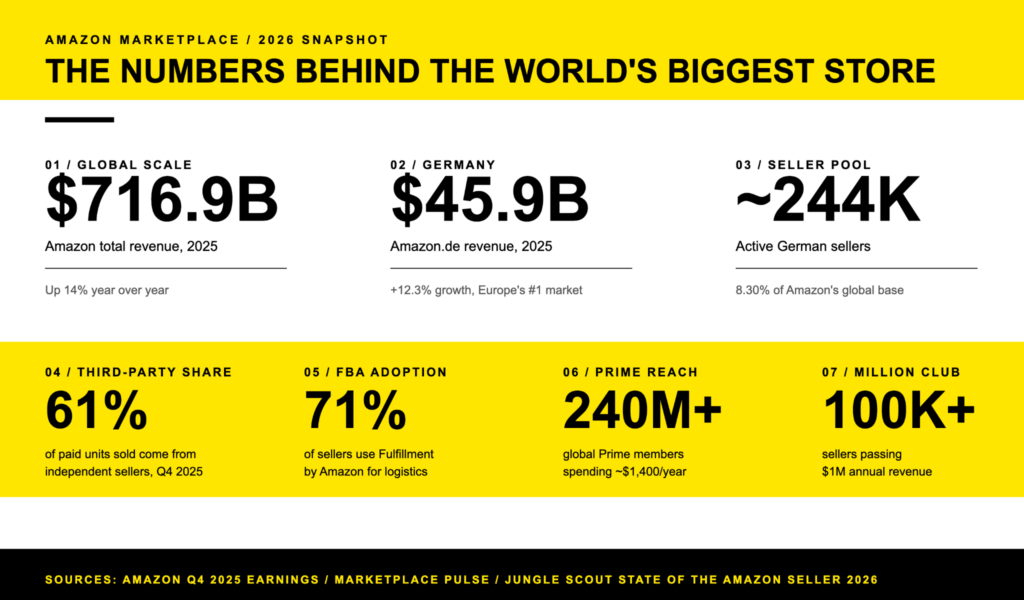
Selling on Amazon in 2026 is a different sport than it was in 2021. Amazon hit roughly $716.9 billion in total revenue for 2025, with around $1.95 billion in average daily sales. Third-party sellers, that is, independent sellers like you, generated 61% of paid units sold in Q4 2025, and the third-party share has not reversed direction since 2017. The marketplace passed approximately 600 million product listings, served through around 2 million actively selling accounts.
But the most useful number for anyone planning to start selling on Amazon is the trend behind those totals. Marketplace Pulse calls it “The Great Compression”: active sellers fell from 2.4 million in 2021 to about 1.65 million at the end of 2025, while traffic per active seller increased 31% in the same period. More than 100,000 Amazon sellers now generate over $1 million in annual revenue, up from 60,000 in 2021, and 235 sellers cross $100 million per year.
Fewer competitors, more demand per listing, but a higher bar to compete.
For European sellers, the German marketplace deserves a closer look. Amazon.de generated $45.9 billion in 2025, growing 12.3% year over year, faster than the U.S. Germany hosts approximately 244,000 active sellers, around 8.30% of Amazon’s global seller base, and Amazon.de holds over 30% of the German ecommerce market with roughly 394 million monthly visits.
German SMEs grew their export sales 10% via Amazon.de in 2023, hitting €5.5 billion. Lower CPC averages, less ad saturation than the U.S., and Pan-EU FBA make Germany a strong launch market for any seller willing to handle VAT compliance.
Three other 2026 numbers shape your planning. First, Prime crossed 240 million members worldwide, and Prime members spend roughly $1,400 per year, about double non-Prime customers. Second, Amazon’s advertising business generated more than $68 billion in 2025, so sellers who treat Sponsored Products as optional are competing with sellers who do not. Third, 71% of sellers use FBA, 10% use FBM, and 19% blend both. FBA is no longer an edge. It is the baseline.
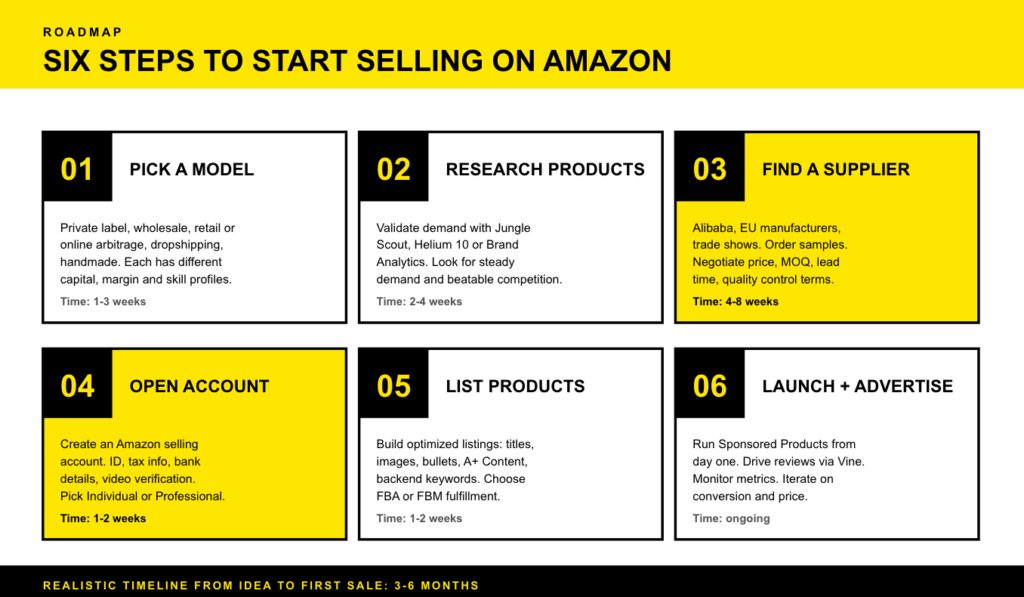
This is also why marketplace strategy should not begin and end with one platform. If you are comparing Amazon with other channels, the wider trend toward marketplace diversification matters. Amazon can be the main sales engine, but many growing sellers use it as one part of a wider channel mix.
Choose your selling model before anything else
Most failed Amazon launches share the same root cause: the seller picked a product before picking a model.
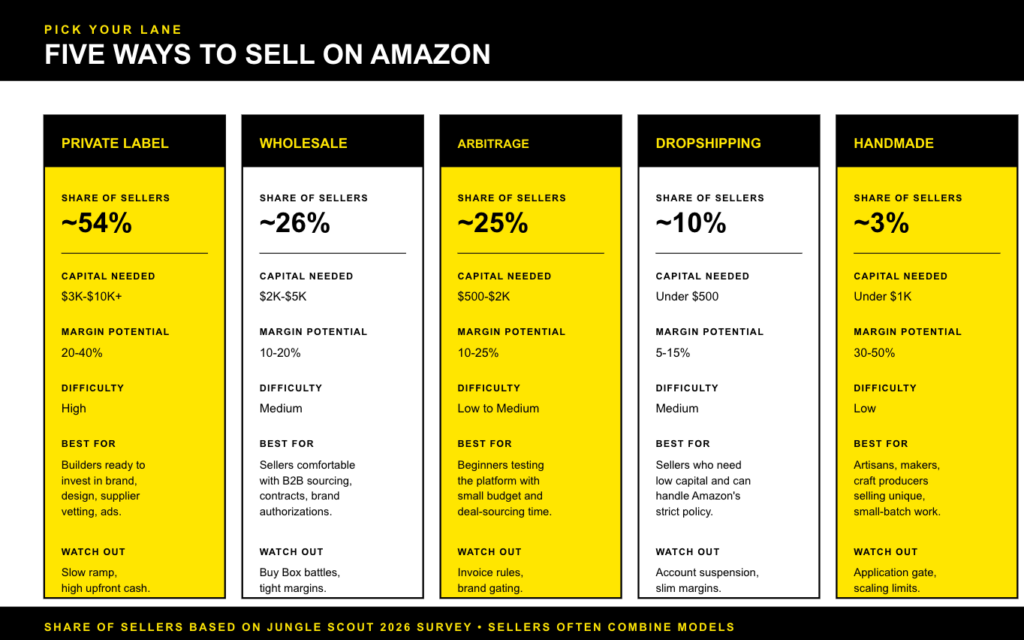
The model determines everything that follows: capital required, margin ceiling, time to first sale, and which problems will hit you first. There are five common ways to sell products on Amazon, and they suit very different operators. If you are still comparing channels, this overview of 20+ best online marketplaces in Germany gives useful context beyond Amazon alone.
Private label
Private label is the closest thing to building an asset. You design a product, source it under your own brand, and own the listing on Amazon. Around 54% of sellers use this model. Margins typically run 20-40%, but you need $3,000-$10,000+ in capital, and 4-6 months from idea to first sale is realistic.
The upside is durable. A private-label listing with reviews and rank holds value in a way that arbitrage flips never do.
Wholesale
Wholesale means buying products in bulk from authorized distributors or brand owners and reselling on existing listings. About 26% of sellers run this model. Capital sits in the $2,000-$5,000 range, margins are tighter at 10-20%, and the daily work is supplier outreach plus Buy Box management.
Wholesale is fast to scale once you have the supplier relationships, but it is exposed to other sellers entering the same listing.
Online arbitrage
Online arbitrage and retail arbitrage involve reselling products you buy from discount retailers, clearance aisles, or other online sellers at a higher price on Amazon. Roughly 25% of sellers use this approach, often as a low-capital entry point of $500-$2,000.
When you buy products on clearance and list them as new on Amazon, the trade-off is volatility. Invoice requirements have tightened, brand gating restricts what you can list, and a single account-health hit can pause your business. Arbitrage works as a school, less so as a long-term business.
Dropshipping
Dropshipping on Amazon is allowed, but Amazon’s specific requirements are strict. You must be the seller of record, your invoices and packaging must show only your name, and you cannot fulfill from another retailer like a third-party Amazon competitor.
Margins are slim at 5-15%, and the policy risk is real. Around 10% of sellers run this model. For sellers entering Germany or other EU markets, dropshipping also needs careful compliance planning. Before you commit to this route, understand the market barriers for selling online in Germany, especially around legal duties, documentation, customer rights, and tax.
Handmade
Handmade is a separate Amazon program for artisans. The application gate filters most applicants out, but accepted sellers get a separate fee structure, with no $39.99 monthly Professional fee while in Handmade, and a less-saturated audience. Margins can be excellent at 30-50%, but volume is naturally capped.
Pick the model that matches the capital you can actually risk, the time you can actually invest, and the work you actually enjoy. A wholesale operator hates the design work that excites a private-label seller. An arbitrage hunter is bored with supplier negotiation. Self-knowledge here saves you a year.
If Amazon is only one market in your broader plan, compare it with other leading marketplaces in Europe before you lock in your model.
Create an Amazon selling account
Once your model is set, the practical part begins. Sign up at sell.amazon.com, or sell.amazon.de for the German market, and start the registration. To create an Amazon selling account, you will need a business email address, a phone number for verification, an internationally chargeable credit card, government-issued ID such as a passport or national ID, tax information, and a bank account that can receive deposits in your selling region’s currency.
Amazon also runs a video verification step where a human reviewer confirms your identity over a video call.
Plan the legal structure before signup. Selling on Amazon as a registered business protects you from personal liability, simplifies VAT, and is required for serious scale. In Germany, this typically means a GmbH, UG, or Einzelunternehmen depending on volume. In the U.S., LLC is the common starting point. If Germany is your target market, start with the basics of how to enter the German e-commerce market.
Your seller account name will appear to customers, so pick a name that fits your brand strategy, not just your legal entity.
The biggest decision at signup is the selling plan. You can switch later, but starting on the wrong one costs money or kills features you need.
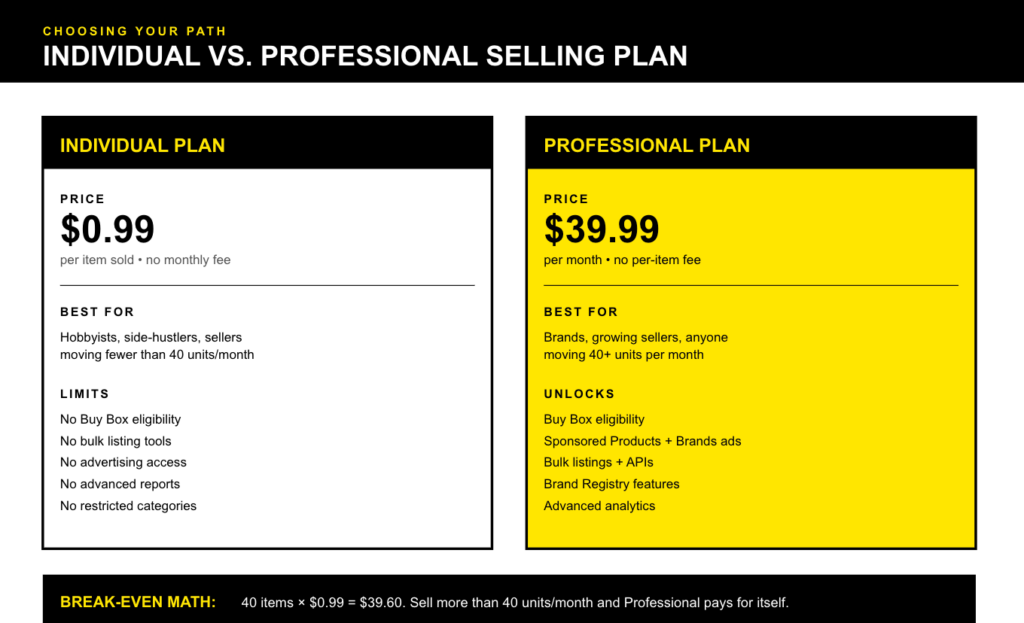
The Individual plan charges $0.99 per item sold and has no monthly fee. It suits hobbyists testing the platform with fewer than 40 units a month. The Professional selling plan costs $39.99 per month, waives the per-item fee, and unlocks Buy Box eligibility, Sponsored Products, bulk listings, advanced reports, restricted-category applications, and Brand Registry features.
The break-even is exactly 40 items per month. Anything above that means the Professional plan pays for itself on the math alone.
But the math is not the real argument. Individual sellers cannot win the Buy Box, which means they are essentially invisible on most listings. They cannot run Amazon Ads. They cannot use most third-party tools that require API access. Anyone serious about how to start selling on Amazon should default to Professional and treat the $39.99 as a cost of doing business.
For sellers entering Germany, tax obligations matter early. If you store goods in Germany or use Amazon’s fulfillment network across the EU, VAT responsibilities can quickly move from “later problem” to account-risk problem.
What to do in your first hour inside Seller Central
When you first log into Seller Central, the dashboard is overwhelming on purpose. Amazon shows you everything because it cannot guess what you are about to do.
A focused first session looks like this. Start with the Account Health page. Bookmark it, because every metric there can suspend your account. Open the Settings menu and confirm your tax information, banking details, and shipping templates. Set your return address and your default shipping rates if you plan to use FBM. Add a deposit method that matches the marketplace’s currency. Enable two-factor authentication.
Then, and only then, start exploring the Catalog and Inventory tabs, where the actual work of listing products lives.
Seller University is Amazon’s free training library, embedded inside Seller Central, and it is genuinely worth the time. It covers everything from listing optimization to PPC fundamentals, with short videos that match the current interface. By the time you finish the basics, you will be ready to sell with at least the minimum viable setup, and you will know which advanced tools, such as bulk uploads, Brand Analytics, and Stores, to grow into.
New sellers using Amazon’s New Seller Guide during their first 90 days generate roughly 6x more first-year sales on average. That figure exists because most sellers ignore the basics, not because the basics are magic.
Research products before you fall in love with one
Product research is the highest-leverage hour you will spend as an Amazon seller. The right product makes mediocre execution profitable. The wrong product makes flawless execution irrelevant.
Use product research tools such as Jungle Scout, Helium 10, or DataHawk to validate three things at once: demand, competition, and margin headroom. Pick a product category that you actually understand, and confirm that what you want to sell will comply with Amazon’s category rules. Some categories, including jewelry, watches, grocery, and beauty, are gated and require pre-approval before you can list.
Demand is search volume and sales velocity. A product with 200 monthly searches is a hobby, not a business. Look for keywords with at least 1,500-3,000 monthly searches in your target marketplace, and verify that the top-ranked listings actually generate $5,000-$30,000 per month in revenue. Below that, the category does not pay rent. Above $100,000 per month, you are entering a fight with established brands and well-funded ad budgets.
Competition is the structure of the top 20 listings. Count the number of sellers with under 100 reviews on page one. Three or more is an opening. Zero is a closed category. Read the negative reviews on the top sellers. That is your product brief. If 30% of one-star reviews complain about the same defect, your product version that fixes it has a built-in angle.
Margin headroom is the gap between landed cost and current selling price after all Amazon fees. A product that retails for $25 with $10 landed cost and $11 in fees leaves $4. That is fine for a hobby, fatal at scale. Aim for at least 25-30% net margin after all fees, including PPC, before sourcing.
Two patterns separate disciplined Amazon sellers from impulse buyers. First, they validate at least 20 product candidates before picking one. Second, they always order samples from at least two suppliers before committing to a production run. The cost of a $200 sample order is the cheapest insurance you will ever buy.
Find a supplier who will not become your worst problem
Once a product passes research, supplier sourcing decides if your launch survives the first reorder. Most new Amazon sellers source from Alibaba, but Alibaba is not the supplier. It is the discovery layer. The supplier behind the listing is what matters.
Treat supplier selection as a vetting process, not a transaction. Ask for the factory’s business license. Ask for photos of the production line, not just the product. Order samples from three suppliers in parallel, never one. Compare quality, packaging, and how each supplier responds to questions. Communication speed during sourcing predicts communication speed during a quality crisis.
For European sellers, EU-based manufacturers in Poland, Czech Republic, Portugal, and Italy increasingly compete on lead time and tariff exposure, even when their unit price runs higher than China.
Negotiate four things in writing before any wire transfer: unit price with volume tiers, MOQ, lead time including production and shipping, and quality control terms. Specify defect tolerance, typically AQL 2.5 for general consumer goods, and arrange third-party inspection through a service like QIMA or AsiaInspection before goods leave the factory. Inspection costs $300-$500 and prevents the kind of defective shipment that kills a launch.
For sellers shipping into Germany, do not treat packaging as an afterthought. The German Packaging Act can affect online shops, importers, and retailers, especially when products enter the German market through marketplaces.
Amazon also keeps tightening seller obligations. Before you ship your first batch, check if your products face new documentation obligations for Amazon sellers, especially in regulated or higher-risk categories.
Pay 30% deposit and 70% on inspection-passed shipment. Never pay 100% upfront. Use trade assurance, escrow, or letters of credit for first orders. After three successful orders, terms can loosen.
List products on Amazon that actually convert
Listings are the product page where everything you have built comes together. A listing for your product has six elements: title, bullet points, description, A+ Content for brand-registered sellers, images, and backend keywords. Each element does a specific job, and skipping any one of them costs visibility or conversion.
Product titles need the primary keyword in the first 60 characters because that is what mobile shoppers see. Format: brand, primary keyword, key feature, size or quantity, color or variant. Avoid keyword stuffing, because Amazon penalizes title abuse with suppressed listings. German listings have a 200-character cap, and U.S. listings allow 200 characters for most categories.
Bullet points are five short scannable benefit statements, not specs. The pattern that works is simple: capitalized hook, benefit, proof. For example: “WATERPROOF DESIGN: survives full rain immersion thanks to IP67 sealing tested to 1m for 30 minutes.” Lead with what the customer cares about, not the engineering.
Images carry the bulk of conversion. The first image must be the product on a pure white background per Amazon policy. Then add lifestyle images, infographic images explaining features, scale images, comparison images, and a packaging shot. A listing with seven well-shot images converts measurably better than one with three.
Video is now a significant ranking factor. Amazon Posts, product video, and brand video are all separate slots.
Backend keywords, also called search terms, are the hidden field where you put synonyms, common misspellings, and use-case phrases that did not fit naturally into the visible copy. You have 250 bytes. Every byte counts.
FBA versus FBM: how to fulfill customer orders
Fulfillment is the operational heart of selling on Amazon. You have two models: Fulfillment by Amazon (FBA) and Fulfilled by Merchant (FBM, also called fulfillment by merchant). Most successful sellers run both.
Using Fulfillment by Amazon means you ship inventory to Amazon’s warehouses, and Amazon handles storage, picking, packing, shipping, returns, and customer service. Your products get the Prime badge, which lifts conversion materially. You pay FBA fees, typically $3-$10 per unit depending on size tier and weight, plus monthly storage fees. About 71% of Amazon sellers use programs like Fulfillment by Amazon as their primary method.
FBM means you store inventory in your own warehouse or a 3PL, and you ship orders directly to the customer when they buy. You pay no FBA fulfillment fees, but you handle customer service, returns, and Prime eligibility. Prime eligibility through FBM is only available via Seller Fulfilled Prime, which has strict performance requirements.
Ecommerce sellers can choose between FBA and FBM logistics models, but each model changes your cost structure, customer service workload, and account-health risk.
FBM works for oversized, heavy, slow-moving, or low-margin SKUs where FBA fees would eat the margin. It can also help sellers avoid some fulfillment and logistics pitfalls as they move from small-scale selling into more complex operations.
| Factor | FBA (Fulfillment by Amazon) | FBM (Fulfilled by Merchant) |
| Prime eligibility | Automatic on most products | Only with Seller Fulfilled Prime and strict criteria |
| Storage | Amazon warehouses, monthly fees apply | Your space or 3PL, your costs |
| Customer service | Amazon handles 24/7 | You handle it, with strict response SLAs |
| Returns | Amazon processes, you pay return fees | You manage every return |
| Per-unit cost | $3-$10+ FBA fee, plus storage | Your shipping cost only |
| Best for | Small, fast-moving, light products | Oversized, heavy, slow-moving, custom products |
| Cash flow | Amazon pays every 14 days | You collect directly on each order |
| Account-health risk | Lower because Amazon’s infrastructure handles fulfillment | Higher because late shipments hurt your metrics |
The pattern that works for growing sellers is hybrid: FBA for fast-moving Prime-eligible SKUs, FBM as a backup when FBA inventory runs low or for SKUs where FBA economics fail. Sellers using FBA also unlock Buy Box advantages and faster delivery promises that drive higher conversion across the catalog.
If you sell across borders, your fulfillment setup affects delivery speed, margin, and customer trust. That is why cross-border fulfillment deserves planning before your first large shipment.
Understand Amazon fees before they understand you
Selling fees on Amazon are not one fee. They are a stack. Misreading one layer can turn a profitable product into a loss-maker by the third reorder. Amazon’s effective take rate, including all major seller expenses, can exceed 50% of a product’s revenue once you include referral fees, FBA, ads, and storage.
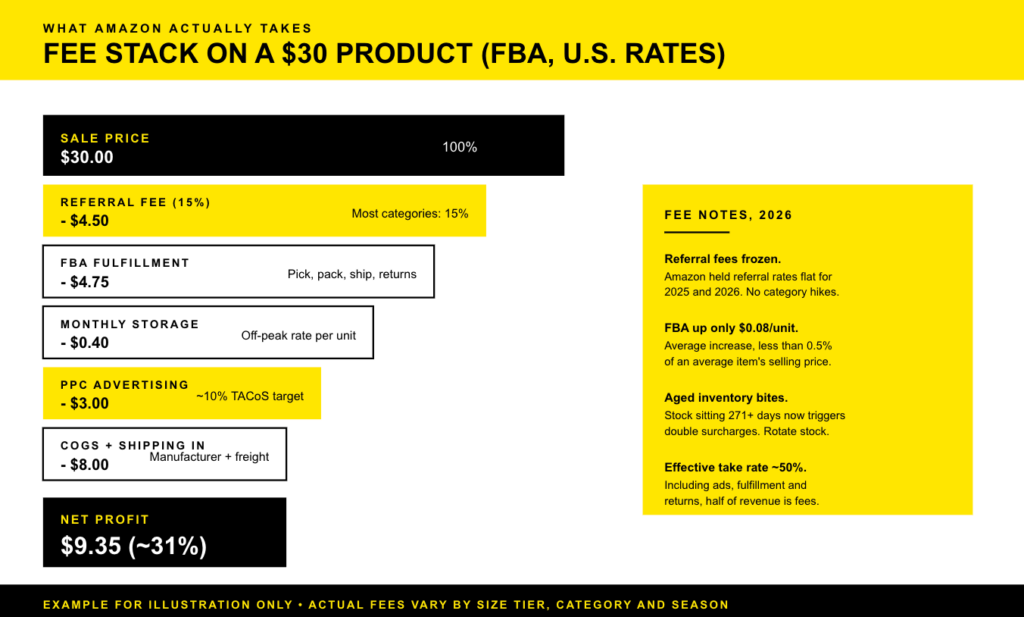
The selling plan fee comes first: $0.99 per item for Individual sellers or $39.99 per month for Professional sellers. The referral fee comes second. It is Amazon’s commission on every sale, calculated on the total sale price including shipping and gift wrap, with sales tax excluded. Most categories charge 15%; electronics is 8% on price up to $100 and 8% above; apparel runs tiered at 5-17%; and some specialty categories, such as Amazon Device Accessories, hit 45%.
Amazon froze referral fees in both 2025 and 2026, with no rate increases on this layer for new sellers planning their next 12 months.
FBA fulfillment fees are the third layer, charged per unit shipped and scaled by size and weight tier. The 2026 update raised average FBA fees by $0.08 per unit, less than 0.5% of average item price, but introduced a new Small Bulky tier with 21-23% lower fees for mid-size products.
Storage fees follow. Monthly off-peak rates sit around $0.40 per cubic foot for standard size, jumping to roughly $2.40 per cubic foot in October-December peak. Aged inventory surcharges now double at 271-365 days, which means slow-moving stock can generate fees larger than the unit profit within a quarter. If your catalogue grows quickly, good stock discipline matters as much as listing quality. This is where inventory management companies can become useful, especially once spreadsheets start hiding cash-flow problems.
Refund administration fees apply when a customer returns an item. Amazon retains the lesser of $5 or 20% of the original referral fee. Long-term storage, removal, prep, and labeling fees can stack. Sellers using PPC pay additional costs on top.
| Fee type | When it applies | Typical 2026 rate |
| Selling plan | Always | $0.99/item or $39.99/month |
| Referral fee | Every sale | 8-17% of total sale price, most categories 15% |
| FBA fulfillment | Per unit shipped via FBA | $3-$10+ depending on size and weight |
| Monthly storage | Inventory in FBA warehouses | $0.40-$2.40 per cubic foot |
| Aged inventory surcharge | Stock sitting 271+ days | Doubled in 2026, varies by age |
| Refund admin fee | Customer returns | Lesser of $5 or 20% of referral fee |
| Closing fee | Books, DVDs, music, video games | $1.80 per media item |
| High-volume listing | 100K+ active SKUs | $0.005 per SKU/month above threshold |
| PPC ad spend | When you run ads | Variable, with CPC averages around $1.18-$1.25 |
The practical lesson: build a per-SKU profit model before you sell a single unit. Amazon’s revenue calculator gives a fast first estimate, but only your real numbers, including your specific shipping-in cost, expected return rate, and ad spend, tell you if the SKU is viable.
Most unprofitable Amazon sellers underestimated total fee load before launch.
Promote and advertise: how Amazon Ads actually work
The single biggest shift in selling on Amazon between 2020 and 2026 is that organic visibility, by itself, no longer launches a product. Page-one search presence in most categories now requires both organic and paid presence. Ad spend is no longer just a growth lever. It is a launch requirement.
Amazon Ads has three primary formats. Sponsored Products are keyword-targeted ads that appear in search results and on product pages, accounting for more than 75% of Amazon’s ad revenue. Sponsored Brands are banner-style ads featuring your logo, a tagline, and three products, available only to brand-registered sellers. Sponsored Display ads target shoppers based on past behavior across Amazon and the wider web, including display ads that retarget visitors who viewed your listing.
In competitive categories, Amazon Sponsored Ads are not a nice extra. They are part of launch economics.
For new launches, Sponsored Products is the workhorse. Start with two campaign structures: an automatic campaign to discover which keywords convert, then a manual campaign to bid up the winners. Set a daily budget you can sustain for 30 days minimum. Launches that pause at week two never gather enough data.
Target Advertising Cost of Sale (ACoS) of 30-40% during launch, dropping to 15-25% as organic ranking builds. Total ACoS (TACoS), which measures ad spend against all revenue including organic, is the more useful long-term metric. A 10-15% TACoS is a healthy target.
CPCs have climbed steadily. Average Sponsored Products CPC sits around $1.18-$1.25 in 2026, up from $0.97 in 2024. Categories range from $0.89 in fashion to over $7 in supplements and competitive health. Plan ad budgets against these averages. A $5 daily budget in supplements buys almost nothing.
Once campaigns collect enough data, Amazon PPC optimisation becomes the difference between paying for clicks and paying for learnings that actually improve your listing.
Brand-registered sellers get additional levers: Sponsored Brands video, Sponsored Brands store spotlight, Brand Analytics with search-term data Amazon does not show anyone else, and the ability to launch an Amazon Store, a custom branded subdomain inside amazon.com. Brand Registry approval typically takes 2-10 business days when documents align.
Get product reviews without breaking Amazon’s policy
Reviews are the conversion lever no ad budget can replace. New listings face a chicken-and-egg problem: customers buy what others have reviewed, and reviews come from customers who buy. Amazon’s policies on review manipulation are strict. Incentivized reviews, fake reviews, and review-swap schemes can suspend your account.
Amazon Vine is the official program. Brand-registered sellers enroll a SKU into Vine, send free units to a curated panel of trusted reviewers, and receive honest reviews in 30-60 days. Vine costs a fee per enrolled SKU and limits enrollment to 30 units, but it is the only sanctioned way to generate reviews on a new listing. Most successful Amazon sellers enroll every new launch in Vine on day one.
Outside Vine, your tools are the “Request a Review” button in Seller Central and any third-party tools that automate that same templated message. Do not send custom review requests. Do not offer incentives. Do not ask only happy customers to review. The Buyer-Seller Messaging system tightened in 2025-2026, and Amazon now suspends accounts that send anything resembling review solicitation outside the templated path.
Realistic timeline: a new private-label launch typically reaches 50-100 reviews in 90-120 days with Vine plus organic accumulation. Below 25 reviews, conversion stays weak. Above 100, the listing starts to compound on its own.
Price products to win the Buy Box and protect your margin
Pricing on Amazon is a continuous decision, not a one-time setting. The Buy Box, the main “Add to Cart” button on shared listings, algorithmically rotates among eligible sellers based on price, FBA status, fulfillment speed, account health, and several other signals. Holding the Buy Box drives roughly 80% of sales on a shared listing. Losing it makes your inventory close to dead.
Pricing becomes even more sensitive when you compete for Amazon’s Buy Box, where price, fulfillment speed, FBA status, and account health all influence visibility.
For private-label sellers with a unique listing, Buy Box competition does not apply, but pricing still matters. Amazon’s algorithm rewards listings that convert at competitive prices. Drop the price too low and your margin collapses. Raise it too high and conversion falls.
Most sellers use repricing tools such as Aura, Bqool, Seller Snap, and Feedvisor to adjust prices based on rules they set: minimum price, maximum price, competitor logic, and target Buy Box share.
Build pricing rules around your minimum viable price. Start with COGS, add referral fee, FBA fees, expected return cost, and target margin. The result is the floor below which you should never reprice. Above that, the question is positioning.
Premium-priced listings work when your reviews and content carry the difference. Value-priced listings work when your supply chain is genuinely cheaper than competitors. The middle is the worst place to live.
Brand Registry and the brand-building layer
Once you have a registered trademark, enroll in Amazon Brand Registry for free. Brand Registry is gated by trademark. You need an active registered trademark from an approved IP office, such as USPTO, EUIPO, UKIPO, IPO Germany, and others, or a pending trademark filed through Amazon IP Accelerator. Approval usually takes 2-10 business days when documentation matches.
Brand Registry unlocks the difference between an Amazon seller and an Amazon brand. Registered brands get A+ Content, which means enhanced product descriptions with images and modules, Stores, Brand Analytics, Sponsored Brands ads, Vine, Project Zero counterfeit removal, and Transparency for unit-level authentication.
From spring 2026, Amazon will require Brand Registry to use manufacturer UPC barcodes for FBA shipments. Sellers without it will need Amazon-issued FNSKU barcodes on every unit. That alone makes Amazon Brand Registry worth pursuing for any private-label seller.
| Layer | Without Brand Registry | With Brand Registry |
| Listing control | Anyone can edit your listing | You control title, images, and copy |
| Counterfeit protection | Manual reporting only | Project Zero, Transparency, automated tools |
| Content | Standard listing only | A+ Content, Brand Story modules |
| Storefront | None | Custom multi-page Amazon Store |
| Advertising | Sponsored Products only | Sponsored Brands, video, display |
| Data | Basic Seller Central reports | Brand Analytics with search insights |
| Reviews | Standard request flow | Amazon Vine enrollment |
| FBA labeling | FNSKU required from spring 2026 | Manufacturer UPC accepted |
Grow your business beyond the first SKU
The first profitable SKU teaches you the system. The second, third, and tenth SKUs are how you focus on growing your business into something worth running full-time.
Most sellers who scale follow a similar pattern: pick adjacent products that share your supplier, your audience, or your category. A kitchen-tool brand expands into more kitchen tools, not into pet supplies. The shared infrastructure, including listings, ad accounts, supplier relationships, reviews, and brand authority, compounds.
For European sellers, cross-border expansion via Pan-EU FBA is the obvious next step. Once you sell on Amazon.de, enrolling in Pan-EU FBA lets Amazon distribute your inventory across fulfillment centers in Germany, France, Italy, Spain, Poland, and Czech Republic, fulfilling orders from the closest center. This reduces FBA fees per unit, improves delivery times, and helps you reach more customers across the continent without operating multiple warehouses.
Once your first SKUs work, cross-border trade in Germany becomes one of the most natural expansion paths.
The trade-off is tax: EPR, VAT, sales tax, and import duties. Most sellers use a VAT compliance service like AVASK, hellotax, or Amazon’s own VAT Services on Amazon. If you sell products online through your own DTC store, Amazon adds a parallel channel rather than replacing it. Most successful brands consider selling on both, using each for what it does best.
Beyond Europe, Amazon Global Selling links your seller account to international marketplaces. The U.S., U.K., Japan, Canada, and Australia are the next-largest English-friendly markets after Germany. Each has different ad costs, different tax regimes, and different cultural quirks in product copy.
A second growth path is going wider on the same marketplace: launching a B2B channel through Amazon Business, entering the Subscribe & Save program for consumables, or applying for the Amazon Launchpad program for innovative brands. None of these channels are required, but each adds a revenue line on top of your existing listings.
Key takeaways
- Amazon hit roughly $716.9 billion in 2025 revenue, with Germany as Europe’s largest market at $45.9 billion and 12.3% growth.
- Third-party sellers generated 61% of paid units in Q4 2025, and 100,000+ sellers now exceed $1M in annual revenue.
- The Professional selling plan at $39.99/month pays for itself above 40 units per month and is the default for serious sellers.
- Pick a business model, such as private label, wholesale, arbitrage, dropshipping, or handmade, based on your capital, time, and risk profile.
- Spend more time on product research than on listing creation. Demand, competition, and margin headroom must all check out.
- FBA covers 71% of sellers because Prime eligibility lifts conversion. FBM works for oversized, heavy, or low-margin SKUs.
- Referral fees stayed frozen for 2025 and 2026. FBA rose only $0.08 per unit on average, but aged inventory surcharges doubled.
- Sponsored Products advertising is no longer optional. Page-one visibility requires it in nearly every category.
- Brand Registry unlocks A+ Content, Stores, Brand Analytics, Vine, and Sponsored Brands. From spring 2026, it is also tied to FBA UPC use.
- Pan-EU FBA and Amazon Global Selling are the natural growth paths once your first SKUs are profitable.
Conclusion
Selling on Amazon in 2026 rewards sellers who treat it as a business, not a side experiment. The marketplace has fewer competitors than four years ago and more demand per active seller, which creates a rare opportunity window where being deliberate beats being early.
Pick your model, validate the product, source carefully, list well, advertise from day one, and protect your brand. The infrastructure does the heavy lifting. Your job is to make decisions Amazon’s algorithm can reward.
FAQ
How much money do I need to start selling on Amazon in 2026?
A realistic starting budget for a private-label launch is $5,000-$10,000, covering inventory, samples, photography, listing creation, the first 60-90 days of PPC, and a buffer for reorder. Arbitrage and dropshipping can start under $1,000, but the ceiling is much lower. About 25% of sellers start with under $1,000, but most of those operate at hobby scale.
Do I need a registered company to sell on Amazon?
You can start as an individual in most marketplaces, but a registered business is required for serious volume, tax compliance, and access to certain features. In Germany, that typically means a GmbH, UG, or registered Einzelunternehmen. In the U.S., an LLC is the common starting structure. Registering early simplifies banking, VAT, and account verification.
How long does it take to see real revenue from selling on Amazon?
Most sellers see first sales within days of going live, but meaningful revenue takes longer. Roughly 22% of sellers reach profitability within three months and 58% within twelve months. Private-label launches typically need 90-120 days to accumulate 50+ reviews and stable organic ranking. Quick results almost always come from arbitrage or wholesale, not from new private-label brands.
Is Amazon FBA worth it compared to handling shipping myself?
For most sellers, yes. Programs like Fulfillment by Amazon deliver Prime eligibility, faster delivery promises, and offload customer service and returns. The conversion lift from Prime alone usually outweighs the FBA fee, especially on small, light, fast-moving products. FBM still wins for oversized, heavy, or specialized goods where FBA economics fail. Many sellers run hybrid setups.
Can I sell on Amazon from outside the U.S. or Germany?
Yes. Amazon supports sellers from most countries in its U.S., U.K., Germany, and other marketplaces, provided you have valid business documentation, a bank account in a supported country, and tax compliance. German-based sellers selling on Amazon.com and U.S.-based sellers selling on Amazon.de are both common. The friction is mostly tax: EPR, VAT, sales tax, and import duties. A compliance service can handle much of that setup.
What is the biggest reason new Amazon sellers fail?
Underestimating fees and overestimating margin. Most sellers who quit unprofitably picked a product without modeling all-in cost: referral fee, FBA, storage, returns, and PPC. They discovered too late that the margin was always going to be thin. The second-biggest reason is impatience: launching without reviews, pausing ads at week two, and reading week-three data as a verdict instead of a signal.
Do I need Amazon Brand Registry from day one?
Not strictly, but it pays for itself fast for any private-label seller. Brand Registry is free, requires a registered or pending trademark, and unlocks A+ Content, Stores, Brand Analytics, Vine, and Sponsored Brands ads. Most of these directly lift conversion. From spring 2026, Brand Registry also becomes the requirement for using manufacturer UPC barcodes with FBA, which adds operational urgency.