Same-day delivery in Germany in 2026: retailers, rapid-delivery services and what works
Want to know what are the top companies in Germany that offers same-day delivery? Is this service common in Germany? Check out!
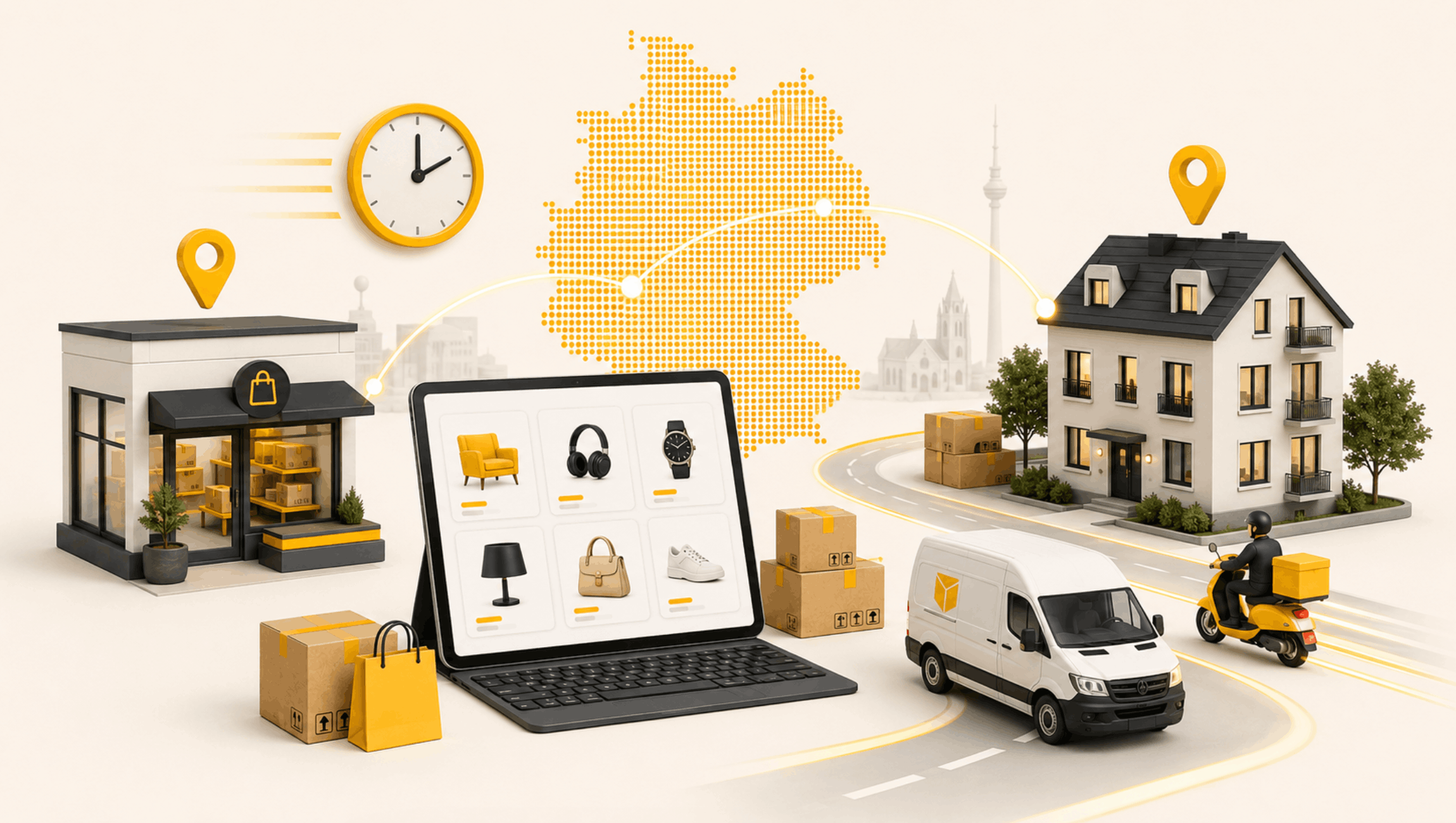
Same-day delivery is no longer a novelty in German ecommerce. It is also not a universal customer expectation.
For some purchases, speed can change the decision completely. A broken phone charger, drinks for unexpected guests, printer ink before a deadline or a last-minute gift all create a clear case for fast fulfilment. In other categories, customers may prefer a free next-day option, a reliable pickup slot or a parcel locker over paying extra for delivery within hours.
That is the part many retailers miss.
Same-day delivery is not about promising speed everywhere. It is about offering the right delivery model for the order, the location and the margin behind it. For a broader view of the market in which these services operate, see our complete guide to understanding the DACH market.
TL;DR: same-day delivery is not one service
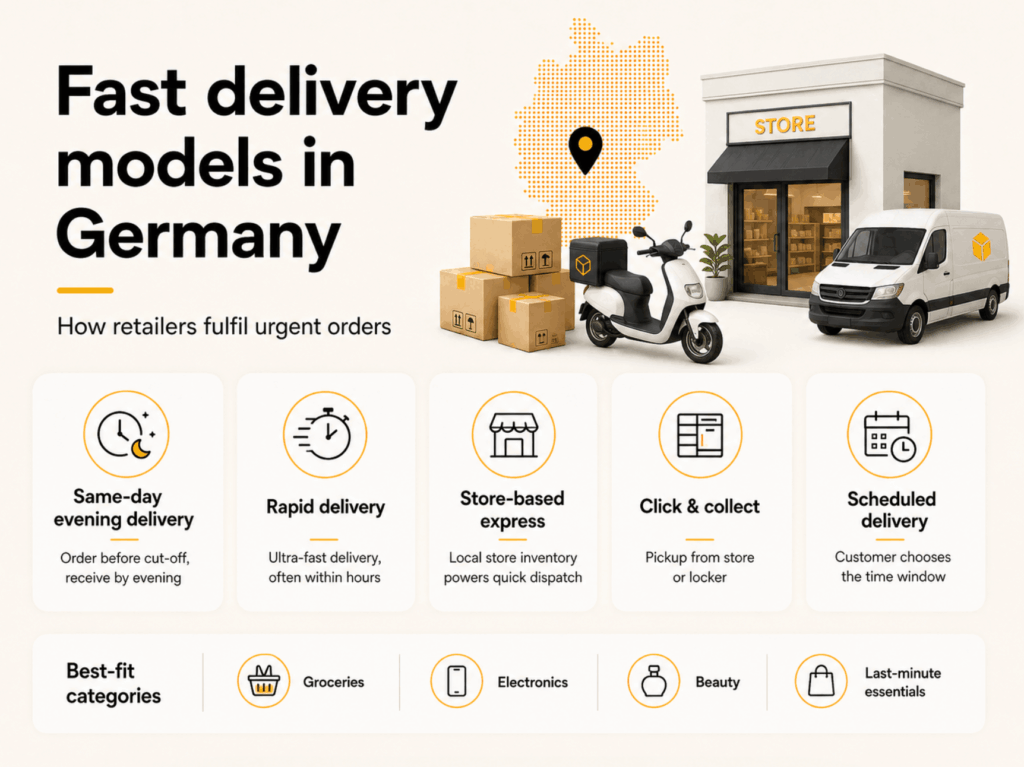
| Service type | Typical promise | Best-fit categories |
| Same-day evening delivery | Order before a cut-off, receive by evening | Marketplace essentials, premium fashion, selected retail |
| Rapid delivery | Around 30–120 minutes | Electronics, groceries, beverages, urgent household items |
| Store-based express delivery | Dispatch from local store inventory | Electronics, DIY, homeware, drugstore |
| Same or next business day | Delivery depends on stock, postcode and order time | Furniture, bulky goods, larger baskets |
| Fast click & collect | Ready within hours | Drugstore, electronics, photo, convenience products |
| Scheduled delivery | Customer selects a delivery window | Grocery, beverages and larger weekly baskets |
What counts as same-day delivery?
Same-day delivery means the order reaches the customer before the end of the same business day.
That sounds straightforward, but German retailers use several different models under the broader “fast delivery” label. A customer may order at 9 a.m. and receive a parcel at 8 p.m. Another may receive a laptop in 90 minutes from a nearby store. A third may reserve household products online and collect them two hours later.
All three experiences are fast, but they rely on different operations.
| Model | What happens behind the scenes | Customer value |
| Same-day delivery | Order is fulfilled from a local or regional hub and delivered by evening | Convenience without leaving home |
| Rapid delivery | Local store or dark store dispatches an order quickly | Useful for urgent purchases |
| Express delivery | Retailer offers faster delivery depending on stock and postcode | Better for larger or bulky products |
| Click & collect | Store team picks the order for local pickup | Fast access without courier cost |
| Scheduled grocery delivery | Retailer assigns a delivery route and time slot | Reliability for larger baskets |
The distinction matters because “faster” is not always better. A retailer that promises a realistic 18:00–20:00 delivery window can create more trust than one that promises same-day delivery but cannot fulfil it consistently.
Same-day delivery in Germany: a 2026 market snapshot
Fast delivery now sits inside a wider customer-experience expectation. Customers care about speed, but they also care about delivery choice, tracking, cost, pickup options, return handling and carrier trust.
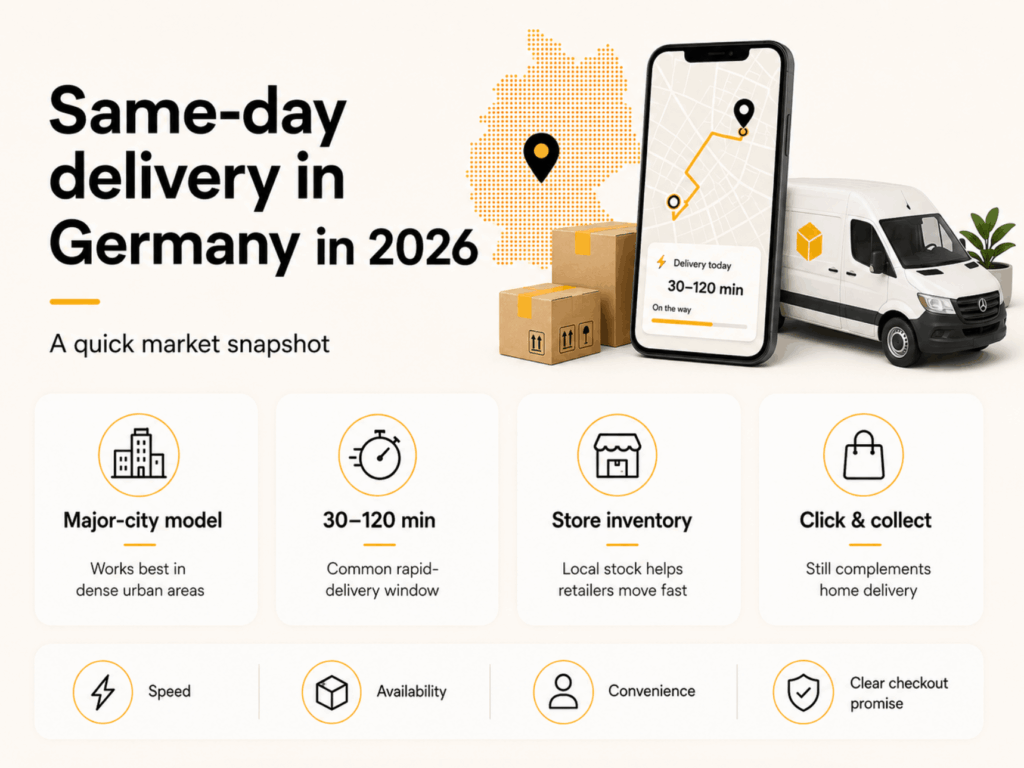
DHL’s 2026 ecommerce research found that seven in ten shoppers see trust in the delivery provider and the availability of delivery choices as critical when deciding where to buy. The report surveyed 29,000 online shoppers and 5,800 ecommerce businesses across 29 countries.
That creates a practical reality for retailers:
- same-day delivery can win urgent orders;
- next-day delivery often has better economics;
- lockers and pickup points can reduce failed deliveries;
- click & collect can solve urgency without adding courier cost;
- free delivery may matter more than extreme speed for lower-margin orders.
These expectations are part of wider DACH ecommerce trends, where delivery flexibility, local fulfilment and checkout trust increasingly shape conversion. The gap between demand and execution is explored in German shoppers have the highest delivery standards in Europe.
Top retailers and retail platforms with fast delivery in Germany
The following examples focus on verified fast-delivery propositions. Availability depends on postcode, cut-off time, product eligibility and local inventory.
1. Amazon Prime
Amazon remains the broadest same-day-delivery benchmark in Germany.
Amazon said Prime delivered more than 500 million products in Germany on the same or next day during 2025. Its same-day service is now available in more than 70 German cities for eligible products and addresses.
Amazon’s advantage is not only speed. It combines local fulfilment capacity, Prime membership, clear delivery messaging, saved payment details, tracking and familiar returns.
Its delivery model also helps explain why Amazon remains central to our ranking of top online stores in Germany and best online marketplaces in Germany.
For smaller retailers, Amazon is difficult to copy directly. The useful lesson is simpler: show customers what they need to know before checkout. Is the item in stock? When will it arrive? Who will deliver it? Can it be returned easily?
2. MediaMarkt
MediaMarkt offers one of Germany’s clearest rapid-delivery examples through its Sofort-Lieferung service.
The company partnered with Uber to deliver qualifying online orders within 90 minutes. The model depends on nearby store stock and local dispatch capacity, with the service originally launching across major German cities through MediaMarkt’s store network.
This is a strong model because MediaMarkt uses physical stores as a local fulfilment network. Instead of moving every order through a central warehouse, it can dispatch selected products from nearby stores.
That makes rapid delivery relevant for chargers, headphones, printer cartridges, gaming accessories and smaller appliances. Electronics is one of the categories where delivery certainty matters most, as shown in why electronics remain one of Germany’s top ecommerce categories.
For marketplace sellers, this type of inventory accuracy also matters. See how to sell on Amazon and how to build an ecommerce distribution strategy for broader channel context.
3. SATURN
SATURN operates under the same wider MediaMarktSaturn rapid-delivery model.
The same infrastructure lets selected orders move from local store inventory to the customer through Uber’s delivery network, with a 90-minute promise for qualifying purchases.
The key takeaway is not that every retailer should promise 90-minute delivery. It is that store-based retailers can turn branches into an advantage.
A local store can become a micro-fulfilment point instead of only a place for walk-in shopping. This is especially relevant for categories with urgent demand, smaller products and high local store density.
4. Mytheresa
Mytheresa proves that same-day delivery can work in luxury retail when the average order value supports it.
The Munich-based retailer offers same-day delivery in Munich, Berlin and Potsdam. Orders placed before 11:00 CET from Monday to Saturday can arrive by 22:00 on the same day. The service costs €15 and does not run on Sundays or public holidays.
Luxury is one of the categories where same-day delivery can make commercial sense. The order value is higher, customers may be buying for travel, gifting or an event, and the delivery service reinforces premium positioning.
Same-day delivery is not merely a logistics feature here. It becomes part of the brand promise. This is also relevant to the trends covered in fashion retail in DACH.
5. Flaschenpost
Flaschenpost is one of Germany’s strongest rapid-delivery benchmarks for groceries, beverages and household essentials.
The company promises delivery within 120 minutes or in a selected delivery slot. It says its service area now reaches more than 40% of German households.
Its model works because the category is urgent and repeat-driven. A customer may not need a sofa in two hours, but they may need drinks before guests arrive, groceries for dinner or household supplies before the weekend.
Flaschenpost also reflects the wider rise of mobile-first retail, explored in top shopping apps in Germany.
6. Knuspr
Knuspr is not a classic 90-minute service, but it is one of the strongest examples of same-day grocery fulfilment in Germany.
Its FAQ states that orders placed before 18:00 from Monday to Saturday are delivered within three hours in most service areas. Augsburg has a four-hour promise.
Knuspr’s model matters because it balances speed with planned grocery shopping. It supports larger baskets and scheduled demand without relying on the economics of ultra-fast single-item orders.
For grocery and household shopping, reliability can be more valuable than a vague speed claim. That principle also appears in our ultimate guide to customer experience in DACH.
7. IKEA
IKEA should not be presented as a broad, nationwide same-day delivery retailer in the same way as Amazon or Flaschenpost.
Still, IKEA’s express delivery is a useful benchmark for bulky goods. Its current terms state that qualifying orders can be delivered on the same or next business day, with orders placed by noon potentially eligible for same-day delivery. Availability depends on capacity, postcode, product type and the time of order.
This is a more realistic model for furniture and larger home products. The service is not about instant delivery everywhere. It gives customers an urgent option when local operational capacity exists.
Furniture and DIY businesses need a different delivery model from grocery or electronics. More context is available in best online DIY stores in Germany.
8. REWE delivery service
REWE is better understood as a flexible grocery-delivery and pickup retailer than as a standardised same-day player.
Its online proposition depends on address-level availability and selected delivery windows. Customers choose from available local delivery slots, which suits weekly baskets and planned grocery shopping more than instant-order behaviour. REWE also supports delivery and pickup for eligible products in supported locations.
REWE belongs in this guide because it shows that customers often value control over delivery timing as much as raw speed. A dependable chosen slot can beat a rushed delivery promise that creates uncertainty.
9. dm Express-Abholung
dm is no longer a same-day home-delivery example, but it is an excellent fast-fulfilment case through click & collect.
Customers can order eligible dm products online or in the app and collect up to 50 items from a selected store after as little as two hours. Larger orders may need at least six hours, while availability depends on stock at the chosen branch.
This is an important reminder: many customers do not necessarily need a courier. They need certainty that the item will be ready when they arrive.
For drugstore, beauty, baby, health and household categories, fast pickup can deliver much of the same convenience with lower cost and fewer failed-delivery risks.
10. Lieferando’s local retail network
Lieferando is not a retailer itself, but its platform connects customers with nearby supermarkets, convenience stores and other local merchants that can offer rapid delivery.
Its grocery section is postcode-based: customers enter their location and see local stores that can deliver essentials to the door.
This platform model matters because it lowers the barrier for smaller merchants. A local supermarket, florist or specialist store may not have the scale to build an in-house same-day network. Through a platform, it can test local delivery demand without building the full logistics stack alone.
Same-day delivery comparison: who does what?
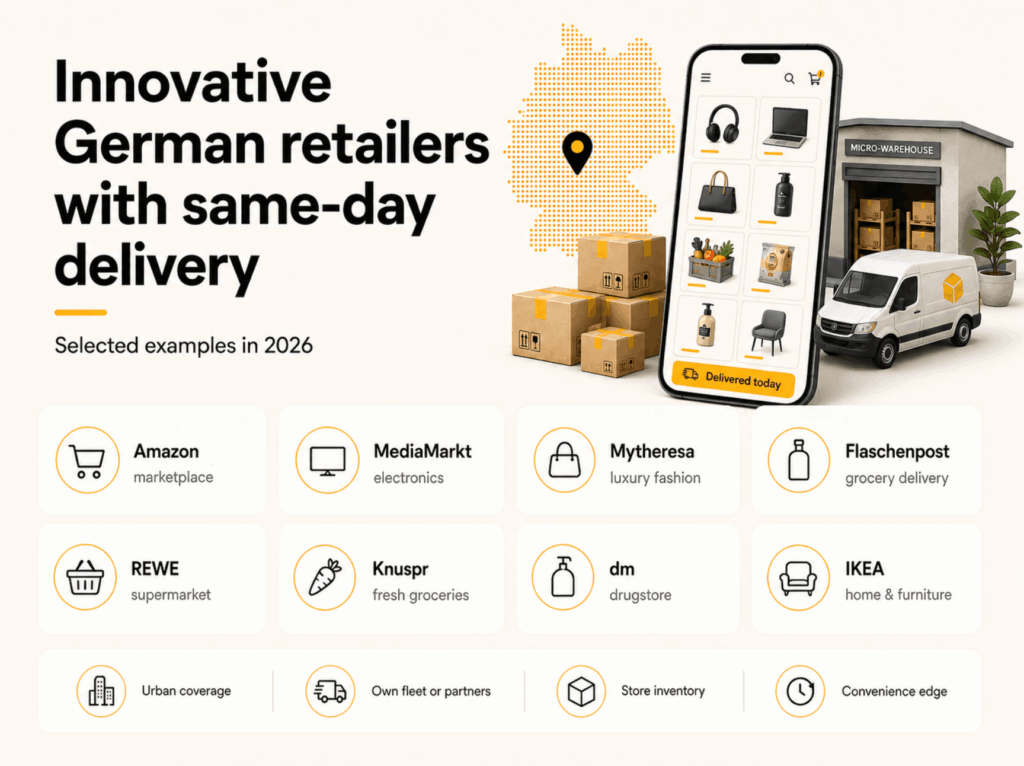
| Brand or platform | Delivery model | Current customer promise | Main limitations | What retailers can learn |
| Amazon Prime | Same-day evening delivery | Same day for eligible products and postcodes | Product, postcode and cut-off restrictions | Dense fulfilment and clear delivery messaging |
| MediaMarkt | Rapid local delivery | Up to 90 minutes for qualifying orders | Local stock, selected products and local service coverage | Stores can become fulfilment hubs |
| SATURN | Rapid local delivery | Up to 90 minutes for qualifying orders | Similar limits to MediaMarkt | Shared stock and local dispatch can improve convenience |
| Mytheresa | Premium same-day delivery | By 22:00 for qualifying orders | Munich, Berlin and Potsdam only; orders before 11:00 | Higher AOV can support premium delivery |
| Flaschenpost | Rapid grocery delivery | Within 120 minutes or a chosen slot | Service-area availability | Urgent categories suit rapid delivery |
| Knuspr | Fast same-day grocery delivery | Usually within three hours | Limited service areas | Scheduled speed can protect margins |
| IKEA | Same or next business day express | Same day possible for eligible orders placed early | Postcode, capacity and product restrictions | Bulky goods need realistic express promises |
| REWE | Scheduled grocery delivery | Customer-selected available slot | Availability differs by location | Reliability can matter more than extreme speed |
| dm | Fast click & collect | Ready from two hours | Pickup only and local stock required | Store pickup can solve urgency cheaply |
| Lieferando | Local rapid-delivery platform | Depends on local partner and postcode | Merchant selection differs by city | Platforms can unlock local delivery tests |
Why same-day delivery works only in certain categories
Same-day delivery is not a universal conversion lever.
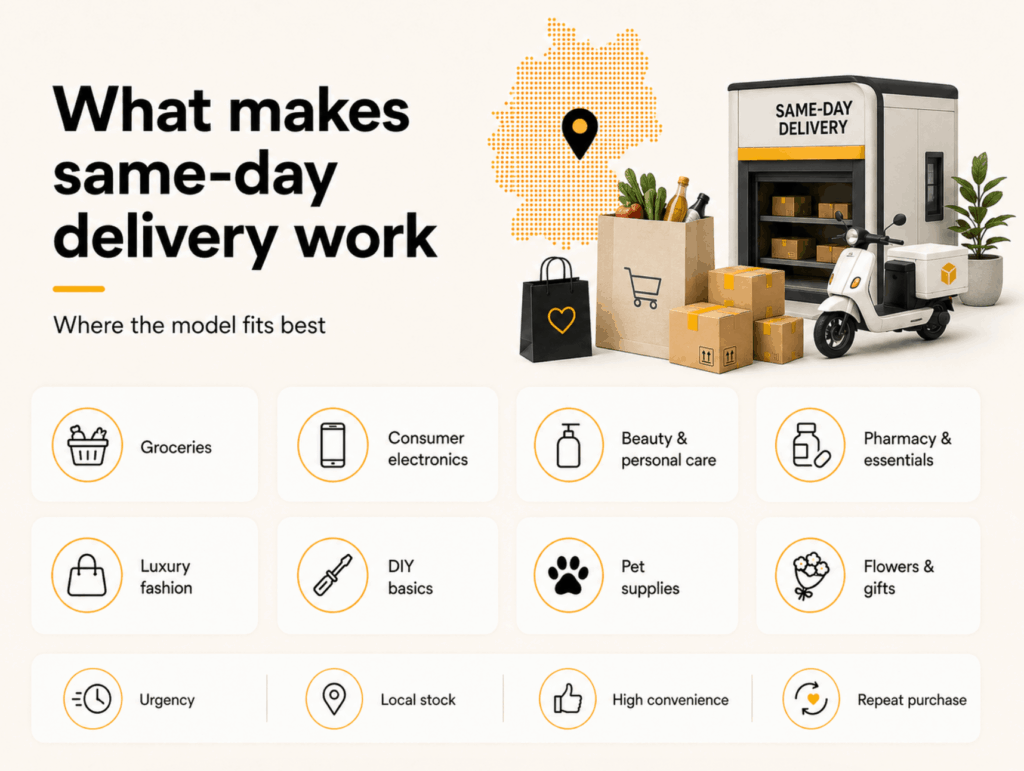
It works best when urgency is high, the product is locally available and the cost of delivery does not consume the full margin.
| Category | Does same-day delivery make sense? | Why |
| Grocery and beverages | Usually yes | Customers may need items the same day |
| Consumer electronics | Often yes | Replacements and urgent accessories have clear value |
| Luxury fashion | Selectively | Higher order values can support the service |
| Drugstore and health essentials | Often through pickup or local delivery | Repeat demand and immediate need |
| DIY essentials | Selectively | Urgent project needs can justify fast delivery |
| Beauty and gifting | Sometimes | Event-driven demand can create urgency |
| Furniture | Rarely as a broad promise | Delivery cost and handling complexity are high |
| Low-margin fashion basics | Often no | Delivery cost can exceed commercial benefit |
| Heavy or fragile products | Usually no | Damage risk and route cost rise quickly |
The decision should come from contribution margin, not competitor anxiety.
A retailer may feel pressure to offer same-day delivery because Amazon does. But if the order value is €18, the product is low margin and the delivery needs a dedicated courier, the service can destroy profitability.
Price-sensitive shoppers will compare the full offer, not only speed. That makes price comparison platforms in DACH relevant even in a delivery-focused strategy.
The operating model behind same-day delivery
Fast delivery works only when the operational chain is short and visible.
A retailer needs to know where stock is, who can pick it, which carrier can collect it and whether the customer can realistically receive it on time.
| Operational layer | What needs to work |
| Local inventory | Stock must be accurate at store or warehouse level |
| Cut-off logic | Orders must stop when same-day capacity is no longer realistic |
| Picking speed | Team needs clear service-level targets |
| Delivery zone | Retailer needs a commercially viable radius |
| Carrier capacity | Courier supply must match demand peaks |
| Product rules | Heavy, fragile, oversized and regulated items need restrictions |
| Tracking | Customers need real-time order updates |
| Failed-delivery handling | Clear fallback is needed when nobody is home |
| Returns | Fast delivery should not create a slow return experience |
| Margin control | Delivery cost must be visible before the offer goes live |
The strongest delivery models are built around accurate inventory, narrow delivery zones, clear cut-offs and honest customer communication.
For the operational side, see top fulfilment centres and logistics operators in Germany, better, faster, greener: how fulfilment changed and top carriers for peak season in European domestic routes.
When same-day delivery does not make sense
Same-day delivery can become an expensive distraction.
It is usually a poor fit when:
- the retailer sells low-margin products;
- inventory is spread across unreliable locations;
- customers are unlikely to pay for speed;
- the delivery area is too large;
- products are bulky, fragile or difficult to handle;
- returns are already costly;
- the category is planned rather than urgent;
- checkout cannot show realistic eligibility;
- peak-hour dispatch capacity is weak.
A fashion retailer with high return rates may be better off investing in fit tools, clear product descriptions and easy returns.
A furniture retailer may gain more from precise delivery slots and room-of-choice service.
A grocery retailer may benefit more from recurring scheduled routes than from trying to beat every competitor on minutes.
Same-day delivery vs lockers, pickup and next-day delivery
Fast home delivery is only one form of convenience.
DHL’s research shows that out-of-home delivery is becoming more important, while trust in delivery and returns partners remains central to conversion.
| Option | Best for | Retailer benefit |
| Same-day home delivery | Urgent purchases | Strong convenience signal |
| Next-day delivery | Planned orders | Better route and margin economics |
| Parcel locker / PUDO | Urban and flexible shoppers | Fewer failed deliveries |
| Click & collect | Store-led retailers | Uses local stock without courier cost |
| Scheduled delivery | Grocery and bulky goods | Predictable routing and customer control |
| Express pickup | Drugstore, electronics and convenience categories | Fast fulfilment with lower cost |
For more context, read OOH delivery in DACH, smart parcel lockers in DACH and ecommerce trends among online shoppers.
What retailers should test before launching same-day delivery
A same-day option should begin as a controlled local experiment.
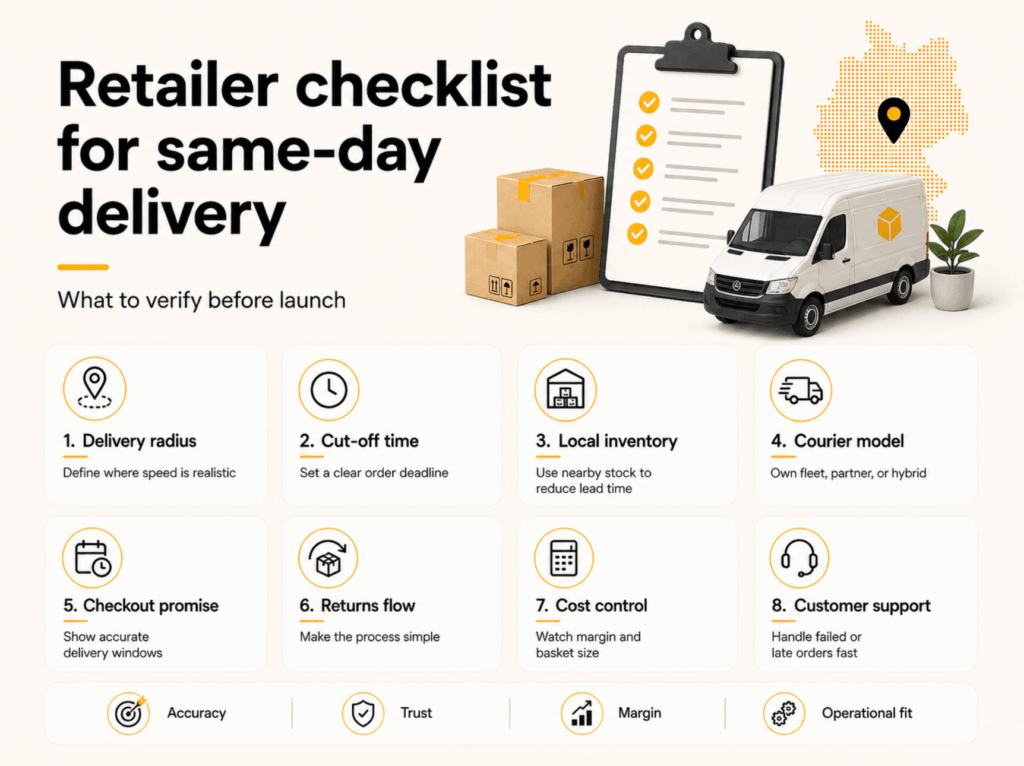
Start with one city, one category, selected SKUs and a clear delivery zone. Track profit per order, not only conversion uplift.
| Test area | What to measure |
| Delivery zone | Cost per order by postcode and distance |
| Cut-off time | How many orders arrive before and after the threshold |
| Product eligibility | Which SKUs create the fewest delivery issues |
| Order value | Whether speed increases basket size or only cost |
| Customer demand | How many shoppers choose same-day when it is paid |
| Carrier performance | On-time delivery, failed delivery and complaints |
| Customer support | WISMO tickets, cancellations and delivery questions |
| Repeat purchase | Whether fast delivery improves loyalty |
| Returns | Whether rapid purchases create more return risk |
| Margin | Contribution after pick, pack, courier and support costs |
First-attempt delivery deserves close attention. A fast service loses value if the customer misses the parcel or receives vague tracking. See top routes with the highest first-time delivery success rates for the wider operational context.
Same-day delivery checklist for German retailers
Before promoting a same-day option, check:
- Is stock accurate at the local fulfilment point?
- Can the order be picked within a clear SLA?
- Is there enough courier capacity during peak hours?
- Can checkout show eligibility before payment?
- Are product exclusions clear?
- Is the delivery fee commercially viable?
- Is the service limited to a manageable radius?
- Does the customer receive reliable tracking?
- Is there a fallback if same-day delivery fails?
- Are return terms still clear?
- Can customer support answer delivery questions quickly?
- Does the option fit the category and order value?
[IMAGE 4: Same-day delivery readiness checklist. A polished checklist board beside a local store, shelf inventory, courier bike, tracking phone and delivery van. Off-white, black and yellow. No text.]
Same-day delivery trends in Germany for 2026
Store inventory is becoming a local delivery asset
MediaMarkt and SATURN show how physical stores can become local fulfilment points. This matters most in electronics, drugstore, DIY, beauty and categories where retailers already hold stock close to customers.
Grocery delivery is shifting toward fast but predictable fulfilment
Flaschenpost, Knuspr and REWE represent different versions of grocery convenience. The strongest model is not always the fastest one. It is the model that balances delivery speed, assortment, freshness, route efficiency and customer choice.
Out-of-home delivery keeps expanding
Same-day home delivery will grow in selected categories, but lockers, pickup points and return drop-off locations will continue to grow too. Many shoppers want control, not just speed.
Retailers will use more selective promises
Blanket nationwide same-day delivery is expensive. More retailers will use postcode logic, local stock checks, dynamic cut-offs and product restrictions to decide when fast delivery makes commercial sense.
Delivery trust is becoming brand trust
Customers do not separate the retailer from the delivery experience. A late parcel, unclear tracking or failed delivery can damage the brand, even when the retailer uses a third-party courier. DHL’s research underlines that delivery-partner trust has become part of the purchase decision.
The same logic applies to checkout. Fast delivery loses value if the payment flow feels unfamiliar or incomplete. See top payment providers in the DACH region for the payment side of conversion.
FAQ: same-day delivery in Germany
Is same-day delivery common in Germany?
Same-day delivery exists in Germany, especially in major cities and urgent categories such as electronics, groceries, beverages and premium fashion. It is not yet a universal standard for every product or postcode.
Which retailers offer same-day delivery in Germany?
Verified examples include Amazon Prime for eligible products and locations, MediaMarkt and SATURN through rapid local delivery, Mytheresa in Munich, Berlin and Potsdam, Flaschenpost for groceries and beverages, Knuspr for fast grocery fulfilment, and IKEA for eligible express orders.
Does Amazon offer same-day delivery in Germany?
Yes. Amazon offers same-day delivery for eligible products and addresses in selected German cities. Amazon says the service is available in more than 70 cities.
Does MediaMarkt deliver within 90 minutes?
MediaMarkt and SATURN have used Uber-powered rapid delivery for qualifying orders. Availability depends on local store stock, product eligibility, delivery radius, timing and service coverage.
Is same-day delivery suitable for furniture?
It can work in selected cases, but it is rarely suitable as a blanket promise. Furniture delivery involves bulky goods, higher route costs, handling complexity and scheduling needs. IKEA’s same-day or next-business-day express model is a more realistic example.
Is click & collect better than same-day delivery?
It can be. Click & collect is usually cheaper for the retailer and can still be highly convenient for customers, especially when they need a product quickly and already live near a store.
What is the main challenge of same-day delivery?
The main challenge is balancing customer convenience with profitability. Retailers need accurate local inventory, enough picking capacity, reliable courier partners and delivery fees that do not erase margin.
Do shoppers always want the fastest delivery?
No. Many shoppers prefer free next-day delivery, parcel lockers, pickup points or a chosen delivery slot. The best option depends on urgency, product type and lifestyle.
Conclusion
Same-day delivery in Germany is not about copying Amazon or promising 90-minute delivery across the country.
It is about understanding where speed creates real value.
For groceries and beverages, rapid delivery can win urgent orders. For electronics, local-store fulfilment can turn physical branches into an advantage. For luxury, same-day delivery can reinforce a premium customer experience. For furniture, an honest same-day or next-day express option can be more valuable than an unrealistic instant promise.
The strongest retailers will not offer the fastest delivery everywhere.
They will offer the right delivery choice at the right moment, with clear expectations and enough operational discipline to keep the promise.