Online marketplace strategy: 7 questions to ask before adding a new sales channel
A marketplace launch can look simple until stock, returns and margin start behaving like a real channel. This guide covers the seven questions to ask before adding one: audience fit, unit economics, selling model, product data, ownership and what the first 90 days should prove. A special treat inside: if you’re a fashion brand looking for a new marketplace opportunity, join experts from ChannelEngine and ABOUT YOU live on July 15 at 11am CEST to see how it applies in practice. More information inside!

A marketplace opens up to more brands. Competitors start talking about it.
The first internal question is often how fast the team can get live. That question skips the part that decides if the launch is worth doing.
A new marketplace can give a brand access to demand it can’t reach through its own store. It can also expose problems that were easy to ignore before: weak product data, unclear stock ownership, returns that damage margin, or pricing rules that depend on someone updating a spreadsheet at the right time.
A useful online marketplace strategy should answer two questions before any launch work starts:
- what should this channel do for the business,
- and what will the team need to run it properly?
For fashion brands, listing products is rarely the hard part. The harder work starts once the channel needs accurate stock, localised product data, reliable fulfilment, clean returns handling and margin control at the same time.
Are you a fashion brand looking for a new marketplace opportunity? This webinar may interest you
For fashion brands, ABOUT YOU is a good example of why the “why” has to come before the launch plan.
A brand looking for new European reach will assess the opportunity differently than a team trying to move seasonal stock or scale one product category. The selling model, assortment fit, fulfilment setup and returns process can all change the answer.
That is the focus of the live ABOUT YOU and ChannelEngine online session on July 15. The discussion will cover what has changed, how to assess fit, how Dropshipping, Fulfilment by ABOUT YOU and Marketplace compare, and what to prepare before launch. (Ad)

If ABOUT YOU is on your radar, register for the live webinar before you build the launch plan.
Question #1: What role should the marketplace play?
Traffic numbers are a poor starting point, and country coverage can be misleading too.
Start with the business reason for adding the channel.
A brand may use a marketplace to test demand in a country where its own store has little reach. Another may want stronger visibility for one category. And then, another may need a controlled way to sell seasonal stock without pushing discounts across its direct channel.
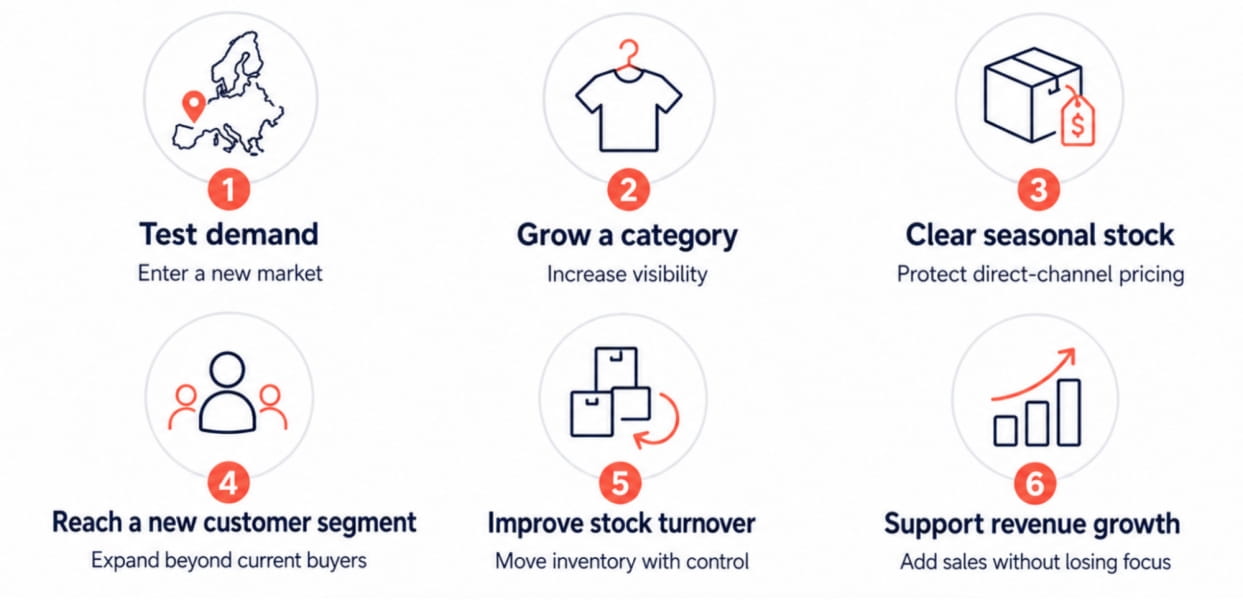
Each goal changes the marketplace shortlist.
A premium fashion brand entering Germany will assess brand fit and customer expectations differently than a retailer trying to grow order volume in several markets at once. A brand clearing seasonal inventory will care less about full-catalogue presentation and more about margin, stock control and return rates.
Write the goal in one sentence before you review any platform.
Example: We want to test demand for our spring collection in Germany while keeping margins above our usual target.
That sentence gives the team a filter. If a marketplace doesn’t support the goal, it shouldn’t move forward just because competitors are there.
Question #2: Does the audience fit your brand?
Large audience numbers look good in a pitch deck. They don’t prove that the platform attracts shoppers who will buy your products at your price point.
Check the fit at the level where buying decisions happen: category, price, brand position, country demand and return behaviour.
A fashion marketplace can still be a poor fit for a specific brand. The platform may lean toward lower prices. The category may already be crowded. Or, the audience may expect delivery terms or return policies that change the economics of the channel.
Use a simple scorecard before you commit resources.
| Area | Question to ask | Score |
| Customer fit | Are the platform’s shoppers close to our target buyer? | 1–5 |
| Category fit | Is there clear demand for our product type? | 1–5 |
| Price fit | Can we compete at our usual price point? | 1–5 |
| Brand fit | Can we present the brand in the right way? | 1–5 |
| Market fit | Does the channel support a priority market? | 1–5 |
| Operations fit | Can we meet the channel’s daily requirements? | 1–5 |
| Scale fit | Can this channel grow without creating manual work every week? | 1–5 |
A low score isn’t always a hard no; it actually shows where the launch plan needs limits.
For example:
- Weak price fit may mean starting with a narrow assortment.
- Weak brand fit may mean keeping core collections off the platform.
- Weak operations fit may mean waiting until stock updates and fulfilment processes are cleaner.
Question #3: Will the channel still make money after normal costs?
Marketplace performance can look healthy at GMV level and weak at contribution level.
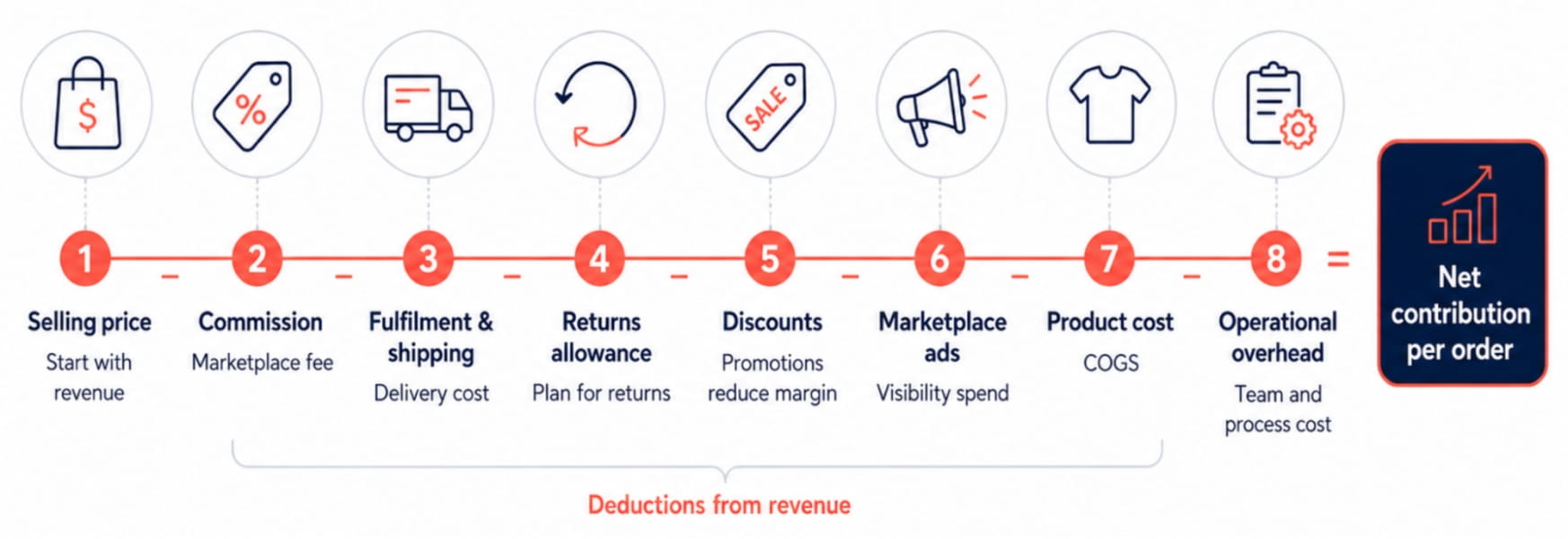
Before you commit inventory, model the order economics in plain terms:
Selling price – marketplace commission – fulfilment and shipping – returns allowance – discounts – marketplace advertising – product cost – operational overhead = net contribution per order
The model doesn’t need to predict every euro, but exists to show what happens once the channel starts behaving like a real channel.
For example, returns can change the whole picture for fashion brands. A fulfilment model can improve delivery speed but reduce margin. A marketplace may bring volume only after heavier promotional activity than your direct store needs.
You can test it with the pressure case: slower sell-through, more returns, stronger price competition or extra operational work. If the channel only looks good in the optimistic version, it possibly needs more scrutiny before launch.
Question #4: Which selling model fits your operations?
The marketplace choice is only one decision, but it’s the selling model that decides how much work lands on your team.
A standard marketplace model gives the brand more control over stock, range and fulfilment. It also puts more responsibility on the brand when delivery performance, inventory accuracy or returns start causing issues.
Dropshipping can reduce the need to place stock in another fulfilment network. It still depends on clean inventory data and reliable shipping, though. If stock updates lag behind reality, the channel can create cancellations quickly.
Marketplace fulfilment can make delivery and returns easier for shoppers. It also affects margin, inventory planning and control over day-to-day operations.
Before you choose the setup, answer the operational questions first:
- Can we meet delivery expectations in each market?
- How quickly does stock data update?
- What does fulfilment cost at product level?
- Who handles order exceptions?
- How will returns affect margin?
- Do we need to move inventory into a fulfilment network?
The best setup is the one your team can keep running after launch week.
Considering ABOUT YOU as your next fashion marketplace? ABOUT YOU and ChannelEngine are hosting a live webinar on July 15 at 11am CEST. The session covers marketplace fit, selling models, launch preparation and daily operations. (Ad) |
Question #5: Is your product data ready?
Marketplace launches often struggle because product data was “good enough” for one channel and too weak for another.
A new platform may require different attributes, image formats, size details, taxonomy and language fields. Product information that works in your own store can perform poorly on a third-party marketplace if shoppers can’t find it, compare it or trust it.
Review the launch assortment first:
- titles and descriptions
- category mapping
- attributes
- images
- size and fit details
- local language requirements
- stock availability
- pricing logic
- return policy information
Don’t clean the full catalogue before testing a new marketplace. Start with products that have reliable stock, complete information and enough margin to absorb the channel’s cost structure.
Consequences can be very practical: products become harder to find, harder to compare and easier to misinterpret, which weakens the launch before pricing or traffic can do their job.
Marketplace data quality needs an owner. Otherwise, every new channel repeats the same clean-up work.
Question #6: Can your team run the channel after launch?
Going live is a project, while running the channel is an operating model.
The real workload starts after onboarding: stock mismatches, price changes, cancelled orders, return issues, content updates and performance reviews.
Before launch, assign ownership.
| Task | Owner |
| Product content updates | [Role or team] |
| Pricing and promotions | [Role or team] |
| Stock and order exceptions | [Role or team] |
| Returns monitoring | [Role or team] |
| Marketplace advertising | [Role or team] |
| Performance reporting | [Role or team] |
| Scale or exit decisions | [Role or team] |
A small team can run several marketplaces well when product data, stock and pricing are connected.
A larger team can struggle with a few channels when information is scattered across tools and no one owns the decision.
Check the weak points before launch:
- stock updates happen manually
- prices live in spreadsheets
- content changes need several approvals
- returns follow a different process on each channel
- nobody reviews contribution margin regularly
The aim is to know which issues could distort the test.
Question #7: What should the first 90 days prove?
A marketplace launch should answer a clear question. It shouldn’t become a full-catalogue rollout just because the onboarding process is complete.
Start with a limited assortment, and then, choose products with clean data, stable availability and enough margin.
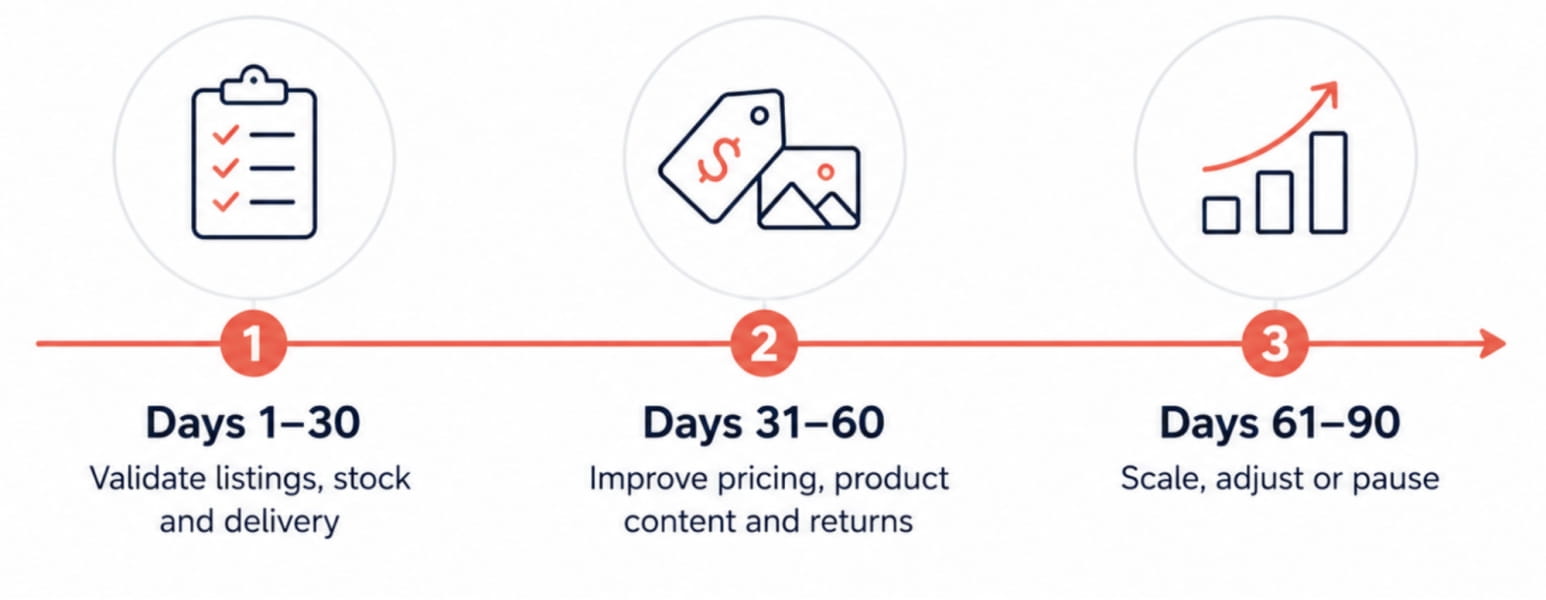
In the first 30 days, check if the channel works operationally. Watch listing approvals, stock accuracy, cancellations, delivery performance and early returns.
During days 31 to 60, review product-level performance. Look for listings that get views but do not convert, products with high returns, weak price positions and content gaps.
By day 90, the team should be able to choose a path:
- expand the assortment,
- adjust the selling model,
- improve data and retest,
- pause the channel,
- or stop investing in it.
Stopping early is often seen as a failed launch, but that is the wrong way to frame it. It’s more of a controlled decision made before the channel absorbs more time, stock and attention.
A marketplace strategy should make “not yet” easier
A useful online marketplace strategy helps a brand choose channels that fit its customers, products, margins and team capacity.
Sometimes the answer is to launch quickly. But, sometimes, it is to wait until stock processes, product data or ownership are ready.
For fashion brands looking at ABOUT YOU, the same questions apply. (Ad)
- Does the audience fit?
- Does the selling model work?
- Can the team run the channel after it goes live?
ABOUT YOU and ChannelEngine will explore those questions in a live online session on July 15 at 11am CEST. The webinar covers marketplace fit, Dropshipping, Fulfilment by ABOUT YOU, product data, localisation, fulfilment and returns.
Who should join?
Ecommerce directors, marketplace managers, heads of digital commerce, and marketplace teams at European fashion brands & everyone reviewing their next marketplace move.
The webinar will be led by experts at the topic:
- Clemence Dhuyvetter, Sales Manager, Partner Business at ABOUT YOU
- Katharina Caracciolo, Senior Partner Management (DACH) at ChannelEngine
Register now and get:
✔️ Access to the live panel discussion and Q&A
✔️ Insights directly from ABOUT YOU
✔️ Practical guidance from ChannelEngine on setup, operations, and marketplace readiness
✔️ The recording in your inbox
Don’t miss your chance!