Top beauty brands in DACH in 2026: German, Austrian and Swiss names to know
Discover the top beauty brands in DACH in 2026, including German, Austrian and Swiss skincare, makeup, haircare and luxury beauty names.
The DACH beauty market is not one market with three flags.
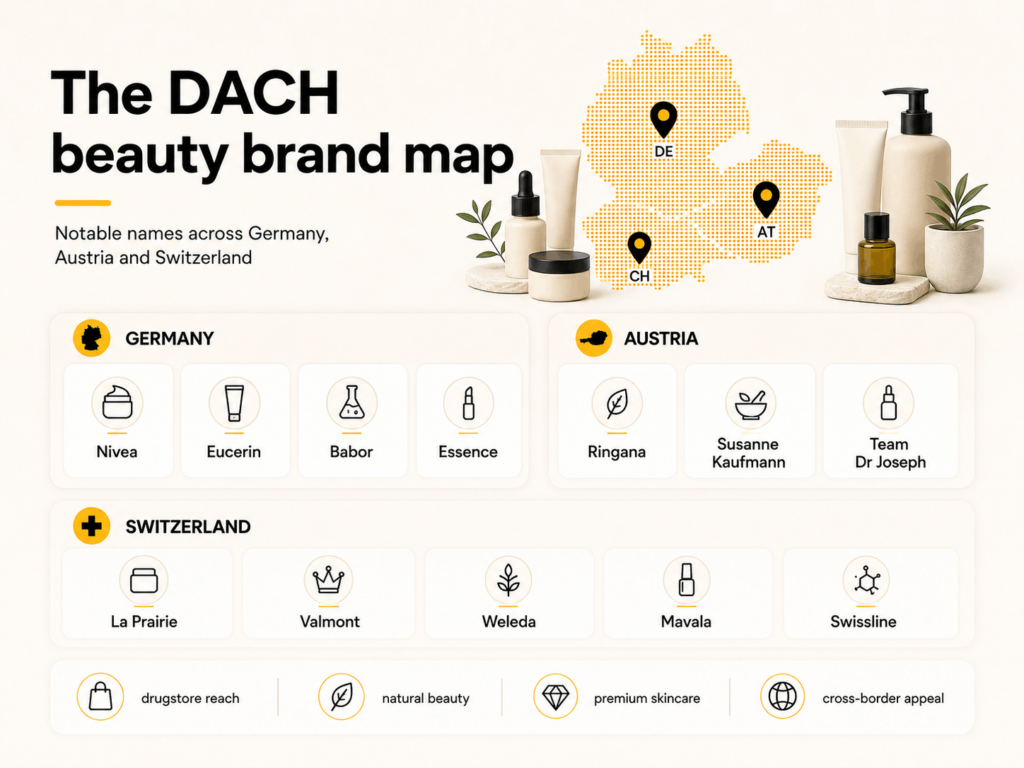
Germany brings scale, drugstore influence and strong dermocosmetics. Austria is known for natural skincare, wellness-led positioning and premium Alpine formulas. Switzerland remains a major reference point for luxury skincare, science-led beauty and high-end treatments.
Together, Germany, Austria and Switzerland form one of Europe’s most interesting beauty regions. Germany alone was Europe’s largest cosmetics and personal-care market in 2025, with retail sales valued at roughly €18 billion. Across Europe, beauty ecommerce is also growing faster than physical retail, while marketplaces, online specialists and DTC brands are reshaping discovery.
This list focuses on product brands with genuine roots in Germany, Austria or Switzerland. It does not treat retailers, clinics or subscription boxes as beauty brands, even though companies such as dm, Douglas, Rossmann and Sephora remain important routes to market.
For a broader view of the region, read our complete guide to understanding the DACH market.
TL;DR: DACH beauty market in 2026
| Market | What defines it | Strongest opportunity |
| Germany | Scale, drugstores, dermocosmetics, accessible makeup and professional haircare | Mass-market skincare, pharmacy beauty and ecommerce |
| Austria | Natural formulas, wellness positioning and Alpine-origin stories | Premium natural skincare and wellness-led brands |
| Switzerland | Luxury skincare, premium pricing, spa heritage and science-led positioning | Prestige skincare and high-AOV beauty |
| DACH overall | High trust expectations, strong offline retail and rising online discovery | Omnichannel brands with clear proof, product data and local relevance |
What makes a beauty brand relevant in DACH?
The brands below were selected because they have a clear DACH origin or strong operational roots in the region, an active product portfolio and meaningful relevance in skincare, makeup, haircare, fragrance or professional beauty.
| Selection factor | Why it matters |
| DACH roots | The brand was founded in Germany, Austria or Switzerland, or is strongly tied to the region |
| Clear category focus | Customers understand what the brand stands for |
| Current market presence | The brand remains active through retail, ecommerce, salons or professional channels |
| Distinct positioning | It offers more than generic products or vague lifestyle claims |
| Relevance for shoppers or retailers | It helps explain an important part of DACH beauty demand |
What defines beauty in DACH in 2026?
DACH beauty is shaped by a few overlapping forces.
Dermocosmetics continue to matter, especially in Germany. Beiersdorf’s Derma business, which includes Eucerin and Aquaphor, grew organically by 11.7% in 2025, outperforming the wider consumer beauty business.
At the same time, shoppers are becoming more selective. Premium skincare remains attractive, but brands increasingly need to justify their price through clinical positioning, ingredient transparency, packaging, service or stronger product education. Online discovery is also becoming more important, yet DACH remains highly omnichannel: drugstores, pharmacies, department stores, salons and marketplaces still shape the purchase journey.
| Trend | What it means for brands |
| Dermocosmetics | Clinical claims, sensitive-skin positioning and pharmacy credibility matter |
| Drugstore power | Affordable private labels and value-oriented brands stay influential |
| Premiumisation | High-AOV skincare needs visible proof, education and service |
| Ecommerce growth | Product content, reviews and retailer availability affect discovery |
| Social-led discovery | Makeup, fragrance and trend-led products benefit from stronger visual storytelling |
| Sustainability scrutiny | Specific evidence is more credible than broad “clean” or “green” claims |
| Omnichannel shopping | Customers may discover online, test in-store and reorder through an app or retailer |
Beauty retailers should also consider how payment, delivery and product information influence trust. See our guides to top payment providers in the DACH region, top shopping apps in Germany and data privacy vs personalization in DACH online retail.
Best German beauty brands
1. Nivea
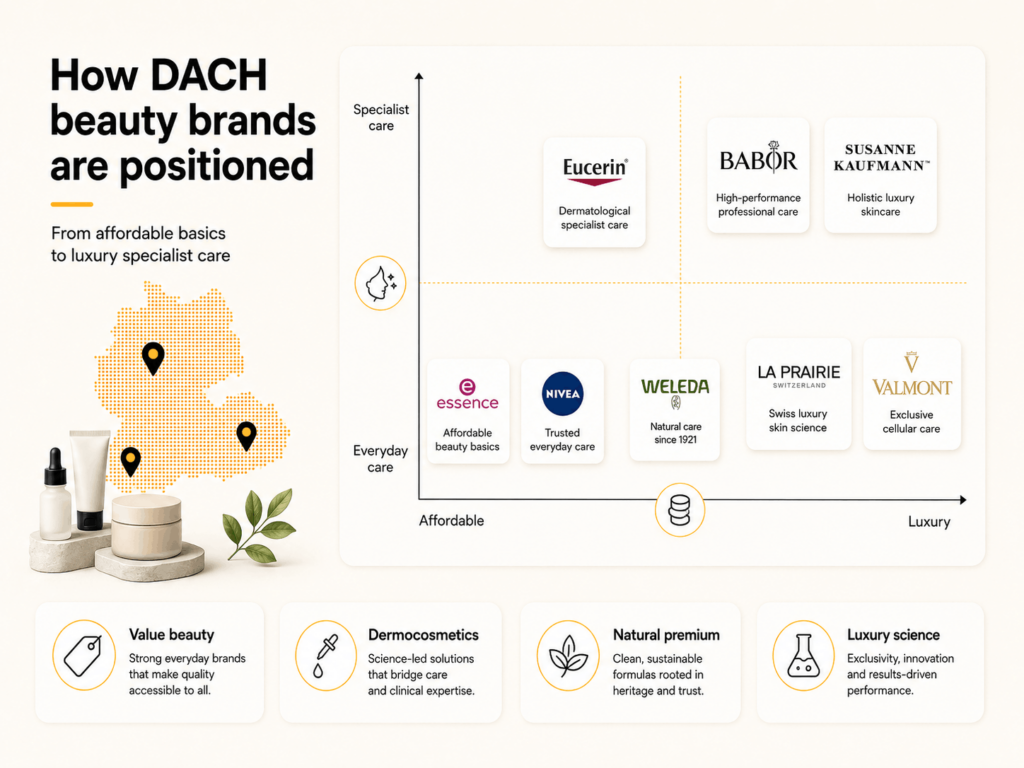
Nivea is one of Germany’s most recognisable skincare brands and a flagship of Beiersdorf.
Its broad range spans face care, body care, sun protection, lip care and family-oriented everyday skincare. Nivea remains relevant because it combines mass-market accessibility with global recognition and extensive drugstore, supermarket and ecommerce availability.
The brand is also an example of how established DACH beauty brands are adapting to more demanding sustainability expectations. Beiersdorf introduced EcoBeautyScore labeling for Nivea face-care products, with 99% of the relevant assortment receiving A or B ratings in 2025.
Best for: Mass-market skincare, body care, sun care and household familiarity.
2. Eucerin
Eucerin sits in a different part of the Beiersdorf portfolio from Nivea.
It is a dermocosmetics brand built around skin concerns such as dryness, pigmentation, acne, sun protection and ageing. Its positioning is more clinical and pharmacy-led, which gives it a strong role in a region where dermatological credibility matters.
Eucerin’s growth also shows the strength of derma beauty in DACH and globally. Beiersdorf reported double-digit growth in its Derma segment during 2025.
Best for: Pharmacy beauty, sensitive skin, targeted skincare and science-led routines.
3. Babor
Babor is a German professional skincare brand with strong salon, spa and premium retail positioning.
The brand is best known for ampoules, active skincare, facial treatments and a results-led approach to skin concerns. It occupies a useful middle ground between classic luxury beauty and professional cosmetics.
Babor works especially well for customers who want a more structured routine without moving fully into ultra-luxury skincare territory.
Best for: Professional skincare, ampoules, salon-grade routines and treatment-led beauty.
4. Essence
Essence is one of Germany’s best-known affordable makeup brands.
It has built its position around accessible pricing, trend-led launches and products designed for experimentation. Mascara, lip products, nail products and seasonal makeup collections are central to its appeal.
Essence matters because DACH beauty is not only about premium serums and prestige counters. Affordable cosmetics remain a powerful entry point for younger shoppers and frequent beauty buyers.
Best for: Affordable makeup, trend-led launches and accessible experimentation.
5. Artdeco
Artdeco is a German makeup brand known for accessible premium positioning.
Its refillable eyeshadow systems, complexion products and broad colour cosmetics range have helped it build recognition among both everyday shoppers and professional users. The brand sits above entry-level drugstore makeup without requiring full prestige pricing.
Artdeco is also a good example of how modular products can support repeat purchase and personalised beauty routines.
Best for: Customisable colour cosmetics, affordable premium makeup and refill systems.
6. Schwarzkopf Professional
Schwarzkopf Professional is one of Germany’s strongest professional haircare names.
It is especially relevant in salon colour, styling and treatment products. The brand sits within Henkel’s Beauty Care portfolio and is designed around hairdressers, salon education and professional-grade performance.
For ecommerce, haircare brands such as Schwarzkopf Professional show why product education matters. Colour, hair type, compatibility and technical instructions all influence conversion and returns.
Best for: Professional hair colour, salon care and styling products.
7. Kryolan
Kryolan is a Berlin-rooted professional makeup brand with a strong identity in theatre, film, television, drag artistry and stage performance.
It is not designed around viral launches or mass-market beauty trends. Its strength lies in pigmentation, durability, specialist colour products and professional credibility.
Kryolan remains relevant because it serves a specific audience exceptionally well. It is a reminder that niche authority can be more valuable than trying to appeal to everyone.
Best for: Stage makeup, professional artistry, bold pigment and performance makeup.
8. Dr. Barbara Sturm
Dr. Barbara Sturm is a German luxury skincare brand built around science-led positioning, minimalist routines and high-end pricing.
The brand is strongly associated with anti-inflammatory skincare narratives, premium formulations and celebrity visibility. It has become particularly relevant in prestige beauty, clinics, luxury retailers and global DTC skincare.
Its importance in DACH comes from the way it combines German medical-brand cues with international luxury positioning.
Best for: Prestige skincare, premium routines and clinical-luxury positioning.
9. gitti
Berlin-based gitti began with plant-based nail colour and expanded into conscious beauty products.
Its visual identity, ingredient transparency and sustainability-led messaging appeal to customers who want modern beauty without the highly clinical feel of dermocosmetics or the traditional packaging of legacy brands.
gitti is not a market-scale player like Nivea or Eucerin. It is more useful as an example of how smaller DACH beauty brands can build loyalty through a clear point of view.
Best for: Nail products, conscious beauty positioning and minimalist branding.
10. Bilou
Bilou is a German body-care brand known for playful scents, colourful packaging and a younger target audience.
Its range includes shower foam, body sprays and body-care products. It is a lighter, sensory-driven counterpoint to the clinical and premium brands elsewhere in this list.
Bilou shows that fun and product experience still matter in DACH beauty, especially in accessible body care.
Best for: Younger shoppers, body care, gifting and scent-led routines.
Best Austrian beauty brands
11. Ringana
Ringana is one of Austria’s most distinctive beauty and wellness brands.
It is known for its “fresh cosmetics” positioning, direct-sales model and wider portfolio covering skincare, supplements and wellness products. Ringana says its roots lie in fresh cosmetics and that it later expanded into products such as CAPS, drinks and sports-related wellness lines.
The brand is particularly relevant because it sits at the intersection of beauty, wellness and sustainability-led consumer behaviour.
Best for: Fresh skincare, supplements, wellness and direct-sales beauty.
12. Susanne Kaufmann
Susanne Kaufmann is an Austrian luxury skincare brand based in Bezau.
Its formulas are closely connected to Alpine botanicals, spa heritage and natural ingredients sourced around the Bregenzerwald region. The brand positions itself around holistic skincare, local ingredient stories and results-led wellness.
Susanne Kaufmann is a strong fit for premium customers who want luxury skincare with a more natural and ritual-led aesthetic.
Best for: Luxury natural skincare, spa-inspired routines and Alpine ingredients.
13. Team Dr Joseph
Team Dr Joseph is an Alpine skincare brand with roots in South Tyrol and strong relevance across the Austrian and German-speaking wellness market.
It focuses on professional skincare, treatments and natural active ingredients. The brand often appears in spas, hotels and professional beauty settings, which strengthens its credibility beyond standard ecommerce retail.
Best for: Spa skincare, professional treatments and Alpine wellness positioning.
Best Swiss beauty brands
14. La Prairie
La Prairie is one of Switzerland’s best-known luxury skincare brands.
It is strongly associated with Swiss precision, high-end anti-ageing formulas, caviar-based product lines and prestige beauty retail. Its positioning is unmistakably premium, with a customer proposition built around service, luxury textures and high-AOV skincare.
La Prairie is not a volume brand. It is a benchmark for how Swiss beauty translates science, craftsmanship and exclusivity into a luxury customer experience.
Best for: Ultra-premium skincare, luxury gifting and high-end anti-ageing routines.
15. Valmont
Valmont is a Swiss luxury skincare house known for high-performance anti-ageing positioning and spa-oriented beauty.
It combines cellular skincare narratives with premium textures, high service standards and strong relevance in luxury hotels, spas and prestige beauty channels.
Valmont fits the same broader Swiss luxury ecosystem as La Prairie, but with its own treatment-led and skin-rejuvenation focus.
Best for: Luxury anti-ageing skincare, spa treatments and premium beauty retail.
16. Weleda
Weleda is often treated as a German brand, but it was founded in Switzerland and remains headquartered near Basel in Arlesheim.
The brand is known for natural skincare, baby care, body care and certified natural cosmetics. It also has deep historical roots in anthroposophic medicine and holistic wellbeing.
Weleda is particularly relevant because natural beauty remains an important part of DACH demand, especially when brands can combine ingredient transparency with strong retail availability.
Best for: Natural skincare, baby care, body care and holistic beauty.
17. Mavala
Mavala is a Swiss family business founded in 1959 and best known for nail, hand and cuticle care.
The brand is sold through pharmacies, perfumeries, department stores and online channels. Its relevance comes from category focus: it owns a clear space in nail care rather than trying to become a generic beauty brand.
Best for: Nail care, hand care and pharmacy-friendly beauty.
18. Swissline
Swissline is a science-led Swiss skincare brand with more than three decades of history.
Its positioning combines Swiss-made manufacturing, advanced skincare science, collagen-related formulas and treatment-led luxury skincare. The brand works across premium retail, hotels, spas and medical-aesthetic settings.
Swissline is particularly relevant for shoppers looking for results-oriented skincare without the exact heritage cues of La Prairie or Valmont.
Best for: Advanced skincare, collagen-focused routines and premium spa beauty.
19. NIANCE
NIANCE is a Zurich-based Swiss luxury skincare and longevity brand.
Its portfolio combines skincare with supplements and wellness products, anchored in its proprietary Swiss Glacier Complex and a broader longevity narrative. The brand positions itself around biotechnology, Alpine ingredients and anti-ageing support.
NIANCE is more niche than La Prairie or Weleda, but it is relevant to the growing overlap between beauty, wellbeing and longevity.
Best for: Luxury longevity skincare, supplements and Swiss biotech positioning.
20. Age Stop Switzerland
Age Stop Switzerland is a niche Swiss skincare brand focused on anti-ageing and premium treatment products.
It is more specialised than mainstream DACH beauty brands and is best understood as a regional premium player rather than a mass-market leader.
Its appeal comes from targeted product positioning, Swiss-origin branding and a focus on mature-skin concerns.
Best for: Swiss anti-ageing skincare and niche premium beauty.
21. Éblouir
Éblouir is a smaller Swiss dermo-cosmetics brand focused on skin repair and premium skincare.
It should not be placed in the same category as La Prairie or Valmont in terms of market scale. However, it is worth watching as an emerging Swiss player with a science-meets-skin-health positioning.
Best for: Emerging Swiss dermo-cosmetics and niche skincare discovery.
International beauty brands with strong DACH presence
Not every beauty brand popular in DACH is a DACH brand.
The following companies are important in German, Austrian and Swiss beauty retail, but they should be classified separately.
| Brand | Origin | Why it matters in DACH |
| MAC | United States | Professional colour cosmetics and department-store beauty |
| Benefit Cosmetics | United States | Brow products, mascara and playful prestige beauty |
| NYX Professional Makeup | United States | Affordable trend-led colour cosmetics |
| Rituals | Netherlands | Body care, home fragrance and gifting |
| Sephora Collection | France | Retailer-owned beauty products with broad DACH visibility |
| Kiehl’s | United States | Apothecary-inspired premium skincare |
| The Ordinary | Canada | Ingredient-led skincare and price transparency |
This distinction matters because local origin can influence brand storytelling, manufacturing perception, retailer partnerships and customer trust. But international brands still play an important role in the DACH beauty mix.
For category-wide context, see most popular online shopping categories in Germany and fashion retail trends in DACH.
Where DACH shoppers buy beauty products
Beauty purchasing in DACH is strongly omnichannel.
Customers may discover a brand on TikTok, compare ingredients on Google, check prices on a marketplace, visit a pharmacy or drugstore, test a product in-store and then reorder through an app.
| Retailer or channel | Why it matters |
| dm | Major drugstore reach, own brands and strong mobile relevance |
| Rossmann | Value-led beauty, personal care and private-label products |
| Douglas | Premium beauty, fragrance and prestige-brand discovery |
| Flaconi | Major online beauty retailer in Germany |
| Sephora | International beauty discovery and prestige makeup |
| Pharmacies | Key for dermocosmetics, SPF and sensitive-skin products |
| Marketplaces | Increasingly important for comparison, convenience and reach |
| Brand-owned stores | Critical for education, loyalty and high-margin DTC sales |
Retail visibility matters, but so does delivery and returns. Beauty may look simple to ship, yet damaged products, hygiene rules, shade mismatches and customer expectations still affect conversion. See top fulfilment centres and logistics operators in Germany and smart parcel lockers in DACH for the wider operational context.
Beauty ecommerce trends in DACH for 2026
Dermocosmetics keep gaining ground
Eucerin’s performance reflects a larger trend: customers increasingly look for products with clear skin-concern positioning, ingredient explanations and pharmacy credibility.
Acne, pigmentation, sensitive skin, barrier repair, SPF and anti-ageing remain strong areas for science-led beauty.
Drugstores remain essential
DACH beauty is not only a prestige market.
dm and Rossmann remain central because they combine accessibility, private labels, repeat purchase and everyday essentials. That makes them important for both established brands and new entrants.
Prestige brands need education, not only aspiration
Luxury skincare can still perform, especially in Switzerland and premium German cities. But high-priced products need stronger product pages, better customer service, visible ingredient stories and a clearer reason to trust the formulation.
Marketplaces increase price transparency
Customers can compare beauty prices quickly, especially for standardised products, fragrances and established brands.
That makes price comparison platforms in DACH increasingly relevant to beauty retailers with broad branded assortments.
Social discovery matters most in colour cosmetics and fragrance
Makeup, fragrance, body care and trend-led skincare are particularly suited to short-form video, creator collaborations and visual product education.
However, brands should not confuse social reach with long-term trust. Product quality, shade accuracy, claims and customer reviews still decide repeat purchase.
Sustainability claims need evidence
Natural ingredients, refill systems and conscious packaging can support beauty positioning. But broad claims such as “clean”, “natural” or “planet-friendly” need supporting detail.
Customers increasingly expect proof around ingredients, packaging, sourcing and product lifecycle.
What beauty brands can learn from DACH shoppers
| Customer expectation | What brands should do |
| Clear product relevance | Explain skin concern, ingredient role and routine fit |
| Trustworthy claims | Avoid vague promises and show evidence where possible |
| Local availability | Make retailer, pharmacy and delivery options easy to find |
| Good product data | Include ingredients, sizes, shades, directions and compatibility |
| Familiar payments | Support payment methods customers expect at checkout |
| Easy reordering | Build loyalty, replenishment and app-friendly experiences |
| Visual confidence | Use realistic product visuals, swatches and texture information |
| Transparent returns | Make hygiene-related return rules easy to understand |
For more on conversion and checkout expectations, see top payment providers in the DACH region and best online marketplaces in Germany.
FAQ: top beauty brands in DACH
What are the top beauty brands in Germany?
Some of the most relevant German beauty brands include Nivea, Eucerin, Babor, Essence, Artdeco, Schwarzkopf Professional, Kryolan, Dr. Barbara Sturm, gitti and Bilou.
Which Austrian beauty brands are worth knowing?
Ringana, Susanne Kaufmann and Team Dr Joseph are among the most relevant Austrian beauty brands. They are especially known for wellness-led positioning, Alpine ingredients and premium natural skincare.
What are the best Swiss skincare brands?
La Prairie, Valmont, Weleda, Mavala, Swissline, NIANCE and Age Stop Switzerland are among the notable Swiss beauty and skincare brands. Their positioning ranges from natural body care to luxury anti-ageing skincare.
Is Nivea a German brand?
Yes. Nivea is a German skincare brand owned by Beiersdorf and is one of the company’s best-known global brands.
Is Weleda German or Swiss?
Weleda was founded in Switzerland and remains headquartered in Arlesheim near Basel. It also has a long operational history and strong market presence in Germany.
Where do German shoppers buy beauty products online?
German shoppers buy beauty products through drugstore websites and apps, online beauty retailers, pharmacies, marketplaces and brand-owned ecommerce stores. dm, Rossmann, Douglas, Flaconi, Sephora and Amazon are important channels depending on the product category.
Which beauty categories are growing in DACH?
Dermocosmetics, sensitive-skin care, SPF, anti-ageing skincare, wellness-led beauty, haircare and prestige skincare remain important. Ecommerce also continues to grow as a beauty discovery and reordering channel.
Conclusion
The DACH beauty market is broad, but it is not random.
Germany provides scale, drugstore reach and dermocosmetics expertise. Austria brings premium natural and wellness-led beauty. Switzerland continues to set the standard in luxury skincare, science-led formulas and high-end treatments.
The strongest brands in the region are not necessarily the loudest.
They are the brands with a clear place in the customer’s routine: accessible everyday skincare, serious dermatological care, trusted salon products, credible luxury, natural body care or focused niche expertise.
For retailers and beauty brands entering DACH, the message is simple: define your category, explain your product clearly and give customers enough proof to trust the purchase.
***