European Ecommerce Overview: Albania
A clear look at Albanian e-commerce in 2026. Learn how consumers shop online, which platforms lead, how payments work, and where the market is heading.
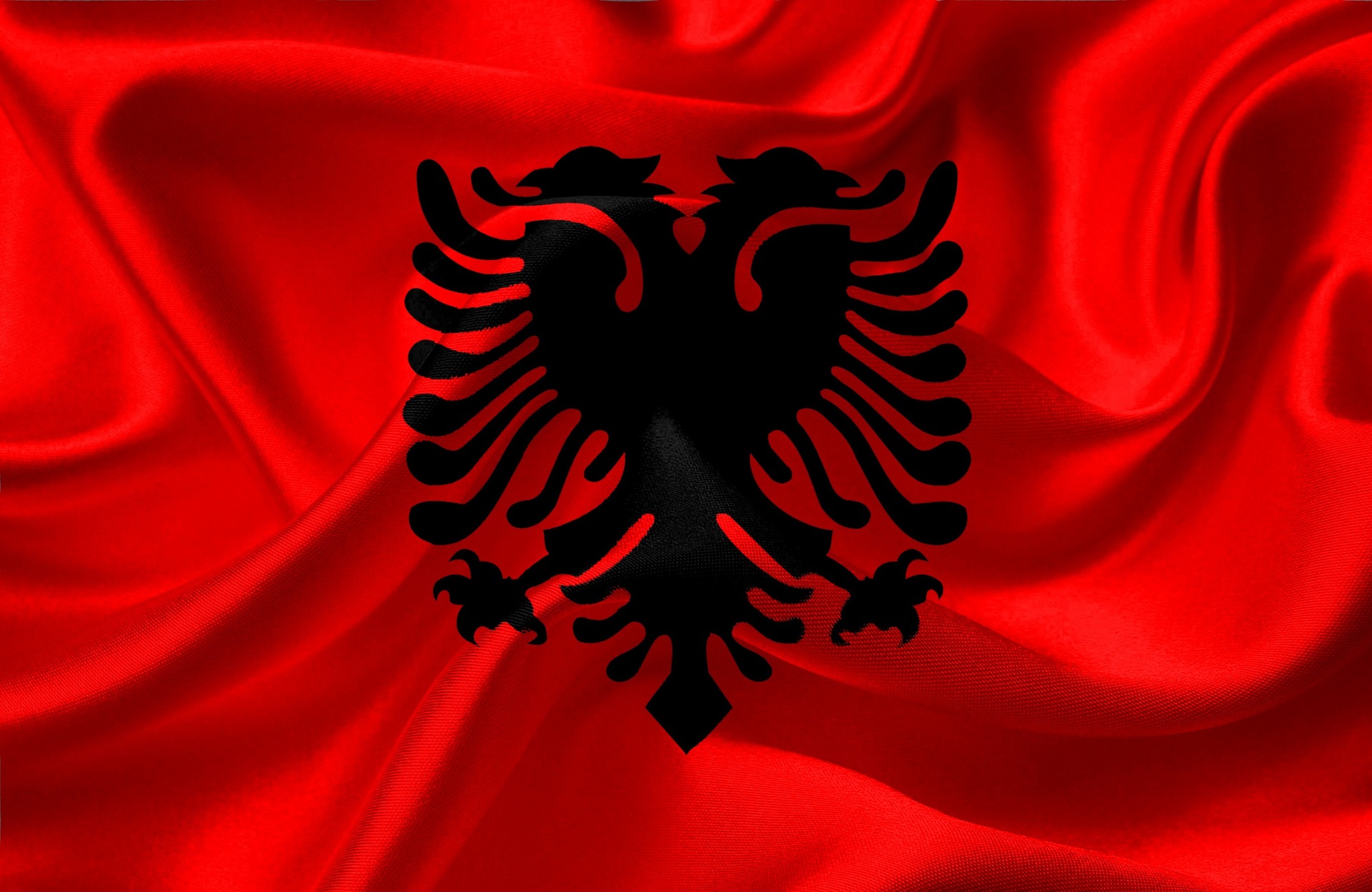
Albania is a Balkan country that has access to the Adriatic Sea. It borders Greece, Montenegro, North Macedonia, Serbia, and Kosovo. Albania is a member country of the UN, NATO, and WTO. Since 2014 it is one of the candidate countries for the European Union. And regarding this country’s e-commerce, it sits at an interesting point.
The basics are in place: strong internet access, heavy mobile use, and growing interest in buying online. At the same time, habits shaped by cash payments, cross-border shopping, and uneven logistics still influence how fast the market moves.
Below you will find information about Albanian e-commerce, consumer preferences, and which internet markets are worth entering.
Albanian e-commerce overview
Albanian e-commerce feels like a market that’s finally getting the “ingredients” lined up — more people online, more shopping on phones, and payments slowly getting less old-school. By the end of 2025, about 88.4% of Albania’s population (≈ 2.45 million people) used the internet. Moreover, mobile is basically everywhere too: 3.49 million mobile connections (about 126% of the population). It’s a solid starting point for any e-commerce market narrative.
But here’s the twist: while many Albanians are online, relatively few are buying there. According to Eurostat figures, only around 37.52% of Albanians reported purchasing goods or services online in 2024, which places Albania well below most of Europe.
That gap between “connected” and “shopping online” tells you a lot about the market’s character. There’s clear momentum, but structural frictions (like trust in digital payments, logistics, and cash habits) still hold things back. Eurostat also notes that online banking usage sits at just ~15%, signaling that many people are still more comfortable with cash than cards or digital wallets.
From a market size perspective, global research firms paint Albania’s e-commerce market — often defined as online merchandise and services sales — as steadily expanding:
- One forecast sees the market reaching around 0.72 billion in 2026, on a path toward 1.33 billion by 2031 (≈13 % CAGR from 2026).
- Another analysis puts the 2024 market value at about 581 million and projects it to grow toward almost 1.5 billion by 2032 (~12.4% annual growth).
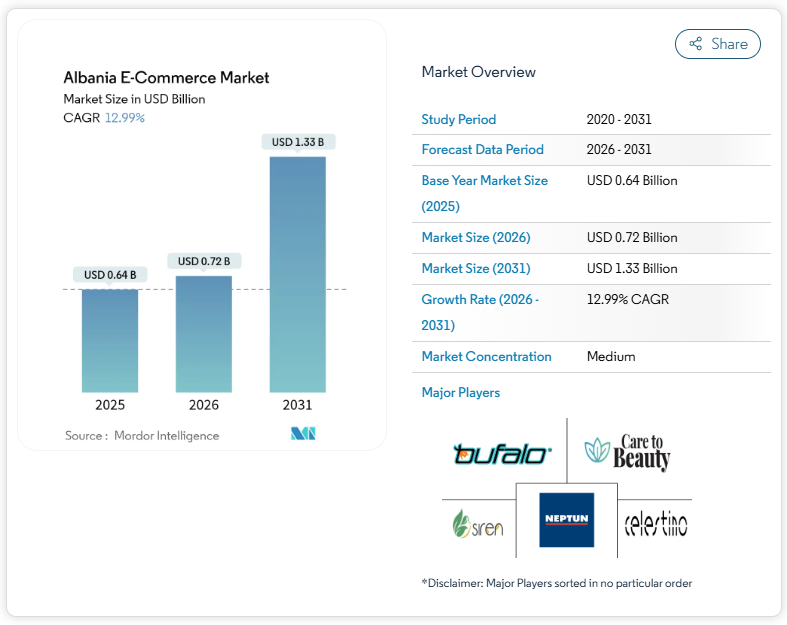
Mobile devices already dominate the shopping scene — roughly 71% of transactions in 2025 came from smartphones, reflecting both where people spend their digital lives and the way merchants optimize checkout experiences.
Finally, official economic stats point to e-commerce’s rising influence on the macro economy: more than 10% of Albania’s total retail turnover was generated online in 2025, up modestly from the year before.
Consumer behavior in Albania
Albanian consumers pay attention to the price, which determines purchasing choices to the greatest extent. Albanians are actively looking for promotions and are willing to use them. They are very much influenced by advertising, especially TV ads. After-sales services, just like e-commerce, are just getting started.
On the product side, categories that show up as the most commonly bought online are:
- Fashion (91%)
- Consumer electronics or household appliances (25.81%)
- Cosmetics (32.82%)
As you see, fashion dominates in Albanian e-commerce with 91% of online shoppers having bought clothes or accessories recently, and strong cross-border interest because local assortments are still limited.
But what’s behind these numbers tells you more about behavior than the raw stats. The big patterns stand out:
- Young, mobile-first consumers lead the charge. Younger Albanians are much more likely to shop online, and smartphone shopping accounts for over 60–70% of e-commerce purchases. That means browsing on Instagram or TikTok often leads organically to buying — social feeds are less window-shopping and more checkout events.
- Convenience drives cross-border buys. Many local stores still have limited assortments, so Albanian shoppers routinely turn to international e-commerce platforms for variety — from Western European fashion to tech gadgets that aren’t widely stocked at home. That trend isn’t just about desire for brands; it’s about access and comparative pricing online.
Thus, personalisation, social-first marketing, international shipping options, and flexible payment choices are all more than nice-to-haves now. For many Albanian consumers, they unlock the decision to click “buy.”
Payment methods in Albania
There’s a wrinkle most global success stories don’t face here: payment preferences.
Cash-on-delivery still leads as the primary payment method in Albanian online shopping, and card/digital wallet use remains relatively low. Growth in POS and card transactions (e.g., 12.5 million card payments at POS in H1 2025 — up 42% YoY) shows greater overall digital payment activity, but it doesn’t yet fully translate into seamless online checkout behaviour.
Behind that headline figure is a bit of a paradox: digital payments are growing quickly, but their share is still small compared with COD. Digital wallets and online payment options are the fastest-growing segment — with projected double-digit annual growth — but they’re starting from a low base.
At the same time, card and electronic usage is on the rise in the broader economy. The Bank of Albania reports record increases in electronic banking transactions, with about 5 million home banking transfers in H1 2025 and 12.5 million card payments at POS terminals over the same period (up 22–42 % year-on-year). That doesn’t mean online card payments have caught up with COD, but it does show Albanians are adopting digital financial tools in everyday life.
Another emerging trend is the development of modern payment infrastructure — such as AECH and instant payment rails — which make real-time transfers and digital wallet integration easier. These systems, supported by banks and fintechs, are essentially building the plumbing needed for more seamless online checkouts in the future.
Social media in Albania
Social media remains a major part of everyday digital life in Albania, with about 1.35 million active social media user identities in October 2025 — roughly 48.8% of the total population engaged on at least one platform by late 2025.
When it comes to platform leadership, the landscape looks a bit different from many other European markets:
- Facebook still dominates in overall reach and usage, counting well over 2 million users in early 2026 — making it the most widely present network among all age groups and demographics in Albania.
- Instagram follows as the second major social platform, with roughly 1.4 million users, especially popular with younger adults and urban audiences.
- LinkedIn and Messenger also have strong bases (hundreds of thousands of accounts) and are widely used for networking and communication.
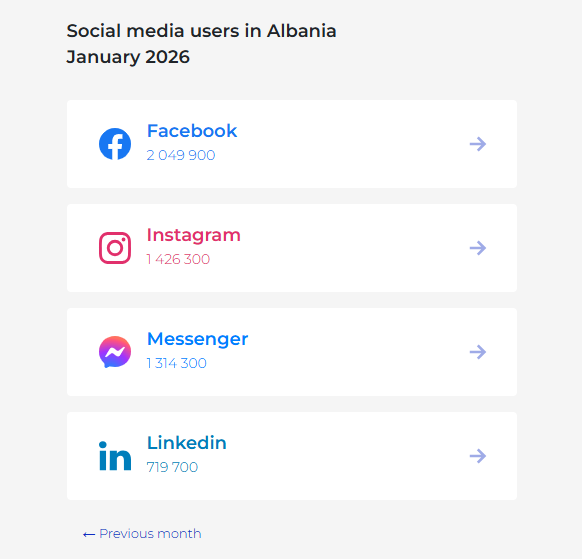
Other networks like Twitter, Pinterest, and YouTube as a social sharing destination have much smaller formal advertising reach figures according to one aggregated data source, though YouTube content consumption remains widespread informally.
A notable recent development in 2026 is the lifting of Albania’s temporary TikTok ban that had been in place — officially ending an 11-month restriction on the short-video platform.
In terms of user behaviour, social platforms are used for everything from news and sports updates to lifestyle and entertainment — with some demographic splits showing men more engaged with news content and women with lifestyle posts.
Overall, Facebook and Instagram remain the primary platforms for reach and engagement in Albania’s social ecosystem going into 2026, with broader digital participation continuing to grow alongside broader internet penetration.
Albanian logistics
Albania’s logistics ecosystem has been evolving steadily alongside its growing e-commerce market. The country’s road and transport infrastructure improvements — like the new Drini Bridge on the A1 motorway and expanded highways — are gradually making inland transport more reliable and faster, which is crucial for last-mile delivery outside major cities.
Physical logistics assets are also maturing. For example, Tirana Logistic Park — a major warehousing and distribution hub near Tirana and the Port of Durrës — offers modern “Class A” storage and distribution space positioned to serve both domestic delivery networks and international freight arriving by sea and rail.
Despite these improvements, Albania’s logistics still reflects its small market size and geographic hurdles. Delivery times and costs remain higher than in larger European markets, and “last-mile” coverage is uneven outside Tirana and other urban centers. Cross-border delivery often depends on partnerships between local couriers and international carriers, especially to improve speed and reliability for imported goods.
One promising development for e-commerce is the rise of parcel locker networks and automated pickup points — solutions that reduce failed delivery attempts and help lower costs for both merchants and consumers. Adoption of these smart lockers (including BOPIS-style systems) is increasing in densely populated areas, and some pilot efforts aim to extend them to secondary cities.
Legally and operationally, the postal system and regulated courier services in Albania are adapting rules for online retail delivery, with the public postal regulator clarifying terms under Albanian e-commerce law.
Over to you
Albanian e-commerce is not a newbie anymore. Consumers are online, mobile-first, and curious, even if habits like cash-on-delivery and cross-border shopping still shape how they buy.
Payments are slowly shifting toward cards and digital tools, logistics is improving with better roads, warehouses, and delivery models, and social media — led by Facebook and Instagram — keeps driving discovery and trust. The picture that emerges isn’t one of a fully mature market, but of one that’s laying solid groundwork.
If you are interested in other Balkan countries here, you can read about Croatia and Romania.