Top 50 Fashion Shops, Brands and Marketplaces in Germany in 2026
Explore 50 leading fashion shops, brands and marketplaces in Germany, from Zalando and Amazon to luxury, sportswear and secondhand platforms.
Germany’s online fashion market is too diverse for one simple ranking.
Amazon and Zalando compete through scale. Shein and Temu push prices down. Mytheresa and Breuninger serve premium customers. Adidas, Nike and Snipes blur the line between performance clothing and streetwear. Vinted, Sellpy and momox fashion have made used clothing part of mainstream online shopping.
This guide maps 50 fashion shops, brands and marketplaces relevant to German consumers in 2026.
It is not a revenue ranking. The companies are grouped according to their role in the market, making it easier to compare platforms with similar customers, products and business models. For a strictly data-based comparison, see our ranking of the top 20 clothing retailers in Germany.
Methodology
The list combines companies with a significant online presence, consumer recognition or strategic influence in Germany. Inclusion does not indicate endorsement, and the order within each category should not be read as a precise revenue ranking.
German fashion e-commerce at a glance
| Metric | Latest figure |
| Estimated German fashion e-commerce revenue | $30.85 billion |
| Data period | 2025 |
| Forecast market growth in 2026 | 5–10% |
| Apparel share of fashion e-commerce | 71% |
| Estimated online share of the wider fashion market | 35–40% |
| Leading online clothing retailers by GMV | Amazon, Zalando and Shein |
| Largest dedicated fashion platform | Zalando |
| Largest online fashion category | Apparel |
ECDB estimates that German fashion e-commerce generated approximately $30.85 billion in 2025 and forecasts another 5–10% change in 2026. Its definition includes apparel, footwear, bags and accessories.
A separate HDE methodology places German online fashion and accessories revenue at €21.2 billion for 2025. The figures should not be compared directly because the organisations use different currencies, market definitions and data models. Our collection of 100+ Germany e-commerce statistics for 2026 explains the differences in more detail.
The German online fashion market is becoming more concentrated
Germany’s online fashion market returned to growth, but expansion has not been distributed evenly.
KPMG reported that the German online fashion segment grew only 0.1% in 2024, even as the wider online retail market began recovering. Its analysis identified virtual fitting, personalised size recommendations and AI-supported styling as increasingly important competitive features.
At the same time, the largest platforms are gaining more influence.
Amazon, Zalando and Shein lead the current Ecommerce Germany ranking of online clothing retailers by GMV. Amazon generated an estimated $5.75 billion, Zalando $4.42 billion and Shein $2.74 billion.
This concentration is visible beyond fashion. Amazon, Otto and Zalando remain central to the top 100 online stores in Germany, while Shein has entered the overall top tier.
The middle of the market faces the greatest pressure. Traditional retailers may be too expensive to match ultra-low-price platforms but insufficiently distinctive to command premium prices.
Top fashion shops in Germany by market role
| Category | Companies included |
| Major marketplaces and multi-brand platforms | 10 |
| German and DACH fashion retailers | 10 |
| International high-street and value brands | 10 |
| Sportswear, sneakers and streetwear | 8 |
| Premium and luxury fashion | 6 |
| Secondhand and sustainable fashion | 6 |
| Total | 50 |
Major fashion marketplaces and multi-brand platforms
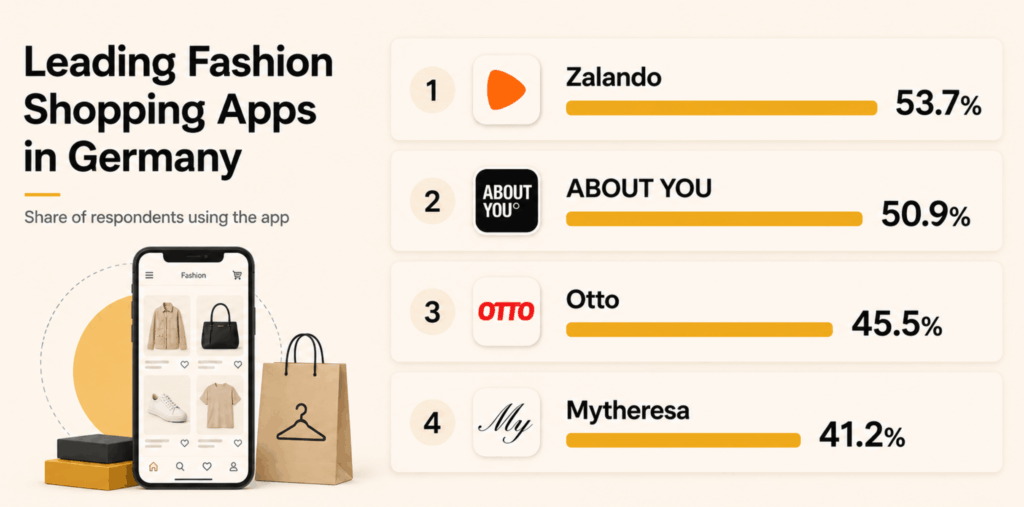
These platforms compete primarily through scale, assortment, convenience, recommendations or access to discounted inventory.
1. Zalando
Zalando remains Germany’s most important dedicated fashion platform.
Its assortment covers clothing, footwear, sportswear, accessories, beauty, designer labels and children’s products. The business combines its customer-facing shop with partner inventory, logistics services, advertising products and software for fashion brands.
Zalando’s role therefore extends beyond selling products to consumers. It also provides infrastructure that helps brands reach customers and fulfil orders across Europe.
Its integration of ABOUT YOU has expanded the group’s reach among younger, app-led and inspiration-focused shoppers. Read more about Zalando’s recent results, AI investments and growth strategy.
Best known for: scale, brand selection and fashion-specific product discovery.
2. Amazon Fashion
Amazon is Germany’s largest online retailer and currently leads the country’s online clothing ranking by estimated GMV.
Its fashion advantage comes from convenience rather than curation. Customers can purchase clothing alongside electronics, beauty products, homeware and groceries, often using the same Prime delivery account.
The marketplace carries products from established brands, independent sellers, private labels and international merchants. That range is valuable, but presentation, sizing information and seller quality can vary considerably.
Amazon’s wider position is covered in our guide to the best online marketplaces in Germany.
Best known for: convenience, selection and Prime delivery.
3. ABOUT YOU
ABOUT YOU focuses more heavily on outfits, creators, personalisation and visual discovery than many conventional online shops.
Its interface is designed around inspiration as much as direct product search. The platform has built a particularly strong presence among younger consumers who discover clothing through apps, influencers and social content.
ABOUT YOU became part of Zalando Group in 2025, although the two brands continue to operate as separate consumer propositions.
Best known for: mobile discovery, creator collaborations and personalisation.
4. Otto
Otto is one of Germany’s longest-established online retail names.
Fashion sits alongside furniture, electronics, household products and other categories. The platform benefits from strong recognition among German consumers and from Otto Group’s wider retail, logistics and payment operations.
Its fashion offer is especially relevant to mainstream, family and mid-market shoppers who prefer dealing with a familiar domestic retailer.
Best known for: local trust and broad household shopping.
5. Shein
Shein has become one of Germany’s largest online clothing retailers through low prices, a vast assortment and extremely rapid product turnover.
Its app-led model encourages frequent browsing and uses personalised feeds, promotions and constant new arrivals to drive repeat visits. It is particularly influential among younger and highly price-sensitive consumers.
Shein ranks third in Ecommerce Germany’s current online clothing comparison, behind Amazon and Zalando.
Best known for: ultra-fast fashion, low prices and mobile-first discovery.
6. BestSecret
BestSecret operates a members-only, off-price fashion model focused on premium and designer inventory.
The platform uses exclusivity, limited availability and restricted access to distinguish itself from conventional outlet stores. Its proposition suits shoppers looking for recognisable brands at lower prices without moving into secondhand fashion.
Best known for: members-only premium discounts.
7. Zalando Lounge
Zalando Lounge is Zalando’s campaign-based off-price service.
Rather than offering a permanent catalogue, it organises products around time-limited sales. Inventory and brands change frequently, giving shoppers a reason to return even when they are not searching for a specific item.
Best known for: limited-time sales and discounted branded fashion.
8. Limango
Limango combines private-sale campaigns with family-focused fashion and lifestyle shopping.
The platform is part of Otto Group and is particularly relevant for children’s clothing, footwear, women’s fashion and household products. Its time-limited promotions distinguish it from Otto’s conventional marketplace model.
Best known for: discounted family and children’s products.
9. Veepee
Veepee uses flash sales to distribute discounted inventory from fashion and lifestyle brands.
Its campaigns are temporary and typically require registration. Like BestSecret and Zalando Lounge, Veepee relies on scarcity and urgency rather than a stable permanent assortment.
Best known for: campaign-led brand discounts.
Marketplace requirements differ considerably. A premium brand may evaluate Zalando or BestSecret, while a high-volume value seller may prioritise Amazon or Temu. Our German marketplace comparison covers the major platforms in more detail.
German and DACH fashion retailers
These companies have strong roots in Germany or the wider German-speaking market. Many began in mail order, department stores or physical retail before developing large e-commerce operations.
10. Bonprix
Bonprix is a Hamburg-based retailer focused on affordable fashion and broad size availability.
Its range covers women, men and children, together with accessories and selected home products. The company has built a recognisable proposition around accessible styling, value and practical fit.
Best known for: affordable clothing and inclusive sizing.
11. Breuninger
Breuninger combines premium department-store heritage with a sophisticated online operation.
Its assortment includes contemporary fashion, designer labels, footwear, accessories and beauty. It occupies a useful position between large mass-market platforms and highly selective luxury retailers.
Best known for: premium multi-brand fashion and service.
12. C&A
C&A remains one of the most recognisable mainstream fashion chains in Germany.
It serves women, men and children, with particular strength in basics, denim, underwear and family clothing. Its online store supports an extensive physical network, allowing customers to combine digital browsing with store collection and returns.
Best known for: affordable family clothing and everyday basics.
13. s.Oliver
s.Oliver is a German casual-fashion group operating in the broad middle of the market.
The company offers everyday clothing, accessories and footwear through direct stores, e-commerce and wholesale partners. Its position illustrates the pressure facing established mid-priced retailers as shoppers move towards either lower prices or more distinctive premium products.
Best known for: mainstream casualwear.
14. Marc O’Polo
Marc O’Polo sits at the premium end of casual fashion.
The brand is associated with understated design, knitwear, natural-looking materials and a clean Northern European aesthetic. It combines direct-to-consumer e-commerce with stores and wholesale distribution.
Best known for: premium casual clothing.
15. New Yorker
New Yorker targets younger shoppers through trend-led clothing, casualwear and a large physical-store network.
Its brand recognition remains strongly connected to stores, but its influence extends to the online market through youth culture, social media and price expectations.
Best known for: accessible youth fashion.
16. Peek & Cloppenburg
Peek & Cloppenburg operates large multi-brand stores and an online shop covering mainstream and premium fashion.
The assortment includes businesswear, occasion clothing, casual fashion and international labels. Its main strength is the ability to connect department-store service with online ordering.
Best known for: multi-brand fashion and occasionwear.
17. Deichmann
Deichmann is one of Germany’s dominant footwear retailers.
Its online store covers affordable shoes for women, men and children, along with selected branded sports and lifestyle footwear. A broad physical network gives customers convenient access to collection and returns.
Best known for: value footwear and extensive store coverage.
18. Tchibo
Tchibo is not a dedicated fashion retailer, but rotating clothing collections are an established part of its commercial model.
Weekly assortments regularly include underwear, basics, activewear, outerwear and seasonal products. The limited-time structure gives apparel a discovery element not found in a fixed catalogue.
Best known for: rotating value collections.
19. Ernsting’s family
Ernsting’s family focuses on affordable clothing for women, children and families.
Its physical stores provide strong local reach, while the online shop supports broader assortments, click-and-collect and convenient returns.
Best known for: family and children’s clothing.
Several of these businesses also appear among Germany’s largest online retailers outside fashion. The top German online shops by revenue show how specialised apparel retailers compare with marketplaces, electronics stores and pharmacies.
International high-street and value fashion brands
These international brands operate German stores, local e-commerce sites or both.
20. H&M
H&M is one of Germany’s most visible international fashion chains.
Its range covers women, men and children across entry and mid-range price points. The company combines a large physical presence with e-commerce, loyalty benefits and access to related H&M Group brands.
Best known for: mainstream fast fashion and family reach.
21. Zara
Zara competes through frequent collection updates and a close connection between stores and online inventory.
Its German online shop supports store collection and returns, while its pricing and presentation generally sit above the ultra-low-price segment occupied by Shein.
Best known for: rapid interpretation of fashion trends.
22. Uniqlo
Uniqlo has a smaller German store network than H&M or Zara but offers a more distinctive product proposition.
Its range centres on functional basics, technical fabrics, lightweight outerwear and long-running product lines rather than constant trend replacement.
Best known for: minimalist basics and technical materials.
23. Mango
Mango provides mainstream fashion with a polished, Mediterranean-influenced identity.
Its assortment includes women’s and men’s clothing, tailoring, occasionwear and accessories. It competes most directly with Zara and the more fashion-led parts of H&M.
Best known for: polished high-street fashion.
24. Bershka
Bershka is an Inditex brand aimed primarily at younger consumers.
Its collection is more casual, trend-driven and streetwear-influenced than Zara’s. A local online store gives it national reach beyond its physical locations.
Best known for: youth-oriented fast fashion.
25. Pull&Bear
Pull&Bear combines denim, graphic clothing and relaxed street-inspired fashion.
The brand targets a similar customer to Bershka but tends to use a more casual, lifestyle-led presentation.
Best known for: casual youth clothing.
26. Stradivarius
Stradivarius focuses mainly on women’s fashion and accessories.
Within the Inditex group, it occupies a position between highly youthful fast fashion and more polished mainstream styling.
Best known for: accessible women’s trends.
27. Massimo Dutti
Massimo Dutti targets a more mature and higher-spending customer than the other major Inditex brands.
Its offer includes tailoring, knitwear, leather goods, footwear and understated wardrobe pieces.
Best known for: elevated high-street clothing and workwear.
28. Reserved
Reserved is the main fashion brand of Polish retail group LPP.
Its German range covers women, men and children, positioning it as a broad European alternative to H&M, C&A and Zara.
Best known for: accessible European high-street fashion.
29. Primark
Primark remains predominantly store-led, but it has a significant influence on German value fashion.
The company prioritises large physical stores and low prices rather than conventional nationwide e-commerce. Its pricing still shapes online expectations because customers compare digital offers with what they can find in Primark stores.
Best known for: low prices and large destination stores.
Fashion remains Germany’s largest online retail category. Our guide to the most popular categories for online purchases in Germany shows how apparel compares with electronics, beauty, groceries and home products.
Sportswear, sneakers and streetwear shops
Sportswear, sneakers and everyday fashion increasingly overlap. The following retailers compete across performance, lifestyle and youth culture.
30. Adidas
Adidas is one of Germany’s most important international consumer brands.
Its direct online shop covers running, football, training, outdoor products and lifestyle collections. Memberships, exclusive releases and collaborations help the company build direct customer relationships rather than relying entirely on wholesale partners.
Best known for: sportswear, football and lifestyle sneakers.
31. Nike
Nike operates a strong direct-to-consumer business in Germany alongside wholesale distribution.
Its digital range includes running, training, football, Jordan products and lifestyle footwear. Member access and limited releases play an important role in its app and e-commerce strategy.
Best known for: global sportswear and sneaker demand.
32. Puma
Puma is another German-founded sportswear business with international reach.
Its German online store combines football, running and training products with motorsport partnerships, collaborations and lifestyle footwear.
Best known for: sports-lifestyle crossover.
33. JD Sports
JD Sports is a multi-brand sneaker and sports-fashion retailer.
Its German assortment includes Nike, Adidas, Puma, New Balance and Jordan. Online ordering is supported by a growing physical-store network.
Best known for: branded sneakers and youth sportswear.
34. Snipes
Snipes is closely associated with streetwear, sneaker culture and music-led branding.
Its range includes major sports brands alongside its own collections. The company serves a younger and more culture-focused audience than traditional sporting-goods retailers.
Best known for: streetwear and sneaker culture.
35. Foot Locker
Foot Locker focuses on athletic footwear, sneaker launches and sports-inspired apparel.
Its German operation combines urban stores with online ordering and access to major international footwear brands.
Best known for: sneaker retail.
36. SportScheck
SportScheck is a recognised German sports retailer whose assortment extends beyond fashion into equipment.
Sportswear, outdoor clothing and footwear remain important parts of its e-commerce offer.
Best known for: broad sports and outdoor selection.
37. Blue Tomato
Blue Tomato specialises in skate, snow, streetwear and action-sports products.
It serves a more defined community than mainstream sports retailers, with fashion closely connected to skateboarding, snowboarding and outdoor culture.
Best known for: skate and snow fashion.
Mobile discovery is particularly important in sportswear and sneaker retail. Membership apps, launch alerts, wishlists and personalised product feeds keep customers within a retailer’s ecosystem. See our analysis of the top fashion apps in Germany and the wider ranking of shopping apps in Germany.
Premium and luxury fashion retailers
Germany’s luxury retail market is spread across several cities rather than concentrated in one capital.
Munich, Berlin, Düsseldorf, Hamburg and Frankfurt serve different premium audiences. E-commerce helps luxury retailers reach affluent consumers outside these physical centres. German buyers also tend to value quality, discretion and long-term utility rather than highly visible trend consumption.
38. Mytheresa
Mytheresa is one of Germany’s most internationally recognised luxury e-commerce businesses.
Its assortment focuses on designer clothing, bags, shoes and accessories. The platform competes through curation, exclusive collections and premium service rather than marketplace scale.
Best known for: curated international luxury fashion.
39. Hugo Boss
Hugo Boss is a major German premium brand with a developed direct online operation.
Its BOSS and HUGO labels cover formalwear, workwear, casual clothing, footwear and accessories.
Best known for: premium tailoring and businesswear.
40. Farfetch
Farfetch gives German shoppers access to designer products from boutiques and brand partners in multiple countries.
Its marketplace model provides an unusually large range, although fulfilment and returns can vary according to the partner supplying the product.
Best known for: global luxury marketplace inventory.
41. Net-a-Porter
Net-a-Porter is a curated luxury platform focused on women’s designer fashion.
Its editorial presentation and selective assortment position it closer to a digital luxury department store than to an open marketplace.
Best known for: luxury womenswear and editorial commerce.
42. Engelhorn
Engelhorn is a German premium retailer with department-store roots.
Its online assortment covers designer fashion, footwear, sportswear and lifestyle products.
Best known for: premium multi-brand retail with regional heritage.
43. Lodenfrey
Lodenfrey is a Munich-based premium and luxury retailer.
Its assortment combines international designers with traditional Alpine and German clothing categories, giving it a more distinctive identity than many global luxury platforms.
Best known for: luxury fashion and traditional premium clothing.
Premium retailers face different expectations around presentation, packaging, personal service and cross-border fulfilment. Our analysis of luxury and premium e-commerce across DACH explores the role of AI personalisation, virtual try-ons and omnichannel service.
Secondhand and sustainable fashion platforms
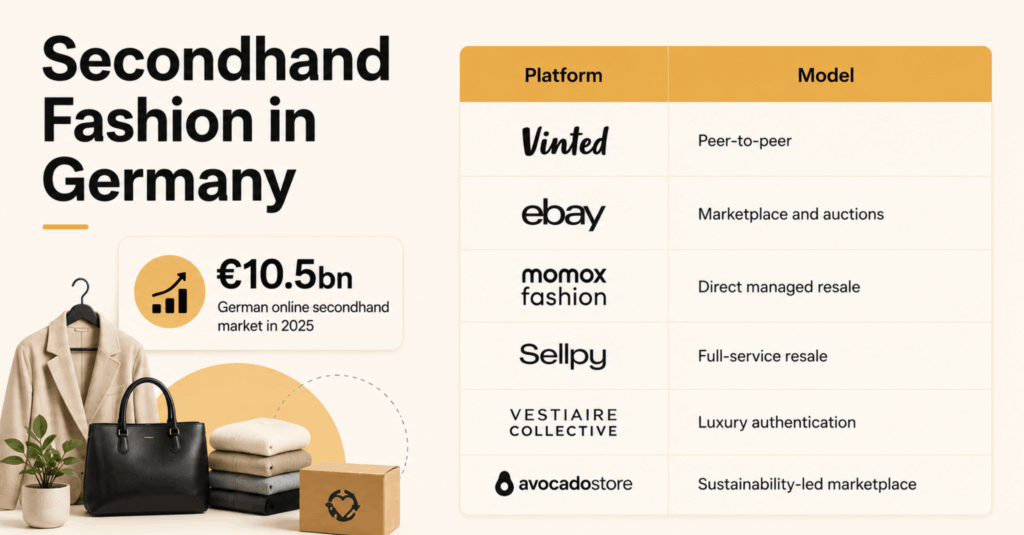
Secondhand fashion is now part of mainstream German e-commerce rather than a separate niche.
The wider German online secondhand market reached €10.5 billion in 2025, up from €5.7 billion in 2019. Books generate the largest category share, followed closely by fashion and accessories.
For the wider market context, read our guide to re-commerce in Germany.
44. Vinted
Vinted is one of Germany’s most prominent peer-to-peer fashion resale platforms.
Users list clothing, footwear and accessories and sell them directly to other users. Its large inventory makes it particularly relevant to affordable everyday fashion rather than only luxury resale.
Best known for: peer-to-peer secondhand clothing.
45. eBay
eBay remains relevant to fashion resale because it combines private listings, professional sellers and auctions.
Its broad structure makes it useful for vintage products, sneakers, discontinued collections and accessories.
Best known for: broad resale inventory and auctions.
46. Momox Fashion
Momox Fashion uses a managed resale model.
Consumers sell clothing directly to the company instead of creating individual listings. Momox then handles inspection, product photography, storage and resale.
Best known for: convenient managed resale.
47. Sellpy
Sellpy manages most of the selling process for the customer.
Sellers send garments to the company, while Sellpy handles preparation, listings, storage, transactions and delivery.
Best known for: full-service secondhand selling.
48. Vestiaire Collective
Vestiaire Collective specialises in premium and luxury resale.
Its proposition includes a brand-focused catalogue and authentication services for eligible items, making it suitable for designer bags, footwear and higher-value clothing.
Vestiaire Collective has also expanded its reach through partnerships with major platforms. Read about the Zalando and Vestiaire Collective authenticated pre-owned fashion partnership.
Best known for: authenticated pre-owned luxury.
49. Avocadostore
Avocadostore is a German marketplace focused on products positioned around environmental or ethical criteria.
Its fashion assortment includes clothing, footwear and accessories from brands using different sustainability claims and production standards.
Best known for: sustainability-led product discovery.
| Platform | Model |
| Vinted | Peer-to-peer |
| eBay | Marketplace and auctions |
| momox fashion | Direct managed resale |
| Sellpy | Full-service resale |
| Vestiaire Collective | Luxury authentication |
| Avocadostore | Sustainability-led marketplace |
Comparison of Germany’s main fashion retail models
| Retail model | Examples | Main advantage | Main limitation |
| Broad marketplace | Amazon, Otto, Temu | Convenience and large selection | Inconsistent presentation and seller quality |
| Fashion marketplace | Zalando, ABOUT YOU | Fashion-specific discovery | Heavy competition between brands |
| Direct fashion brand | Adidas, Zara, Hugo Boss | Brand control and customer data | Higher customer acquisition burden |
| Multi-brand retailer | Breuninger, JD Sports | Curated cross-brand selection | Less scale than leading marketplaces |
| Flash-sale platform | BestSecret, Veepee, Zalando Lounge | Discounts and urgency | Unpredictable inventory |
| Physical-first retailer | C&A, New Yorker, Primark | Local presence and omnichannel access | Digital experience may be less mature |
| Peer-to-peer resale | Vinted, eBay | Large secondhand selection | Variable item and seller quality |
| Managed resale | Momox Fashion, Sellpy | Easier selling process | Less control over pricing |
| Luxury marketplace | Farfetch, Vestiaire Collective | Access to rare products | Higher fees and complex fulfilment |
| Sustainable marketplace | Avocadostore | Values-led discovery | Smaller assortment and higher prices |
Which fashion shops dominate Germany?
The answer depends on the metric used.
Amazon leads the latest online clothing comparison by estimated GMV, followed by Zalando and Shein. Zalando remains the country’s largest dedicated fashion platform.
For fashion-specific discovery, Zalando and ABOUT YOU offer more focused interfaces than Amazon or Otto.
For low prices, Shein and Primark influence customer expectations.
For luxury, Mytheresa, Breuninger, Farfetch and Net-a-Porter serve different premium customer groups.
For secondhand clothing, Vinted offers a large peer-to-peer inventory, while Sellpy and momox fashion remove much of the work normally required from sellers.
What German fashion shoppers expect
Clear prices and delivery information
German consumers tend to compare offers carefully.
VAT-inclusive prices, realistic delivery estimates and visible return conditions should be available before checkout. An apparent discount loses much of its value when shipping or return charges appear late in the purchase process.
Reliable sizing information
Fit remains one of the largest difficulties in online fashion.
A single generic size chart is often insufficient because fit varies between brands, collections and product types. Useful pages include garment measurements, model information, fabric composition and size-specific customer feedback.
Research into fashion-platform data identifies poor fit as a major cause of returns and a source of customer dissatisfaction, environmental impact and lost profitability.
Convenient but controlled returns
Fashion has one of the most difficult return profiles in e-commerce.
Retailers need to give legitimate customers a manageable return process without encouraging excessive ordering of multiple sizes. Read our full analysis of online returns in Germany.
Zalando has already adjusted its policy for a small group of customers showing unusually high return behaviour. Our report on the Zalando return-policy update explains the change.
Mobile-first discovery
Fashion purchases increasingly begin in marketplace apps, social feeds, creator content and mobile search rather than on a brand homepage.
The mobile experience should support product filtering, wishlists, clear images, saved sizes and simple checkout. App investment makes the most sense when it offers a reason to return, such as member access, launch alerts or personalised recommendations.
Familiar payment options
Customers expect established card, wallet, invoice and deferred-payment methods.
A retailer does not need to support every available provider, but the checkout should reflect common local expectations rather than only the payment habits of its home market.
Local trust signals
Clear business information, German-language customer service, recognised delivery partners and local reviews reduce the perceived risk of ordering from an unfamiliar retailer.
Final thoughts
Germany’s online fashion market is not controlled by one type of retailer.
Amazon provides scale and convenience. Zalando provides fashion-specific infrastructure. Shein and Temu compete through price and speed. German retailers rely on trust, stores and established customer relationships. Luxury specialists win through curation, while resale platforms create an entirely different source of inventory.
The strongest companies do not simply offer the largest catalogues. They give customers a clear reason to choose them: convenience, price, expertise, exclusivity, local service or easier resale.
That is also the central lesson for brands entering Germany.
Competing as another generic online fashion store is unlikely to work. The market rewards businesses with a defined role, a clear customer and an experience that reduces the uncertainty of buying fashion online.