European Ecommerce Overview: Moldova
Uncover the potential of Moldova’s e-commerce market. Get insights on consumer behavior, key players, and growth strategies to thrive in this emerging economy.
Online retail in Europe is often discussed through the lens of large markets like Germany, France, or the United Kingdom. Yet some of the most interesting shifts in e-commerce are happening in smaller countries where digital adoption is accelerating quickly. Moldova is a good example of this dynamic.
Moldova is a South European country that borders Ukraine and Romania. While the market remains modest in absolute size, its e-commerce sector has been expanding steadily over the past few years as internet access improves, logistics networks evolve, and consumers grow more comfortable with online shopping.
In this article, you will find some information about Moldovan e-commerce. If you are interested, keep reading. We will start with the e-commerce overview.
Moldovan e-commerce overview
Moldova’s e-commerce market is still relatively small by European standards, yet its trajectory over the past decade shows a steady and increasingly predictable expansion. What makes the country interesting from a digital commerce perspective is the pace at which it is aligning with broader European e-commerce patterns.
According to ECDB data, Moldova’s e-commerce revenue reached $215 million in 2025, with projections showing continued growth to $240 million in 2026 and around $263 million in 2027. The market is expected to expand further toward $335 million by 2030, indicating a consistent upward trajectory.
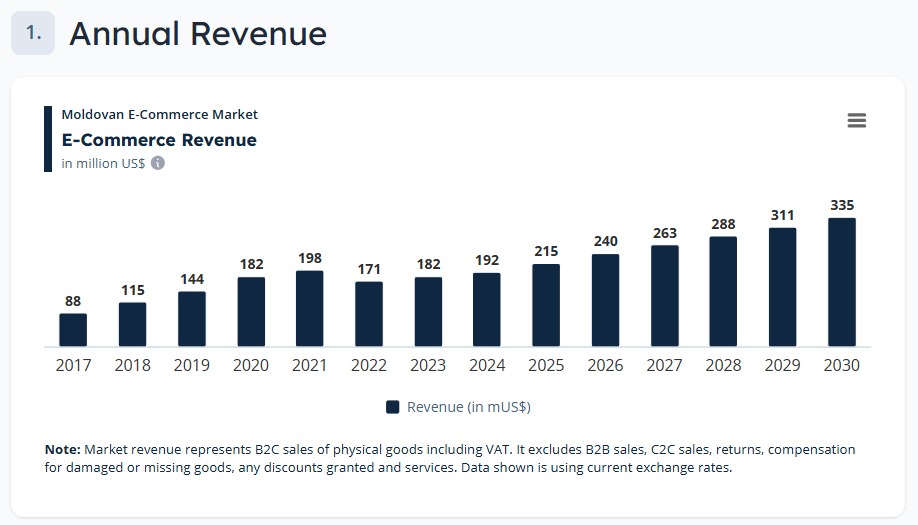
Moreover, after a brief slowdown around 2022, growth resumed quickly and returned to its previous trajectory. This pattern reflects the broader normalization of online retail following pandemic disruptions across Europe.
Several structural factors explain why e-commerce adoption is accelerating in Moldova.
First, internet access has improved significantly during the past decade. Moldova now has internet penetration exceeding 80.2% of the population, with mobile broadband becoming the primary gateway to digital services. Smartphones have effectively replaced desktop computers as the main device for online browsing, social media usage, and increasingly for shopping.
Second, Moldova’s geographic and economic position plays an important role. The country sits between the European Union and Eastern markets, which creates a strong orientation toward cross-border commerce. Many consumers regularly shop from foreign retailers, especially those located in Romania or other EU countries. This cross-border orientation has historically limited the growth of domestic e-commerce platforms, but it has also helped Moldovan consumers become comfortable with online purchasing earlier than local infrastructure alone might have allowed.
Another factor supporting e-commerce development is the increasing digitalization of services. Moldovan banks, telecom operators, and government institutions have invested heavily in digital infrastructure over the past five years. Online banking adoption has expanded rapidly, while public services are increasingly accessible through digital portals. These changes gradually normalize online transactions and build trust in digital systems, which indirectly supports e-commerce.
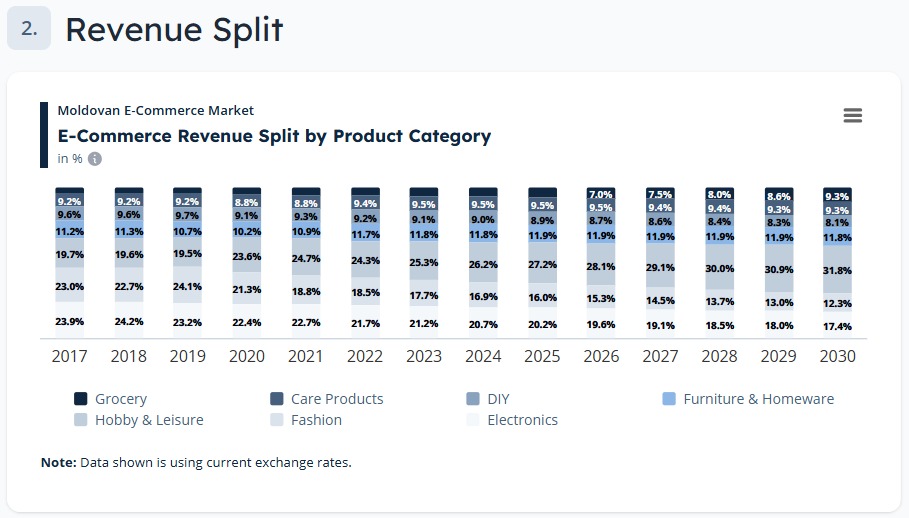
Market composition also matters. As in many emerging e-commerce markets, the largest product categories tend to be electronics, fashion, hobby & leisure, and household goods.
Regional dynamics reinforce these trends. Moldova’s close economic and cultural ties with Romania have a particularly strong influence on e-commerce development. Romanian online stores and marketplaces are widely used by Moldovan shoppers, partly because they share language and product catalogs that are already optimized for nearby markets.
In Moldova’s case, the foundations for e-commerce growth already exist. Internet penetration is high, mobile usage is widespread, and consumers are comfortable buying online even if many purchases still come from international platforms. As logistics networks and payment infrastructure continue to improve, domestic e-commerce players are expected to gain a larger share of this growing market.
Consumer behavior in Moldova
The behavior of Moldovan online shoppers reflects both local economic realities and the influence of broader European retail patterns.
As we mentioned earlier, one of the most notable characteristics of Moldovan e-commerce is the strong role of cross-border shopping. Unlike larger European markets where domestic retailers strongly dominate online sales, Moldovan consumers frequently purchase goods from foreign websites. At the same time, global marketplaces such as eBay or Amazon also attract significant traffic from Moldovan buyers.
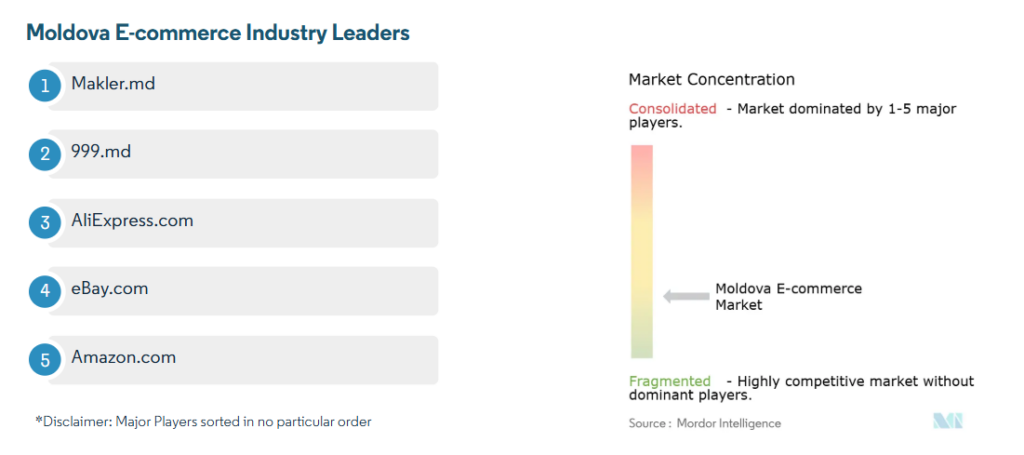
This cross-border orientation is partly driven by price sensitivity. Moldova’s average income levels remain lower than in most EU countries, which makes price comparison an important part of the purchasing process. Online platforms make it easier to compare offers across different markets. Consumers can search for better deals even if delivery times are slightly longer.
However, price is not the only factor shaping consumer behavior.
Moldovan shoppers also show strong interest in product variety and availability, especially for categories that may not be widely available in domestic retail stores. Electronics accessories, niche fashion brands, beauty products, and specialized household items are commonly purchased online because the local offline retail market remains relatively limited.
Another important feature of consumer behavior is the influence of the Moldovan diaspora. A large number of Moldovans live and work abroad, particularly in EU countries, and they often introduce new shopping habits when interacting with family members at home. Products purchased online in other European markets frequently circulate through personal networks, increasing familiarity with digital retail and encouraging relatives in Moldova to adopt similar purchasing patterns.
Trust is also fundamental. In markets where e-commerce infrastructure is still developing, consumers typically rely on reviews, recommendations, and social proof before making purchases. Social media discussions, influencer content, and peer recommendations frequently guide shopping choices.
Despite these factors, the long-term trajectory of consumer behavior in Moldova appears to be moving closer to patterns seen in other European e-commerce markets.
Payment methods in Moldova
Moldova’s digital payments ecosystem has been evolving rapidly in recent years. While cash-on-delivery remains present in certain segments of the market, electronic payments are gaining ground as banking services become more digital and consumers grow more comfortable with online transactions.
Historically, many Moldovan consumers preferred to pay for online purchases in cash upon delivery. This approach helped reduce perceived risk because customers could inspect the product before completing the transaction. Over time, however, the growth of online banking and card payments has begun to change these habits.
Visa and Mastercard remain the dominant payment networks used for online purchases. Most Moldovan banks issue debit or credit cards that can be used internationally, which allows consumers to shop not only from local retailers but also from foreign e-commerce platforms.
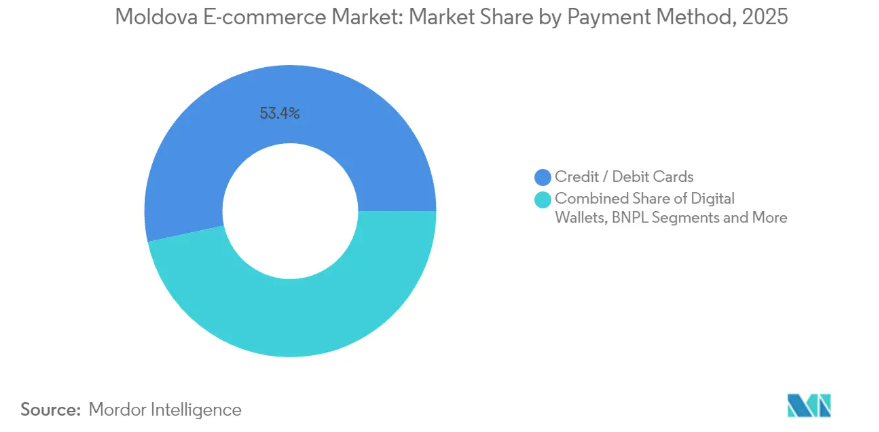
The rise of mobile banking is another important development. Banking apps have become widely used for checking balances, transferring money, and increasingly for authorizing online purchases. These apps simplify the payment process and reduce friction during checkout, which supports e-commerce adoption.
Industry observers also note the gradual introduction of digital wallet solutions and alternative payment methods in Eastern European markets. While Moldova’s digital wallet ecosystem is still developing, the general trend across the region points toward greater diversification of payment options.
Moldovan social media
For a relatively small market, Moldova’s level of social media penetration is surprisingly strong and continues to grow as internet access expands across the country.
There were 1.88 million social media user identities in Moldova in late 2025, representing about 63% of the total population. The same dataset shows that around 78.6% of internet users in Moldova actively use at least one social platform, highlighting how closely social media and everyday internet activity are connected in the country.
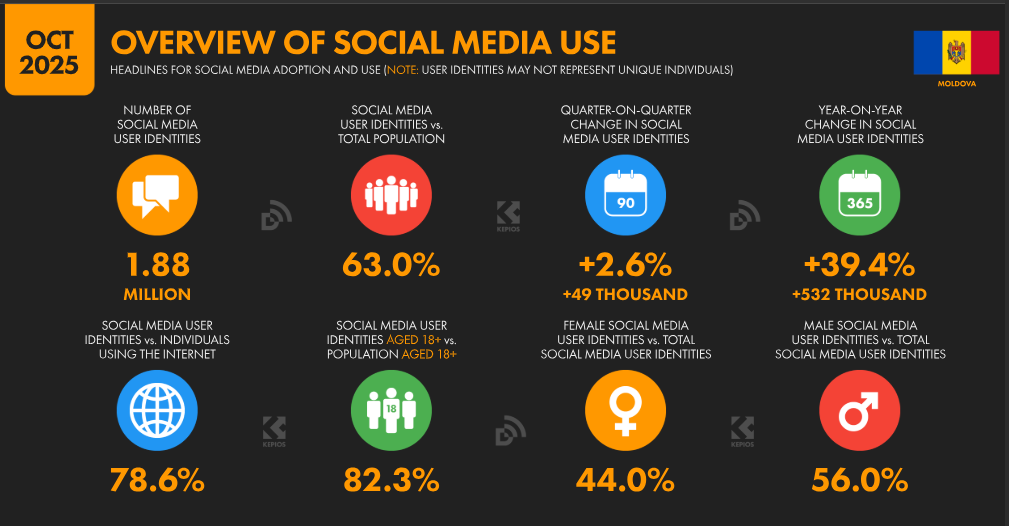
Thus, for many Moldovan consumers they function as information hubs, product discovery engines, and informal marketplaces.
Facebook remains the dominant platform. Data compiled by the analytics platform NapoleonCat shows that over 2.04 million Facebook users were active in Moldova by the end of 2025. The largest user segment falls in the 25–34 age group, while women represent roughly 56% of the platform’s audience.
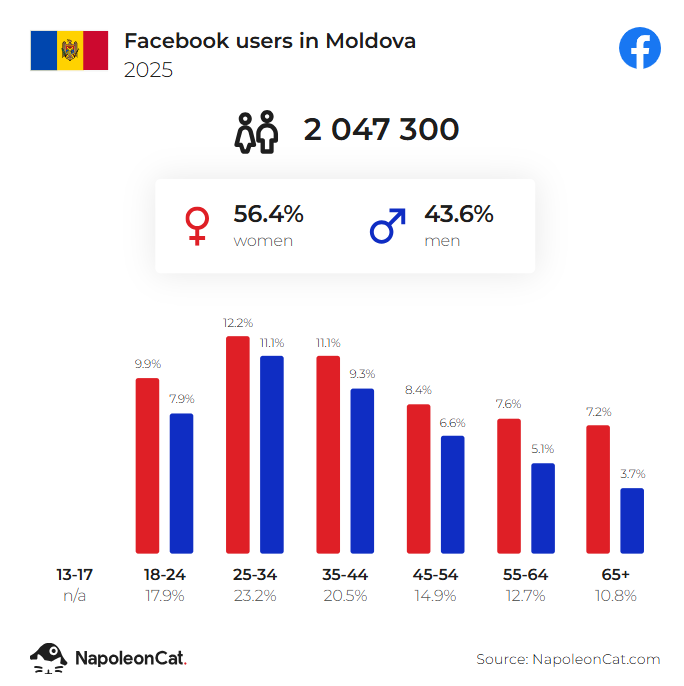
Facebook’s strong presence gives it an important role in e-commerce discovery. Local retailers often rely on Facebook pages and marketplace listings to promote products, announce discounts, and interact directly with customers. Small businesses in particular treat Facebook as both a marketing tool and a lightweight e-commerce channel.
Instagram has also become increasingly influential, especially among younger consumers. NapoleonCat estimates that around 1.17 million Moldovans used Instagram in 2025, representing over 31% of the population. The platform’s audience skews younger, with the largest group again falling between 25 and 34 years old.
The visual nature of Instagram makes it especially relevant for e-commerce categories such as fashion, cosmetics, and lifestyle products. For many local sellers, Instagram functions as a hybrid platform where marketing, communication, and sales all happen within the same ecosystem.
Logistics in Moldova
Logistics infrastructure is one of the key factors shaping the development of Moldovan e-commerce. Improvements in courier services, cross-border shipping routes, and parcel delivery networks are gradually strengthening Moldova’s e-commerce ecosystem.
The foundation of Moldova’s logistics system is the national postal operator, Poșta Moldovei, which maintains a nationwide delivery network connecting both urban and rural areas. It operates an extensive postal infrastructure that supports domestic and international parcel shipments across the country.
The organization runs more than 1,100 post offices nationwide, forming the backbone of the country’s postal delivery system and ensuring that even smaller towns and rural communities remain connected to e-commerce logistics networks.
At the same time, the Moldovan logistics market has seen growing activity from private courier companies and international delivery providers. Global carriers such as DHL, UPS, and FedEx operate in Moldova and support international shipments for both businesses and consumers.
In recent years, regional logistics providers have also expanded their operations in the country. One example is Nova Post, a courier company active across Eastern Europe that has been rapidly scaling its Moldovan infrastructure. According to the company’s 2025 operational update, Nova Post processed more than 10.1 million shipments in Moldova during 2025, serving approximately 915,000 customers across the country. The company’s delivery network now includes 57 branches, 262 parcel lockers, 249 pickup points, and three sorting centers, reflecting the growing demand for parcel logistics linked to e-commerce activity.
To sum up
Moldova’s e-commerce market remains relatively small, but the underlying trends point toward steady development rather than stagnation. Over the past decade, improvements in internet connectivity, mobile adoption, and digital payments have gradually reshaped how Moldovan consumers interact with retail.
Online shopping is becoming a more normal part of everyday consumption. Younger audiences in particular show strong familiarity with digital services and international marketplaces.
At the same time, the market still carries the characteristics of an emerging e-commerce ecosystem. Yet the overall trajectory is positive.
As Moldova continues to integrate economically with European markets, its digital retail sector is likely to grow alongside broader improvements in infrastructure and digital services. The market may remain smaller than many of its regional neighbors, but its steady growth suggests that e-commerce will play an increasingly important role in Moldova’s retail landscape.
Two articles are waiting for you – about Ukraine and Romania.